

Creative Planning · Oct 8, 2026 · 1h 9m · 52m saved
With Ramesh Poola, Chief Investment Strategist at Creative Planning
A portfolio that borrows to hold more stocks and sells others short can generate tax losses worth 20% to 70% of the account in a year, Ramesh Poola said, against about 10% in the first year for ordinary direct indexing.
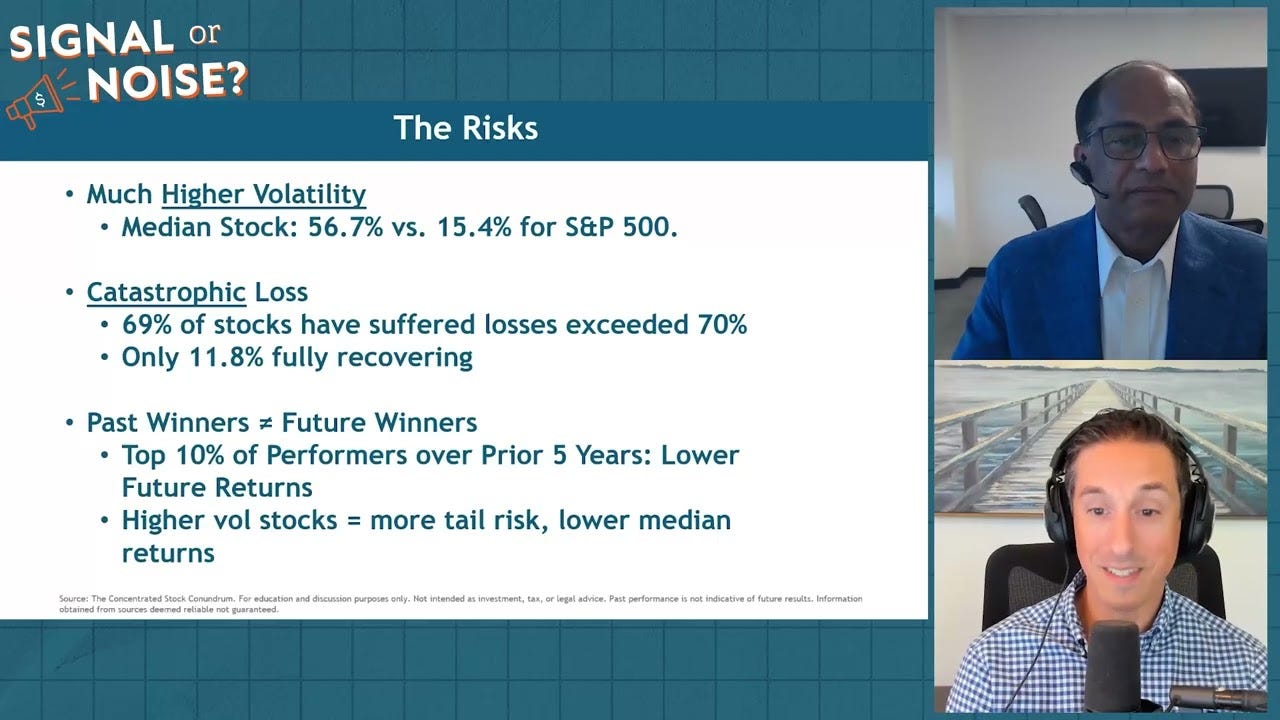
Most people holding a single large winner see two choices: sell and pay the tax, or hold and keep the risk. Poola said the tax can be managed with several tools, while the chance of a large loss in one stock cannot be forecast, and that most investors weigh the two the wrong way round.
"Investors are choosing the uncertainty over the certainty" — Ramesh Poola
Ramesh Poola, Chief Investment Strategist at Creative Planning, on Signal or Noise, sits on the firm's investment committee and published "The Concentrated Stock Conundrum" in The Journal of Wealth Management, a paper that tests these strategies against one another and is the basis of this interview.
The full episode is covered here so you can skip it. 69 minutes of audio, 17 minutes of reading.
Here are the 16 lessons that matter.
Key Takeaways
Owning more than 25% of a portfolio in one stock is a concentrated position, by the industry's rule of thumb
Past winners tend to underperform, he said, citing Tesla back at its November 2021 price of $381
Taxes, not risk, are what stop most holders from selling
In California the long-term capital gains rate he cited is 37.1%
Ordinary direct indexing runs out of tax losses within about 3 years
A leveraged long-short version can produce 20% to 70% in tax losses a year, so more stock can be sold without a net tax bill
A charitable remainder trust can turn $10M of stock into a $2.6M deduction and $12M of income over 20 years
The IRS has started to question some ETFs that take in appreciated stock under Section 351
A variable prepaid forward hedges, borrows and buys time in one contract, at the cost of upside above a cap
1. Why He Wrote the Paper
The host introduced Poola as Creative Planning's chief investment strategist and a member of its investment committee, and said his paper had just been published in The Journal of Wealth Management.
Clients kept facing the same choice, and there was no evidence on which fix worked best
Over two or three years of client conversations, Poola said, the same dilemma kept coming up: the uncertain chance of a loss in the stock against the certainty of a tax bill if they sold. His firm had built solutions over time, but there was no empirical evidence showing which worked better than the others.
"So that is the motivation to not only educate the investors and clients but also provide more academic research to it." — Ramesh Poola
