

How Leaders Lead with David Novak · Oct 29, 2026 · 1h 2m · 56m saved
With David Rogier, Co-founder and CEO, MasterClass
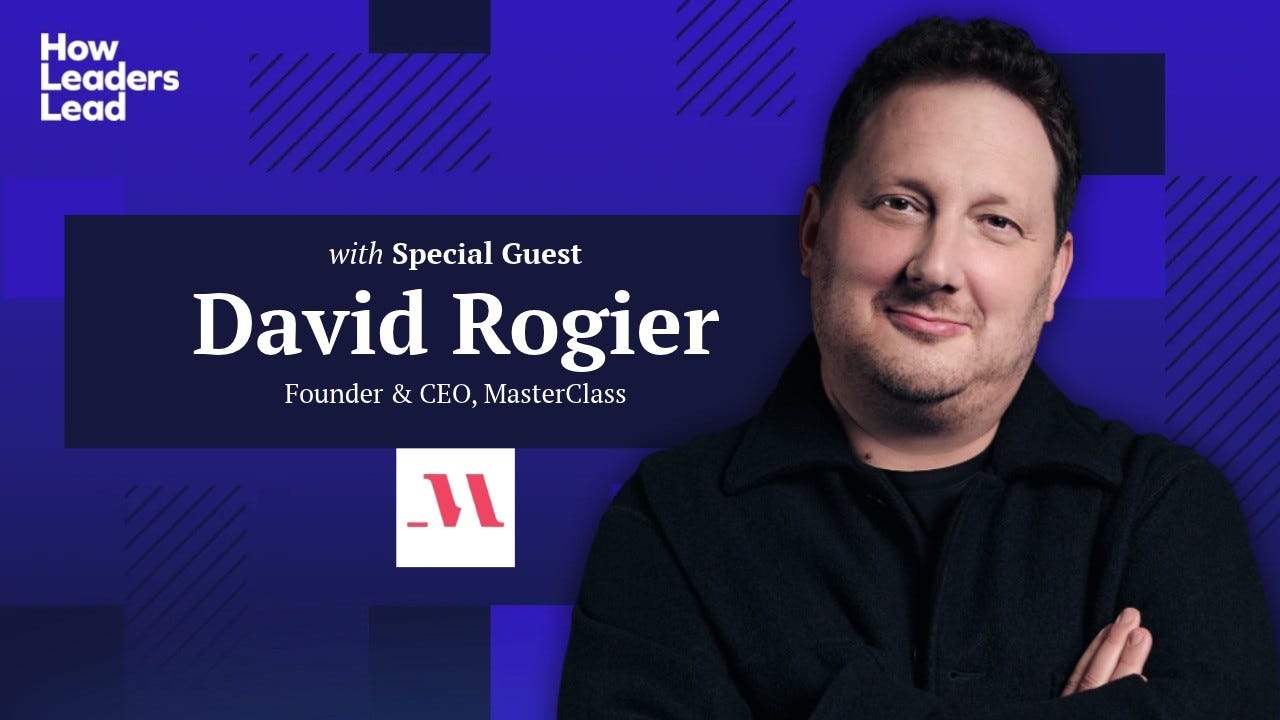
David Rogier, co-founder and CEO of MasterClass, told David Novak on How Leaders Lead that AI has made his own executives revert to doing individual-contributor work themselves, because it's now faster to just do a task than to explain the context to someone else — and he called that not sustainable. His answer isn't to slow down; it's to compress how fast junior people can develop the broad, generalist skill set executives already have.
"AI can let anybody do almost anything, at least on an okay bar. So if you're going to be a specialist, you've got to be in the top 1% of that specialty. Everybody else should be a generalist." — David Rogier
David runs MasterClass, the online education platform built on celebrity and expert-led courses, and has led the company through a pandemic-era shift in what customers actually want from it.
The full interview is covered here so you can skip it. 1 hour 2 minutes of audio, 6 minutes of reading.
Here are the 6 takeaways that matter.
This Scuttlebutt Summary is available in full to premium subscribers. If you're not one already, please consider subscribing to keep reading.
Key Takeaways
A 360 review calling him "indecisive" was actually an awareness gap, not a capability gap
He didn't realize colleagues were asking him to decide, not just to weigh in
AI is pushing his executives into individual-contributor work, and he says that's not sustainable
His fix: compress how fast junior staff can build the generalist skills executives already have
The specialist bar has risen: be top 1% at your specialty, or become a generalist
Being on the wrong side of mass displacement cuts lifetime income about 20% and doubles next-year mortality risk
He runs a weekly company-wide "failure email," borrowed from Spanx's Sara Blakely
He made sure the second one was about his own failure, after the first landed badly
MasterClass demand shifted from "love of learning" to career anxiety after the pandemic
Long leisurely courses gave way to business, AI and personal-health content
Duke coach Mike Krzyzewski taught him to set explicit team ground rules before big meetings
MasterClass borrowed a code word, "squirrel," for when a discussion drifts off-topic
1. An Awareness Gap
David described receiving 360-degree feedback that he was indecisive and being "very hurt" and "very scared" by it, since he believed a CEO can't be indecisive and felt he had strong points of view on most things.
David didn't realize colleagues were asking him to decide — he thought they wanted his input
"I realized in that time I didn't even know that they were asking me to make a decision... it wasn't even a capability gap. It was like an awareness gap." — David Rogier
Working with his therapist and executive coach, he dug into specific examples the team provided: a colleague would ask "what are your thoughts," and David would answer as if offering input, while the colleague was actually asking him to make the call. His fix was procedural — he now opens meetings by asking what decisions the team wants to make that day, and the next round of feedback called him decisive and "a huge improvement."
