

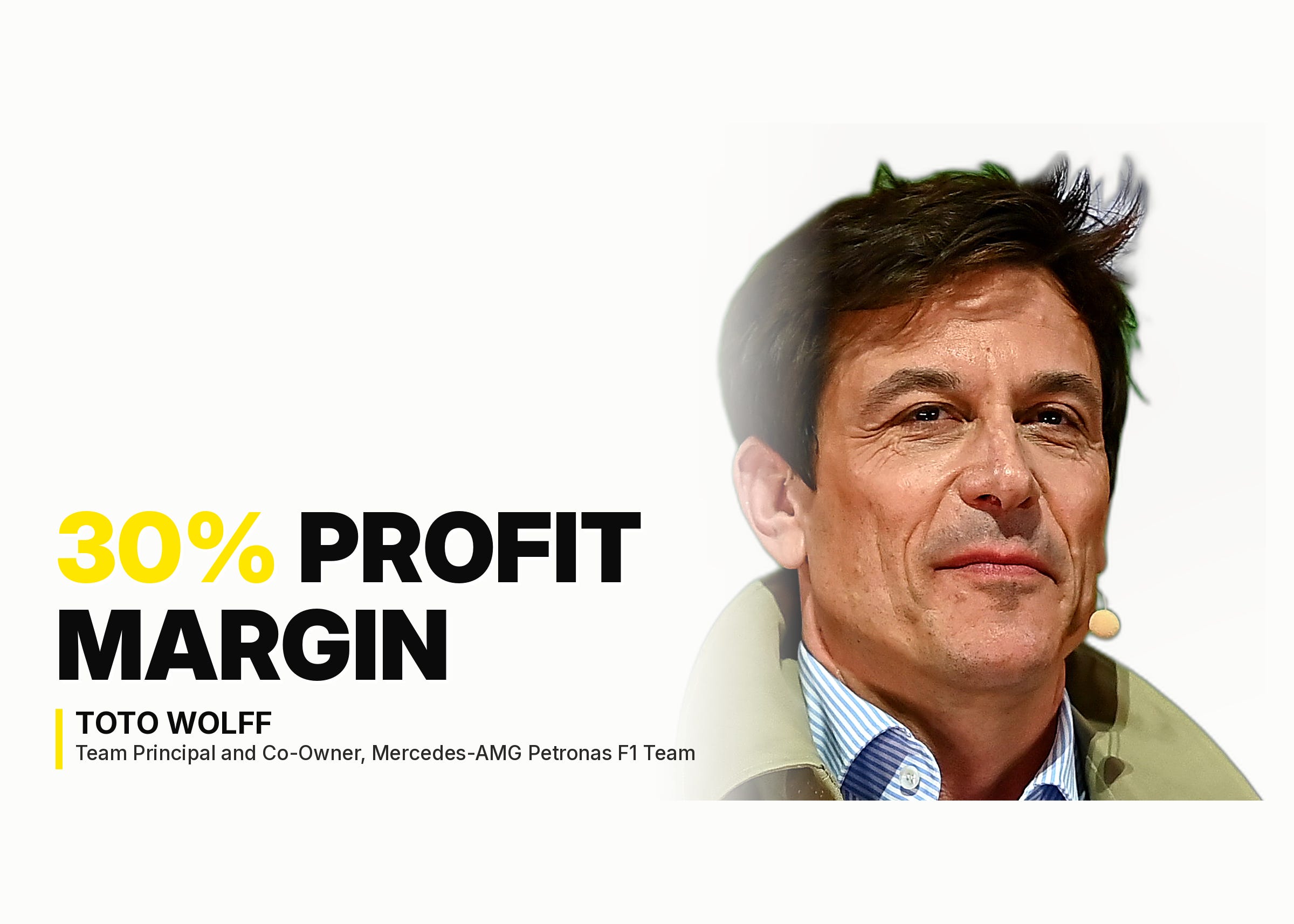
Toto Wolff said the Mercedes-AMG Petronas F1 Team, which he runs and co-owns, brings in about $1 billion of revenue at a 30% margin, or about $300 million of operating profit. By his count, that probably means more profit than any sports team in the world except the Dallas Cowboys.
That was one of 25 people in this issue. The others ranged from Terry Duffy, who said the CFTC has not denied any of the 2,500 contracts exchanges have certified since the second Trump administration began, to Noah Glass, whose new Olo app charges restaurants no commission, and Sundar Pichai on why Google can barely promise anyone computing capacity for 2027.
"We're generating around a billion dollars in revenue, and 30% profit margin... 300 million of EBIT." — Toto Wolff, Team Principal and Co-Owner at Mercedes-AMG Petronas F1 Team, on Stripe's Cheeky Pint (Read summary)
We scanned 743 shows and 15 hours of audio, wrote 19 summaries, and pulled 54 quotes into this 21-minute read.
Here is what mattered.
Macro
Edward Jones sees AI demand holding up while higher financing costs squeeze weaker players
Angelo Kourkafas said the AI trade is moving away from everything with AI attached going up. It is moving toward the highest-quality companies with the most cash, which may raise more money in the stock market as debt gets more expensive.
"There are no signs yet that demand is slowing... What has changed is financing costs are becoming higher, and that is pushing some of the marginal players." — Angelo Kourkafas, Senior Global Investment Strategist at Edward Jones, on Bloomberg Surveillance
International
Trade friction with the US has Canadians holding off on buying homes, RBC's CEO says
Dave McKay said the dispute over steel, autos and softwood lumber has hit confidence more than prices, slowing home buying and foreign manufacturing investment in Canada.
"It's certainly affected us in that Canadian consumers aren't buying homes. It's not a price issue anymore. It's really around a confidence issue." — Dave McKay, President and CEO at Royal Bank of Canada, on Bloomberg Surveillance (Read summary)
Financials
CME passed on a 24/7 perpetual oil contract because it says perpetuals are swaps
Terry Duffy said futures and swaps are taxed and regulated differently, and CME is in litigation with the CFTC over its approval of perpetual futures on another platform. CME launched a smaller round-the-clock oil contract instead.
"We didn't list the 24-7 PERP contract because PERPs are swaps. They're not futures. And that's the whole premise behind our litigation with the CFTC." — Terry Duffy, Chairman and CEO at CME Group, on Odd Lots (Read summary)
Stocks cannot trade 24/7 until banks can move money on weekends, Duffy says
Duffy called round-the-clock trading inevitable. The banks come first, he said: they would have to move money on weekends before stock trades could be funded around the clock.
"There's nobody on the planet that could fund, pre-fund on a Friday, a $76 trillion market as the banking system is closed." — Terry Duffy, Chairman and CEO at CME Group, on Odd Lots (Read summary)
RBC mostly runs its own AI models rather than paying for outside tokens
McKay said running its own compute, storage and open-weight models helps RBC manage uncertain demand. That same uncertainty is clouding the financing of AI infrastructure.
"We're not consuming a third-party Anthropic token in most cases. So we found a way to optimize our demand." — Dave McKay, President and CEO at Royal Bank of Canada, on Bloomberg Surveillance (Read summary)
AI has cut RBC's product cycles from two years to two or three months
McKay said he does not expect half of white-collar jobs to disappear within a year or two. He does expect a large shift in how the work is done.
"Things that took us two years to build are taking us two months, three months." — Dave McKay, President and CEO at Royal Bank of Canada, on Strategic Alternatives (Read summary)
JPMorgan expects to finance $1.5T for security and supply chains over 10 years
The target belongs to the bank's Security and Resiliency Initiative, now a year old. Doug Petno said it is also not quite halfway through investing its original pool of equity capital.
"We've got $1.5 trillion we expect to facilitate or originate over 10 years. We're well on our way there." — Doug Petno, Co-President of JPMorganChase and CEO of its Commercial & Investment Bank, on Making Sense (Read summary)
Crypto and Digital Assets
An AI scan of 650 Bitcoin codebases turned up 1,500 critical or high findings
Rob Hamilton said about two dozen self-organized developers, calling themselves the Bitcoin Red Team, ran the scan over roughly two months after a bug in the Coldcard hardware wallet was exploited in late July. A critical finding, he said, typically means money is at risk. Bitcoin Core itself held up.
"In total, it was just about 650 [codebases]... we found a total of 10,000 findings. 1,500 were critical or high." — Rob Hamilton, CEO and Co-Founder at AnchorWatch, on What Bitcoin Did (Read summary)
Whatever amount feels large enough to move into multisig custody, halve it, Hamilton says
Hamilton's AnchorWatch sells shared custody that lets a customer lose their keys without losing their Bitcoin. He said holders should not wait to move off a single point of failure, because the price can climb quickly.
"Whatever that number is, cut it in half. You should already be well off and migrated at that point... because Bitcoin doubles, Bitcoin rips." — Rob Hamilton, CEO and Co-Founder at AnchorWatch, on What Bitcoin Did (Read summary)
Onramp's CEO sees AI agents spending from a Bitcoin savings layer held in custody
Michael Tanguma described a core Bitcoin position held with several custodians, with a lighter wallet above it that can use stablecoins to pay AI agents, for example one booking a flight.
"You'll naturally have that like core position or savings account in Bitcoin, and that naturally would sit in something like multi-institution custody, where no smart contract, no exploit can move those assets." — Michael Tanguma, Founder and CEO at Onramp, on Final Settlement (Read summary)
Wall Street's new crypto moves are defensive now, Onramp's strategy chief says
Brian Cubellis said that a year or two ago, moves such as Schwab turning on Bitcoin and Ether trading and JPMorgan putting JPM Coin on Ethereum would have read as land grabs.
"I almost see all these things as defensive at this point... they see the writing on the wall, and they know that their peers, other incumbents, are moving in this direction, and they better have a plan." — Brian Cubellis, Chief Strategy Officer at Onramp, on Final Settlement (Read summary)
AI labs will become digital-asset companies to bill for small API calls, Nelson says
Liam Nelson said tokens are the fastest way to charge for small amounts of usage as AI labs sell compute and data-center energy.
"Many of these AI companies are going to become digital asset companies too... just because it's going to be the fastest way to use APIs and micropayments as it relates to smaller API usage." — Liam Nelson, Partner at Early Riders, on Final Settlement (Read summary)
Consumer
REI members pay $30 once and get a 10% dividend on what they buy
Mary Beth Laughton said the co-op has no shareholders and has to fund its mission from its own profit and cash flow, without quarterly earnings calls.
"They pay a $30 fee for a lifetime membership... Part of being a member is getting a 10% dividend on your purchases." — Mary Beth Laughton, President and CEO at REI Co-op, on Masters of Scale (Read summary)
Laughton grew Sephora's US online business from about $250M to over $1B
She said moving early to mobile drove that growth, and the lesson she is applying to AI is to be a fast follower without falling behind.
"I was running the digital business at the time, and when I came in, it was like a $250 million business, and we grew it to over a billion during the time I was there." — Mary Beth Laughton, President and CEO at REI Co-op, on Masters of Scale (Read summary)
Five Guys forced its point-of-sale vendors to let Olo plug in
Noah Glass said opening restaurant point-of-sale systems to online ordering took more political pressure than engineering.
"It took a brand like Five Guys Burgers and Fries saying to its multiple point of sale providers, 'We're growing really fast, and if you don't let Olo plug into you, we're going to go really fast with your competitor.'" — Noah Glass, Founder and CEO at Olo, on Summation with Auren Hoffman (Read summary)
Marketplace diners typically pay 15-30% over menu prices; the new Olo app charges menu prices
Olo's app, launched October 20, lists every restaurant brand on its network, charges restaurants no commission and gives them the guest's data, which marketplaces such as DoorDash do not share.
"On a marketplace, typically you're paying 15 to 30% more than you pay at the restaurant for menu prices... that is not true on the Olo app. On the Olo app, you're paying menu prices." — Noah Glass, Founder and CEO at Olo, on Summation with Auren Hoffman (Read summary)
Olo handles about $30B of orders in a $1.5T industry, under 2%
Thoma Bravo took Olo private in September 2025, and Glass said his family put most of its proceeds back into the company.
"We serve a $1.5 trillion industry... we do about $30 billion of GMV. In one way I feel really good about that. In another way, I think that's less than 2%. We have such a long runway to go." — Noah Glass, Founder and CEO at Olo, on Summation with Auren Hoffman (Read summary)
Most of ChatGPT's 300M weekly health users are free users outside the US
Karan Singhal said OpenAI adds specialized healthcare data to every phase of training its frontier models rather than building a separate medical model that would fall behind.
"Of the 300 million weekly active health users, the vast majority of them are free users, and... most of them are outside the US as well." — Karan Singhal, who leads Health AI Research at OpenAI, on a16z (Read summary)
OpenAI's newest model beat its best model of a month ago on a health benchmark at 34x lower cost
Singhal said GPT-6 Luna, OpenAI's newest and cheapest frontier model, outscored GPT-5.6 Sol on HealthBench Professional.
"GP[T-]6 Luna... performed better than 5.6 Sol, which was literally our best model like a month ago... despite being 34 times cheaper." — Karan Singhal, who leads Health AI Research at OpenAI, on a16z (Read summary)
Cheaper AI has not yet brought down US health spending, Singhal says
He said savings will come from integration, workflows and deployment. Cheaper models alone will not do it.
"I don't think health intelligence has had yet a macro effect on the problem... I think [cost compression] happens from integration and workflows and deployment." — Karan Singhal, who leads Health AI Research at OpenAI, on a16z (Read summary)
Today's virtual-cell models cannot yet stand in for lab experiments, Biohub's science head says
Alex Rives, who led the ESM protein language model project, said progress needs better models, far more data and better tools for measuring what happens inside a cell.
"The models that are being called virtual cells today, I just don't think they meet that definition of a model that could actually simulate the cell in a meaningful way and actually really serve as an oracle for experimental biology." — Alex Rives, Head of Science at Biohub, on The Cognitive Revolution
Biohub's cell-data effort now includes the Energy Department, the NIH, Google DeepMind, Isomorphic and Meta
The partnership is part of a $1.8 billion expansion of Biohub's Virtual Biology Initiative, which aims to map cells at the scale of hundreds of billions to train the next generation of cell models.
"We announced, I guess, just the day before yesterday, a flagship partnership with the Department of Energy, with the NIH, and with Google DeepMind, Isomorphic, Meta, to come together and coordinate an effort to generate this data." — Alex Rives, Head of Science at Biohub, on The Cognitive Revolution
Sports
F1's cost cap of about $200M a year counts every engineering hour
Wolff said the cap, brought in so Mercedes, Ferrari and Red Bull could not outspend everyone else, has moved engineering time onto this season's and next season's cars and away from long-range research.
"Every resource that you deploy into engineering is being counted for in the cost cap, which is $200 million and a bit a year." — Toto Wolff, Team Principal and Co-Owner at Mercedes-AMG Petronas F1 Team, on Stripe's Cheeky Pint (Read summary)
Wolff says a stock-market listing does not suit an F1 team, after Williams tried one
Mercedes and INEOS each own about a third of the team alongside Wolff, and he said none of the three owners wants to sell. A team's results, he said, can swing too quickly for public shareholders.
"We went public with Williams, and that was not a success... in this sport, it goes from mania to depression within a week." — Toto Wolff, Team Principal and Co-Owner at Mercedes-AMG Petronas F1 Team, on Stripe's Cheeky Pint (Read summary)
Mayweather paid $750,000 to buy his way out of his promoter's options
Floyd Mayweather said the payment made him his own promoter, so fighter pay, merchandise and ticket revenue stopped being split.
"They had me in a contract and my contract had came to an end, but they still had options on me. So I took it upon myself, wrote the check for 750,000." — Floyd Mayweather, professional boxer and entrepreneur behind Mayweather Promotions, on PBD Podcast (Read summary)
His next three fights as his own promoter paid him $750M
That is a thousand times what he paid to leave.
"When I left the company, in three fights — McGregor, Pacquiao, and Canelo — I made 750 million." — Floyd Mayweather, professional boxer and entrepreneur behind Mayweather Promotions, on PBD Podcast (Read summary)
Technology & AI
Google's cloud business gives up near-term revenue to keep compute for frontier AI
Sundar Pichai said Google is constantly trading computing capacity between its own AI research and its cloud customers.
"Our cloud business is, at any given moment in time, foregoing short-term revenues because we are making compute trade-offs to support frontier AI development." — Sundar Pichai, CEO at Google and Alphabet, on Big Technology Podcast (Read summary)
A customer asking Google for compute in 2027 is hard to serve today, Pichai says
He said today's capacity reflects decisions made in 2024, because data centers take years to build. Nearly every company in the industry has less than it planned for.
"If today a customer is coming out and asking us for compute in '27, that is incredibly difficult to do." — Sundar Pichai, CEO at Google and Alphabet, on Big Technology Podcast (Read summary)
Grass feeds exabytes of web data to frontier AI labs through millions of home connections
Andrej Radonjic said Grass's network of about 8 million opted-in nodes looks to websites like ordinary users browsing.
"From the internet's perspective, it just looks like users of the internet accessing the internet as usual. But in reality, it's a massive data infrastructure platform feeding the frontier of AI. At this point, we're at exabyte scale." — Andrej Radonjic, Co-Founder and CEO at Wynd Labs, on Delphi (Read summary)
Websites now block data-center traffic by default, which is the opening Grass sells into
He said sites cannot easily tell an AI crawler from a scraping competitor, so they block anything that looks like it comes from a data center.
"The default policy is normally just block it... In order to have the best access possible, the only way to do that is to be able to route traffic through millions of residential IPs around the world." — Andrej Radonjic, Co-Founder and CEO at Wynd Labs, on Delphi (Read summary)
An open-weight model found the Coldcard flaw for $1 after Claude refused, Hamilton says
Hamilton said Kimi K2, an open-weight model, answered questions about the wallet's firmware that frontier models would not take up.
"I loaded up Claude, instant downgrade to Opus... it wouldn't even talk to me. Then I loaded up Kimi K2 and I spent a dollar and I got the full answer in like three, five minutes." — Rob Hamilton, CEO and Co-Founder at AnchorWatch, on What Bitcoin Did (Read summary)
A security audit that cost $25,000-$50,000 now costs about $25 in AI compute, Hamilton says
He said the work used to take a professional auditor two to three weeks, and that AI does the most for reviewers who already know the code well.
"What I used to have to wait two to three weeks for and pay twenty-five, fifty thousand dollars for, I can get for like twenty-five bucks." — Rob Hamilton, CEO and Co-Founder at AnchorWatch, on What Bitcoin Did (Read summary)
Tools for Humanity expects websites to require proof that a person stands behind an AI agent
Alex Blania said banks and websites blocking AI agents outright will push services toward confirming that an agent acts for a real, identified person, not away from it.
"If you don't have a proof of human, it will just not be possible [to use certain services], because all these websites are blocking agents." — Alex Blania, Founder and CEO at Tools for Humanity, on TBPN (Read summary)
World's new protocol with Cloudflare confirms that a person approved an agent's decision
Blania said the protocol, announced the day of the interview, is meant for high-stakes decisions an agent makes on someone's behalf.
"I think we will want to know that an agent is acting on behalf of a human and of human intention... has a human been in the loop with that specific decision." — Alex Blania, Founder and CEO at Tools for Humanity, on TBPN (Read summary)
AI will make code secure by design, but the path there will be noisy, Zatlyn says
Michelle Zatlyn said Cloudflare now sees roughly 234 billion cyberthreats a day.
"We're going to get to a point where things will be much better because finally code will be secure by design, so that you don't have to worry about all this stuff after the fact... But we've got to get from here to there." — Michelle Zatlyn, Co-Founder and President at Cloudflare, on CNBC Changemakers and Power Players (Read summary)
VC & Startups
Investors give low-margin AI companies up to 10x the multiple of high-margin software, Vanta's CEO says
Christina Cacioppo said Vanta, which serves about 16,000 customers, is growing fast at high margins, yet investors now pay more for faster growth at much lower margins.
"At the fullness of time, an 80% growth business with 80% margins will... be better than a 160% growth business with 30% margins. But today the latter is valued at three, four times the multiple of the former — ten times the multiple of the former." — Christina Cacioppo, Founder and CEO at Vanta, on Invest Like the Best (Read summary)
Vanta absorbs the cost of AI tokens instead of marking it up
She said customers compare any markup with what Claude itself charges, so Vanta takes lower margins now and plans to sort out pricing later.
"We're eating the token cost right now... we're taking lower margin." — Christina Cacioppo, Founder and CEO at Vanta, on Invest Like the Best (Read summary)
Vanta wants 75% of its customers using its AI agents, up from 25%
She said the agent-led product does security and compliance work for the customer instead of only sending alerts.
"We've got, call it, 25% of our customers in that [agent-led] flow right now, and if we can get that to 75%, I think we'd have much better retention." — Christina Cacioppo, Founder and CEO at Vanta, on Invest Like the Best (Read summary)
Dan Henry rewrote his sales webinar from an AI review of every sales call
Dan Henry said he fed transcripts of the calls and a pre-webinar survey into AI about every six weeks to find the objections buyers raised.
"Every month and a half or so, I took a transcript of all the sales calls... and I used AI to scan it, compare it against the transcript of what I said on the webinar, and find the pain points, objections, and all the things that were being said on the actual sales calls, and tighten them on my webinar." — Dan Henry, Founder at GetClients, on Wealthy Way (Read summary)
The rewritten pitch took GetClients from $200K to $950K of cash in a month
Henry counts cash collected, not booked revenue.
"We went from 200 a month to 950 [thousand] cash collected, not revenue... revenue was way over a million in four months because we started with a speech." — Dan Henry, Founder at GetClients, on Wealthy Way (Read summary)
Industrials and Transport
Helicon went from an empty building to its first composite part in 20 days
Alex Niehaus said the Torrance, California startup, which came out of stealth with $16.5 million raised, is building to mass-produce composite structures for drones, defense and vehicles.
"This building is where we went from blank slate... to first part made in 20 days." — Alex Niehaus, Co-Founder at Helicon, on TBPN (Read summary)
Helicon wants engineers to go from 10 prototypes to 100,000 units in a year
He said composite parts are still made much as a blacksmith made metal parts, and that Helicon aims to cut manufacturing time from a week to 30 minutes.
"It's really about unlocking to mechanical and design engineers for the first time this option... to go from 10 units of a prototype... to ramping up to 100,000 units over the same year period." — Alex Niehaus, Co-Founder at Helicon, on TBPN (Read summary)
Materials & Energy
Workday ran 1.7B AI actions last year without growing its carbon footprint
Erik Hansen said cloud efficiency work cut an estimated 5,000 metric tons of emissions in fiscal 2025, with cost savings attached.
"Workday delivered 1.7 billion AI actions across our platform in our last fiscal year... our total carbon footprint last fiscal year actually didn't grow in absolute terms." — Erik Hansen, Chief Sustainability Officer at Workday, on Sustainability Leaders (Read summary)
Workday joined Frontier, a buyers' group pledging nearly $2B for carbon removal
Hansen said multiyear purchase agreements, rather than one-off purchases, give carbon-removal developers the steady cash flow to borrow more cheaply.
"Frontier is now almost a two billion dollar advanced market commitment... if you build it and it meets a set of quality criteria that we agree with, we will buy from you." — Erik Hansen, Chief Sustainability Officer at Workday, on Sustainability Leaders (Read summary)
Policy
The CFTC has denied none of 2,500 new-contract filings under Trump, CME's Duffy says
Exchanges list new contracts by certifying that they meet the rules, and the regulator can object. Duffy, who steps back as CEO next year, said some of the approved contracts, such as a prediction market on Nathan's hot-dog eating contest, break the rule against contracts that are easy to manipulate.
"Since the second Trump administration's come into place, there's been 2,500 self-certifications that have been submitted into the Commodity Futures Trading Commission. Not one of them has been denied." — Terry Duffy, Chairman and CEO at CME Group, on Odd Lots (Read summary)
A Hinojosa win for Texas governor could bring a data-center moratorium, Raymond James says
Ed Mills said the governor's race is a bigger market risk than the Texas Senate seat.
"If Gina Hinojosa wins, you actually have a real moratorium that could be coming on data centers. That could be like a Hurricane 5 category storm hitting the data center market that most investors are not paying attention to right now." — Ed Mills, Managing Director and Washington Policy Analyst at Raymond James, on Bloomberg Surveillance
A bad midterm for Republicans raises the odds of a lame-duck defense bill
Mills expects Democrats to win the House and said they are increasingly likely to take the Senate as well.
"The worse Republicans do on November 3rd, the more likely Republicans try to use this lame duck session to do a reconciliation to increase defense funding." — Ed Mills, Managing Director and Washington Policy Analyst at Raymond James, on Bloomberg Surveillance
Geopolitics
US military officials asked JPMorgan for help securing defense technology
Petno said that request, the war in Ukraine, last year's tariffs and export bans, and China's curbs on rare-earth magnet exports led the bank to start the Security and Resiliency Initiative. The US has the deposits but no capacity to refine them or make the magnets.
"Military officials had actually reached out to J.P. Morgan and said, 'We're having a hard time securing those types of technologies with the procurement process. Can you help us?'" — Doug Petno, Co-President of JPMorganChase and CEO of its Commercial & Investment Bank, on Making Sense (Read summary)
Cohere and Mistral are the democracies' two chances at an AI alternative, Gomez says
Aidan Gomez said the world is heading toward AI built only in the US and China. Canada's government has named Cohere a strategic asset.
"We have Cohere in Canada, and we have Mistral in France. Those are our two shots... to ensure there's a democratic second rail." — Aidan Gomez, Co-Founder and CEO at Cohere, on Strategic Alternatives (Read summary)
The most advanced AI security tools are being released selectively, RBC's CEO says
McKay said uneven access to the models banks use to find and fix software flaws leaves some countries more exposed to cyberattacks than others.
"No, I don't think we have enough guardrails... these most advanced tools... are being selectively released outside of the United States." — Dave McKay, President and CEO at Royal Bank of Canada, on Strategic Alternatives (Read summary)
Nuggets of Wisdom
Cloudflare's founders turned down early advice to sell with fear
Zatlyn said she and co-founders Matthew Prince and Lee Holloway wanted to help customers solve security problems, not scare them into buying.
"Some of the very first pieces of advice you get... is you need to use more fear, uncertainty, and doubt in how you talk about Cloudflare, and that just was never Matthew's and mine and Lee's ethos." — Michelle Zatlyn, Co-Founder and President at Cloudflare, on CNBC Changemakers and Power Players (Read summary)
Mayweather says a man helping run his business took $200M
He said a different person, whom he described as a father figure, took a further $350 million in a case still in litigation, and that he now confirms what people tell him before he trusts them.
"It's a guy who was sitting next to me acting like he was a friend, helping me clean up business, and he stole 200 million." — Floyd Mayweather, professional boxer and entrepreneur behind Mayweather Promotions, on PBD Podcast (Read summary)
Leno ran The Tonight Show on the belief that he was not the smartest person in the room
Jay Leno said any staff member could stop a joke that sounded corny or dated.
"I'm a huge believer in low self-esteem... if you don't think you're the smartest person in the room, you just shut up and you pay attention." — Jay Leno, comedian and former host of The Tonight Show, on TBPN
If this was worth your time, send it to someone who has to follow all of this too.
What did you think of today’s edition? Hit ‘reply’ to this email, send us a message, leave a comment, or join the chat!
Get the latest market chatter as it happens: