

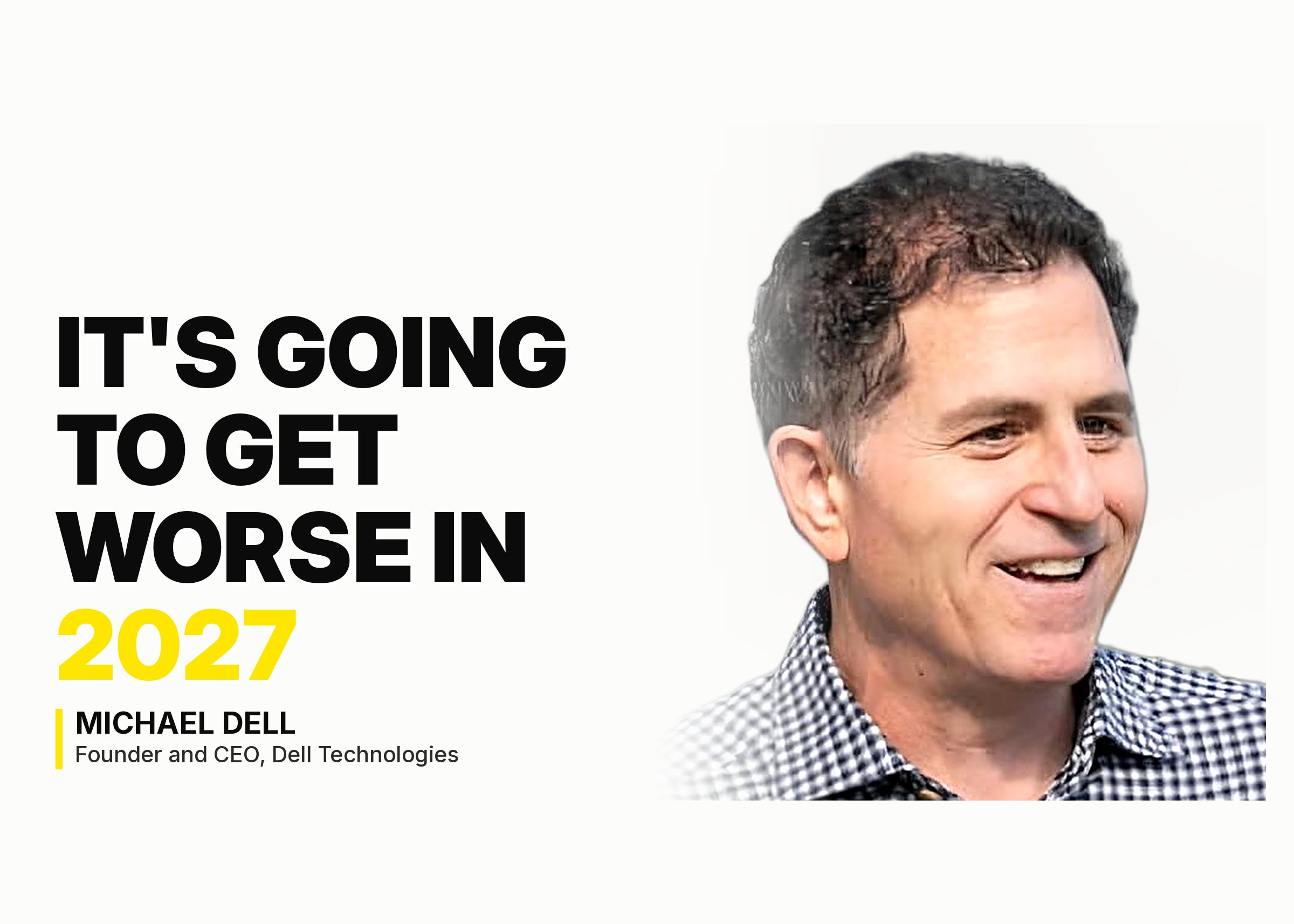
Michael Dell, founder and CEO of Dell Technologies, expects the shortage of memory chips to get worse in 2027, because the factories now being built will not start producing until 2029.
That was one of 23 people in this issue. The others ranged from Immad Akhund, whose Mercury went from zero to $1 billion in revenue in seven and a half years, to Jeff Lawson, who hired almost 100 Twilio sales reps in six months after finding the company had far too few, and Don Wilson on why nobody knows what an Nvidia B200 will be worth in five years.
"I think it's going to get worse in 2027 based on what I see right now." — Michael Dell, Founder and CEO at Dell Technologies, on WSJ Tech News Briefing (Read summary)
We scanned 741 shows and 16 hours of audio, wrote 21 summaries, and pulled 43 quotes into this 16-minute read.
Here is what mattered.
Macro
Retail investors now trade 20-25% of US stock volume, up from 8-10% before 2020
Dave Mazza said retail flow has grown large enough to set prices rather than serve as a contrarian signal, and that the old "dumb money" label no longer fits.
"Prior to 2020-2021, [retail's share of equity volume was] somewhere around 8 to 10%. Today, it's around 20 to 25%. There are some days where it's 30 to 35%." — Dave Mazza, CEO at Roundhill Investments, on Schwab Network (Read summary)
Partners Group expects bond yields to stay higher for longer
Anastasia Amoroso said her firm titled its fourth-quarter chart book "Higher for Longer," and tied the call to government debt and deficits.
"If I look at the debt-to-GDP ratios, if I look at the budget deficits, there's no quick fix. So I do think it's higher for longer." — Anastasia Amoroso, Chief Investment Strategist at Partners Group, on Squawk on the Street (Read summary)
International
Australian property is absorbing new tax rules and persistently high rates at once
Pat Noll, a mortgage broker, said the market is softening because two pressures arrived together.
"Broadly there's just a few things happening at the moment and it's all coinciding in one go... the tax changes obviously from the May budget is the big one. The other is we have persistently high interest rates on the back of high inflation." — Pat Noll, Founder at Runestone Finance, on Equity Mates (Read summary)
A 10% discount from six months ago is a good entry for a 10-year hold, Noll says
He argued that stamp duty and other transaction costs make property a poor short-term trade, so a falling market favors buyers with a long horizon.
"If you can get a discount of, you know, 10% from 6 months ago, that could be a really good time to actually get in, particularly if you're targeting a 10 plus year hold." — Pat Noll, Founder at Runestone Finance, on Equity Mates (Read summary)
Financials
Fifth Third chose to sit out data-center construction lending
Tim Spence said the bank's only exposure to the AI buildout is legacy lending tied to hyperscalers' cloud-hosting business, not loans for new AI data centers.
"We've elected to sit out data-center construction financing. So we have very little exposure there." — Tim Spence, CEO at Fifth Third Bancorp, on Squawk on the Street (Read summary)
Neobanks that compete only on price are the most exposed to AI, Fifth Third's CEO says
Spence said full-service regional banks compete on distribution, product quality and breadth of service, which AI is slower to undercut.
"It's the folks that are basically internet-only banks, the neobanks, whose only lever is price, that I think are probably more exposed here." — Tim Spence, CEO at Fifth Third Bancorp, on Squawk on the Street (Read summary)
Mercury went from zero to $1B in revenue in seven and a half years
Immad Akhund said Mercury, which provides bank accounts to startups and small businesses, crossed $1 billion in annualized revenue this year, up from $650 million a year earlier.
"In seven and a half years, we've kind of gone from literally zero to a billion in revenue." — Immad Akhund, Co-Founder and CEO at Mercury, on Newcomer (Read summary)
Mercury has conditional approval from the OCC and FDIC to become a national bank
A charter would let Mercury offer products it cannot today, such as Zelle, and give it a direct relationship with regulators instead of working through partner banks.
"We applied for a bank charter last year. We've got conditional approval from the OCC and FDIC... sometime next year, we're going to be live, serving customers through Mercury Bank N.A." — Immad Akhund, Co-Founder and CEO at Mercury, on Newcomer (Read summary)
Brex stays out of lending because a bank can always borrow more cheaply
Erica Dorfman, Brex's CFO, said a fintech should only enter lending knowing it is entering a different business, one where banks hold a structural cost advantage.
"We don't have better pricing than a bank. A bank structurally has the best lending price because they are able to borrow at the lowest rate by law." — Erica Dorfman, CFO at Brex, on Run the Numbers (Read summary)
Brex pulled its own cash from SVB months before the bank failed
Brex's banking business grew sharply after Silicon Valley Bank's collapse, Dorfman said, as customers moved money to a provider they could count on.
"We had thankfully taken out our own corporate cash from SVB months prior, having seen their metrics and not feeling super comfortable with that." — Erica Dorfman, CFO at Brex, on Run the Numbers (Read summary)
A third of Bank of America's money-laundering investigations began with an outside call
Marit Rødevand, who runs an anti-money-laundering software company, read the regulator's order against the bank and said its monitoring caught little on its own.
"They had systems. They had transaction monitoring. They had thousands of people. They had billions spent, but a third of their investigations started by another bank or law enforcement calling them. So, not because their own system flagged anything." — Marit Rødevand, CEO and Co-Founder at Strise, on Fintech Insider (Read summary)
Ramp already has 80,000 firms on its books, FG Partners' Parkin says
Joe Parkin cited the customer count to explain the $60 billion valuation of Ramp, which sells corporate cards and expense software, saying almost every business needs that kind of tool.
"These guys have got 80,000 you know firms already on their books, which just shows the opportunity set that's there if you can deliver the right solution." — Joe Parkin, Managing Partner at FG Partners, on Fintech Insider
Roundhill's DRAM ETF holds only companies earning more than half their revenue from memory
Mazza said the fund became the fastest ETF on record to pass $25 billion in assets by giving US investors direct access to memory makers such as SK Hynix and Samsung, rather than a broad semiconductor basket.
"These companies are producing greater than 50% of their revenues from memory and storage... you're not going to have watered-down positions." — Dave Mazza, CEO at Roundhill Investments, on Schwab Network (Read summary)
One in three Canadians has not discussed end-of-life finances with anyone, RBC's survey finds
Farzana Damji, who leads product development at RBC Insurance, cited the bank's own survey. Single people are the least prepared.
"One-third of Canadians have not discussed end-of-life finances with anyone... this increases to nearly half for single people, 51%." — Farzana Damji, Senior Director of Product Development at RBC Insurance, on Insight is Capital (Read summary)
Crypto and Digital Assets
From an $80B base, Strategy needs $80B of new capital to double, Saylor says
Michael Saylor said Strategy holds about 845,000 Bitcoin, so this year's purchases of about 160,000 coins were a smaller percentage gain than in earlier years.
"We're the biggest buyer of Bitcoin in the world... but when you're starting from an $80 billion base, you need $80 billion of capital to double." — Michael Saylor, Executive Chairman at Strategy, on Schwab Network (Read summary)
Strategy wants its STRC preferred to pay a dividend every calendar day
Shareholders are voting on moving STRC, a preferred stock Saylor pitches as a credit instrument, from monthly or quarterly payouts to daily ones.
"What we've realized is that you can smooth the volatility, increase the liquidity if you pay daily... those will be the first securities in the world that pay dividends every calendar day." — Michael Saylor, Executive Chairman at Strategy, on Schwab Network (Read summary)
Alternatives and PE
Private credit and private equity are headed into ETFs, Roundhill's CEO says
Mazza compared the change to the arrival of gold and crypto ETFs, while warning that assets without transparent daily prices need care inside a daily-traded fund.
"You no longer have to have an account with a lot of zeros on it to be able to access private credit or private equity when that comes in the ETF form." — Dave Mazza, CEO at Roundhill Investments, on Schwab Network (Read summary)
Consumer
WW moved every in-person workshop online in six days when COVID hit
Mindy Grossman, then CEO of WW International, said the company was running 30,000 in-person workshops a week in 13 countries when it had to shut its offices.
"I remember I called Eric Yuan at Zoom and I said I need your help, and we shifted all of our assets to focus on this, and in six days we converted every one of those workshops to virtual." — Mindy Grossman, Vice Chair at Consello and former CEO of WW International, on Power Players with Brian Sozzi (Read summary)
Other appearances:
Hospice Buffalo CEO on what dying patients report seeing in their final weeks on The Diary Of A CEO
Technology & AI
New memory factories take about four years to build, so new supply arrives in 2029
Dell called memory the tightest supply constraint in the industry, with demand from AI agents outrunning supply until the new plants open.
"It takes about four years to build a new memory factory... those factories will start producing in 2029." — Michael Dell, Founder and CEO at Dell Technologies, on WSJ Tech News Briefing (Read summary)
Dell added 3,300 AI-factory customers in three quarters, after 3,200 in the eight before
Dell's "AI factories" are AI computing systems that customers install in their own data centers. He read the acceleration as a sign that business adoption is still early.
"It took us eight quarters to have 3,200 customers building these Dell AI factories. And in the last three quarters, we've added 3,300 customers." — Michael Dell, Founder and CEO at Dell Technologies, on WSJ Tech News Briefing (Read summary)
Nobody knows what a B200 will be worth in five years, which is why DRW wants GPU futures
Don Wilson's trading firm is backing futures contracts on GPU rental prices. If the CFTC takes no action during its comment period, he said, they could list on November 9.
"So that is the trillion dollar question. ... And that is why these futures need to exist. Because nobody knows what the value of a B200 will be four years from now, five years from now." — Don Wilson, Founder and CEO at DRW, on Odd Lots (Read summary)
H100 prices turned up around Thanksgiving when a new Anthropic model lifted demand
Wilson said on-demand prices for Nvidia's H100 had been falling steadily until then, which is the kind of swing a hedging contract exists for.
"Right around Thanksgiving, [H100 prices] turned around and kind of went up and to the right. What happened was Anthropic's newest model came out, which was a massive step up in usefulness, and all of a sudden there was a ton of demand for inference." — Don Wilson, Founder and CEO at DRW, on Odd Lots (Read summary)
Partners Group and Fifth Third read wider AI credit spreads differently
Amoroso said the jump in spreads on CoreWeave-linked debt overstates the cost to most AI projects. Spence, whose bank avoided the lending, said fast-growing, unproven categories tend to be mispriced early, and pointed to the blowout in data-center bond spreads as the market reassessing.
"We shouldn't automatically assume that the wider credit spreads translate to just the cost of debt going up on every single project. In fact, a lot of these companies fix the debt and hedge it." — Anastasia Amoroso, Chief Investment Strategist at Partners Group, on Squawk on the Street (Read summary)
"Generally, unproven categories that are growing quickly, at a minimum, don't get priced well out of the gate." — Tim Spence, CEO at Fifth Third Bancorp, on Squawk on the Street (Read summary)
Figma's CEO says the blocked Adobe deal was 1-2% of a far larger market
Dylan Field said the 16 months of regulatory review that ended Adobe's bid for Figma rested on a market definition that was too narrow.
"The market is this massive market and this deal is one or two percent of the market." — Dylan Field, Co-Founder and CEO at Figma, on All-In (Read summary)
Figma's CEO is neither bullish nor bearish on Anthropic's Claude Design
Figma's revenue growth, 48% year over year, accelerated after Anthropic launched Claude Design. Field said it is easy to mistake a better AI model for a better product.
"I'm not bullish or bearish on the product. I think it's just hard to make good design tools for professionals." — Dylan Field, Co-Founder and CEO at Figma, on All-In (Read summary)
Nvidia buys from every coding-agent company but wanted code validation kept separate
Daksh Gupta's Greptile, which reviews and tests AI-written code before it is merged, raised a $50 million Series B led by Menlo Ventures.
"We heard this first from Nvidia, which became our first large customer. They said, well, we buy coding agents from every good coding agent company that there is... but we wanted our validation to be separate." — Daksh Gupta, Founder at Greptile, on TBPN
Engineering teams scrutinize a $250,000 hire far more than coding-agent spend
Gupta expects that gap to close once companies can measure what their spending on AI coding tools actually produces.
"We've put a lot more thought into whether we should hire another person for 250,000 [dollars] than we just let the coding agent math rip." — Daksh Gupta, Founder at Greptile, on TBPN
Tolan has not yet found a ceiling on users' demand for smarter models
Quinten Farmer, whose company makes an AI companion app, said each model upgrade raises engagement.
"We continue to be surprised by the fact that we don't saturate demand for more intelligence. Every time we ship a new model to users, people engage more, people value it more." — Quinten Farmer, Founder at Tolan, on TBPN
AI agents make supply aggregation worth less, a risk to Amazon's ad business, Town's CEO says
Jean-Denis Greze said a retailer that wins by gathering many sellers in one place loses some of that advantage when software agents, not people, do the shopping. His advice to Amazon was to build its own personal agent.
"I just think supply aggregation is a lot less valuable than it used to be, because human attention can be automated away." — Jean-Denis Greze, Co-Founder and CEO at Town, on a16z (Read summary)
Twilio hired almost 100 sales reps in six months once it counted how few it had
Jeff Lawson said that after Twilio's IPO his COO found the company had seven quota-carrying sales reps, against the roughly 50 Lawson had guessed.
"Within six months we had hired almost 100 sales reps. It was bonkers. We were leaving so much on the table." — Jeff Lawson, Co-Founder and CEO at Inertia and former CEO of Twilio, on Grit (Read summary)
Other appearances:
Box CEO on AI agent swarms as an early cybersecurity risk and a drug-discovery tool on Closing Bell Overtime
VC & Startups
A Y Combinator startup with any traction is now valued at $80M to $100M, Mercury's CEO says
Akhund said the funding market "feels like 2021," with 10 or 20 funded competitors in categories that used to support one or two.
"If you have a pulse in Y Combinator, you're worth like 50 million now. And if you have any traction at all, you're worth 80 to 100 million... all of them can't be successful." — Immad Akhund, Co-Founder and CEO at Mercury, on Newcomer (Read summary)
Town raised a $108M Series B at a $1B valuation
Greze, formerly Plaid's CTO, said Forerunner Ventures and Menlo Ventures led the round for Town, which builds an AI assistant that works from a user's email and calendar.
"I'm the CEO of Town. We just raised our Series B, 108 million dollars at a billion-dollar valuation." — Jean-Denis Greze, Co-Founder and CEO at Town, on TBPN (Read summary)
Town's CEO shut his tax startup because tax is bought once a year
Greze said the tax-preparation business his team built first was earning good revenue, but a once-a-year purchase could not grow fast enough to justify venture funding.
"Tax is also sold once a year... those discontinuities make it really difficult to hyper-scale." — Jean-Denis Greze, Co-Founder and CEO at Town, on a16z (Read summary)
Almost every startup is short of distribution, not product, Lawson says
Lawson credited the framework to his former COO: at any moment a company is limited either by what it can build or by how many customers it can reach.
"Very few startups are product constrained. Almost every startup is distribution constrained." — Jeff Lawson, Co-Founder and CEO at Inertia and former CEO of Twilio, on Grit (Read summary)
Materials & Energy
Inertia has $450M of committed capital for fusion power and a 50,000-square-foot facility
Lawson's new company is building on the 2022 fusion ignition result at Lawrence Livermore National Laboratory. He said the remaining problems are engineering and supply-chain work, not basic science.
"We've got 450 million of committed capital, and we've built now a 50,000 square foot facility in Livermore." — Jeff Lawson, Co-Founder and CEO at Inertia and former CEO of Twilio, on Grit (Read summary)
Policy
Saylor says probably 620 of the Clarity Act's 630 pages were restrictions
With the crypto market-structure bill stalled, Saylor said guidance from the SEC, CFTC and Treasury has given the industry more usable rights than the legislation would have.
"The Clarity Act was 630 pages. And it was a bill of restrictions. It was 630 pages of which probably 620 pages were restrictions." — Michael Saylor, Executive Chairman at Strategy, on Schwab Network (Read summary)
Nuggets of Wisdom
Old families hold legacy assets too long, until everything else is gone
Octavian Graf Pilati faced his family's creditors at 25 and sold its 300-year-old palace to save the rest of the estate. His rule is that every asset needs a clear purpose.
"I've seen in many families, particularly aristocratic families, they hold onto these legacy assets way too long, till everything else is gone." — Octavian Graf Pilati, Founder at The Antifragile Family, on Talking Billions (Read summary)
Creditors who had worked with the family for generations agreed to wait
Pilati said relationships built over generations bought the family time when it could not pay.
"We had some people we had worked with before, generations, that we couldn't pay... they said, 'We've been working, our families have worked together for generations. You will pay us when you can. We'll wait.'" — Octavian Graf Pilati, Founder at The Antifragile Family, on Talking Billions (Read summary)
Fear makes people hide problems, Grossman says
Grossman, who has run HSN and WW International, said she answers new ideas with perspective and alternatives rather than a negative reaction.
"The worst thing you can have in an organization is fear, because what happens is people hide things and they don't want to come out with it." — Mindy Grossman, Vice Chair at Consello and former CEO of WW International, on Power Players with Brian Sozzi (Read summary)
Other appearances:
London Futurists chair on how badly Psion and Symbian underestimated the smartphone market on The Peter McCormack Show
Other
Diary of a CEO is forecast at about $60M this year, and Bartlett's media company at about $90M
Steven Bartlett said the show brought in about $1.2 million in 2021. It began with him reading his own diary, with no guests for the first couple of episodes.
"The forecast for this year is in the region of $60 million... and the forecast for our broader media company this year is in the region of about $90 million." — Steven Bartlett, Founder at Diary of a CEO and Steven.com, on Fortune Daily (Read summary)
Bartlett turned down a buyout offer that would have meant four times the ads
He said 70% of the show's sponsors are companies whose founders he contacted himself.
"One of the central reasons why I turned down such an offer is because that is four times more ads than I have to put in now." — Steven Bartlett, Founder at Diary of a CEO and Steven.com, on Fortune Daily (Read summary)
If this was worth your time, send it to someone who has to follow all of this too.
What did you think of today’s edition? Hit ‘reply’ to this email, send us a message, leave a comment, or join the chat!
Get the latest market chatter as it happens: