

The Nasdaq Dorsey Wright Podcast · Oct 8, 2026 · 1h 1m · 44m saved
With Yanni Angelakos, Head of Investment Insights at Nasdaq's Capital Access Platforms · John Lewis, Portfolio Manager at Nasdaq Dorsey Wright · Miles Clark, Senior Research Analyst at Nasdaq Dorsey Wright
Nasdaq Dorsey Wright's asset class rankings put international equities first and fixed income last going into the fourth quarter of 2026, and its team said the stocks with the strongest momentum took the heaviest losses in the third quarter.
Much of the market debate is about whether higher Treasury yields will stop US stocks. Yanni Angelakos said the 10-year yield rose mainly because real yields did, which reflects a strong economy, and that over 20 years earnings estimates, not yields, have lined up with the Nasdaq 100's returns.
"So the point is it's the micro. It's the fundamentals. It's the bottom up EPS that continues to drive equities." — Yanni Angelakos
John Lewis, Portfolio Manager at Nasdaq Dorsey Wright, who handles much of the research for the firm's new portfolios and manages many of its indexes, ran the quarterly outlook on The Nasdaq Dorsey Wright Podcast with Senior Research Analyst Miles Clark and Yanni Angelakos, Head of Investment Insights at Nasdaq's Capital Access Platforms, the division the index group sits under.
The full episode is covered here so you can skip it. 61 minutes of audio, 17 minutes of reading.
Here are the 14 calls that matter.
Key Takeaways
Momentum's Q3 losses came from the very top of the momentum rankings, after the same stocks delivered the first half's returns
Lewis said forced deleveraging made the drop deeper than a normal correction
Steep momentum drops in a bull market have usually been followed by good 12-month returns, Lewis said
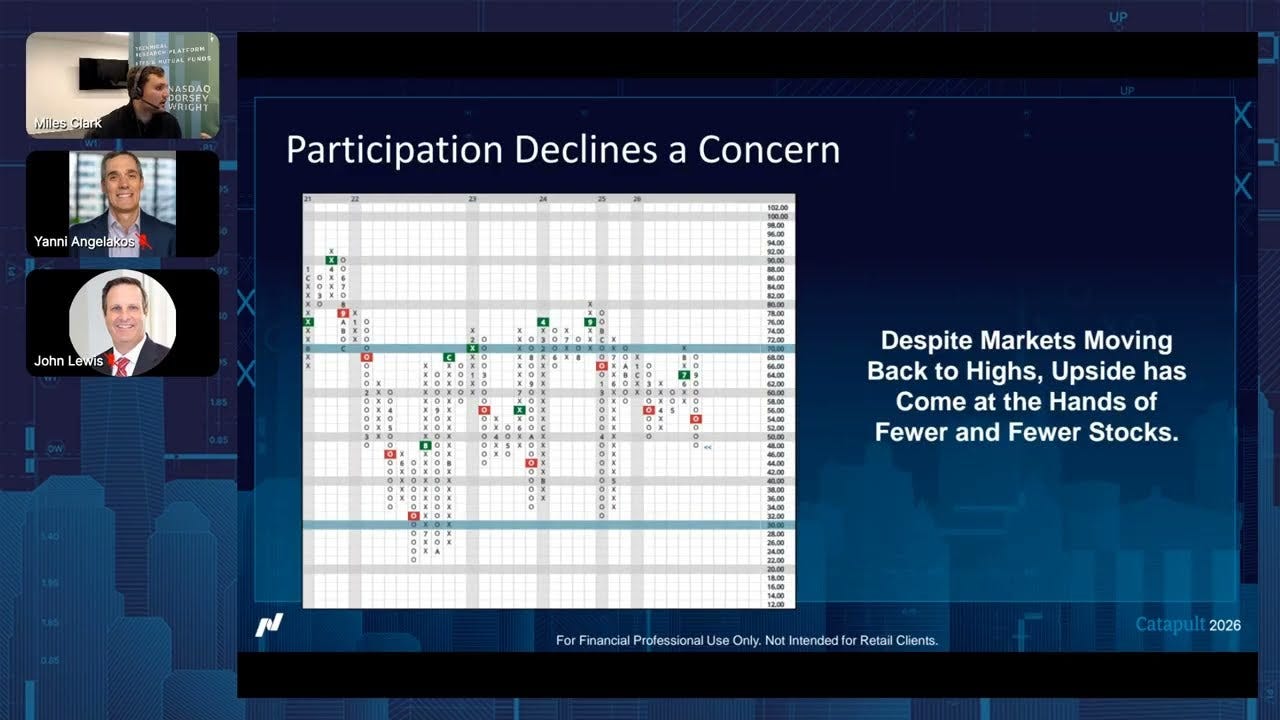
Long-term participation in the S&P 500 fell from about 70% of stocks to under half during the third quarter
A rising dollar has historically hurt foreign stocks and commodities more than the S&P 500
The Iran war is the largest oil supply shock in history as a share of global supply, Angelakos said, and rate hikes cannot fix it
The top 10% of US earners account for 50% of consumption, while gasoline and tariffs squeeze the bottom 80%
Stocks and Treasuries now move together, which leaves investors asking where the buffer in a 60/40 portfolio is
Foreign stocks could beat the US for a second straight year, which last happened in 2006 and 2007
Hyperscalers' operating cash flow still covers about 2/3 of their capital spending, Angelakos said
1. International Ranks First
Lewis opened by describing Nasdaq Dorsey Wright's three business lines: an online research platform for financial advisors, separately managed accounts available on more than 40 platforms, and an index business that licenses indexes to firms including First Trust, PowerShares, ProShares and AdvisorShares. All three rest on momentum and relative strength, he said: the premise that strong assets keep outperforming, and that a holding is sold once it stops being strong.
The firm's asset class rankings put international equities first, domestic equities second and fixed income last
Commodities sit third and currencies fourth. Within US stocks the rankings favor growth over value, with technology and communication services near the top and interest-rate-sensitive and consumer sectors near the bottom. International equities moved to first place earlier in 2026 and have stayed there all year, though Lewis said the gap has narrowed.
Fixed income has ranked last for a long time as rates rose, with long-dated Treasuries hit hardest. Convertible bonds have held up, which he attributed to their link to equities rather than to rates.
In commodities, precious metals led coming into the year. Energy took the lead after the war in Iran started.
Emerging markets stepped back in the third quarter after leading for most of 2026.
