

Betting on the companies that make AI work is probably the most naive trade in the market right now, Nassim Taleb said on Bloomberg Television — because in every past wave of transformative technology, from the personal computer to the first web browsers, it was the pioneers who went bankrupt, not the companies that used the technology afterward.
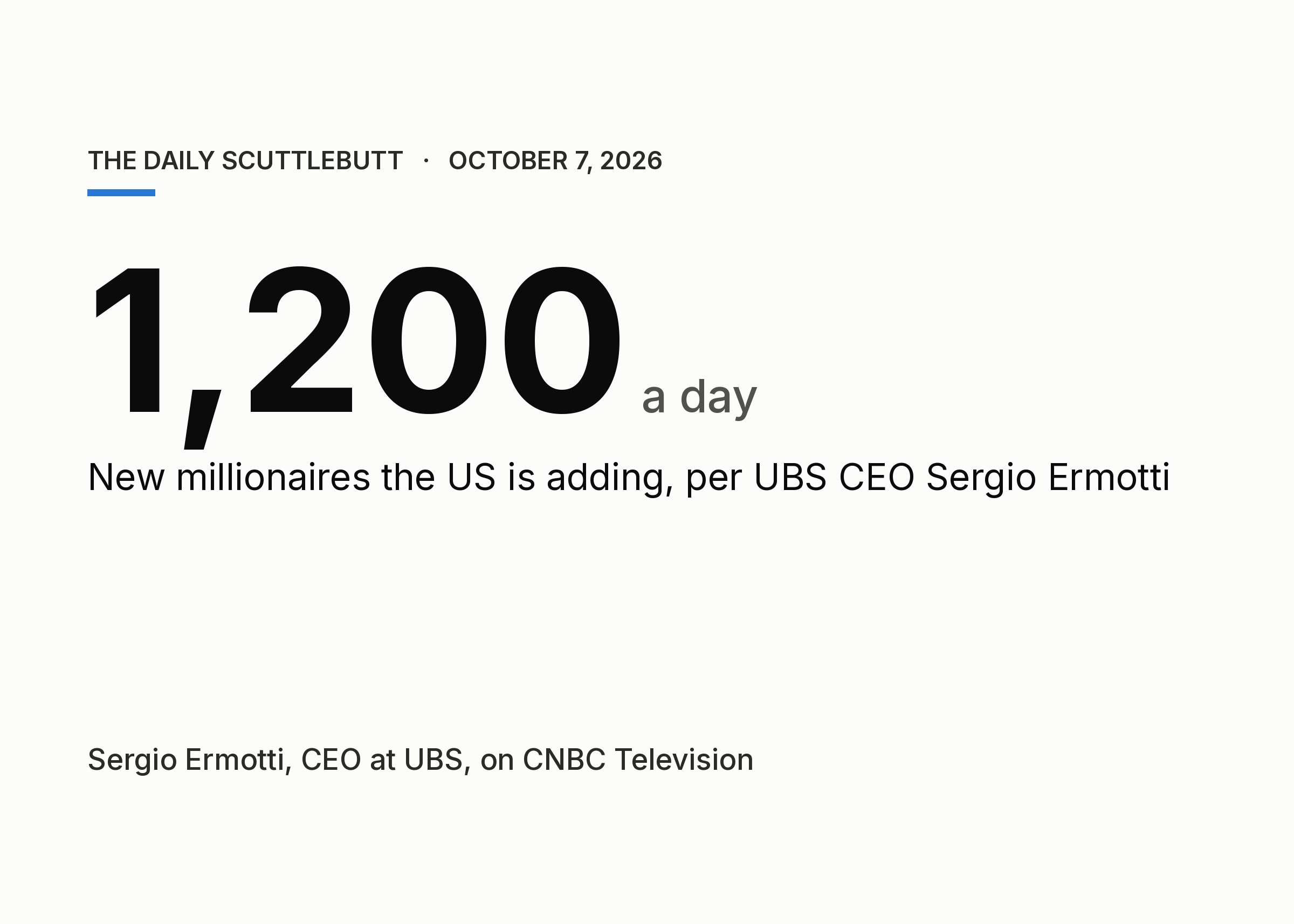
That was one investor's warning about chasing the next big thing. Below are 31 more quotes from 31 other speakers. JPMorgan's chief executive said China has quietly cut its Treasury holdings in half over two years, and UBS's chief executive said the US is now minting 1,200 new millionaires a day.
"I'm the naive. There's a class of naive investors who say, okay, I is going to change the world, and let's invest in firms that are linked to AI. And that probably be the most naive thinking you can. Because if you look backwards, the things that the change the world in retrospect, we can see that the company that benefited were not the pioneers. I mean, take the personal computer. Apple started the personal computer, then almost went out of business, and then IBM took the market and then, of course, almost went out of business. And the one who started the personal computer, Sir Clive Osborne, went bankrupt. ... Technology companies are threatened by other technology companies. And technology is fundamentally unpredictable in the sense that we don't know what will cause AI to become more efficient and it will be a trap to go invest in companies that benefit from it." — Nassim Taleb, Distinguished Scientist at Universa Investments, on Bloomberg Television (Read summary)
We scanned 547 shows and 8 hours of audio, wrote 16 summaries, and pulled 32 quotes into this 19-minute read.
Here is what mattered.
Macro
Ray Dalio says the US spends 40% more than it takes in, and that is squeezing out other spending
"So what we're seeing now, for example, on the U.S. debt is that we spend about 7 trillion a year. Think about this like a business or an individual. They spend seven okay. They take in five. Okay. Spending 40% more than they're taking in. And they've been doing that for a number of years. So as a result, debt and debt service payments are building. And as a result, they are squeezing out the spending." — Ray Dalio, Founder at Bridgewater Associates, on Bloomberg Television (Read summary)
The Fed's mandate is now a waterbed, Gundlach says: push on inflation and interest expense pops up somewhere else
"But now at the dual end date is forever intention because it's inflation and it's the interest expense and you cannot deal with both of them simultaneously. You push on one it's like a water bed. You push on one spot and it's just going to get a bump on the other spot. You're just pushing the problem around." — Jeffrey Gundlach, Founder, CEO and CIO at DoubleLine Capital, on DoubleLine Capital (Read summary)
19 stocks drove the entire S&P 500 return this year, and 59% of the index sits 20% or more below its own high, Tilson says
"Well, normally if you told me the market was within 2% of its all-time high and the S&P 500's trading at 41 times inflationadjusted trailing 10-year earnings, the so-called Schiller PE multiple, which is in the 99th percentile of its valuation all time. A value guy like me would be finding nothing to look at much less buy. But in fact I'm finding a rich target list and the reason for that is we have a very bifurcated market. 19 of the top 20 stocks driving the S&P 500 this year all AI techreated the Nvidias the SanDisk the Microns of the world and that's accounted for the entire 13% return of the S&P 500 this year and the other 480 stocks are collectively flat and here's an interesting statistic for you 59% of the stocks today in the S&P 500 are trading at 20% or more below their all-time highs and 17% one out of six are trading at 50% or more below their all-time highs." — Whitney Tilson, of Stansberry Research, on MarketBeat
Monthly job growth has fallen from 200,000 to about 60,000 this year, Fundstrat's Tom Lee says
"Yeah, the September payrolls kind of confirmed the bigger trend. I mean, jobs growth used to be 200,000 a month. It's averaged like 60,000 a month in 2026. I mean, I'd hardly say that's a booming economy." — Tom Lee, Co-Founder and Head of Research at Fundstrat Global Advisors, on CNBC International Live
Other appearances:
Humilis Investment Strategies CEO and CIO on why 8 to 10 years still remain in this bull market on Bloomberg Surveillance
Robinhood Markets CIO on why $3 trillion of corporate bond issuance is competing with the government for buyers on Full Signal
International
China has cut its US Treasury holdings from $1.2 trillion to $700 billion over two years, Dimon says
"No, because first of all, it's completely public. So it's not like not transparent. And China has already gone from like 1.2 trillion to 700 billion. So that didn't happen today. That's been going on for, I don't know, two years. Japan is a little bit different because they have issues about the yen and issues about the dollar and how they're going to fan some of the growth. So they may want to do something different. But I'll leave that to the Secretary of Treasury about how they deal with that. But again, it's just supply and demand. The dollar is a commodity and bonds are a commodity. Interest rates are a commodity. There's a lot of supply and demand issues. And so I'm not worried about it. But yeah, it may cause a problem one day." — Jamie Dimon, Chairman and CEO at JPMorgan Chase, on Bloomberg Talks
The UK's October 28 budget could cut Britain's own borrowing costs by 25 to 50 basis points, Haldane says
"This is a hostile environment for all borrowers, all government borrowers. And that's not largely our fault as a nation, but it is our problem because we are a leveraged bet on the world economy. Our inflation is higher and stickier. Our growth is lower and stickier. We have yet to balance the books this century. So history is not on our side. The facts are not on our side. That's why the ice is thin and that's why we need to skate carefully. And step one in that is demonstrating this government demonstrating its ability and willingness to do something to curb one of the big spending pump. Triple lock was a good first installment but then he spent the gift up front straight away and probably some actually. So welfare remains a signature issue a toxic issue for the party but also for bond markets as does wider spending across the public sector. I think action on one or both of those in the upcoming budget on the 28th of this month would deliver a very pleasant surprise in terms of 25 to 50 basis points of borrowing costs and could therefore actually be good for growth even though it was taking the knife to spending." — Andy Haldane, former Chief Economist at the Bank of England, on CNBC International Live
Brazil's incoming far-right majority will spend to consolidate power, not cut the deficit markets expect, de Bolle says
"So the process by which they're going to consolidate themselves in power. A party in the process of consolidating itself, especially one that has a kind of authoritarian bent, if not an outright authoritarian bent, is a party that is going to spend to be able to stay in power in the way that they intend. So any plans for fiscal adjustment bringing down the debt to GDP ratio, which in Brazil is very high, everything that the market imagines is going to be possible now, is really not a priority for these people because they've just come to power. And the first thing that they're going to want to do is to consolidate that power. And consolidation, power consolidation involves spending, not less spending, more spending." — Monica de Bolle, Senior Fellow at the Peterson Institute for International Economics, on Prof G Markets
Financials
The US adds 1,200 new millionaires a day, and UBS manages half its $5 trillion globally there, Ermotti says
"Well, first of all, we have been here in the U.S. We manage almost half of the 5 trillion assets we manage globally. And last year, the U.S. has added 1200 millionaires a day. 40% of the millionaires in the world lives in the U.S. So as a truly global manager of wealth, we need to be in the U.S. to be successful. And we continue to see growth alongside with Asia in terms of creating value. And so we are further investing in capabilities to stay competitive." — Sergio Ermotti, CEO at UBS, on CNBC Television
Munis now pay an 8% to 10% taxable-equivalent yield, the best risk-adjusted trade PIMCO sees, Hammer says
"The IG muni index yield today is about 4.70%. You'd have to earn a little under 8% in a taxable investment to get the same after tax return. A portfolio with a little bit of credit can earn you 5% to 6% tax exempt, and that is an 8% to 10% taxable equivalent return. Within our framework here at PIMCO, and we look over the next five years for U.S. taxpayers, those really stand out as the highest risk adjusted, tax adjusted areas of potential investment. So, painful getting here, but quite excited about munis on a go forward basis." — David Hammer, Managing Director and Head of Municipal Bond Portfolio Management at PIMCO, on Market Signals by LPL Financial (Read summary)
Schwab and Bank of America mismanaged bond duration as rates rose, costing shareholders billions, Whalen says
"but yes, today are unrealized losses a problem for banks? Yes. as the bond market backs up, all of the older, lower coupon, higher duration securities that they own go down in price. So, Bank America, Schwab is another one. there's several banks out there that have not restructured their book and they're going to be showing some pretty ugly numbers in the third quarter and the fourth quarter. Is it fatal? No. But it takes away earnings from investors. If you sat down and calculated how much the shareholders of Schwab and Bank America have missed because management couldn't figure out duration, it's it's billions and billions of dollars." — Chris Whalen, Chairman at Whalen Global Advisors, on Adam Taggart | Thoughtful Money®
Other appearances:
VettaFi Director of Research on the IRS cracking down on ETF tax-deferral loopholes on ETF Prime
Crypto and Digital Assets
Crypto rules finished before summer 2028 will be durable, regardless of who controls Washington, Smith says
"Well, I think that's why this rule making process is so important. It can take anywhere between eighteen and twenty four months to get completely through the process. There are different notice and comment periods. They go back and forth with different drafts. It's really important that we get as many of those rules done as possible before the congressional review act window, so sometime before the summer of twenty twenty eight. I think anything that gets across the finish line by then is going be durable. We could see a change of administration or not. We could see changes in congress or not." — Kristin Smith, interim head of the Blockchain Association, on Bloomberg Television
The CFTC is building a "federal option" for crypto exchanges after Congress failed to pass the CLARITY Act, Selig says
"I'm absolutely disappointed in Congress and not getting this bill to the President's desk. It's been a priority since day one. We've worked really hard to get here, but we've got statutory authority and we're going to use it. The SEC is doing the same. They issued their proposed Reg Crypto Assets, which is kind of the framework for distributing crypto assets. ... We don't have the ability to say every exchange needs to register with us as the CLARITY Act would have done, but we can create a federal option. And that's exactly what we're doing here today." — Michael Selig, Chairman at the CFTC, on CNBC Television
Alternatives and PE
Rockefeller Capital is embedded in 30 wealth centers to catch founders early, as US startup formation hits a record 6.2 million, Fleming says
"It is, Jordy. And in fact, Rockefeller Capital Management, we're in over 30 wealth centers over 50 cities across the country, and one of the reasons we do that is we wanna be embedded in local communities with the clients, with the families, because wealth is created in this country. when I was younger, you had a certain set of cities, they're still there, New York and Boston and Houston and Dallas. But now you've got Nashville and Charlotte. Obviously, many places in Florida and in California, obviously, Silicon Valley. So we're in these communities. So we'll often have people working at, the companies that are getting built and built quickly come to our advisers and look for help. So we get a lot of introductions that way because we're embedded in the community. And we do a lot of work with entrepreneurs across all different industries. ... I think we have 6,200,000 new companies being created The United States this year, which will be a record. This entrepreneurial surge has been great for us in terms of creating clients all over the country." — Greg Fleming, CEO at Rockefeller Capital Management, on TBPN (Read summary)
Two-thirds of 30 years of UK landlord returns came from rental income, not capital gains, Beveridge says
"Yeah, so when we look over the full 30-year period, around two-thirds of a investor's typical kind of total return has come from rental income." — Aneisha Beveridge, Head of Research at Hamptons International, on Bloomberg Podcasts (Merryn Talks Money)
Consumer
Cigna's AI-driven care coordination cut avoidable inpatient visits by 42%, Andresen says
"And a great example of what happens when we combine our clinical expertise with emerging technology is we see far fewer people having to have avoidable ER visits. 42% fewer people with avoidable inpatient visits and we're cutting the time to therapy in half for those receiving specialty medications." — Katya Andresen, Chief Data, Digital and AI Officer at The Cigna Group, on Forbes
A decade of federal open-pricing mandates now lets General Medicine show real cash prices with no deals required, Parker says
"Yeah. And the other thing that's happened is the federal government mandated open pricing files a handful of years ago, so providers have to contribute what their reimbursement rates are, to this central repository. And so when you combine these things, we can effectively give customers a clear cash and insurance price for any procedure or service with any provider and that doesn't require us having gone and done a bunch of deals with a bunch of offline systems that can do that on our own." — TJ Parker, CEO at General Medicine, on TBPN
HealthTap draws a hard line against Teladoc-style urgent care, built for chronic-condition continuity instead, Mehra says
"Yeah, there's different groups of competitors out there all doing something slightly different and so we do take quite a bit of pride at being differentiated. So the legacy telehealth I'd say are those TEDuck type businesses that have historically been very urgent care oriented. You push a button, the first available nurse or doctor picks up, you spend 7 to nine minutes triaging your cold and flu symptoms. That's largely what that is. They're not taking responsibility for your, hypertension and your diabetes and saying, let's get on a chronic condition management plant. That's not that, right? So, that's a type of telehealth that is largely like an after hours nurse triage service, but by video and sometimes with a doctor." — Sean Mehra, Co-founder and CEO at HealthTap, on SiliconANGLE theCUBE
Other appearances:
VitalChat Co-Founder and Chief Strategy Officer on staying capital-light while rivals raised $100 million or more on The Innovators & Investors Podcast
Technology & AI
Hyperscalers keep posting 20% profit growth despite their size, and the power trade may have bottomed, van Eck says
"Yes. And everyone is looking for the deceleration point. And, you know, I look at the quarterly earnings. That's my kind of reconfirmation re underwriting of the trade. So I pay a lot of attention to the hyperscalers. And they keep reporting great like 20% year over year profit growth. And even though they're multi-trillion dollar companies. So I'm really good. I mean, this year has been what I call the AI 1.0 trade, which was chips and semiconductors, the AI 2.0 trade, which is the supporting ecosystem, independent power producers, right. The nuclear energy trade that you talked about, that's really been suffering partly because of political concerns relating to data centers. I actually think today is a great day. Maybe we've seen the bottom here with the Constellation deal." — Jan van Eck, CEO at VanEck, on CNBC Television (Read summary)
Google's oldest TPUs, seven and eight years old, are still running at 100% utilization, Vahdat says
"Yeah. So I've been on record as saying this—I was surprised by how much pickup this had—but I said that our seven- and eight-year-old TPUs are still at 100% utilization." — Amin Vahdat, Chief Technologist for AI Infrastructure at Google, on Training Data (Read summary)
Security is moving from keeping bad guys out to enabling AI to be used safely, and that is a different market, Kurtz says
"Well, I think they should consult the security guys more often because if you look at what an agent does, it's a program that runs just non-deterministically. And these are things that CrowdStrike has been focused on protecting what a human does for many, many years, right? An agent is superhuman, touches a lot of different files, but the technology is there. And I think what's important to remember is that the security industry now is moving from keeping all the bad guys out to enabling AI to be used safely. So we move from security to safety. And that's not just a bigger market. It's a different market. It's allowing the CEO to expand their business and run faster. And this is the opportunity that we see in front of us, not only for the security market, but for CrowdStrike." — George Kurtz, CEO at CrowdStrike, on CNBC Television
Identity software is a "marriage," not a date, and that is SailPoint's moat, McClain says
"I like to jokingly say that there's parts of the technology landscape where it's okay to date and you might change dates regularly. You kind of get married to identity products. They tend to be a long-term commitment with significant cost and time to get them fully integrated. So once you've done that, you are not very motivated to change. We have a very high gross retention rate because companies once they choose us, they don't go away." — Mark McClain, Founder and CEO at SailPoint, on SiliconANGLE theCUBE
One person built an internal AI ad agent in weeks, and it added $100 million in ARR for Runway, Kwon says
"we increased the ads that we were producing by over 1,000% and keeping all of the kind of metrics that you're thinking about low. So customer acquisition cost, the time to be able to deliver these ads, and now with this internal tool that we built, and we actually are now making public because it was so valuable for us. We built in just a handful of weeks. One person built this internally, and it was instrumental and by truly central to helping us scale to an additional 100 million in ARR and top line for the business in just a few months." — Michelle Kwon, Chief Operating Officer at Runway, on Fortune AI Weekly (Read summary)
Other appearances:
Bartlett Wealth Management President and Wealth Advisor on overlooked AI-infrastructure plays in connectivity and utilities on CNBC Television
Marvell Executive Vice President and General Manager, Custom Cloud Solutions on lifting its 2031 revenue target to $80 billion on the inference shift on SiliconANGLE theCUBE
VC & Startups
Tu self-funded Ask Dolly to avoid investors pressing for a fast ROI, she says
"A lot of these people announced like, oh, we got $35 million of funding. You now have all of those investors breathing down your neck of when am I going to see an ROI? How are you going to become profitable? How are you going to grow as quickly as possible? It doesn't matter. Do whatever you need to do to make money. I didn't want that kind of pressure and I luckily had the cash. So, I'm fully self-funding this, fully bootstrapped." — Vivian Tu ('Your Rich BFF'), Founder and CEO at Ask Dolly, on Forbes
Industrials and Transport
The Pentagon wants more than five prime contractors, pulling AI and supply-chain firms into procurement, Michael says
"Well, I think we definitely want more than five prime contractors. And those three are great contractors. We also need the AI companies at the table. We need the supply chain companies at the table. Like there's a long chain of supply chain that goes into making anything that we use in warfare. There's also chips, all the things that sustain a domestic economy that protect the homeland. So the list is really pretty endless. If you think about sort of a major potential conflict. And that's why we need as many voices around the table as we can." — Emil Michael, Undersecretary of Defense for Research and Engineering at the US Department of Defense, on CNBC Television
Physical AI is about to attack defense primes' own supply chains, Crusey says
"Well, just to riff a little bit off of your physical AI comment, I think we see something similar on the industrial side as well that, we're going to start taking manh hours off the production line using a lot of this autonomy. And we're watching cycles start to compress. And it's pretty interesting to see that on the industrial side. But what else am I excited about? Well, I think Shaun Maguire recently said something to the effect of, a lot of the primes are kind of set in defense. They've been chosen. And on some I tend to agree with them there. And so what sort of excites me is if you kind of take a step back and look at the big platforms they still have these massive supply chains underneath them." — Jeff Crusey, Co-founder at IceNine Ventures, on Sutton Capital: THE INVESTOR with Joel Palathinkal
Materials & Energy
Diesel is trading over $200 a barrel, and the back of the curve is rising too, which Currie says means this is structural
"ANOTHER POINT I WANT TO EMPHASIZE IS NOT ONLY DO WE HAVE CASH PRICES TRADING AT $128 A BARREL, REFLECTING THESE SHORTAGES, YOU HAVE DIESEL TRADING OVER $200 A BARREL, BUT WE HAVE THE BACK END OF THE FORWARD CURVE STARTING TO RISE, MEANING MARKETS STARTING TO GO. THIS IS MORE STRUCTURAL THAN BEING TRANSIENT." — Jeff Currie, Energy Strategist at Carlyle Group, on CNBC Television
Weekly SPR releases have collapsed from 7-9 million barrels to under half a million, Young says
"the recent releases from the SPR in the last couple of weeks have been much lower. We were releasing 7 to 9 million barrels a week from the SPR let's say 3 months ago and in the last week going off memory I think we released less than half a million barrels of oil from the SPR and same with two weeks ago. So I think if we have sustained low release numbers from the SPR that could lead to triggering some of these lower commercial inventory levels for crude oil and higher prices." — Josh Young, Founder and Chief Investment Officer at Bison Interests, on The David Lin Report (Read summary)
Copper needs to double to $10 a pound before new mines actually get built, Ferris says
"Okay. The price that incentivizes putting capital into producing new copper resources, building new copper mines was five bucks a pound. Okay? And so theoretically, if it gets to five bucks a pound, a rational person says, "Ah, I will commit capital to the building of a new copper mine." Right? But what did I tell you about the refiners? It's got to be this way for a long time because they've been taught not to commit too much. So what the folks at Altius found was that you need double the incentive price before the capital even begins to move. So that was copper five bucks a pound. Where are we as we speak? Almost seven." — Dan Ferris, Editor of Extreme Value at Stansberry Research, on Stansberry Research
Other appearances:
Angeleno Group Co-Founder and Managing Partner on why air conditioning will use twice as much new electricity as AI on Forbes
London School of Economics Professor in Practice on why air conditioning will use twice as much new electricity as AI on Forbes
Policy
The new federal housing law works by forcing local deregulation, because "time is money," Donovan says
"WHAT IT MEANS IS IN A PLACE WHERE YOU HAVE SINGLE FAMILY HOMES, MAYBE ALLOWING WHAT WE CALL ACCESSORY DWELLING UNITS TO BUILD AN APARTMENT OVER YOUR GARAGE OR A SMALL BUILDING IN YOUR BACKYARD, IN MORE URBAN NEIGHBORHOODS. WHAT IT MEANS IS ALLOWING TALLER BUILDINGS, MORE UNITS TO BE BUILT. IT ALSO MEANS NOT REQUIRING 17 STEPS TO GET A BUILDING BUILT. TIME IS MONEY, RIGHT? AND SO THE REGULATORY REDUCTION IS REALLY ABOUT LIMITING THE NUMBER OF REVIEWS AND MAKING SURE WE CAN MOVE WITH MORE CERTAINTY." — Shaun Donovan, Former US HUD Secretary and CEO at Enterprise Community Partners, on CNBC Television
Oil majors have already won nine dismissals of climate lawsuits, undercutting the "50-state avalanche" fear, Parenteau says
"Yeah, well, how do you think that will work out in all the red states which have intervened in this case to say there is no basis for state law? That's 27 states for crying out loud. And the Republican-led states have enacted immunity laws to protect the companies from even being sued. So, no, I don't see a 50-state avalanche. These are expensive cases. If anything... And frankly, a number of these cases have lost. I think the tally right now, the companies have won nine dismissals of these cases in various state courts. So it's not true that this is a highway to bankruptcy for all these companies. By no stretch of the imagination can the companies say, you know, we're going to lose all these cases." — Pat Parenteau, Professor at Vermont Law and Graduate School, on Bloomberg Law
Nuggets of Wisdom
Selling shares as a protest does nothing to a big company, Webb says — it only matters for ones still raising money
"Now, that is absolutely fair. And one of the things that we've talked about or I've written about quite a lot over the years is that when people sell shares in big companies as a protest, sell shares in tobacco companies or whatever, it makes absolutely no difference whatsoever to anything because the capital has already been raised and the company just carries on as is. But it's different, I think, if we're talking about small companies who may need to raise money again in the future. the higher the share price, the lower their cost of capital effectively, right? So they want to raise more money, they want to issue shares at a high price. So if you're supporting a smaller company that may need an injection of capital, then simply by buying and holding the shares, you are to a degree supporting them." — Merryn Somerset Webb, Bloomberg Opinion Columnist, on Bloomberg Podcasts (Merryn Talks Money)
If this was worth your time, send it to someone who has to follow all of this too.
What did you think of today’s edition? Hit ‘reply’ to this email, send us a message, leave a comment, or join the chat!
Get the latest market chatter as it happens: