

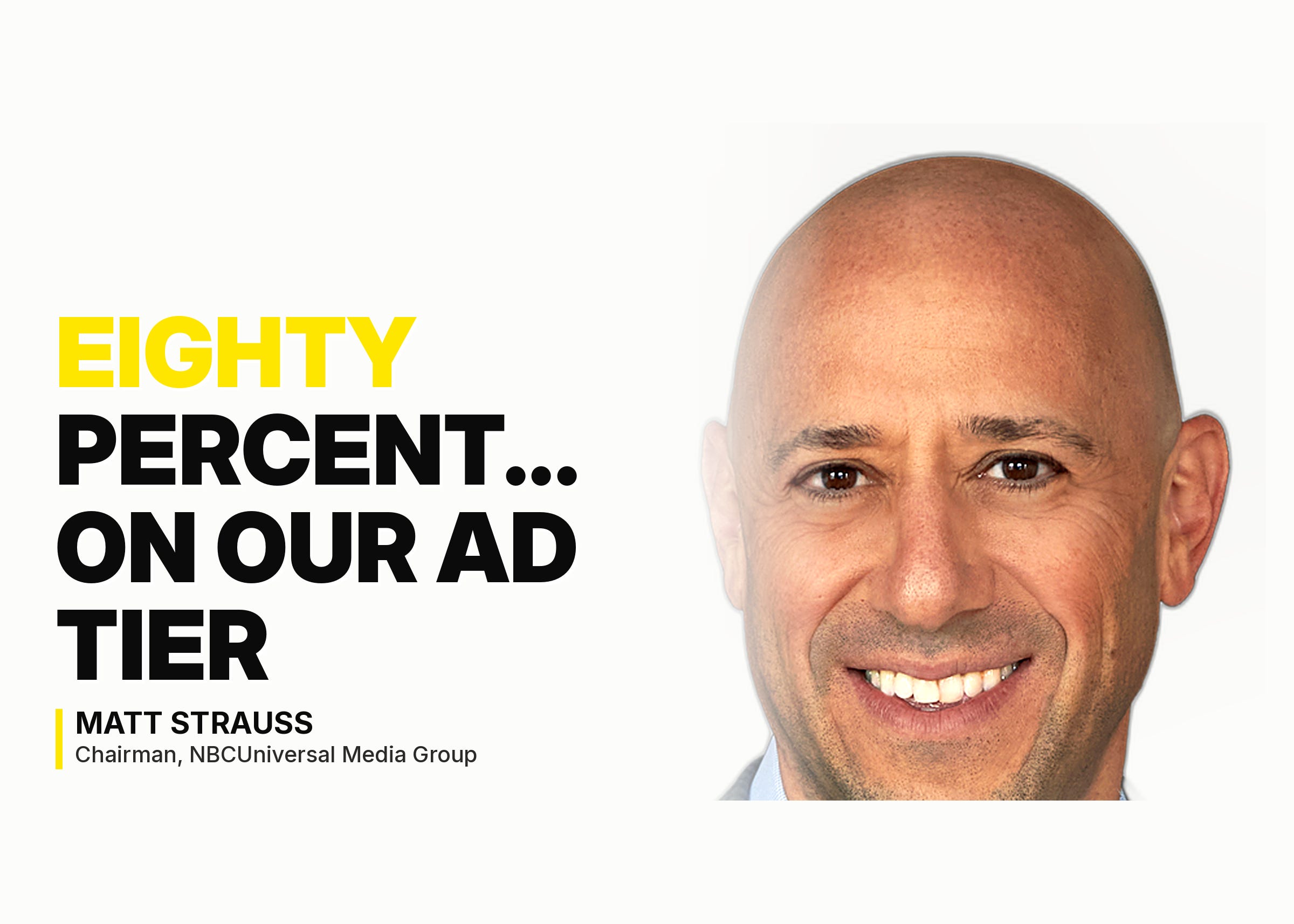
Eight in ten Peacock subscribers are on the tier that carries commercials. Matt Strauss, chairman of NBCUniversal Media Group, told Decoder he thinks almost no other streaming service has a mix that heavy in advertising.
Strauss was one of 10 people quoted in this issue. The others ranged from Shiv Verma, who said retail investors are 25% of the equities market and should get a large share of new listings, to Brian Neider, who said many companies report positive EBITDA for years without producing a dollar of cash, to Josh Gruenstein, who said developers would move all their demand to factory-built homes if those homes were even 1% cheaper.
"Eighty percent of the subscribers on Peacock are on our ad tier, which is a higher mix of advertising subs than I think almost any other streaming service." — Matt Strauss, Chairman at NBCUniversal Media Group, on Decoder (Read summary)
We scanned 814 shows and 7 hours of audio, wrote 8 summaries, and pulled 30 quotes into this 14-minute read.
Here is what mattered.
Financials
Robinhood is telling companies that retail investors deserve a large share of their IPOs
Shiv Verma, CFO of Robinhood, said the firm has amended its filing to take part in Anthropic's IPO, which he expects to be a bellwether for the market. He gave no details of the allocation because the deal is in its quiet period, when the companies and banks involved are restricted in what they can say.
"We are making sure companies know that retail is here... and given they are 25% of the equities market, they should consider a large allocation." — Shiv Verma, CFO at Robinhood, on Bloomberg Podcasts (Read summary)
Robinhood gave 20% of its own IPO to retail investors
Verma said individual investors used to receive 1% to 5% of the shares in a typical IPO. SpaceX is aiming for 15% to 20%.
"When we did our own IPO, we gave 20% to retail, which was the highest in history. That is how you get a good allocation." — Shiv Verma, CFO at Robinhood, on Bloomberg Podcasts (Read summary)
Verma says most of Robinhood's deposits are up 50% from a year ago
Robinhood cannot take orders for a listing before the deal opens. Verma reads the growth in deposits as an early sign of demand for a coming run of large IPOs, with Anthropic and OpenAI among them.
"We are seeing incredibly strong engagement. Customers are depositing more and trading more. Most of our deposits are up 50% year over year." — Shiv Verma, CFO at Robinhood, on Bloomberg Podcasts (Read summary)
Non-sports contracts are now about 30% of Robinhood's prediction-market trading, up from 15%
Prediction markets let customers trade contracts that pay out on the result of an event. Verma said Robinhood will add contracts tied to a company's reported business figures, so a customer can trade the stock, a derivative on it, or a contract on the figure itself.
"As of this quarter, about 30% is non-sports. That is up from 15% a quarter ago. They are using it for the midterm elections." — Shiv Verma, CFO at Robinhood, on Bloomberg Podcasts (Read summary)
About 200,000 customers have also opened Robinhood Agents accounts, in which an AI agent trades and does research for them, holding about $250M in all. Verma said those accounts are kept apart from customers' investment and retirement accounts.
Australians hold tens of billions of dollars in deposits that earn no interest, says Betashares' CEO
Alex Vynokur founded Betashares, an Australian manager of exchange-traded funds, in 2009. The hosts of Equity Mates said its assets under management were $90B a few days before the interview and $95B by the time of the live interview.
"In Australia we have tens of billions of dollars worth of deposits that are earning zero interest rate. Inertia... the banks obviously benefit from that inertia." — Alex Vynokur, Founder and CEO at Betashares, on Equity Mates (Read summary)
Vynokur expects an AI agent to tell customers when they are overpaying on a mortgage
He expects that within a few years each investor will have an AI financial agent working only in their interest. Once people are comfortable with it, he said, the agent could refinance on its own, within limits the customer sets.
"If you are in a mortgage and you're paying more than you have to, your agent will proactively tell you that you're paying too much for your mortgage, and it will suggest where you should refinance." — Alex Vynokur, Founder and CEO at Betashares, on Equity Mates (Read summary)
Crypto and Digital Assets
Rival countries would try to buy ahead of any US Bitcoin purchases, says Alloc Init's co-founder
Misha Komarov co-founded Alloc Init, a research lab building a way to send Bitcoin privately. If the US government began adding Bitcoin to its balance sheet, he said, anyone who could see the purchases coming would buy first. In his view governments and institutions are the next large group of holders, and they will need privacy the network does not offer today.
"There will be countries who will be trying to front run the US Treasury." — Misha Komarov, Co-Founder at Alloc Init, on What Bitcoin Did (Read summary)
Shielded Bitcoin hides the sender, the receiver and the amount without changing Bitcoin's rules
Clara Shikhelman, head of protocol research at Alloc Init, said the system needs no fork, the kind of rule change that splits a blockchain in two. It borrows its design from Zcash, a separate private cryptocurrency whose underlying idea was first meant to run on Bitcoin.
"I think in the heart of it is the ability to send Bitcoin, our regular good old Bitcoin, just without revealing the sender, the receiver, and the amount. You can do it to parties of your choosing." — Clara Shikhelman, Head of Protocol Research at Alloc Init, on What Bitcoin Did (Read summary)
Shielded Bitcoin can be no safer from quantum computers than Bitcoin itself
A shielded transaction takes up about four to five times the space of an ordinary one. The design can be upgraded for quantum computers, but only as far as Bitcoin's own signatures are.
"As long as Bitcoin is not quantum secure, we can't be quantum secure." — Clara Shikhelman, Head of Protocol Research at Alloc Init, on What Bitcoin Did (Read summary)
Samourai Wallet's developers were prosecuted though they never held customer funds, Komarov says
Komarov said prosecutors went after Samourai Wallet, a Bitcoin privacy app, essentially for acting as the central party that coordinated users' pooled transactions. Alloc Init designed its system so that no such party exists.
"I don't think that is true with Samourai's case — they never touched any users' funds and they believed they were inside the regulatory requirements. But they still decided to come after them." — Misha Komarov, Co-Founder at Alloc Init, on What Bitcoin Did (Read summary)
Shielded Bitcoin has no operator for regulators to pursue
No company, Alloc Init included, runs the system. Both guests described the project as open-source research rather than a service.
"It's all self-custodial. It's all on the user side. A user can do it — if you have enough storage at home... you can go through the whole process just yourself. You don't need anybody." — Misha Komarov, Co-Founder at Alloc Init, on What Bitcoin Did (Read summary)
Alternatives and PE
Lead Edge's Brian Neider sees companies report positive EBITDA for years without producing cash
EBITDA is earnings before interest, taxes, depreciation and amortization. Brian Neider, managing partner at Lead Edge Capital, said the cash in these companies gets tied up in working capital, the money a business needs for inventory and unpaid customer bills, while the reported profit looks clean.
"You see a lot of companies that are not levered and they had significantly positive EBITDA metrics for like years, but they've never produced a dollar of cash and they've never issued a dividend... it's like wonky accounting." — Brian Neider, Managing Partner at Lead Edge Capital, on Run the Numbers (Read summary)
Neider says investors accept weak EBITDA adjustments to get deals approved
One company he wrote about could be described as a $58M business on cash EBITDA, $38M on adjusted EBITDA, or $25M after subtracting costs it had capitalized, meaning recorded as assets rather than expenses. Neider starts from EBITDA, takes off only the add-backs he considers legitimate, and then subtracts capitalized spending. Add-backs are costs a seller asks a buyer to treat as one-time.
"A lot of investors want to suspend disbelief to some regard, and it allows them to kind of jam things through their investment committees." — Brian Neider, Managing Partner at Lead Edge Capital, on Run the Numbers (Read summary)
The worst add-backs are recurring costs presented as one-time, Neider says
His example is a company that adds back a year of unusually high recruiting fees, though it will keep hiring as it grows. Legal and deal costs at a company that grows by acquisition recur the same way. A founder's boat on the books bothers him less, because that spending stops once an investor takes over.
"The ones that are the hardest to kind of swallow are recurring expenses that the company's going to add back and argue that it's more of a one-time thing." — Brian Neider, Managing Partner at Lead Edge Capital, on Run the Numbers (Read summary)
Run the Numbers' host says growth above 30% earns a revenue multiple
CJ Gustafson, CFO of PartsTech and host of the show, offered his rule for when a profitable company should be valued on its revenue and when on its EBITDA. Neider called it a good framing.
"My rough mental framework is if a company's over $100 million in revenue and they have profitability, if you're growing at more than 30% year-on-year, you have the right to trade at your revenue multiple. But if you're growing at, say, 20%, 15%... that's probably more indicative of an EBITDA multiple." — CJ Gustafson, CFO at PartsTech, on Run the Numbers
Consumer
Sports and streaming now bring in probably about 60% of NBCUniversal's ad revenue, up from 30%
Strauss runs programming, marketing, product and ad sales for NBC, Bravo, Peacock, NBC Sports, NBC News and Telemundo as one group. Comcast plans to spin NBCUniversal off as a standalone company next year.
"I think about 30 percent of our advertising revenue six years ago came from sports and streaming. Now it's probably closer to 60 percent." — Matt Strauss, Chairman at NBCUniversal Media Group, on Decoder (Read summary)
Peacock's ad-supported tier will be bundled with YouTube Premium next year
Strauss predicted that within a year Peacock will be one of the most widely distributed streaming services in the US.
"There's going to be a bundle launched next year with the ad-supported tier of Peacock and a tier of YouTube Premium... we believe that these are mostly incremental subscribers." — Matt Strauss, Chairman at NBCUniversal Media Group, on Decoder (Read summary)
Strauss says NBCUniversal draws viewers that other platforms keep
Clips of shows such as Saturday Night Live and Love Island find large audiences on YouTube, TikTok and Instagram among people who do not subscribe to Peacock. NBCUniversal plans to recut shows as vertical video inside Peacock, in the format those viewers already watch on their phones.
"We are creating this demand, but I would argue we're not doing a good enough job super-serving them. Then we are fueling this what I would call 'dark matter engagement' on these other platforms." — Matt Strauss, Chairman at NBCUniversal Media Group, on Decoder (Read summary)
Chesky says Airbnb grew before the pandemic because of its business model, not his leadership
Brian Chesky, co-founder and CEO of Airbnb, said it took him 12 to 13 years to become an effective CEO. The change came after Airbnb lost about 80% of its business within weeks of COVID arriving.
"In probably in spite of my leadership, not because of my leadership... We had the curse of having too good of a business model." — Brian Chesky, Co-Founder and CEO at Airbnb, on How I Built This (Read summary)
Airbnb now plans to house people for free for a million nights a year over the next five years, at a cost of about $500M, through its nonprofit, Airbnb.org.
Technology & AI
Legora's CTO says some companies are considering buying a law firm to get legal data
Legora sells AI agents that draft and review legal documents, and has about 100 engineers. Jacob Lauritzen, its CTO, said Legora cannot see what its agent does for a lawyer, because the documents belong to the law firm's clients. A firm's finished documents would also show only the result, not how the lawyers reached it.
"One version of this is you buy a law firm, which some people are considering. But there's some stuff there on whether their data is actually their data or if it's the client's data." — Jacob Lauritzen, CTO at Legora, on Latent Space (Read summary)
Lauritzen says law firms are partnerships because people are their only capital
He wants Legora to help firms turn their way of working into a system the firm owns, which stays when a partner leaves. That would require paying partners for recording what they know, and not only for bringing in clients.
"The partnership model kind of exists because the only type of capital that these companies have is human capital... you can't own human capital. You can't own people. But you can rent them." — Jacob Lauritzen, CTO at Legora, on Latent Space (Read summary)
Lauritzen says companies gain by tuning the models that search their own documents
Embeddings turn text into numbers so software can find related passages. In a RAG system the AI model looks up documents before it answers, and MTEB is a public leaderboard that ranks embedding models.
"There's a lot of alpha left on embeddings. If you're a RAG-heavy workload... you're just looking at MTEB and you're taking the top model, you're leaving a lot on the table... customize your embeddings." — Jacob Lauritzen, CTO at Legora, on Latent Space (Read summary)
Neider says token counts are the AI industry's version of page views
Tokens are the units of text an AI model reads and writes. Neider said a company that makes real cash profit talks about its cash profit, and one that does not reaches for other figures, down to page views and app downloads.
"In the AI world today, the page view sort of equivalent is probably this token maxing stuff... it really just sort of induces spend without looking at efficiency." — Brian Neider, Managing Partner at Lead Edge Capital, on Run the Numbers (Read summary)
Industrials and Transport
Most of Tutor Intelligence's customers have never bought a robot before
Josh Gruenstein co-founded Tutor Intelligence about five and a half years ago. It has about 160 employees, mostly in Boston, and he said its robots have helped make and ship more than a quarter of a billion products. When a robot gets stuck, a remote human operator steps in, and that work becomes data to train the robot's software.
"Almost everybody we're selling a robot to has never purchased a robot before. Almost all of the market is greenfield." — Josh Gruenstein, Co-Founder and CEO at Tutor Intelligence, on The a16z Show (Read summary)
A 1% cost advantage would move all developer demand to factory-built homes, Gruenstein says
Homes built in a factory now cost about 5% more than ones built on site, he said. He applies the same logic to robots: a small cost advantage over human labor can move a whole market.
"If these houses were even just 1% cheaper than the equivalent quality of house manufactured or constructed on site in the traditional way, all of the demand from developers would immediately go to that other shape of building these homes in a factory." — Josh Gruenstein, Co-Founder and CEO at Tutor Intelligence, on The a16z Show (Read summary)
China will have to tear out its older factory automation, Gruenstein says, while the US starts fresh
China invested heavily in the previous generation of factory automation. Gruenstein said the US gets to build its base of general-purpose robots from scratch.
"In China they're going to have to tear down. We're not going to have to do that in the United States in the same way." — Josh Gruenstein, Co-Founder and CEO at Tutor Intelligence, on The a16z Show (Read summary)
Nuggets of Wisdom
Chesky studied how Steve Jobs rescued Apple when Airbnb's own survival was in doubt
He spoke with Hiroki Asai, Apple's former creative director, and hired Jony Ive as a consultant.
"What I realized is he got in all the details. He cut a bunch of projects... He was present. Leadership was present, not absence." — Brian Chesky, Co-Founder and CEO at Airbnb, on How I Built This (Read summary)
Chesky says a CEO should know as much detail as the board's audit committee
He also talks to employees two or three levels down to hear what is happening without a filter, over objections from executives who felt undermined.
"You see every board of a public company has an audit committee. The word audit is key... If the board audit committee knows every detail, why wouldn't the CEO know every detail? And by the way, with AI now you can." — Brian Chesky, Co-Founder and CEO at Airbnb, on How I Built This (Read summary)
Betashares' founder says good investing and good entrepreneurship call for opposite habits
Vynokur mortgaged his house to start Betashares, shortly after his first child was born.
"What it takes to be a great investor is the exact opposite of what it takes to be a crazy entrepreneur... as an investor, I definitely would not recommend the all-in strategy. But as an entrepreneur, absolutely, that's the only way to go." — Alex Vynokur, Founder and CEO at Betashares, on Equity Mates (Read summary)
If this was worth your time, send it to someone who has to follow all of this too.
What did you think of today’s edition? Hit ‘reply’ to this email, send us a message, leave a comment, or join the chat!
Get the latest market chatter as it happens: