

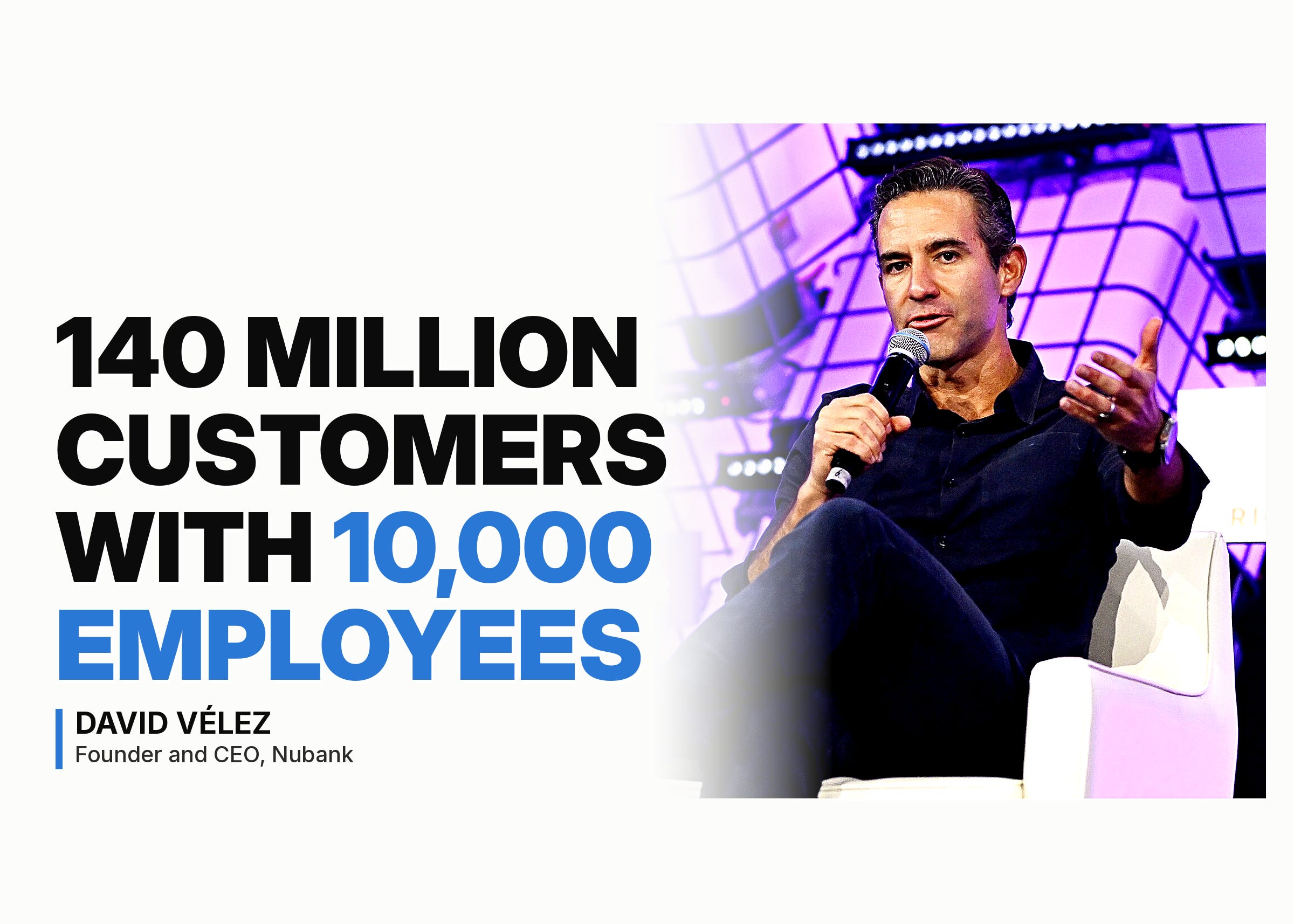
Nubank serves 140 million customers with 10,000 employees. David Vélez, its founder and CEO, says that puts its cost to serve each customer at about 3% of what an incumbent bank spends, before any savings from AI.
That was one of 13 episodes in this issue. The others ranged from a private-credit chief defending the 5% quarterly limit on fund redemptions to the researcher behind AlphaGo, who now expects superintelligence within 3 years, and Michael Saylor on why Strategy sold some of its bitcoin.
"For 10 years, all we heard again and again and again was that it was impossible to compete with any bank, that we were going to get crushed, and that we had no shot at being successful. Today, we have 140 million customers with 10,000 employees." — David Vélez, Founder and CEO at Nubank, on Invest Like the Best (Read summary)
We scanned 789 shows and 14 hours of audio, wrote 13 summaries, and pulled 25 quotes into this 10-minute read.
Here is what mattered.
Macro
A buy-and-hold investor says housing now rewards buyers who can wait and punishes anyone who must sell
Michael Zuber, guest-hosting Wealthy Way, cited a member of his community who bought a Minneapolis house at 20% under its original 2022 listing price after it sat unsold for a year. Ryan Pineda, on the same episode, said conditions for house flippers and wholesalers are worse than in 2022.
"I believe... if your exit is a sale, this market is terrible... but if you can buy and hold and be patient and wait three, five, seven, eight years, this is going to be the easiest market for you in the last 12 years." — Michael Zuber, Real-Estate Investor and Guest Host, on Wealthy Way (Read summary)
Financials
Nubank's cost advantage over incumbent banks came before AI
David Vélez compared Nubank's 10,000 employees with competitors that serve about 100 million customers with roughly 100,000 employees and 6,000 branches.
"Our cost to serve a customer is about 3% of what a traditional incumbent bank is. That's pre-AI." — David Vélez, Founder and CEO at Nubank, on Invest Like the Best (Read summary)
Nubank rebuilt about 120 internal workflows with AI, then cut its management layers
The workflows ran from coding and product design to compliance, internal audit and capital management. David Vélez said the change came partly from what AI let him see and partly from a deliberate push past the usual chain of command.
"I personally went from having one direct report to 20 direct reports over that period... We went from 10 layers to five." — David Vélez, Founder and CEO at Nubank, on Invest Like the Best (Read summary)
Robinhood is selling retail investors stakes in private AI companies to close an ownership gap
Vlad Tenev's case for Robinhood Ventures, publicly traded venture funds that hold stakes in companies such as OpenAI and Databricks, is that most people meet AI only as costly data centers that enrich a small group of investors.
"A lot of the negativity around AI may actually have to do with inequality... if there were more individual owners of these AI companies at the earliest stages, they would be defending it." — Vlad Tenev, Co-Founder and CEO at Robinhood, on Sources Podcast (Read summary)
More than 100,000 Robinhood customers have set up AI agents that can trade for them
The agents trade in a separate account that the customer funds, and approval of every trade is the default. Robinhood has widened them from stocks to options, crypto and limited margin.
"The north star is our customers should have an advantage over the hedge fund and the algorithmic trading firm." — Vlad Tenev, Co-Founder and CEO at Robinhood, on Sources Podcast (Read summary)
Crypto and Digital Assets
Michael Saylor says Strategy has to be free to sell bitcoin, not only buy it
By his account, Strategy sold about 32 bitcoin in June at about $73,000, and later sales of thousands of bitcoin drew no negative reaction. He said Strategy expects to keep adding to its holdings.
"The way to think of our company is we're a structured finance company." — Michael Saylor, Founder and Executive Chairman at Strategy, on Bloomberg Crypto (Read summary)
MSCI is treating digital-asset treasury companies worse than other index members, Saylor says
Saylor called MSCI's possible move to exclude Strategy-style treasury companies from its global equity indices "disappointing," comparing the firm to insurers and banks that also manage large pools of financial assets to create products — in Strategy's case, digital credit.
"MSCI is out on their own on this one." — Michael Saylor, Founder and Executive Chairman at Strategy, on Bloomberg Crypto (Read summary)
Onramp's CEO says tokenizing stocks and bonds will speed up money without stopping inflation
"So all these assets will go up in nominal value and inflation will run through it. But as people start to hold Bitcoin, it will sit there as that kind of like effective tether to let everything else run around it." — Michael Tanguma, CEO at Onramp, on Final Settlement (Onramp Bitcoin Media) (Read summary)
Exchanges that published proof of reserves, including FTX and Bybit, still suffered losses
Michael Tanguma said a proof of reserves mainly shows that a platform is not lending out its customers' bitcoin.
"It's basically saying like we aren't FTX, which is a pretty, pretty, pretty low bar." — Michael Tanguma, CEO at Onramp, on Final Settlement (Onramp Bitcoin Media) (Read summary)
Alternatives and PE
Redemption limits keep private-credit managers from selling performing loans at a discount
Robert Stark said much of the recent news about stress in private credit is really about public credit, and that business development companies, a type of fund that lends to private companies, are under 2% of private credit.
"It's very important that everyone realizes that the 5% quarterly repurchase limit[s] is a feature. It's not a bug." — Robert Stark, CEO at Nomura Capital Management, on Private Capital (Read summary)
Wealth advisers told Robert Stark they wanted one diversified private-credit fund, not niche bets
When he started his own firm, Robert put the choice to as many as 50 registered investment advisers: rotate among niches such as aircraft leasing, litigation finance and music royalties, which he called the red pill, or hold one allocation across all of private credit, the blue pill.
"We gave them like the red pill and the blue pill... My hypothesis was they want the red pill. It did turn out that pretty much everyone wanted the blue pill." — Robert Stark, CEO at Nomura Capital Management, on Private Capital (Read summary)
Private-markets custodians, fund administrators and software vendors still share no data standard
Jeb Altonaga said most still move files by SFTP rather than through APIs, and that the push for one standard has to come from the largest investors in private funds, such as state pension plans.
"Everybody is building for themselves and that's where we're missing [a standard]." — Jeb Altonaga, Head of Business Development for Private Markets at Arcesium, on Alt Goes Mainstream (Read summary)
Technology & AI
Ineffable Intelligence is building its lab on AI that learns without human data
David Silver was the lead researcher on DeepMind's AlphaGo before co-founding Ineffable.
"It took us two years to get to AlphaGo and beat Lee Sedol. When we got Alpha Zero right... that algorithm took just a few hours... to outperform the two years of work." — David Silver, Co-Founder at Ineffable Intelligence, on Training Data (Read summary)
David Silver has shortened his own forecast for superintelligence
"I think we will see some extremely strong evidence that we're on the right track within a year... I originally thought within three to five years [for superintelligence]... my timelines have accelerated a little bit. So I'm going to say three years." — David Silver, Co-Founder at Ineffable Intelligence, on Training Data (Read summary)
Ineffable keeps its team at 20 people so each researcher has more computing power
"We are the first customers of the largest [Vera Rubin GPU] cluster on GCP." — Lasse Espeholt, Co-Founder at Ineffable Intelligence, on Training Data (Read summary)
Din Tai Fung expanded its Dyna Robotics contract beyond folding napkins to cutting food
Dyna's robots fold thousands of napkins a day across several Din Tai Fung locations in the US.
"What's really hard is not putting your robot in one location or doing a pilot. What's really hard is that the customers believe or validate that your robot creates enough value that they want to deploy your robots across many of their sites." — Jason Ma, Co-Founder and Chief Scientist at Dyna Robotics, on Latent Space (Read summary)
Dyna trained its robot model on more than 1M hours of human video
Jason Ma said that base model is then tuned with as little as 45 minutes to a few hours of task-specific robot data.
"Data is the most important thing in robotics today, because unlike language model, there is no internet." — Jason Ma, Co-Founder and Chief Scientist at Dyna Robotics, on Latent Space (Read summary)
Protege's CEO doubts synthetic data can replace real data for pre-training AI models
Protege licenses real healthcare, media and enterprise data to AI labs.
"In the healthcare world, when I started at Datavant... we were 18 months away from synthetic data having a huge moment. When I left four years later, we were 18 months away from synthetic data having a huge moment." — Bobby Samuels, Co-Founder and CEO at Protege, on Summation with Auren Hoffman (Read summary)
Selling data to hedge funds rarely works, because few funds buy and similar datasets compete on price
"If you have a slide that says 'here's who we're going to sell to' and then it's hedge funds, it's like — just cross that out. It's not going to work." — Bobby Samuels, Co-Founder and CEO at Protege, on Summation with Auren Hoffman (Read summary)
AI models are tuned to earn revenue for their makers, Unchained's co-founder says
Dhruv Bansal's alternative is for people to pay AI systems directly for what they deliver, rather than with their attention and data.
"It's not really next token prediction. It's revenue generation for AI companies. That's what they're really being optimized for. But that's not the same thing as net good for all of humanity." — Dhruv Bansal, Co-Founder at Unchained, on What Bitcoin Did (Read summary)
VC & Startups
A startup replacing tools customers already use cannot win just by shipping fast
Luke Shiels's company, Interfere, finds and fixes software failures in production, a market where customers face real costs to switch.
"It's not 2010 anymore and we're not building Uber... our moat is actually convincing people to replace existing tooling that they have with a better way to work." — Luke Shiels, Founder and CEO at Interfere, on Designer Fund (Read summary)
Policy
Crypto guidance from 3 agencies came within a week of the Clarity Act stalling, Michael Saylor says
Treasury, the SEC and the CFTC issued it without the roughly 600 pages of restrictions the bill would have imposed, in Michael Saylor's account.
"I think clarity stalling was the best thing that could have happened to our industry." — Michael Saylor, Founder and Executive Chairman at Strategy, on Bloomberg Crypto (Read summary)
Nuggets of Wisdom
Ryan Pineda traces his worst losses to running too many ventures at once
Between mid-2021 and early 2023 he started an Amazon FBA business, missed the 2022 housing turn while holding a large inventory of houses, entered NFTs and raised money through syndications at what he now sees as the worst moment. He has since shut down the house-flipping business he ran for 11 years.
"I basically had an 18-month stretch where I made a lot of really bad decisions." — Ryan Pineda, Founder at M19, on Wealthy Way (Read summary)
Ryan Serhant credits a daily time budget for outselling New York's next-best team by about $350M in 2018
He treats his roughly 1,000 waking, working minutes a day like cash, split among finding, keeping and doing business.
"You have to treat those thousand minutes like money. It's the only way you won't waste it." — Ryan Serhant, Founder and CEO at SERHANT., on The Knowledge Project (Read summary)
If this was worth your time, send it to someone who has to follow all of this too.
What did you think of today’s edition? Hit ‘reply’ to this email, send us a message, leave a comment, or join the chat!
Get the latest market chatter as it happens: