

Nvidia Hopper chips that Crusoe bought in 2023, when the feedback was that they might not hold their value past year 3, now rent for more than they did when they were new, Chase Lochmiller, co-founder and CEO of Crusoe, said on The Twenty Minute VC.
That was one data-center operator on what his older chips still earn. Below are 36 more quotes from 33 speakers, Lochmiller included. Among them, Tubi's chief content officer said the free streamer has been profitable for 4 straight quarters, and a former Pentagon official for the Middle East said a single missile or drone in the Strait of Hormuz changes what insurers and shippers are willing to risk.
"I think when we started to make really substantial purchases with hoppers, and this was in 2023, the feedback we got was like, well, we don't even know if this is going to be valuable after year three. Right? Here we are 3 years later and the prices being charged for utilizing hoppers is higher than the rates that were being charged 3 years ago when they were brand new. ... So I think people underestimate the ingenuity of applications and application developers of turning compute capacity into value and into valuable services for the economy." — Chase Lochmiller, Co-founder and CEO at Crusoe, on The Twenty Minute VC (20VC) (Read summary)
We scanned 543 shows and 10 hours of audio, wrote 10 summaries, and pulled 37 quotes into this 18-minute read.
Here is what mattered.
Macro
Options traders are betting on falling yields, not buying protection against a stock drop
"And my summary of what we're gonna show you here is that people are not positioning for downside in equities at all. Instead, they are all kind of piling into trades that are going to make money if the yields start to come off. And so, as far as monitoring what traders are doing, there's really no panic, in the equity space at all." — Brent Kochuba, Founder of SpotGamma, on Excess Returns
The largest companies refinanced at 0.5% in 2020, so higher rates are not hurting them, RIA's Roberts says
"So, this is where the 10 largest companies Microsoft, Google, Amazon, etc. That's where all the earnings is. And so, you talk about higher rates. All these companies refinanced their debt back in 2020 when interest rates were at half a percent on the 10-year Treasury. Their interest cost coverage is near record levels right now. So higher interest rates aren't impacting these companies at all." — Lance Roberts, Chief Investment Strategist at RIA Advisors, on Thoughtful Money (Read summary)
Bonds have a place in a 60/40 portfolio again, Damped Spring's Constan says, though not for big gains
"And I think we talked about this on one of our podcasts, of being in a 60/40 portfolio, that bonds have a role in your portfolio now, where they didn't five years ago. So yeah, I think I'm much more constructive on bonds as part of an investment portfolio now. ... But do I think we're going into a situation where bonds generate significant positive returns? No, I don't think so. For that to happen, I think the economy would have to roll over, and I don't think that happens after, you know, a brief period of rates above 5%." — Andy Constan, CEO and CIO at Damped Spring Advisors, on Excess Returns
Micron and Nvidia now have more revenue than Ford, GM and the homebuilders combined, Visser says
"If you take the revenue for Micron and Nvidia in 2015, so 11 years ago, and you compare that to Ford, GM, and the Homebuilders, you're talking about Ford, GM, and the Homebuilders being like almost 20 times the size of the annual revenue for Micron, Nvidia. And now you fast forward, Micron and Nvidia alone have more than those the homebuilders plus Ford and GM. ... We just have a completely different economy." — Jordi Visser, Macro Investor at VisserLabs and former ETF trader at Morgan Stanley, on The Pomp Podcast (Read summary)
New-business formation is at a record because people can use AI to start companies, Apollo's Slok says
"Yeah, because we have very, very strong tailwinds to growth coming from the AI spending boom. ... And what's most noteworthy is also that the weekly data for business formation is telling you that the number of new businesses that are created every week is at the highest level ever, ever in U.S. history. We've never had just a dynamic economy as we're having at the moment, because people can use AI to start a new business." — Torsten Slok, Chief Economist at Apollo, on Bloomberg Surveillance
Growth without a growing labor force must come from productivity, and AI is not widespread enough to explain it, Sahm says
"Well, it's hard to see this being sustainable, particularly, I mean, we have such low labor force growth right now with the sharp reduction in immigration and aging of the workforce, people getting into retirement. It's just we're not growing a lot of workers. ... So right now, if labor force is not growing. And the economy, the activity is growing. It's got to come from productivity. But AI adoption is not widespread enough to explain all of this. So it's curious. It really is." — Claudia Sahm, Chief Economist at New Century Advisors, on Bloomberg Talks
Rate increases cannot produce more oil or more chips, CFR's Patterson says
"I think the challenge for the Fed, the challenge for all these developed markets, and even a few emerging central banks today, is that a lot of the pressure coming in are supply shocks. And central bank policy changes can't create a barrel of oil. They can't create more chips, etc. So it's hard for them to know how to respond to that. ... And the way I'm starting to think about the economy today and AI in particular is it's too much of a good thing. We have too much capex, literally, going in the economy." — Rebecca Patterson, Senior Fellow at the Council on Foreign Relations and former CIO at Bessemer Trust, on Bloomberg Talks
Each of the 10 most valuable companies has had a 12-month drop of 40% to 90%, Galloway says
"I think we're going to have a serious markdown in valuations slowly. It just keep eroding. I don't know what the cadence of it is. I don't think it's going to be a collapse, but when I look at the valuations of these companies and things like the CAPE Shiller price-to-earnings ratio and things like that, it seems to me that just a rational argument is we're due for what I'd call a pretty severe correction. ... And if you look at the 10 most valuable companies in the world, they've all had 12-month periods where they've been down between 40 and 90%. Amazon was down 93% between 99 and 2001. Meta was down 72% in 2022." — Scott Galloway, Professor at NYU Stern, on Figuring Out with Raj Shamani
International
AI tools added 5% to 10% to EBITDA at 2PointZero's companies, its CEO says
"Three, we are very aggressive in pushing our AI agenda to our subsidiaries. This has proven to be a very good practice. With the AI tools that we've deployed for the last 6 years, we've generated between 5 to 10% EBITDA uplift. That's measurable. ... So, we have already deployed 20 billion in the last 5 years. ... So, I think we now have the capacity to deploy between 20 to 30 billion." — Samia Bouazza, Group CEO at 2PointZero, on CNBC International (Read summary)
Tata Trusts proposed a merger that could let Tata Sons stay unlisted
"Tata Trusts has proposed merging Tata Electronic System Solutions and Tata Consulting Engineers into Tata Sons. The idea is to give the group's holding company a larger operating business with its own revenue and change the financial ratios that determine its regulatory classification. The trusts argue that the combined business would no longer qualify as a non-banking financial company or a core investment company that could provide a route to keeping Tata Sons privately held." — Lava, who presents Zerodha's Weekly Tidbits, on Markets by Zerodha
Financials
AI assistants will move idle bank balances to accounts that pay more, Apollo's Slok says
"It's already possible today in many different ways to take your money in and out of your checking account. There are some issues. Sometimes it takes a day. Sometimes it takes a little bit less time. But the issue is, at the end of the day, that if you can swipe your money out of the checking account, you can have a checking account elsewhere where, of course, you also get a higher yield. So, I do think that this is the way we're moving." — Torsten Slok, Chief Economist at Apollo, on Bloomberg Surveillance
Crypto and Digital Assets
Bitcoin's move above 82,000 confirmed a bull market, Visser says, as asset managers start to buy
"I think there's a period here where the asset managers are looking to invest. I think most of what's driving crypto right now is a combination of new players coming in. This is what a bull market is about. And you're right, FOMO is going to start to kick in very soon. I said before when Bitcoin got above 82,000, that was the confirmation of the bull trend. I think we're in that." — Jordi Visser, Macro Investor at VisserLabs and former ETF trader at Morgan Stanley, on The Pomp Podcast (Read summary)
Consumer
Tubi has been profitable for 4 straight quarters with no subscription fee, its content chief says
"But I will correct him in that Tubi, I think, has reached tremendous scale with 110 million monthly active users. And our viewers over the past 12 months have streamed 13 billion hours of content. So I'd say that's scale. And then again, as I just mentioned, four straight quarters of profitability. So it is obviously entirely possible to be profitable and a free streamer." — Adam Lewinson, Chief Content Officer at Tubi, responding to Netflix's Ted Sarandos, on Everybody's Business (Read summary)
HCA holds the No. 1 or No. 2 spot in 80% of its local hospital markets, Right Tail Capital's founder says
"But the way I get comfortable with it relies on a few things. One is we can look at a long history of HCA being likely the best operator in the industry. Their profits are strong. They have the number one or number two market position in 80% of their local markets." — Jeremy Kokemor, Founder and Portfolio Manager at Right Tail Capital, formerly of T. Rowe Price, on Planet MicroCap (Read summary)
Employer health premiums are set to rise 11% this year, the most in 2 decades, Galloway writes
"For people under 65, employer-sponsored plans are the leading source of health insurance, providing benefits to approximately 165 million American workers and their families. Without reducing benefits, premiums for employer-sponsored plans are projected to increase this year by an average of 11% YoY — the steepest rise in two decades and more than 3x the rate of inflation. ... AI, which many had hoped would lower administrative costs, is actually increasing reimbursements paid by private insurers. Providers are using AI to better document care, meaning the same healthcare interactions generate more billing codes and greater profits." — Scott Galloway, Professor at NYU Stern, in his No Mercy / No Malice essay read on The Prof G Pod
Nike's sales in China fell 22% last quarter, a Bloomberg anchor says
"Well, because they're not selling. Jordan is down. Sportswear is down. ... China is just abysmal. That was down 22% in the most recent quarter. They're not selling anything over in Europe right now. This is a story right now where people have options. And for a lot of people, those options are not Nike." — Romaine Bostick, Bloomberg Television anchor, on Bloomberg Surveillance
Sports
A women's team going from $100M to $400M is a safer bet than an NFL team doubling from $9B, Front Office Sports' CEO says
"I think in the sports category specifically, you would have to say some level of women's sports. ... Like in terms of just return on investment, you're getting four, five, 6x investment in that space. And that's why I think so much more smart money is flowing into the women's sports space. ... But are the Seahawks going to go from 9 billion to 18 billion? Maybe. But that's like a huge bet. Is a women's sports team, a WNBA team or an NWSL team or something like that, going to go from a 100 million to 400 million? That's probably a safer bet." — Adam White, Founder and CEO at Front Office Sports, on Forbes (Read summary)
5% of New Jersey sports bettors place 70% of the bets, according to a Rutgers study Elson cites
"Between 2020 and 2025, online sportsbook revenues grew more than 1,000%. As with any drug dealer, they make their widest margins off of the most addicted. A 2023 Rutgers study of sports betting in New Jersey showed that 5% of bettors make up 70% of the bets. That's also why DraftKings built a machine learning algorithm that specifically targets customers who gamble the most. ... The major platforms processed $51 billion in payments volume last year, and that number is expected to grow to $240 billion this year. A vast majority of those revenues came from sports." — Ed Elson, host of Prof G Markets and author of the Simply Put newsletter, on Prof G Markets
Technology & AI
Crusoe writes its GPUs off over 6 years and expects them to earn for longer than that
"The way we depreciate the assets today is we use a six-year depreciation cycle. That's sort of like the standard across the industry. ... And being able to provide intelligence at a lower cost with a older generation of chip that may be slower is still going to have value. And so abstracting away some of the difficulties by actually having a suite of services that can monetize these chips for longer will ultimately we believe extend the depreciation cycle beyond 6 years." — Chase Lochmiller, Co-founder and CEO at Crusoe, on The Twenty Minute VC (20VC) (Read summary)
AI labs move into the businesses of companies that build on them, Replit's CEO says
"The other thing that I think Alex Karp of Palantir has been talking about is that there's like a risk that when you work closely with the foundation model companies is that they're going to move into your business. And we've seen that, you know, with Figma vis-a-vis Anthropic." — Amjad Masad, Founder and CEO at Replit, partly relaying Alex Karp of Palantir, on a16z (Read summary)
Enterprises are spreading AI spending beyond the frontier labs, OpenRouter's co-founder says
"Typically, there's a lot of like brand trust where like enterprises in general are like, oh, I don't really know how to tell the difference between these things. So I'm just going to buy the one that all the other credible enterprises are buying. ... And that just didn't happen that much. It did happen, like, a bit, but we saw a lot of enterprises want to explore new models. ... Enterprises wanted to diversify outside of just the proprietary frontier model labs, both for like cost reasons and for differentiation reasons." — Alex Atallah, Co-founder at OpenRouter, on a16z (Read summary)
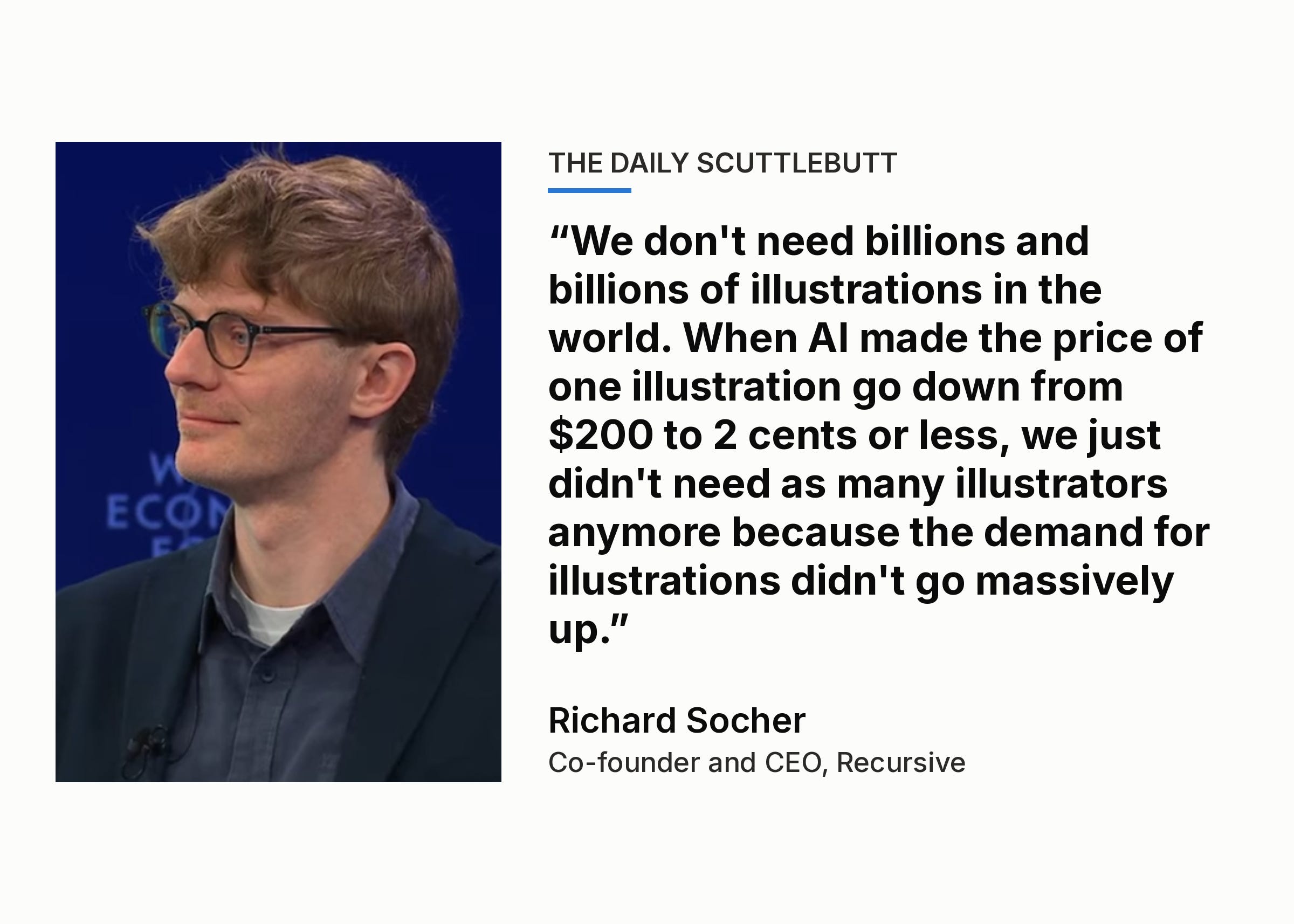
AI cut the price of an illustration from $200 to 2 cents, and demand did not rise to match, Socher says
"We don't need billions and billions of illustrations in the world. When AI made the price of one illustration go down from $200 to 2 cents or less, we just didn't need as many illustrators anymore because the demand for illustrations didn't go massively up." — Richard Socher, Co-founder and CEO at Recursive and former Chief Scientist at Salesforce, on Moonshots with Peter Diamandis (Read summary)
A cheaper open model needed about 20x the tokens, which erased its savings, Fiscal.ai's CEO says
"I'm on the ground making pretty big, you know, multi-million dollar compute run decisions about which models to use. ... And you know what that model did? Was hungry for about 20x the tokens. So go, okay, I have an offer for you. Each token, half the cost. But you need 20 times more of them. ... Way less efficient. Horrible unit economics, right?" — Braden Dennis, Co-founder and CEO at Fiscal.ai, on The Canadian Investor
Robots will be deployed in commercial settings before homes, DeepMind's Gemini Robotics lead says
"I think a lot of pick and place is close to getting very good signal and close to deployment. ... I definitely think that commercial use cases are probably more controllable, therefore, to try out different new intelligence compared to, homes which are more complex and where you cannot exert control and even there is higher bar that you need to meet for safety given toddlers and stuff." — Keerthana Gopalakrishnan, Research Lead for Gemini Robotics at Google DeepMind, on The Cognitive Revolution (Read summary)
The AI labs' profit figures leave out model training and stock pay, The Verge's editor says
"So two of them, Dario at Anthropic and Sam at OpenAI are headed towards IPOs. They're headed toward these big public offerings. I think they know that running a public company is different than running a research lab that can burn money at will. They are all announcing like fake profitability numbers. Like Anthropic is profitable if you don't include the cost of model training or stock based employee compensation." — Nilay Patel, Editor-in-Chief at The Verge, interviewed by Apple News In Conversation, on Decoder with Nilay Patel
Industrials and Transport
The Navy's 11 most recent first-of-class ships ran at least $8B over budget, Business Insider reports
"The Navy has a finite shipbuilding budget to buy 34 ships in 2027. The Navy asked Congress for $65.8 billion, but its 11 most recent lead ships alone came in at least $8 billion over budget — roughly 1/8 of that entire request. Every dollar pulled into those overrun ships is money the Navy can't spend on the next hulls, or the workers and suppliers needed to build them faster." — The narrator of Business Insider's documentary on US shipbuilding, on Business Insider
Materials & Energy
Diesel at $7.13 for a full year would add 0.5 percentage point to inflation, Pachman says
"I wasn't predicting that the crack spreads could go up to $80 or north of it. I just updated this five minutes ago, by the way. Eighty-five dollars right now for Gulf Coast crack spreads. ... But to say it's a massive impact, if we had diesel prices where they are right now or say like, I don't know, I just pulled up 7.13, you know. My guess is it's gonna be higher than that kind of like a year from now or soon. That means 0.5 percentage points of upward pressure, but that was if it stayed there for the entire year." — Eric Pachman, who publishes Data For The People and built refinery models at Morgan Stanley, on Excess Returns
A US ban on diesel exports would also cut gasoline output, Bloomberg Economics' Kennedy says
"But the big risk is anytime you take some sort of an action. You know, The US, since the Iran war, has emerged as the number one global exporter of diesel. Diesel runs the global economy. About 30% of oil is turned into diesel. ... If you ban diesel exports, yes, diesel prices will fall in The US, but storage capacity will quickly get used up. Refiners profit margins will drop. They'll stop producing the other things like gasoline." — Chris Kennedy, Economic Statecraft Lead at Bloomberg Economics and a former White House staffer, on Bloomberg Television
Every solar plant on a grid goes dark within 30 minutes at sunset, so heavy solar needs costly backup, Angwin says
"The thing is that not all nuclear plants will have the same problem at the same time. But all solar plants shut down within half an hour of each other. ... But if you decide, well, we're going for 50% solar on the grid, well, you're going to have an awful lot of backup and people are going to be not happy with how much that costs." — Meredith Angwin, author of the book Shorting the Grid, on Energy News Beat
Policy
Companies that want to build data centers have to bring their own power, Hassett says
"And I think that the AI policy, as an example, is something that we made it basically so that it's voluntary. So if you don't want a data center in your town, nobody's going to make you have a data center in your town. And if a firm wants to build a data center, then they've got to make their own power." — Kevin Hassett, Director of the National Economic Council and a former senior economist at the Federal Reserve, on Bloomberg Television
Geopolitics
One missile or drone in the Strait of Hormuz is enough to change what insurers and shippers will risk, Stroul says
"The key thing here is that there's no 100% military solution that's going to completely eliminate all of the missiles and all of the drones. ... So one anti ship ballistic missile, one drone sent into the Strait Of Hormuz changes the risk tolerance of insurers and shippers, and that's the issue we have today." — Dana Stroul, Research Director at The Washington Institute and former Deputy Assistant Secretary of Defense for the Middle East, on Bloomberg Television
Egypt's intelligence chief flew to Israel for 67 minutes to warn of trouble before Oct. 7, Salama reports
"And so for Abbas Kamal, who was then the Egyptian intelligence chief, to get on an airplane, fly to Israel, and stay for only sixty seven minutes. That alone was indication to us that something just wasn't right. ... I talked to a Saudi official for this story who'd also seen the Egyptian intelligence in advance, and the Saudi official bluntly told me, we all saw trouble." — Vivian Salama, Staff Writer at The Atlantic, on Bloomberg Television
Nuggets of Wisdom
By April most ways to lower this year's tax bill are gone, a Motley Fool analyst says
"I would say that I think for a lot of us taxes, usually treated like an April problem. But the thing to keep in mind is that by April, most of your options are already gone and you're basically just reporting what has already happened." — Amanda Kish, CFA, CFP, analyst at The Motley Fool, on Motley Fool Hidden Gems Investing
Ask how a financial adviser is paid, and treat commissions as a red flag, Bloomberg Money's Auriemma says
"Now, an advisor, someone who gives you financial advice, surely, but also manages your money and charges you a percentage of those assets. That’s a very serious relationship. ... So the first question you have to ask if you’re encountering an advisor or thinking about one is how is this person getting paid? If they’re getting paid as a percentage of your assets, or even worse, if they’re getting paid some sort of commission, they make a small amount of money every time they get a trade or they buy a product for you. That should be a red flag." — Adam Auriemma, author of the Bloomberg Money newsletter and former editor-in-chief of Money magazine, on Slate Money
Other
Uber trades about a third below its high as investors ask whether robotaxis will bypass its app
"It's nearly 33% lower than 52 week highs. ... So why has the stock fallen? Disappointing profit guidance has been one identifiable trigger, but investors are also asking whether autonomous vehicles will strengthen Uber's distribution platform or allow competitors to completely bypass it." — The Dividend Talks host, on Dividend Talks
Only 2% of Gen Z hold the work values employers expect, so companies compete for them, Welch says
"Okay, so not everyone in Gen Z is the same. But if you actually look at the numbers, 2% of Gen Z have the values that we would typically ascribe to. ... And you know what happens is there's a cage match of organizations and individuals who are trying to hire that 2%. And the rest have a different set of values. Their top value is self-care and well-being." — Suzy Welch, Professor at NYU Stern, on Bloomberg Surveillance
If this was worth your time, send it to someone who has to follow all of this too.
What did you think of today’s edition? Hit ‘reply’ to this email, send us a message, leave a comment, or join the chat!
Get the latest market chatter as it happens: