

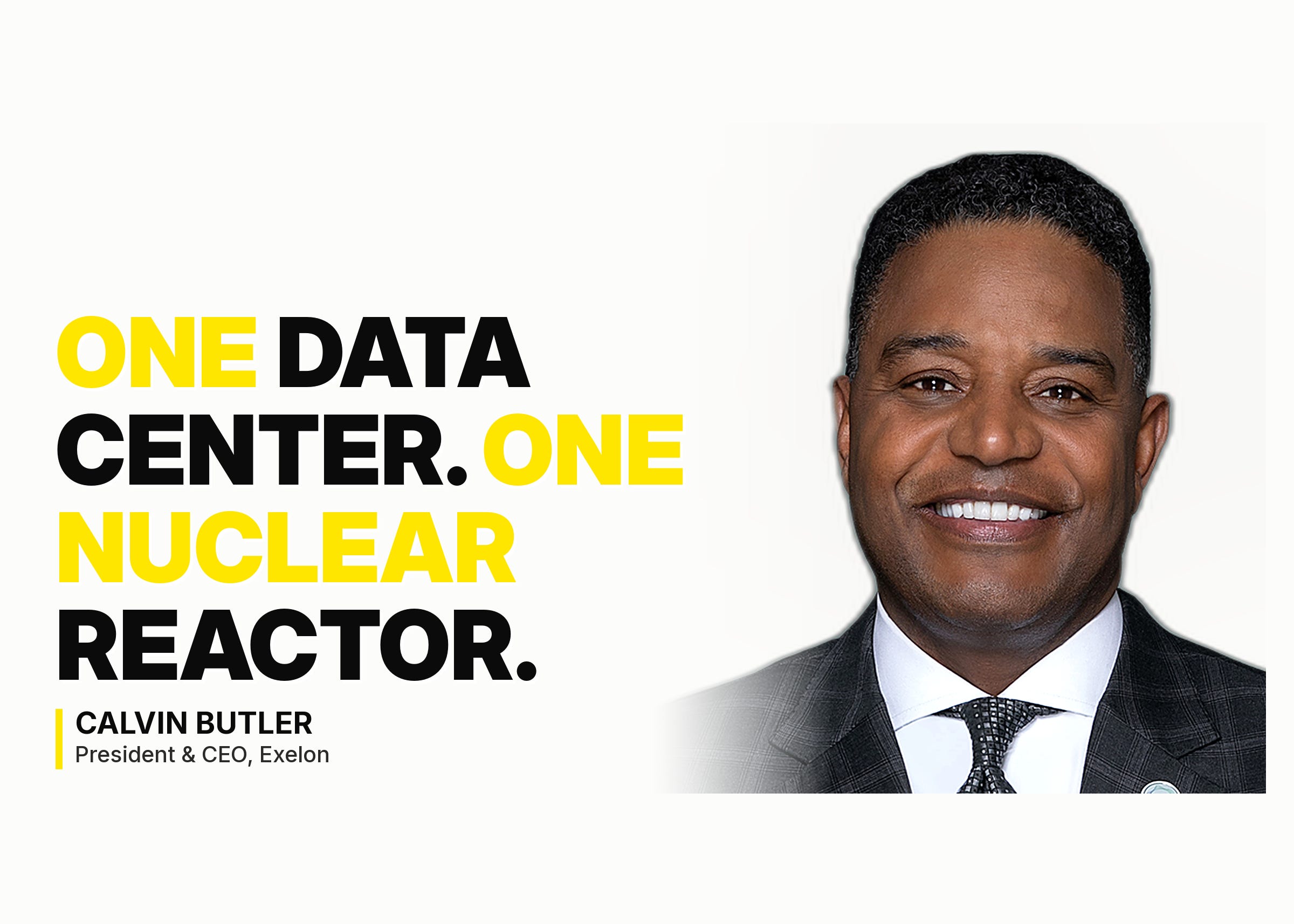
Exelon's Calvin Butler says a single large data center now draws about one gigawatt of power — the output of one nuclear reactor.
That was one utility CEO's math, in a night that ran the same AI buildout through nineteen different conversations: a hedge-fund chief warning about the dollar and $40 trillion of debt, an IBM vice chairman calling foundation models "a commodity business," and a home-services startup now booking $60 million a year because the call center answers itself.
"One data center, a large data center, uses one gigawatt of power, which is the equivalent of one nuclear reactor." — Calvin Butler, President & CEO at Exelon, on Forbes: The Enterprise Zone (Read summary)
We scanned 749 shows and 11 hours of audio, wrote 19 summaries, and pulled 22 quotes into this 9-minute read.
Here is what mattered.
Macro
Bridgewater's CEO says the dollar's weakness is a regime change, not a policy mistake
"The reason the dollar was so strong was because for 100 years, the world has globalized with the U.S. at the center... as of three years ago, the macroeconomic paradigm has shifted completely from globalization to nationalism." — Nir Bar Dea, CEO at Bridgewater Associates, on The David Rubenstein Show (Read summary)
Gary Cohn, IBM's vice chairman and a former White House economic adviser, pointed at the same $40 trillion from the other side of the balance sheet — not the dollar's standing, but who is actually holding America's debt.
"We can't deny that we're $40 trillion in debt and growing," says IBM's Gary Cohn
"We can't deny that we're $40 trillion in debt and growing. And there's no signs on either side of the aisle that we're going to stop spending." — Gary Cohn, Vice Chairman at IBM, on Squawk Pod (Read summary)
His worry is who is exposed to it without knowing it: "All of the pension funds, all of the endowments, many investors, many retail investors own this debt... whether they understand they have exposure or not."
Financials
Kalshi's Tarek Mansour spent the night making the case that a prediction market is a financial exchange, not a sportsbook — and that its own forecasts are beating Wall Street's.
The Fed compared Kalshi's crowd forecasts to Wall Street's own. Kalshi won.
"The Federal Reserve put out a paper in February. They compared our forecast — which is Main Street, average people — to Wall Street on the economy: inflation, Fed interest rates, GDP, unemployment... Guess who did better? Kalshi." — Tarek Mansour, Co-founder & CEO at Kalshi, on PBD Podcast (Read summary)
On manipulation, he argues an open market polices itself faster than a regulator could: "On an open market, it's much harder to game the market because people are seeing it in broad daylight. And if we catch you doing this, you commit a financial crime, and we're going to enforce against you."
Franklin Templeton's CEO confirms the firm's venture desk backed both SpaceX and Anthropic
"We did [have exposure to SpaceX]. We did Anthropic. I mean, a bunch of them." — Jenny Johnson, President & CEO at Franklin Templeton, on Sourcery with Molly O'Shea (Read summary)
"I'm not in the 76% business," says the small-business lender who built his own AI underwriter
"I'm not in the 76% business." — Ilya Fridman, Founder & CEO at Byzfunder, on Fintech One-on-One (Read summary)
Off-the-shelf bank-statement parsers were only directionally right three-quarters of the time, so Byzfunder trained nine language models on the exact rules its own human underwriters follow instead.
Schwab's CEO: 75% of clients use AI, but more than 90% still want a human advisor
"More than 75% of clients... use AI in some way in their financial life, but more than 90% want to work with a person as well." — Rick Wurster, President & CEO at Charles Schwab, on Schwab Network (Read summary)
Alternatives and PE
Ares' CEO: "You can't really find anybody" seeing credit issues in the system
"You can't really find anybody... saying there are credit issues in the system." — Michael Arougheti, Co-founder & CEO at Ares Management, on CNBC (Read summary)
Ares raised $31 billion in the third quarter, a record pace, even as credit deployment fell 33% year over year on muted M&A — nonaccruals and loan-to-value both stayed near historical norms.
iConnections built a $500 version of Goldman's invite-only CEO conference, because public companies now chase Substack and X analysts too
"That shift has already happened in a major way. I am personally on calls with the investor relations teams of many of the CEOs who are speaking... they are very, very focused on having the ability to meet with the Substack analysts, the X analysts." — Ron Biscardi, Co-founder & CEO at iConnections, on After Earnings (Read summary)
His new conference, TomorrowX, recreates the small-room access of a bank's invite-only client event at a fraction of the price: "If you are an institutional investor, you are very likely on the list of invites from Goldman Sachs and Morgan Stanley and JP Morgan... What we're trying to do with TomorrowX is to create that access for a much broader set of investors."
Consumer
WHOOP's founder on why the company fought the FDA over a wellness feature, and won
"We stuck to our guns, and I ultimately really believe in the way that we approached it. Through a long process, the FDA has since updated their guidelines — I think based on our case, but also based on feedback from the industry." — Will Ahmed, Founder & CEO at WHOOP, on All-In Podcast (Read summary)
The business model underneath that fight, in his words: "We do not sell data. You are not the product, Jason — the membership is the product."
Torani's CEO: no layoffs in 101 years, heading toward $1 billion
"This year will be well over 800 million. We're already almost there." — Melanie Dulbecco, CEO at Torani, on Forbes (Read summary)
On AI specifically, she drew a hard line from manufacturing automation's past: "There was no way that we would ever implement something to drive efficiency and eliminate jobs."
Sports
DraftKings' CEO puts a number on how much Kalshi is actually taking from his business: about 3%
"We found, with Kalshi in particular, the overlap was just about 3%. And that's just a customer overlap — that doesn't necessarily mean that all of those dollars are cannibalized... we think it's probably lower." — Jason Robins, CEO & Co-founder at DraftKings, on CNBC Sport (Read summary)
On his own company's AI adoption: "A year ago, I think under 20% of our code was written by AI. Now most of our code is written by AI, and it keeps going higher."
Technology & AI
IBM's Gary Cohn calls AI foundation models "a commodity business" with no moat past seven days
"To me, they look like they're in a commodity business. No one really has a competitive advantage for more than, I don't know, seven days. Your model can be better than mine for seven days." — Gary Cohn, Vice Chairman at IBM, on Squawk Pod (Read summary)
He sees the AI infrastructure buildout headed where fiber optics went in the late 1990s: "I look at this a little bit like the fiber optic trade... we overbuilt it. The three companies that put all the capital to work did not survive. They went over... the second owner is making an enormous amount of money."
ServiceNow's chairman says the company is "operating at the rule of 57" and governing the AI agents built on top of it
"We have a margin profile that's perfect, and a growth company operating at the rule of 57." — Bill McDermott, Chairman & CEO at ServiceNow, on CNBC (Mad Money) (Read summary)
On the governance layer his company is building for AI agents across the enterprise: "We have a kill switch that can revoke the passport for a person, an agent or a robot, and block the action at the point of execution."
The IT-coding-agent startup that still expects a "SaaS apocalypse" — just not the one most people predict
"There will be a SaaS apocalypse, but in that kind of point-solution, smaller-market-cap type companies. I don't think you're going to truly get away from the core systems of record — the ERP, the HRIS, the ITSM, the CRM." — Jake Stauch, Co-founder & CEO at Serval, on No Priors (Read summary)
On why he thinks fully autonomous agents are further off than the hype suggests: "This is the ultimate moonshot in enterprise software... I don't think anyone's going to be able to take [that security risk] anytime soon. Serval is the boundary. Serval is the guardrails."
Crusoe's CEO says selling the company's Bitcoin business was never a pivot — it funded the AI buildout all along
"I think externally a lot of people thought this was a pivot for us, but internally... this was sort of the plan all along. This energy-first approach to computing." — Chase Lochmiller, CEO & Co-founder at Crusoe, on Long Strange Trip: CEO to CEO with Brian Halligan (Read summary)
VC & Startups
Broccoli's founders turned an answered phone into a $60 million business, two years after zero
"If you don't answer the call, that lead is gone. You'll never be able to recover that opportunity." — AJ Jain and Aditya Ketkar, Co-founders at Broccoli, on YC Root Access (Read summary)
Their path there, in their own words: "The run rate for our AI-booked jobs is at over a billion dollars for our customers... the last two years we were at 0 in revenue, and we'll end the year at over 60 million."
Materials & Energy
The grid math behind this issue's headline: Exelon expects to nearly double one of its largest utilities' peak demand by 2030
"In 2024 ComEd had a peak demand of 23 gigawatts. By the end of 2030, ComEd's peak demand will be over 30 gigawatts. So you see, we're almost talking about doubling the fourth largest utility in the nation." — Calvin Butler, President & CEO at Exelon, on Forbes: The Enterprise Zone (Read summary)
Exelon itself owns no generation, so the $41.7 billion it is spending builds only the wires, not the power plants capturing the data-center earnings boom.
B2Gold's new CEO on why a 9-year mine life could really be 15 — and the cost of saying so out loud too early
"Continuing to prove out and delineate these underground portions of the mine helps us see a position where we internally think it's got a 15-year mine life, but we can't show it in the reserve plan." — Mike Cinnamond, President & CEO at B2Gold, on Kitco Mining (Read summary)
He was just as direct about where the company fell short: "We did take longer and it did cost more than we originally thought [at Goose]. So we have to accept that, and we have to show the market that we can deliver there."
EQT's CEO on the $13 billion deal that just created America's largest natural gas producer
"International natural gas prices move from about $10 to now... over $30 per million BTU." — Toby Rice, CEO at EQT, on CNBC (Power Lunch) (Read summary)
Domestic gas, by contrast, trades around $3 — a gap Rice credits entirely to US energy independence, and the reason he argues for unleashing more LNG exports.
Industrials and Transport
Airlines for America's CEO: jet fuel and labor now eat more than half of what airlines spend
"Jet fuel prices are crushing them... jet fuel and labor [are] over 50% of what they have to handle." — Chris Sununu, President & CEO at Airlines for America, on Squawk Pod
Nuggets of Wisdom
MasterClass's CEO was told he was indecisive. The real problem was he didn't know he was being asked to decide.
"I realized in that time I didn't even know that they were asking me to make a decision... it wasn't even a capability gap. It was like an awareness gap." — David Rogier, Co-founder & CEO at MasterClass, on How Leaders Lead with David Novak (Read summary)
His read on what AI does to a career: "AI can let anybody do almost anything, at least on an okay bar. So if you're going to be a specialist, you've got to be in the top 1% of that specialty. Everybody else should be a generalist."
If this was worth your time, send it to someone who has to follow all of this too.
What did you think of today’s edition? Hit ‘reply’ to this email, send us a message, leave a comment, or join the chat!
Get the latest market chatter as it happens: