

S&P 500 earnings are up more than 30% from a year ago. Take out other income and one-time items, including gains on stakes in AI companies, and growth is in the low 20s percent, Steve Hoedt, head of equities at Key Wealth, said on Key Wealth Matters.
That was one bank's head of equities on the quality of index earnings. The 31 other quotes below come from 31 more speakers. Among them, Lockheed Martin's chief executive explained why the Pentagon now lets contractors build prototypes before it writes requirements, and Schwab Asset Management's chief executive said the trouble in private credit has been about getting money out, not about loans going bad.
"So I think that the Earnings numbers for the S&P 500, which they clearly continue to go up into the right, the thing that I've been focusing a lot on lately is the multiple contraction that we've been seeing in the market from a PE perspective. ... the quality of earnings for the S&P 500 over the last year has deteriorated. And by that, I mean, it really has been a large amount of other income or one-time items due to some of these public offerings from the AI companies or marking up what the valuation is of these stakes that they own and then seeing those numbers translate through the earnings line. Now, if you look at the raw numbers, S&P 500 earnings are up over 30% plus year over year. You back out the other items out of that, they're still up in the low 20s, which is fantastic earnings growth. ... So it calls into question, if the stock market's not a bubble, maybe the earnings numbers are the bubble, right?" — Steve Hoedt, Head of Equities at Key Wealth, on Key Wealth Matters
We scanned 486 shows and 5 hours of audio, wrote 12 summaries, and pulled 32 quotes into this 16-minute read.
Here is what mattered.
Macro
Debt taken on at zero rates in 2021 comes due between 2026 and 2028
"First, and I think this is like 101. Everybody refinanced in 2021. ... The truth of the matter, when interest rates are zero, people borrow and the average duration of that debt is five to seven years. That's sovereign, that's corporate, that's private in all kinds of ways. ... Let's do some simple math. 2021 Plus five to seven years is when 2026 to 2028. ... And you borrowed at two and a half, that's pretty good, pretty happy for the last five, six years. Now borrowing is seven and a half. You have a decision to make." — Cem Karsan, Founder and CIO at Kai Volatility Advisors, on Top Traders Unplugged (Read summary)
Wider high-yield spreads are not a sign of weakening companies, Principal's strategist says
"But I think that the other point is, which you have said, but it's really worth emphasizing, is that, yes, you are seeing spread widening. ... But this is one, it's very, very far from record highs. The other thing is that, from a fundamental perspective, we're not really worried about fundamentals. We can see that the corporate perspectives are still pretty strong. So, to us, this is a little bit more of a digestion issue rather than a fundamental issue." — Seema Shah, Chief Global Strategist at Principal Asset Management, on Bloomberg Surveillance (Read summary)
The countries with the strongest finances issue too few bonds for investors to buy
"If I were still chief investment officer managing your money, I would not be adding to Treasuries here. ... But I still think yields have more upside from here. ... The problem right now, both of you know this, is if you're looking for countries that have better fiscal situations, we're talking countries like Singapore and Norway. And because they have good fiscal situations, they don't issue a lot of debt, so their debt markets are not very deep. So where you want to own the bonds, there aren't enough bonds to own." — Rebecca Patterson, Senior Fellow at the Council on Foreign Relations and former CIO at Bessemer Trust, on Bloomberg Talks (Read summary)
Rates are rising because the savings glut of 2010 to 2020 has become a capital shortage
"So, we went from a savings glut from 2010 to 2020 where there was a significant amount of savings from China, from savers, from people who have a 401k. But today, there are so many things to invest in. You can decide to invest in high government bond rates. You could also decide to invest in AI. The number of projects that need capital is very significant. And that's the reason why interest rates keep going up." — Torsten Slok, Chief Economist at Apollo, on Bloomberg Intelligence
The US labor market has been low-hire, low-fire for at least 3 years
"One thing I watch so closely, in addition to the hiring rate, is the quit rate, because that's the opportunity for people to go find better jobs, better pay, deal with higher prices. And that quit rate is also low. We are just not moving people around. ... Things are out of sync in a way that just doesn't feel like it can keep going, and yet it has. We are at least three years into this low hire, low fire labor market. This is not normal." — Claudia Sahm, Chief Economist at New Century Advisors, on Bloomberg Talks
Other appearances:
DoubleLine portfolio manager on Microsoft alone driving 70% of the S&P 500's Q3 return on DoubleLine Minutes
International
Greater Tokyo holds 70% of Japan's potential data-center demand, JERA's CEO says
"The hyperscalers really want to have power within the one or two years. ... And in Asia, outside China, Japan may be the biggest data center, potential demand center. And if you see Japan, greater Tokyo is 70% of the potential data center demand. And from now to next 10 years, it may reach 10 gigawatt." — Yukio Kani, Chairman and CEO at JERA, on Bloomberg Daybreak: Asia Edition (Read summary)
Dino Polska opened 62 stores in Q1 while its biggest rival, Biedronka, opened 3
"If you look under the hood, Dino is actually kicking Biedronka's butt in execution. ... In Q1 alone, 2026, Dino opened 62 new stores. How many did Biedronka open in that same quarter? Just three. ... In Q2 2026, as food deflation hit Poland, Biedronka's like for like sales growth fell to negative 1.6%. Dino's like for like sales growth slowed down to 0%." — The Dutch Investors host, on The Dutch Investors (Read summary)
China's consumer stocks fell about 18% in 6 months while tech rose about as much
"And actually, when you just zoom out a little bit, we're talking about consumer stocks down about 18% in the past six months. And the tech sector actually has risen pretty much the same amount during that period. ... And when we spoke to the strategist at Bank of America, actually she's saying that jokingly, that this year's trend is a lot about selling what people consume and buying what machines consume." — Winnie Su, Asia Equity Reporter at Bloomberg, partly relaying a Bank of America strategist, on Bloomberg Daybreak: Asia Edition
Chinese car sales have fallen about 20% year on year, month after month
"Yeah, it's a little bit has to do with some incremental pullback in state incentives. I think it also has to do with the property market and some of the pressures that we've seen. ... But we've been seeing on the order of 20% month after month of year over year decline And that's really substantial for a car market the size of China. ... I think it's actually reverberating, I think especially for like a Volkswagen and is a major factor in why they're having so much issues." — Craig Trudell, Global Autos Editor at Bloomberg News, on Bloomberg Intelligence
Roughly 45% of UK Help to Buy flats resold in fiscal 2024-25 lost money
"So they're launching something called Your First Home, which is just to help to buy again. ... But the idea is you can have a 2.5% deposit and the taxpayer will back it up with a 20% equity loan. ... And of the flats, specifically flats, flats are the ones that lose money. The houses have actually not been too bad. But the flats, roughly, I think 45% of the ones that were sold in 2024, 2025 fiscal year, lost money on their original purchase price." — John Stepek, Senior Reporter at Bloomberg and author of the Money Distilled newsletter, on Merryn Talks Money
Financials
Banks price deposits on customers not paying attention, and AI agents will pay attention
"Every bank or many banks have a portfolio where they pay a market rate on their high yield savings account to attract deposits. And they also pay a zero rate on their checkings accounts. And it all kind of balances out. And if you made it so that everyone had to, that everyone put all their money at the bank that paid the highest rate, then the highest rate would be lower, right? ... Many banking products are built and priced on the assumption that customers pay too little attention and agentic AI will make them pay more attention and that will mess up the pricing and everything about these products." — Matt Levine, Money Stuff Columnist at Bloomberg Opinion, on Money Stuff: The Podcast
Alternatives and PE
Private credit's problem has been liquidity, not credit, Schwab's CEO says
"I think the biggest misconception, even with the work that we have seen and all the headlines we have seen on private credit, is that it has not ever been a credit issue it has been always a misconception of liquidity. ... That means that your money is not going to be available the next day. That is what really brings the headlines because a lot of the challenges that we have seen in some of the funds that are available is because people are requesting their money and they're not getting the full money back." — Omar Aguilar, CEO and CIO at Schwab Asset Management, on Masters in Business (Read summary)
$3T to $3.5T of private-equity value is unrealized, and secondaries traded about $200B in 2025
"There's roughly, as it relates to just private equity alone, there's roughly 3 to $3,500,000,000,000 of unrealized fair market value on GP's balance sheets. There's a mismatch of cash flows. LPs need liquidity back. ... In 2025 total deal volume in the secondary market was roughly $200,000,000,000 If you compare that to the overall size of alts, which is anywhere from $13,000,000,000,000 to $20,000,000,000,000 it's near zero." — Doug Beyer, Founder and Managing Partner at Roaring Brook Holdings, on How I Invest with David Weisburd (Read summary)
Consumer
Nike flooded the market with Jordan retros and lost the scarcity that sold them
"What went wrong here is that they just started flooding the marketplace with a bunch of different retro product. And the one thing about Jordan that makes it work is exclusivity, it's selection and it's scarcity. ... So you need to have all three. And all of that disappeared over the past few years." — Poonam Goyal, Senior US E-commerce and Retail Analyst at Bloomberg Intelligence, on Bloomberg Intelligence
Toy sales had their best first half in 6 years, driven by adults and teens
"And so the toy industry actually had its best first half in six years. ... The thing is, it's only being driven by a couple of categories, one of them being trading cards, the second games and puzzles, and then also building sets, which is largely Lego. ... These three categories, it's also really being driven by adult and teen demand. So it's not really demand coming from kids and the classic demand driver that we would think about for toys. ... And again, when we come back to Mattel's portfolio, instead of that double-digit growth, which the industry has seen in the first half, they're only expecting a low to mid single digit growth for sales for the year." — Lindsay Dutch, Senior Consumer Hardlines and Beauty Retail Analyst at Bloomberg Intelligence, on Bloomberg Intelligence
Other appearances:
Jim Cramer on the debt load behind the combined Paramount and Warner Bros. Discovery on Squawk on the Street
Sports
NASCAR spread its Cup Series across Fox, Amazon, TNT and USA to reach younger fans
"We needed to get younger, and we needed to bring new fans into the sport. So we elected to go with multiple different outlets. So we have Fox, we have Amazon, we have TNT, and then we have USA. So it is an education in terms of fans, where you're going, what you're doing. The good news for us, though, is most of our fans already had Amazon. ... We needed to get younger. We have gotten younger." — Steve O'Donnell, CEO at NASCAR, on Bloomberg Hot Pursuit! (Read summary)
Technology & AI
Broadcom can convert its chip loan to Anthropic into Anthropic shares, per Reuters
"The contract, per Reuters, allows Broadcom to also convert the debt into Anthropic shares, an interesting escape hatch for the inevitable point at which the AI lab can't actually afford its bills. Also, Broadcom really can't afford this debt." — Ed Zitron, Host of Better Offline, citing Reuters, on Better Offline
Larry Ellison has raised his Oracle stake to 40%, leaving a small public float
"And not only does he maintain control, he grows control. ... And during this period, he accumulates more and more control to a point where he owns 40% of the company, which is unheard of for a company of that size. ... Oracle is basically considered by most traders like a public private company. ... The float is relatively small, and Larry is totally in control, and you just accept it." — Tom Dotan, who reports for Newcomer and wrote Vanity Fair's profile of Larry Ellison, on TBPN
VC & Startups
Founders now resist giving up 7% to 12% of their company in a first funding round
"And the other thing that it does is that it drops the price of how much it costs to really start a software business. ... I think what is different about today's market and I think puts dorm room fund in a really strong position is that founders are increasingly dilution sensitive. Right? And so there are a lot of these legacy solutions that look like seven, ten, 12% dilution with the first big check. And I think founders are quickly realizing that, to John's point, you can build really fast, cheap." — Molly Fowler, General Partner at Dorm Room Fund, on TBPN
A deep-tech VC says crowded defense rounds make a 100x return harder
"I think that generally when everybody's looking in one place, I'm trying to look someplace else. ... When everybody is piling into one area, prices get driven up ... Rounds get insane. ... I'm basically looking at can I 100 x my money? ... And I feel like that is more difficult in defense these days. ... I am actually a lot more interested in some really freaking boring areas ... In chemical production, in steel production." — Greg Castle, Managing Partner at Anorak Ventures, on TBPN
Industrials and Transport
The Pentagon now lets contractors build prototypes before it sets requirements, Lockheed's CEO says
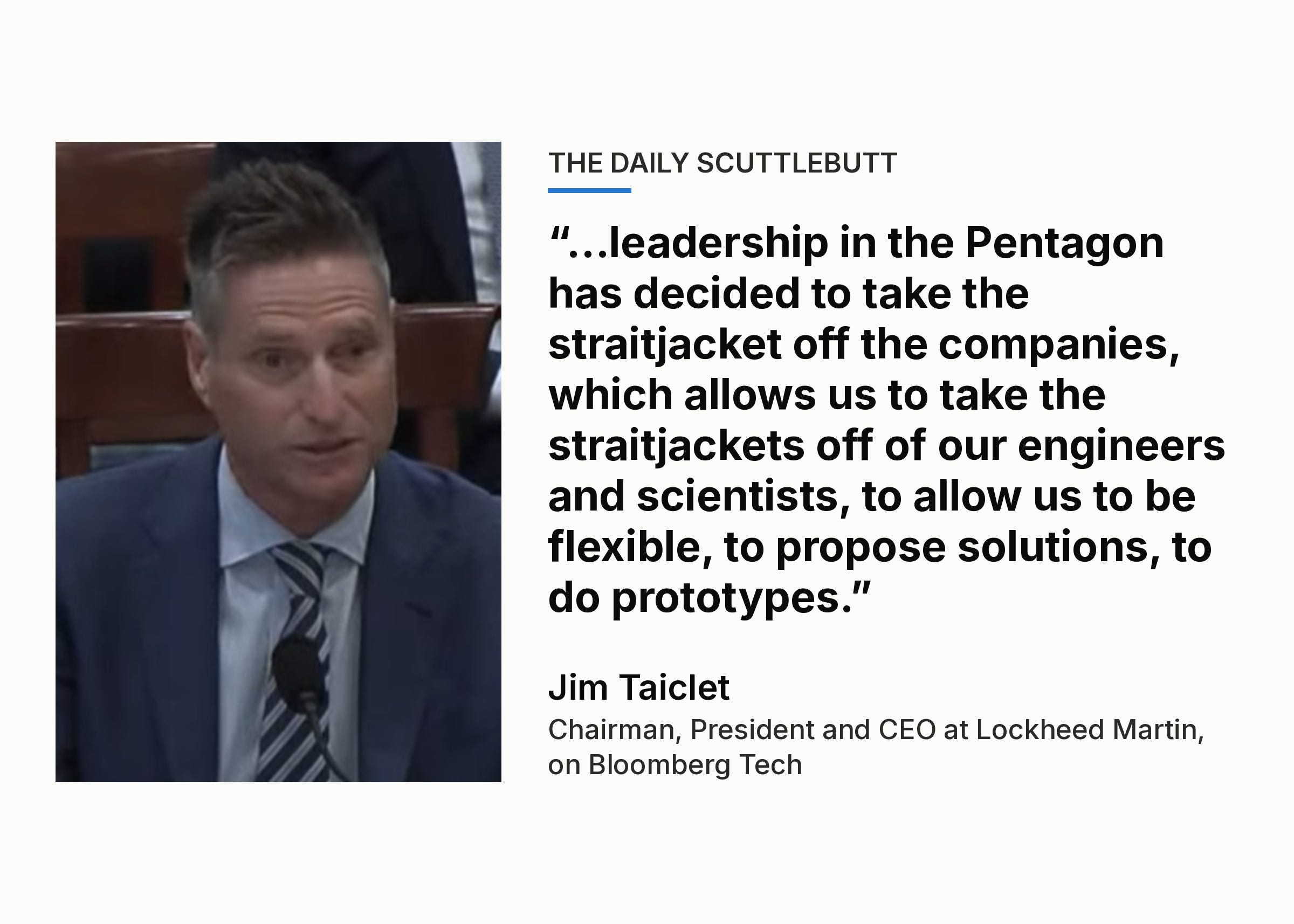
"It'd be down selected to one, usually the lowest-cost provider who was technically qualified would get the job. ... And then it would take years to actually create that capability. What is different now. ... leadership in the Pentagon has decided to take the straitjacket off the companies, which allows us to take the straitjackets off of our engineers and scientists, to allow us to be flexible, to propose solutions, to do prototypes." — Jim Taiclet, Chairman, President and CEO at Lockheed Martin, on Bloomberg Tech (Read summary)
A single F-35 can control up to 8 uncrewed Vectis aircraft, Lockheed says
"And programs like the F-35, a lot of people don't realize, there's 1,350 F-35s out in the world already today. ... That fleet is growing at about 160 a year. When we add the capabilities like Vectis, we've shown that Vectis can be controlled by a single F-35, as many as eight." — OJ Sanchez, President of Lockheed Martin Aeronautics, on Bloomberg Tech (Read summary)
Lockheed runs 55 large language models rather than betting on a single AI lab
"So we have chosen to be agnostic when it comes to Frontier Labs. That's an intentional part of our strategy. We see it a little bit like a horse race. So we're unclear which model will play out in the long term. And there are pros and cons to each. Fun fact, we have 55 different large language models that we're using to run Lockheed Martin." — Sarah Heiser, SVP of Technology and Strategic Innovation at Lockheed Martin, on Bloomberg Tech (Read summary)
Divergent says it can take an airframe from design to flight in under 3 months
"We can go from engineering inputs to flight ready vehicle in under three months. We can have a critical design in less than that, say two or three weeks. ... And we've shown now with primes in the loop that we can go from start to full rate production in under a year. That's much, much faster than programs that were taking five plus years to get to market." — Lucas Singer, CEO at Divergent, on Bloomberg Tech (Read summary)
Airlines are passing fuel costs to fliers rather than hedging, an ex-Qatar Airways treasurer says
"If you're like the rest of the world's airlines, right? So anywhere from 25, 30% of your cost is jet fuel. ... I think they're very wary of the consumption hedging, and they're mainly passing it through to the customer right now because they don't know what to do. ... At the end of the day, it's a pass-through to the customer. So you use your ticket as your weapon of choice." — David Kang, Former Group Treasurer at Qatar Airways, on Odd Lots
Materials & Energy
Rare-earth magnets for national-security uses can no longer be bought from China, MP Materials' CEO says
"We're really seeing a bifurcated industry globally. As it stands today, if it's a dual use technology, which means if there's a national security implication, you just can't buy rare earth magnets out of China. And so this is a highly strategic industry. And so from a competitive standpoint, it's two different worlds." — Jim Litinsky, Co-founder and CEO at MP Materials, on Wall Street Week
An EV uses about 200 magnets against about 50 in a gas car, GM's supply chief says
"In a combustion engine, we use about 50 different magnets across the vehicle. In an electric vehicle, we use about 200 magnets. ... We made these commitments back in 2021. It should have taken eight years if you think about extraction, processing, building a facility for magnets, validating the vehicle level. We're here five years later because of the pacing capabilities that MP Material has brought to the table and the collaboration and working together." — Shilpan Amin, Chief Supply Officer at GM, on Wall Street Week
Russia has gone from exporting 3M barrels a day of fuel to importing 1M, SocGen says
"Crude is managing to get through and that's fine. But if you can't refine it, that's a problem. Of course, Russia's refineries have been hit by Ukrainian drones. They used to export three million barrels a day. Now they're importing one million barrels a day. So that takes it out of the product balances. ... So, in my opinion, I think crude is going to have less of an issue than product, and we can expect product prices to continue to climb after, say, a month of the SPR release in Europe, if that was to go ahead." — Michael Haigh, Global Head of Commodities Research at Societe Generale, on Bloomberg Surveillance
Policy
America.gov can plug into agency systems that outside companies cannot reach, Gebbia says
"So the interesting thing is that because we're in the government, our LLM is only official government sources, which means that we only return information that's published from the government. We don't scrape the Internet. ... A lot of these agencies have APIs that we can connect to that, outside third parties are never going have access to. So we have this advantage right now where we can just connect directly to those, and if they don't exist, we now have an executive order to help create APIs that we need in order to do things like that improve the experience for everyday Americans. ... We looked at the flow of the replacement of our Social Security card. It's 87 clicks to replace that piece of paper." — Joe Gebbia, Chief Design Officer of the United States and Airbnb co-founder, on TBPN (Read summary)
Cutting more than 300,000 federal jobs saves about $500B over 10 years, Hassett says
"The interest payment on debt is a very unacceptably high share of government spending right now. ... Because we've reduced federal employment by more than 300,000 workers ... That saves us about half a trillion dollars over 10 years." — Kevin Hassett, Director of the National Economic Council, on Bloomberg Talks
Other
Small private colleges in the Northeast and Midwest face the worst of the enrollment drop
"And one way they do is, you can try to discount the price to bring in more people. That's a dangerous game because colleges have very high fixed costs. You have to pay for the building, whether it's full or half full. And so what you find is that colleges that have fewer students actually makes it harder to pay the bills in many cases. ... So unfortunately, I think you'll see that trend continue again, especially in small private colleges in the Northeast and the Midwest." — David Deming, Dean of Harvard College, on Wall Street Week
If this was worth your time, send it to someone who has to follow all of this too.
What did you think of today’s edition? Hit ‘reply’ to this email, send us a message, leave a comment, or join the chat!
Get the latest market chatter as it happens: