

How I Invest Podcast · Nov 27, 2026 · 46m · 36m saved
With David Booth, Founder and Chairman of Dimensional Fund Advisors
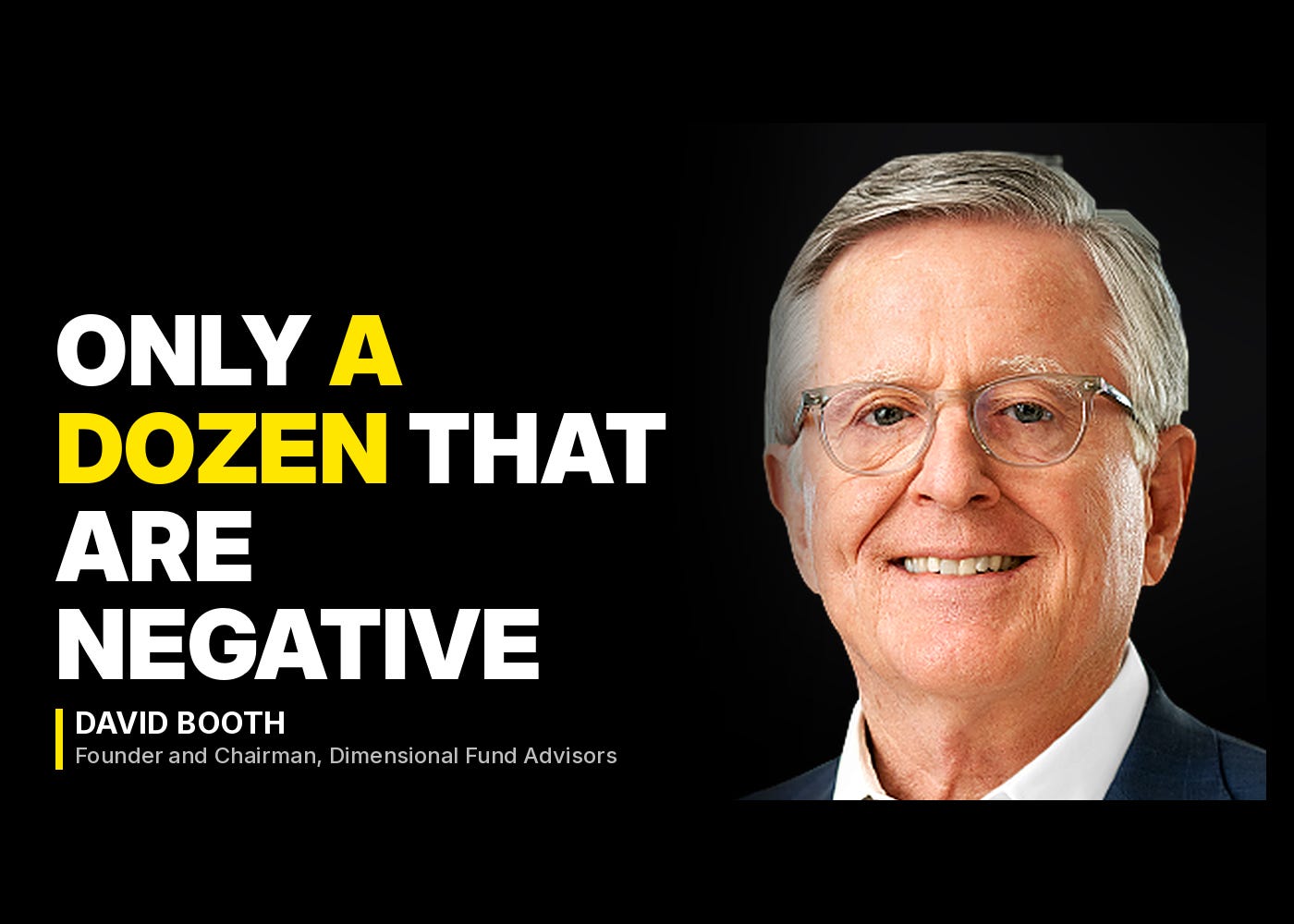
Photo via dimensional.com
Dimensional Fund Advisors now manages more than $1 trillion on an idea David Booth picked up as a PhD student at the University of Chicago in the late 1960s. David Booth, Founder and Chairman of Dimensional, told David Weisburd on the How I Invest Podcast that the idea was Eugene Fama's: in a liquid, well-informed market, professional stock-pickers cannot reliably beat the price.
Most of the money-management industry is paid to try. David Booth built a trillion-dollar firm on the claim that the trying is the problem, and that an investor's real enemy is the urge to outguess the market after a fall.
"Everybody can buy the market inexpensively... you can buy a very low cost market portfolio... It's the ultimate in the democratization of investing." — David Booth
He turns 80 next month and still goes into the office every day. He worked alongside Fischer Black and Myron Scholes early on, and five of the academics Dimensional has worked with went on to win Nobel Prizes.
The full interview is covered here so you can skip it. 46 minutes of audio, 10 minutes of reading.
Here are the 11 principles that matter.
Key Takeaways
Only a dozen of 96 five-year periods in a century of US stocks were negative, and each was followed by at least a 10% return
The US market has returned about 10% a year through depressions, wars, inflation and a pandemic
Dimensional's first years were brutal: 2% a year against the S&P 500's 14%
Dimensional's edge is trading, not stock-picking, by being the patient buyer for anxious sellers
Smaller and cheaper stocks earn more because their higher cost of capital is the investor's return
Commissioned brokers are paid to make clients trade, so Dimensional trained advisors instead
David Booth's advice on AI stocks is to buy all of them, not bet on one winner
1. Kansas to Fama's Classroom
David Booth grew up in Lawrence, Kansas, with parents who never owned stocks and thought the market was rigged for "insiders." He calls himself a slow starter. A finance professor at the University of Kansas steered him to Chicago for a PhD, where he studied under Fama just as research-quality market data turned finance from opinion into a science.
David Booth learned at Chicago that professionals should not be able to beat a competitive market
"In competitive markets like the US stock market, prices settle at fair levels that are fair prices, and professional money managers shouldn't be able to beat the market." — David Booth
Sophisticated institutions trading mostly on public information should produce fair prices, he argues, and insider-trading law reinforces what he calls a "fair game."
