

a16z · Oct 20, 2026 · 56m · 48m saved
With Karan Singhal, who leads Health AI Research at OpenAI
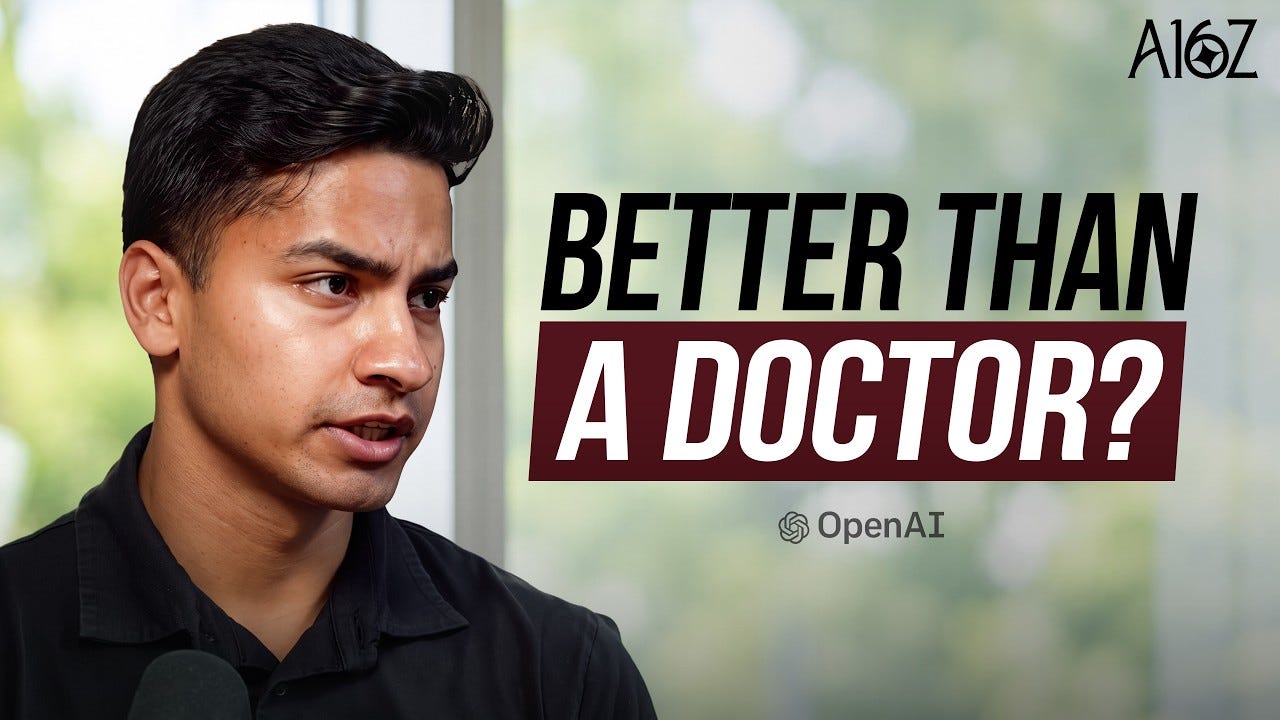
More than 300 million people ask ChatGPT a health or wellness question every week, and most of them are free users outside the US.
The obvious move for a company chasing that scale would be a smaller, cheaper model built just for medicine. OpenAI rejected it: every frontier model it ships now carries specialized health data through every phase of training instead.
"Open[AI]'s mission is to ensure AGI benefits all of humanity, and give people access to trustworthy, abundant, reliable health intelligence."
Karan Singhal, who previously built standalone medical models in an earlier role before joining OpenAI, where he now leads Health AI Research, told Jay Rughani, an a16z partner covering healthcare and biotech, why he thinks that earlier approach was the wrong one.
The full interview is covered here so you can skip it. 56 minutes of audio, 8 minutes of reading.
Here are the 7 insights that matter.
Key Takeaways
OpenAI didn't fork a separate medical model — it folds specialized health data into every phase of training its general frontier models
More than 300 million people use ChatGPT weekly for health questions, most of them free users outside the US
GPT-6 Luna beat OpenAI's prior best model on a health benchmark while costing 34 times less
Karan says cheaper models alone haven't yet dented the US's $5.3 trillion health-spending problem
OpenAI built a global network of physicians across specialties and countries, because five doctors asked the same question give eight different answers
OpenAI calls itself the "front door" to health, not the last mile of care, handing that off to partners like Epic, UCSF and AdventHealth
A Penda Health clinician-copilot study caught missed drug interactions and clinicians' own overuse of antibiotics
Karan's bigger ambition is medicine's own "Move 37," but he says the real bottleneck is getting known science into practice, which takes 5 to 17 years today
1. One Model, Not a Fork
Karan said he tried the specialized-model path earlier in his career, and watched it lose to the pace of the general frontier. OpenAI's bet is the opposite: keep health inside the same models everyone else uses.
Every frontier model OpenAI ships carries specialized health data through every phase of training
"What we do for ChatGPT and all the models that we ship... across every stage of model training... we actually have specialized healthcare data added to each phase of training." — Karan Singhal
A standalone medical model would fall behind a frontier moving this fast
"If you kind of forked and said, 'Hey, we're going to train a smaller specialized model that is just for healthcare'... that model would just fall behind the frontier relatively quickly, because the pace of the frontier... is so fast." — Karan Singhal
