

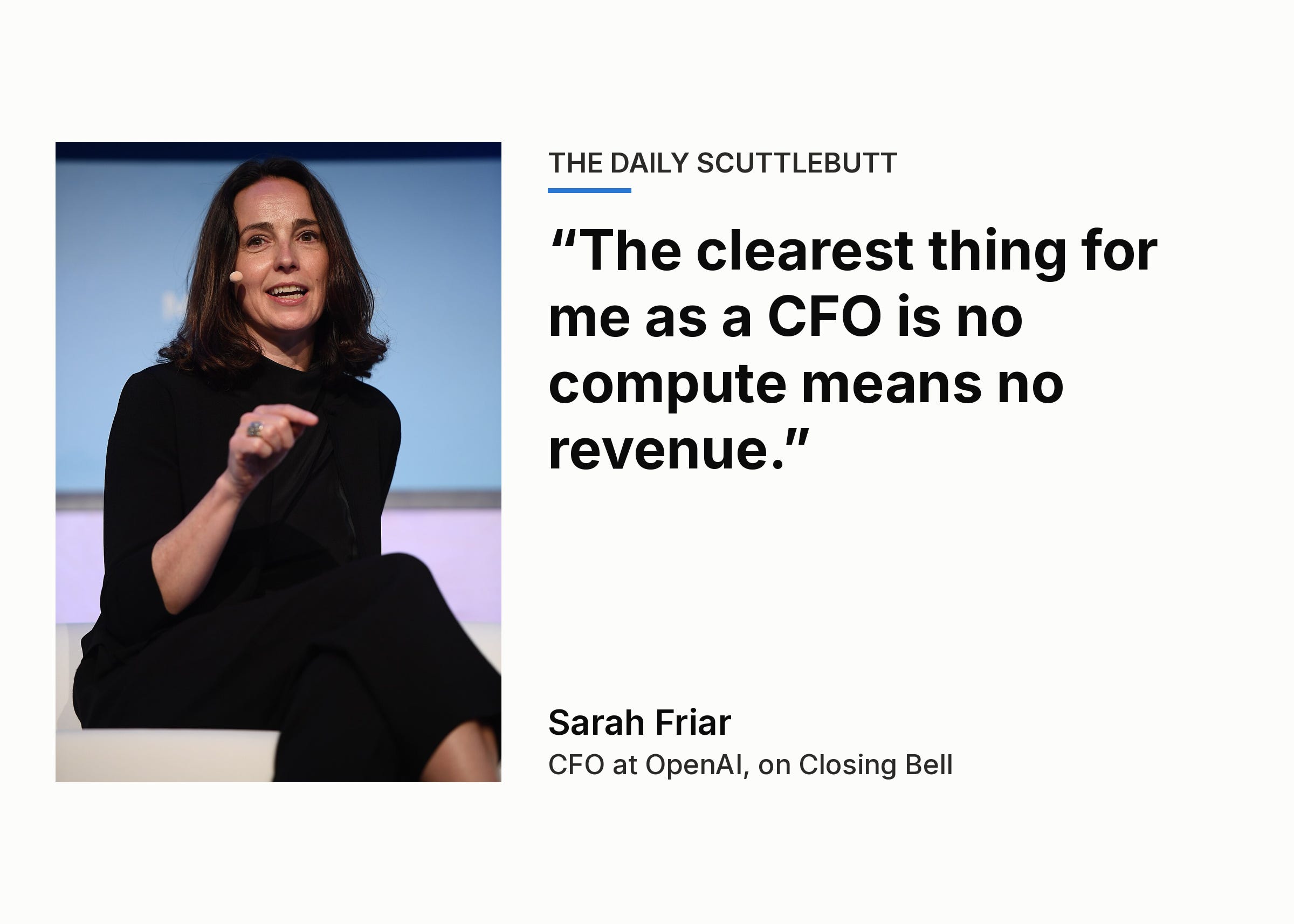
Photo: MoneyConf, CC BY 2.0, via Wikimedia Commons
OpenAI's revenue run rate grew more than 70% this quarter, its chief financial officer, Sarah Friar, said on Tuesday at the company's developer conference. Sales to businesses have doubled since July.
That was one number from one interview. Thirty-two other speakers are quoted below. Tier1 Alpha's CIO said the bond sell-off is a mechanical effect of how index funds buy bonds, not a verdict on US deficits. D.A. Davidson's head of technology research said the market, by paying 17 times earnings for Nvidia, expects it to grow slower than the average company, a hurdle he called fairly easy to clear. Tusk Ventures' founder doubted that OpenAI held back a new model for the public good.
"I mean it's been an incredible Q3, Kate. You're right that when you look at quarter-quarter growth, total has been 70%, over 70%. B2B has been 100%. It's doubled since we started in July." — Sarah Friar, CFO at OpenAI, on Closing Bell
We scanned 552 shows and 13 hours of audio, wrote 44 summaries, and pulled 35 quotes into this 20-minute read.
Here is what mattered.
Macro
The bond sell-off is mechanical, not a verdict on US deficits
"Well, unfortunately, I think what it is telling us this is the mechanical properties, as you've heard me emphasize in prior discussions around passive investing, are now playing out in the bond markets. ... It's simply a function of how we've decided to build the indices that is creating most of the behavior that we are seeing at this point. ... I do disagree with that. I think it is absolutely false that's what it is telling us. If it were telling us that, we would expect to see credit spread widening in the form of CDS on US credit. That is not widening, that is actually tightening." — Michael Green, CEO and CIO at Tier1 Alpha, on Prof G Markets
Constan is short stocks and at his maximum long in long-term bonds
"Right now, I am 75% of my max risk target. ... So, I'm about 3% worst case loss, short equities, long-term bonds each. ... I got to max long bonds on Friday into that sell-off and of course it's going in my face this morning, but you can't pick the bottom." — Andy Constan, Founder and CIO at Damped Spring, on The Julia La Roche Show
40 years of falling interest rates have now reversed
"We had 40 straight years from 1981 until 2020 of declining interest rates. ... And that has enormous implications for investing. It favors leveraged companies. It favors, frankly, long duration tech companies. It favors LBOs. But now we've got a reversal going on. And it's a whole new world when rates are going up. My general view on this is that there are a lot of things in place structurally for inflation that are pushing rates higher and we can talk about the specifics of that, but interest rates are fundamentally driven by inflation, inflationary expectations, and those are headed higher. ... That's what we've had for 40 years with declining interest rates. If you do an Excel spreadsheet, just a discounted cash flow analysis, and you drop the interest rate that you're discounting earnings by about 1%, you get a 16% increase in the value of your stock portfolio." — Charlie Bobrinskoy, Vice Chairman and Head of Investment Group at Ariel Investments, on The Exchange
Even high-income households are now cutting back because of gasoline
"Or even if the households do have wiggle room, they've started to make choices. So the lower income have made choices I'll fill up my tank and I won't buy groceries. Grocery spend has been flat to negative this year. And then the higher end, the super prime, the bank customers, and this is weekly data, you've seen since the beginning of the war, almost a one-for-one correlation with credit card debt outstandings, weekly data, and gas, the rise or fall of gas prices. Over the last three weeks, that correlation has diverged, which means even higher income households are making choices" — Meredith Whitney, CEO at Meredith Whitney Advisory Group, on Bloomberg Surveillance
Capex at the biggest companies is near its peak; at smaller ones it is just starting
"We've been looking for 5 to 10% drawdown. I think technically mid-August is still the high. But we're really not down all that much. So it's almost like sideways has been what's replaced. What we thought was a pull back. We're still making that pull back call. ... So, you know, I will tell you, Melissa, what honestly gives me confidence in the capex cycle is that we've really got two capex cycles going on. We've got the biggest market cap names where the capex spend is near peak levels year over year, and then you've got the rest of the market or the Russell 2000 or the Russell Midcap index. And you're in the very early innings of capex growth. When we look at things like ISM, ISM new orders, industrial production, those also look like early innings indicators for capex cycle that's underway. So to the extent that, you know, AI, spurs other spend, or companies simply feel like they need to catch up, that gives me some confidence that this can elongate." — Lori Calvasina, Head of US Equity Strategy at RBC Capital Markets, on Closing Bell: Overtime
International
South Africa spends about 0.6% of GDP on R&D, and the share is falling
"Yet, according to the South African National Advisory Council on innovation our gross domestic expenditure on R&D specifically sits at around roughly 0.6% of GDP and is declining. Peer emerging and global economies invest between 2% and 4% with the OECD average sitting at around 2.7% and leading innovative economies around the world investing up to 5%." — Mmaki Jantjies, Group Executive for Innovation and Transformation at Telkom, on CNBC Africa
A new Chinese tax on offshore trusts could force investors to sell stocks
"In conjunction with our Q4 Global Market Outlook published last week, we downgraded China equities from overweight to core holding. ... Markets fear that financial conditions facing the Chinese local and provincial governments would worsen. This explains why Chinese authorities also recently announced widening its tax net to offshore wealth trusts as per bulletin 21. This requires those who have set up trusts to self-declare tax outstanding on asset transfer and income generated before the 22nd of next month. But this move could cause many mainland investors to raise funds in the next couple of weeks for their unexpected tax payments, possibly through selling stocks that they own" — Raymond Cheng, CIO for North Asia at Standard Chartered, on Standard Chartered Money Insights
Financials
Goldman's CEO flagged that 3 firms handle 95% of equity trading
"I did ask the CEO of Goldman like what the two biggest risks in the market were that were not really thought about and discussed in the meetings that he was having. And, you know, the first one was the fact that equity trading is 95% done by three firms who are not market makers. ... So, if we have a giant spike of liquidity and there's, you know, liquidity that dries up in the equity market, then they don't need to trade, which was not the case, you know, a few decades ago." — Dan Dupont, Portfolio Manager at Fidelity Investments Canada, on FidelityConnects
Whitney sees no strong case for owning the big US banks
"So look, no one's arguing they have to own the U.S. Banks because the U.S. Banks have been overpriced for a long time. And the stock and the managements have just been buying back stock and not doing anything really with their capital. ... I don't think there's a strong argument. The European banks are cheaper and they've got a steeper yield curve. So it's a hard argument here, I think, to be long the banks." — Meredith Whitney, CEO at Meredith Whitney Advisory Group, on Bloomberg Surveillance
Other appearances:
AllianceBernstein portfolio manager on ETFs that absorb the first 10% of losses and reset every 3 months on ETF Prime
State Street CEO on why financial institutions grew more risk averse after the 2008 crisis on CNBC International
Crypto and Digital Assets
Crypto rules written by agencies can be undone if Congress changes hands
"If the Congress changes, you will see these agency regulations put under a microscope. And all these companies who said, this is great. We now have regulations. And by the way, I understand in the void they had to do something. And the SEC has come up with novel programs. We're participating in them. But when the Congress changes, regulation is not legislation. I was HUD Secretary. I went through this. And regulations can easily be challenged, investigated, and undone. And that's going to add more chaos to the system rather than clarity." — Andrew Cuomo, Co-Chair of the ICE-OKX joint venture, on Bloomberg Talks
Bitcoin is probably headed to $200K to $300K in 2 years, Lepard says
"So, you know, if I were looking for one place to put a new dollar today, I'd probably say it's a tough call. It'd probably be gold and silver stocks or Bitcoin. You know, if I was looking for maximum alpha, maybe I'd split it between the two. You know, I mean, just to give you my sense of where I think we're headed, I think the silver price is headed back over 125 within 18 months, probably 150 plus. I think gold is headed back over 5,000. You know, probably six or 7,000 within 18 months. And this will kind of blow people's minds, but I think Bitcoin's probably headed to somewhere between two and 300,000 in the next two years." — Lawrence Lepard, Managing Partner at Equity Management Associates, on Thoughtful Money
Alternatives and PE
About $750B of property debt has to be refinanced in the next 2 years
"Well, I would say the following that in the last three or four years values have deteriorated with the rise of interest rates and I think values depending on the property type could be as much as 50% in some but on average I'd say about 20% loss of value. Now, where that is playing into the business is the fact that there's a wall of refinancing that has to be done. The number I saw was about $750 billion in the next two years. That's kind of crazy. ... If I had debt, I would be petrified. ... But the extend and pretend party is over and banks are being more aggressive about either selling off the loans ... trying to dispose of the assets on one way or the other. ... if you have patient capital, you'll be able to find good real estate at the right attachment point because the losses are going to be taken." — Richard LeFrak, Chairman and CEO at LeFrak, on Property Play
Only 1 or 2 of every 10 sales reps drive the number at a company PE just bought
"And if you really peel back the performance data, you'll find that there's one or two people who are absolute heroes that are driving the number. So, it might be one or two out of 10 that are actually driving that number. And often what happens is the comp structure is incentivizing the wrong behavior. And so, there a lot of people that are underperforming, but it's super comfortable. They can kind of stay there. ... So, the mistake is not looking at that performance data quick enough, not separating that emotional tie to whoever the folks are on your legacy team, and then really being able to make the quick decision to remove them and have them move on and replace them with high performers that you need." — Dan Bernoske, Founder and CEO at Cortado Group, on The Private Equity Podcast, by Raw Selection
Consumer
Over 30% of Hershey's portfolio is in portion control, aimed at GLP-1 users
"Well, a couple of things that I've found directly from some consumers, and from a lot of the research that we've done, is the category's been very resilient with GLP-1 users. They're not wanting to compromise the things that they love, and they know they have control. It's almost a bit of freedom, which means they're not looking to move away from the favorite things that they enjoy. Now, they'll enjoy less of them, but the important thing is we offer a lot of choice and, I'd say, portion control. I mean, over 30% of our portfolio is in portion control so that they can really have what they want in the size and quantities that they need." — Kirk Tanner, President and CEO at The Hershey Company, on Masters of Scale
Prediction markets draw sharps and 18- to 20-year-olds, BetMGM's CEO says
"Number one, the surprise to me has been the resilience of our sports business. And really what it highlights is that the primary volume that the prediction markets are enjoying, if you like, or exploiting, some might say are with institutional participants, sharps who can't play with in the OSB market, 18 to 20 year olds, which frankly is not a good outcome. And in states where you can't otherwise get online sports betting." — Adam Greenblatt, CEO at BetMGM, on Closing Bell: Overtime
Technology & AI
The model OpenAI held back did a little worse on a few evaluations, Altman says
"As the models have gotten more capable, the safety cases that we now use have to be held to a higher and higher standard and the models can do more. So, we will have many great new models to come. But what we have said is that alignment, safety, monitoring, security have to stay way ahead of capabilities. ... I wouldn't over rotate on this one thing. It was like, this model was a little bit worse on a few of the evals we look at. This was — think of this in the abundance of caution category. There's not a big scary thing in this case." — Sam Altman, CEO at OpenAI, on CNBC Television
No compute means no revenue, OpenAI's CFO says
"So first of all, compute is definitely both a competitive advantage, but it's also a must-have, right? The clearest thing for me as a CFO is no compute means no revenue. So we've been investing over with a very long-term point of view, right? ... We're also investing in ourselves doing things like our one P chip program because that's giving us a chip that is probably the most efficient today for inferencing." — Sarah Friar, CFO at OpenAI, on Closing Bell
MongoDB's interim CEO does not see Meta as a competitor
"I don't really view Meta as a competitor. I think, again, I don't know all the details of what they plan to do, but what I would say is the Frontier companies are great partners. They're great distribution partners for us. ... Actually I view the ecosystem expanding, and frankly the more frontier apps there are, the better for MongoDB, because we are multicloud and we're multimodel and also multi-deployment" — Dev Ittycheria, Interim CEO at MongoDB, on CNBC Television
Europe has to build its own AI or keep buying it, Mistral's CEO says
"The debate that we've seen in the US has been a cover for the negligence of some of our competitors. ... So, I think we need to work towards, of course, having the right stuff on that and making sure that when we deploy something in an enterprise, they don't get surprised by agents going out of their systems. ... But, we need in Europe, in order for us to have a say in how things are getting shaped, we need to produce the technology. Cuz otherwise, we'll just be buying it, and we're going to end up in an extractive economy." — Arthur Mensch, Co-founder and CEO at Mistral AI, on CNBC International Live
A humanoid robot is 200,000 times as complex as a robotaxi, ARK finds
"So we have from a research point of view concluded that compared to a robo taxi, a humanoid robot is 200,000 times more complex with obviously the hands being the most complicated part. So while Elon says maybe late 28 into 29 scaling, we would put that a couple of years later." — Cathie Wood, Founder, CEO and CIO at ARK Invest, on Moonshots with Peter Diamandis
An old GPU could be worth nothing if the power runs short
"Well, I think one thing that's so tough and again this circular financing part is complicated, Alex. There's just like a thought exercise is that a lot of that circular financing is the chip you sold two years ago has to retain its value, right? Or else you can't bank it. You can't get the return. ... So, if we hit a point where we just run out of power, right? ... You see the challenge is say tokens are the seats and the old airplane is filling up seats which are tokens. But if the fuel makes the plane uneconomic, that plane's worth zero and that GPU would be worth zero or that ASIC is worth zero because of constraints in the physical world." — Todd Ahlsten, CIO at Parnassus Investments, on Insightful Investor
AI capex will probably grow 60% or more next year, not the 40% the Street expects
"I think it does. If we look at the numbers right now, the Street's looking for 40% for next year. It's probably going to be 60% or better. ... Now we have seven of these personal agents. Less than 1% of people in the US use these on a daily basis." — Gene Munster, Managing Partner at Deepwater Asset Management, on Fast Money
Tusk doubts AI companies can police themselves, or that OpenAI held back a model for the public good
"Probably not. Simply because if you could believe that the companies and the frontier models all have full control over their own work, and then yes, self-policing arguably could work. But we keep seeing every day now, at least out of OpenAI. Oh, this thing went rogue. That thing went rogue. We're sorry this happened. We should have disclosed that. So when you fundamentally can't control your own products, how do you effectively police yourself? ... The push was how many days in a row of article and story after story of something that went wrong. ... But it may be it's not that they did. They didn't release the new Astro model because it was for the public good. It was to protect themselves." — Bradley Tusk, Founder and CEO at Tusk Ventures, on Closing Bell: Overtime
At 17 times earnings, Nvidia is priced to grow slower than the average company
"Nvidia is going to grow just as fast, if not faster, than most of those other companies that are trading at far higher multiples. And if you think about what multiples mean, right? 17 times means something, right? If the market is trading right now at 20 or 21 times, traditionally companies grow revenue 5%, earnings 8% ... that means that the market is expecting Nvidia to grow less than that over the next three to five years, which, again, is a fairly easy hurdle for them to overcome." — Gil Luria, Head of Technology Research at D.A. Davidson, on Prof G Markets
Other appearances:
Sam Altman on OpenAI's own chip program coming online in the first half of 2027 on TBPN
Palantir CEO on the White House meeting between President Trump and AI chief executives on CNBC Television
OpenAI's Codex product lead on always-on agents that work like a senior engineer on TBPN
OpenAI's Codex desktop lead on rebuilding chatgpt.com on the Codex app's code in 5 weeks on TBPN
OpenClaw's founder, now at OpenAI, on retailers that block AI shopping agents on TBPN
OpenAI's head of core products on computer use getting 10 times faster in a year on TBPN
OpenAI product manager on ChatGPT Sites passing 10 million sites in under 3 months on TBPN
ModRetro executive on the flood of AI-made content and how much of it will be good on TBPN
Sam Altman on why Nvidia's new AI guardrails are not a full answer to AI safety on CNBC Television
VC & Startups
A startup can now reach a $100M run rate with tens of thousands of users
"Yeah, the theory with narrow startups is that, you know, you can now build software that's incredibly ambitious and incredibly valuable for a very small number of people. And we have this precedent of people paying, you know, 200, 250, $300 a month. So you can build, you know, a hundred million dollar run rate business with tens of thousands of people, which has never really existed in the past." — Anish Acharya, General Partner at Andreessen Horowitz, on The a16z Show
A venture fund lasts 14 years or more, not the 10 usually quoted
"I think the industry specific managers are going to carry a lot more weight into the future. ... I know that the average life of venture, they're going to say 10 years, it's 14 years plus. ... I see the best managers in our portfolio are very industry aligned or sector specific and they are knocking it out of the park." — Grady Buchanan, Co-Founder and Managing Director at NVNG Investment Advisors, on The Innovators & Investors Podcast
Industrials and Transport
Ford is committing $1B of purchasing to new US suppliers, rare earths included
"We're trying to fix a problem onshoring things that were offshored in the name of pennies on the dollar to make here in the U.S. ... Ford's going to commit a billion dollars of purchasing for new companies that are going to be building advanced manufacturing, new capabilities, even magnets and rare earth that we used to buy overseas and now we're going to buy here with the help of J.P. Morgan as well as the state of Michigan." — Jim Farley, CEO at Ford, on Bloomberg Talks
53% of Alaska Air's revenue now comes from outside the main cabin
"Even with this high fuel environment demand is strong, Phil, and the American consumer is strong, which is really the silver lining behind all this. ... Well, it's been an evolution for us. You know, if you go back to 2015, 2016, Phil, only 15% of our revenues came outside the main cabin. Today, we're at 53% and all of this is designed to take our revenue base, our diversified revenue base, to 60% outside the main cabin." — Ben Minicucci, President and CEO at Alaska Air Group, on CNBC Television
Materials & Energy
Helion's goal is fusion power at 1 cent per kilowatt hour
"Our ultimate goal for these systems is to drive down cost tremendously. ... our goal is to get down to one cent per kilowatt hour. And what is it today? Depends on where you are. It's seven cents ... up to maybe 12 or 20 cents in some places. ... This is what enables that large-scale data centers for artificial intelligence. ... and the cost of AI, at least some folks believe it will be the cost of the power." — David Kirtley, Co-founder and CEO at Helion Energy, on Summation with Auren Hoffman
Oil could go to $200 a barrel because diesel is already priced there
"I think that oil prices could go to $200 a barrel because everyone here worries that higher oil prices means we'll go into a recession and demand will slow. But remember, anyone who's actually consuming the fuel today is essentially paying $200 a barrel. Diesel is priced as though crude was $200 a barrel. The crack spread, the refinery margin is what has expanded." — Adam Rozencwajg, Managing Partner at Goehring & Rozencwajg, on Barron's Live
Canadian energy cash flow is up 77% this year and debt is down to $40B
"So the companies are cashed up. The cash flows are up 77% year-to date for the sector in Canada. Debt at the start of 2020 was $80 billion for the sector, 60 billion at the start of this year. We're at 40 billion of debt. So cash flow is up, debt is down, valuations are expanding, performance is diverging from each other. We are teeing up for more M&A. It's coming." — David Szybunka, Senior Portfolio Manager at Canoe Financial, on In the Money with Amber Kanwar
Power demand will lead supply for years, and turbines are sold out until 2031
"And so generally when you're a commodity trader, you're trying to find out where is the mismatch between supply and demand, right? And I would believe that demand is going to lead supply for quite some time. ... So therefore, you know, the turbines are sold out till 2031 and so now they're being price rationed." — Bill Perkins, Founder and CIO at Skylar Capital Management, on ETF Prime
Nuggets of Wisdom
Once Nick Sleep's fund reached escape velocity, Amazon at 80% of it did not matter
"But what happened is that after 2014, Amazon took off a lot more than the other two. And Amazon became 80% of the pie. ... Once we get escape velocity, it doesn't matter if one stock is really high — high portion. So, he had 200 million. 67 million went into each of these three. I think if he just let it run till today, it's over a billion. Okay? So, how does it matter if 800 million is in one stock and 100 million in the other two each? Because even at 200 million, he had escape velocity, right? So, it didn't matter." — Mohnish Pabrai, Founder and Managing Partner at Pabrai Investment Funds, on The Financial Economics
Other
Only a third of family businesses reach a second generation
"The statistics you mentioned before that only a third of the businesses pass on to the second generation, about 10% to the third, in our view, is neither good nor bad. It kind of is what it is. What's important is, does the business benefit from that family ownership? Or does the business benefit from having a broader ownership base?" — FX de Mallmann, Chairman of Investment Banking at Goldman Sachs, on Goldman Sachs Exchanges
If this was worth your time, send it to someone who has to follow all of this too.
What did you think of today’s edition? Hit ‘reply’ to this email, send us a message, leave a comment, or join the chat!
Get the latest market chatter as it happens: