

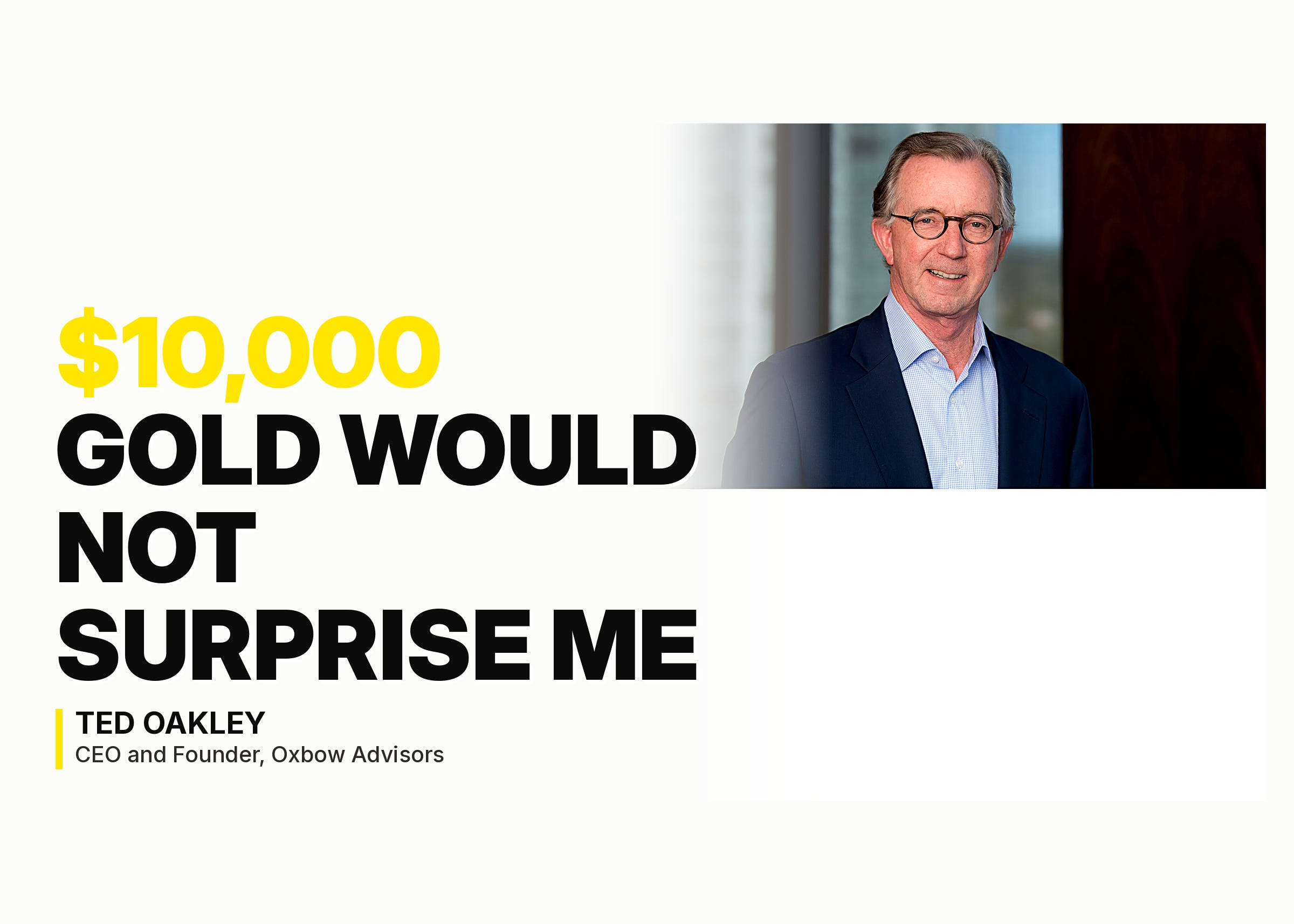
Ted Oakley, CEO and Founder at Oxbow Advisors, says gold at $10,000 would not surprise him, because central banks are still rebuilding reserves they spent decades cutting.
That was one of 16 episodes in this issue. The others ranged from Kurt MacAlpine, who took a $525 billion wealth manager private rather than wait nine years to buy out its remaining public shareholders, to Helen Miller on the UK's shrinking fiscal headroom, and Harrison Chase on a $40,000 coding-agent mistake.
"If somebody told me gold was going to be 6,000 or 8,000 or 10,000, it would not surprise me. I'm not saying it's a prediction. I'm just saying that if you look at these countries overseas, they don't want to own the treasuries anymore." — Ted Oakley, CEO and Founder at Oxbow Advisors, on VRIC Media (Read summary)
We scanned 757 shows and 10 hours of audio, wrote 11 summaries, and pulled 40 quotes into this 15-minute read.
Here is what mattered.
Macro
The S&P 500's real diversification is far narrower than its 500 names suggest
Ted Oakley said the market's gains are concentrated in a narrow group of companies in one industry. Paisley Nardini put a number on the same point.
"I think our main theme right now would be the fact that you've got a high concentration, maybe 20 or 30 companies, that are really running the market or pushing the indexes, and they're all in one industry — that's the problem." — Ted Oakley, CEO and Founder at Oxbow Advisors, on VRIC Media (Read summary)
"I don't think the S&P 500 is diversified... the effective number of stocks in the S&P 500 is really only 50." — Paisley Nardini, Strategist at Tema ETFs, on Excess Returns (Read summary)
5% interest rates are normal, not the anomaly, Bianco says
Jim Bianco turned bullish on bonds this month after six years bearish, arguing the right level for yields is roughly nominal GDP growth.
"5% is normal... Zero 10 years ago was the wrong rate. And we got to get off of thinking that somehow that was a normal thing." — Jim Bianco, President at Bianco Research, on Monetary Matters with Jack Farley (Read summary)
Inflation is structurally stuck near 3%, not heading back to 2%, Bianco says
He traces the floor to the end of a one-time disinflation dividend from Chinese goods entering the US market.
"We're not going back to goods deflation. And if we're not going back to goods deflation, we cannot disinflate back under, say, 3% on overall inflation." — Jim Bianco, President at Bianco Research, on Monetary Matters with Jack Farley (Read summary)
Bond yields rose because the economy is strong, not because investors are scared, Fidelity's Wolf says
David Wolf broke the 10-year yield's climb from about 4% to 5.25% into three pieces — a real-rate component, an inflation component and a risk-premium component — and says the entire move has come from the first one.
"In our judgment, it's been entirely the first piece of that that's been driving the increase in bond yields. It's because the economy is strong and investment is strong." — David Wolf, Portfolio Manager at Fidelity Investments Canada, on FidelityConnects (Read summary)
International
Yandex's shares fell just 11% after Ukraine knocked out half its data centers
Patrick Boyle said Ukrainian drones struck three of Yandex's six major data centers, the company known as Russia's Google. The market's reaction was muted.
"Yandex's shares fell about 11% over the course of the strikes, a modest reaction for a tech company that had just had half of its major data centers knocked out." — Patrick Boyle, Former Hedge-Fund Manager and Adjunct Professor, on Patrick Boyle On Finance (Read summary)
Fidelity spent a decade underweight Canada's "road to nowhere" — now it's the overweight
Wolf said Fidelity avoided Canadian stocks, bonds and the dollar for roughly ten years because growth there was built on consumer spending and housing rather than investment. That has changed.
"Up until about last year we were underweight [Canada]... the Canadian economy was kind of on a road to nowhere — all of the growth we were seeing was basically consumer spending, fueled by immigration and fueled even more by selling houses to one another." — David Wolf, Portfolio Manager at Fidelity Investments Canada, on FidelityConnects (Read summary)
Canada is the one bet in the portfolio that isn't correlated to AI, Fidelity's Tulk says
David Tulk splits Fidelity's equity exposure into an AI-correlated bucket and a ballast bucket that is not. Canada sits in the second.
"Canada for a number of different reasons has a really nice property in terms of not being correlated, or at least being a very small correlation, to the AI theme." — David Tulk, Portfolio Manager at Fidelity Investments Canada, on FidelityConnects (Read summary)
Financials
Corient runs one P&L and one comp plan, with no chargebacks between advisors
Kurt MacAlpine built Corient to fix what he calls wealth management's flawed structure, in which advisors are paid to hoard clients rather than share them.
"We have one compensation plan. We have no exceptions to the compensation plan... I run one P&L across the firm, and I don't do any form of chargebacks." — Kurt MacAlpine, Partner and CEO at Corient, on David Senra (Read summary)
MacAlpine called CI's shares "criminally undervalued" while buying them back at $12-13
CI Financial's stock, Corient's former public parent, swung from one of the best-performing financial stocks in North America in 2021 to one of the worst in 2022. MacAlpine kept buying.
"I felt like our shares were, in my opinion, criminally undervalued... if every single morning you wake up with somebody having to sell your shares for things outside of your control, that creates a tremendous buying opportunity." — Kurt MacAlpine, Partner and CEO at Corient, on David Senra (Read summary)
Mubadala told MacAlpine it would take nine years to buy out CI's public float
Mubadala Capital approached him about two years before the deal that took the firm private closed.
"I was approached about two years ago right now, actually, by Mubadala Capital... the message was, 'We think it's going to take you about nine years to effectively buy the shares remaining.'" — Kurt MacAlpine, Partner and CEO at Corient, on David Senra (Read summary)
Alternatives and PE
Tema's private-market ETFs carry no extra financing or management fees, its strategist says
Nardini's funds hold pre-IPO stakes such as SpaceX and, she says, the first SPV exposure to Anthropic, packaged inside ordinary daily-liquid ETFs.
"There's no financing charges. There's no additional management fees behind the surface. That cost that you see is the single expense ratio." — Paisley Nardini, Strategist at Tema ETFs, on Excess Returns (Read summary)
Consumer
Athletic brands' mindshare has fallen for three straight years, Piper Sandler's Andreeva says
Anna Andreeva's team surveyed roughly 9,000 teens for Piper Sandler's 26th annual Teens Survey. Athletic wear's share of teen spending has been sliding since its post-pandemic peak.
"That mind share peaked at about 40% plus a couple of years ago, and since then it's been a consistent decline. The fall number's 29%, give or take, down about 300 basis points from last year." — Anna Andreeva, Analyst at Piper Sandler, on What's Next For Markets
Piper Sandler avoids Nike even as it stays teens' top athletic brand, Andreeva says
Nike has topped the survey for five years running on sheer size alone.
"This is five surveys in a row that Nike stays as the number one brand just because of the sheer size of it, but the mind share keeps slipping... it's the most expensive stock in our coverage when sales are not yet back to growth." — Anna Andreeva, Analyst at Piper Sandler, on What's Next For Markets
Piper Sandler upgraded VF Corp this week with a $20 price target, tied to the survey
The call rests partly on Vans, which held flat among male teens this survey after three straight declines.
"We just upgraded VF Corp, which has Vans as one of the assets that hasn't fully turned around yet... we have a $20 price target this week in conjunction with the survey." — Anna Andreeva, Analyst at Piper Sandler, on What's Next For Markets
Aritzia generates about $1,000 of sales per square foot, against $400-700 at a typical mall tenant
Kyle Grieve, who has held Aritzia personally since 2020, pitched the stock to his co-host on its store economics.
"This has all led to some very, very compelling store economics where they're generating about $1,000 per square foot... Shopify arrived at a range of about $400 to $700 per square foot for comparable mall tenants." — Kyle Grieve, Co-host at The Intrinsic Value Podcast, on The Intrinsic Value Podcast (Read summary)
A brand-only moat is exactly what let Abercrombie, J.Crew and Gap fall out of fashion, O'Malley warns
Shawn O'Malley's skepticism is informed by his own losing bet on Lululemon. Aritzia's only real edge, both hosts agree, is its brand.
"There's just an old folks' home full of brands that were once powerful that few people still talk about today — Abercrombie, J. Crew, Gap, American Apparel, Club Monaco." — Shawn O'Malley, Co-host at The Intrinsic Value Podcast, on The Intrinsic Value Podcast (Read summary)
Grieve's blended intrinsic value for Aritzia is $148, a 23% discount to today's price
That is his estimate after blending bull, bear and base-case scenarios with a margin of safety.
"When I factor all three of these scenarios and a 20% margin of safety, I get an intrinsic value of about $148, and this means the current share price actually offers a discount of about 23%." — Kyle Grieve, Co-host at The Intrinsic Value Podcast, on The Intrinsic Value Podcast (Read summary)
Only about one in 10 US singles under 30 use a dating app now, Equity Mates' Bryce says
The hosts were discussing Bumble's sale to Efficacy Holdings, a fraction of its 2021 peak value, when they turned to why the category has shrunk.
"Only about one in 10 US single people under 30s currently use a dating app. And that's because they're actually going offline into the real world." — Bryce, Co-host at Equity Mates Investing Podcast, on Equity Mates Investing Podcast
Eli Lilly's revenue grew 48% last quarter against 7% for Novo Nordisk, Equity Mates says
Both hosts hold Eli Lilly personally and stress-tested the position against their own buy/hold/sell framework.
"In the US it has about 61% market share, Novo has about 39%... Eli Lilly's revenue was up 48%, Novo's was up 7%." — Bryce, Co-host at Equity Mates Investing Podcast, on Equity Mates Investing Podcast
Other appearances:
Rask Founder on how a newborn's simple index portfolio could beat his own stock-picking on Equity Mates Investing Podcast
Technology & AI
LangChain spends about 30% of its engineering pay on coding tools, its CEO says
Harrison Chase said the share has started falling even as token usage keeps rising, after LangChain began tracking every engineer's usage and setting soft budget limits.
"I think we spend 30% of our engineering salary on coding tools. It's actually gone down the last 2 months. While tokens, the number of tokens that we've used has actually gone up." — Harrison Chase, Co-Founder and CEO at LangChain, on 20VC
One misconfigured plugin cost LangChain $40,000 in a week, Chase says
The plugin screenshotted a web page's underlying code on every turn of an agent's work and sent it back to the model, running an expensive loop nobody had caught.
"We spent 40k in a week on one thing" — Harrison Chase, Co-Founder and CEO at LangChain, on 20VC
The domain experts who write an agent's tests will capture its value, LangChain's CEO says
Chase said the tests that score whether an AI agent did its job well are hard to write without knowing the field, which favors agents built for one industry over general-purpose ones.
"If value is derived through verification, I think the people who win are the domain experts... I'm massively bullish on vertical agents for different domains for this reason." — Harrison Chase, Co-Founder and CEO at LangChain, on 20VC
Triple-C credit is "detention" for AI's problem children, not a contagion yet, Bianco says
Bianco frames the CCC-rated bond selloff, which includes CoreWeave, as a small, troubled cohort rather than a systemic warning, since single-B and double-B spreads are barely moving.
"Triple-C is... detention. It's all the problem children that have to stay after school because they've been bad." — Jim Bianco, President at Bianco Research, on Monetary Matters with Jack Farley (Read summary)
Hyperscalers have issued $450B of AI debt this year, after boasting fat free-cash-flow a year ago
Nardini said the shift from cash-rich balance sheets to heavy borrowing is the kind of leverage dynamic that has preceded past financial-crisis setups.
"A year ago, we were talking about how fat... the free cash flow balances were on these hyperscalers... Now we've shifted to negative free cash flow, AI financing. I think we've seen about $450 billion of issuance year to date through the end of the third quarter." — Paisley Nardini, Strategist at Tema ETFs, on Excess Returns (Read summary)
CoreWeave's bonds, issued four months ago, now trade at 78 cents on the dollar
The hosts tracked the selloff spreading from a pulled Firmus IPO to CoreWeave's own debt.
"Those bonds are now trading at 78 cents on the dollar... yields touched 15%. So, they're getting into junky territory." — Ren, Co-host at Equity Mates Investing Podcast, on Equity Mates Investing Podcast
Anthropic's revenue run rate fell from $80B to $76B between August and September
Ren read the reversal as customers balking at token costs and trimming usage.
"In April, they were at an annualized run rate of 30 billion. By August... it was 80 billion... but as of September, it's actually gone backwards. The annualized revenue run rate was down to 76 billion." — Ren, Co-host at Equity Mates Investing Podcast, on Equity Mates Investing Podcast
Deals with clear data-governance models fetched a 15% premium last quarter, Fexingo's M&A desk says
Lucas argues big tech's acquisition target has shifted from user growth to proof that a target's data pipelines are legally compliant and isolated.
"In the last quarter, deals involving data infrastructure saw an average premium of fifteen percent over comparable peers who lacked clear data governance models." — Lucas, In-House M&A Analyst at Fexingo, on Tech M&A with Fexingo
90% accuracy is "totally unbearable" at EliseAI's 60 million calls a year, its head of research says
Mario Martone, a former theoretical physicist, says the reliability bar in production housing and healthcare AI is far higher than academia's.
"If the LLM can take it up to 90%... for 60 million phone calls a year, that is totally unbearable." — Mario Martone, Head of Applied Research at EliseAI, on a16z (Read summary)
EliseAI skips LLMs for its own renewal predictions, using traditional machine learning instead
Martone said the company does not default to large language models for every problem, because of determinism and calibration weaknesses he attributes to them.
"We have a mixture of cutting-edge AI, kind of more LLMs frontier-based, but we also use a lot of traditional machine learning, because we have a ton of data, and so for that LLMs are not really the answer." — Mario Martone, Head of Applied Research at EliseAI, on a16z (Read summary)
Anthropic ran an AI model across 15 off-brand Android TV boxes bought for $55 each
Boyle closed his episode on an Anthropic paper testing whether small AI models could run on, and spread themselves across, cheap hijacked hardware.
"They bought 15 off-brand Android TV boxes for about $55 each, networked them together, and ran an AI model across all of them. It managed 0.39 tokens per second." — Patrick Boyle, Former Hedge-Fund Manager and Adjunct Professor, on Patrick Boyle On Finance (Read summary)
Other appearances:
KNA Capital Management President and CIO on AI compressing the time horizon behind every economic moat on Planet MicroCap
VC & Startups
Taking a valuation discount to raise from Sequoia or Benchmark is worth it, LangChain's CEO says
Chase called Benchmark effectively a third co-founder when LangChain was just him and his co-founder, before Sequoia joined a few months later.
"I think absolutely it's worth taking a discount for Sequoia and Benchmark and probably other of these top one, tier one VC firms." — Harrison Chase, Co-Founder and CEO at LangChain, on 20VC
Materials & Energy
Central banks are back to holding 30% of reserves in gold, still far below a 70% historic high
Oakley's gold thesis rests on reserve composition, not charts. He says overseas governments are shunning US Treasuries and buying gold instead.
"At the height of gold, they owned about 70% of their reserves in gold. Now they're only about 30. They got down to 20. So they've got a long way to go before they'd even get back to 50." — Ted Oakley, CEO and Founder at Oxbow Advisors, on VRIC Media (Read summary)
Policy
The IFS pegs UK fiscal headroom near £20bn, below the Treasury's £24bn estimate
Helen Miller said the gap between competing headroom estimates is small in the context of public finances measured in the trillions.
"Back in March, Rachel Reeves had about 24 billion pounds of headroom against the main fiscal rule... we think in a plausible scenario, that could be around 20 billion." — Helen Miller, Director at the Institute for Fiscal Studies, on The Rest Is Money
Inflation alone has tripled the IFS's NHS funding-gap estimate since March, from £9bn to £24bn
The bigger story, she said, is that inflation is quietly eroding departmental spending power.
"Just the inflationary increase since March... has turned that 9 billion into 24 billion. That's a sense of the scale about how much inflation is going to squeeze those public service budgets." — Helen Miller, Director at the Institute for Fiscal Studies, on The Rest Is Money
The UK isn't paying an unfair premium versus other big economies, the IFS's Miller says
Comparing bond-yield moves since the Iran war began, she said the US and France have fared worse than the UK.
"I don't think there's a huge premium... the UK's not an outlier. If anything, the UK's getting a bit of breathing space from the market." — Helen Miller, Director at the Institute for Fiscal Studies, on The Rest Is Money
Geopolitics
A Pakistani pageview earns a creator 40 cents; a US or UK one earns up to $30, Boyle says
Boyle traced the economics behind foreign-run political pages aimed at angering Western audiences for ad revenue.
"A thousand views from a Pakistani audience earn a creator around 40 cents, while a thousand views from the US, the UK, or Canada earn between $6 and $30." — Patrick Boyle, Former Hedge-Fund Manager and Adjunct Professor, on Patrick Boyle On Finance (Read summary)
Nuggets of Wisdom
Earning power and behavior with money are the two best predictors of wealth, Orion's Crosby says
Daniel Crosby argues the biggest threat to long-term investing success is the investor's own behavior, not the market, the Fed or geopolitics.
"The best predictor of people's terminal wealth is A, their earning power and B, their behavior with the money that they've earned." — Daniel Crosby, Chief Behavioral Officer at Orion, on The Disciplined Investor (Read summary)
Attaching a family photo to an investment account makes investors 10x less likely to panic-sell, Crosby finds
Rather than fighting human nature, Crosby advocates working with it.
"There's research that shows that if you attach a picture of your family to an investment account, it changes your behavior... the simple act of making that more emotional and more personal makes people 10 times less likely to sell in a down market." — Daniel Crosby, Chief Behavioral Officer at Orion, on The Disciplined Investor (Read summary)
If this was worth your time, send it to someone who has to follow all of this too.
What did you think of today’s edition? Hit ‘reply’ to this email, send us a message, leave a comment, or join the chat!
Get the latest market chatter as it happens: