

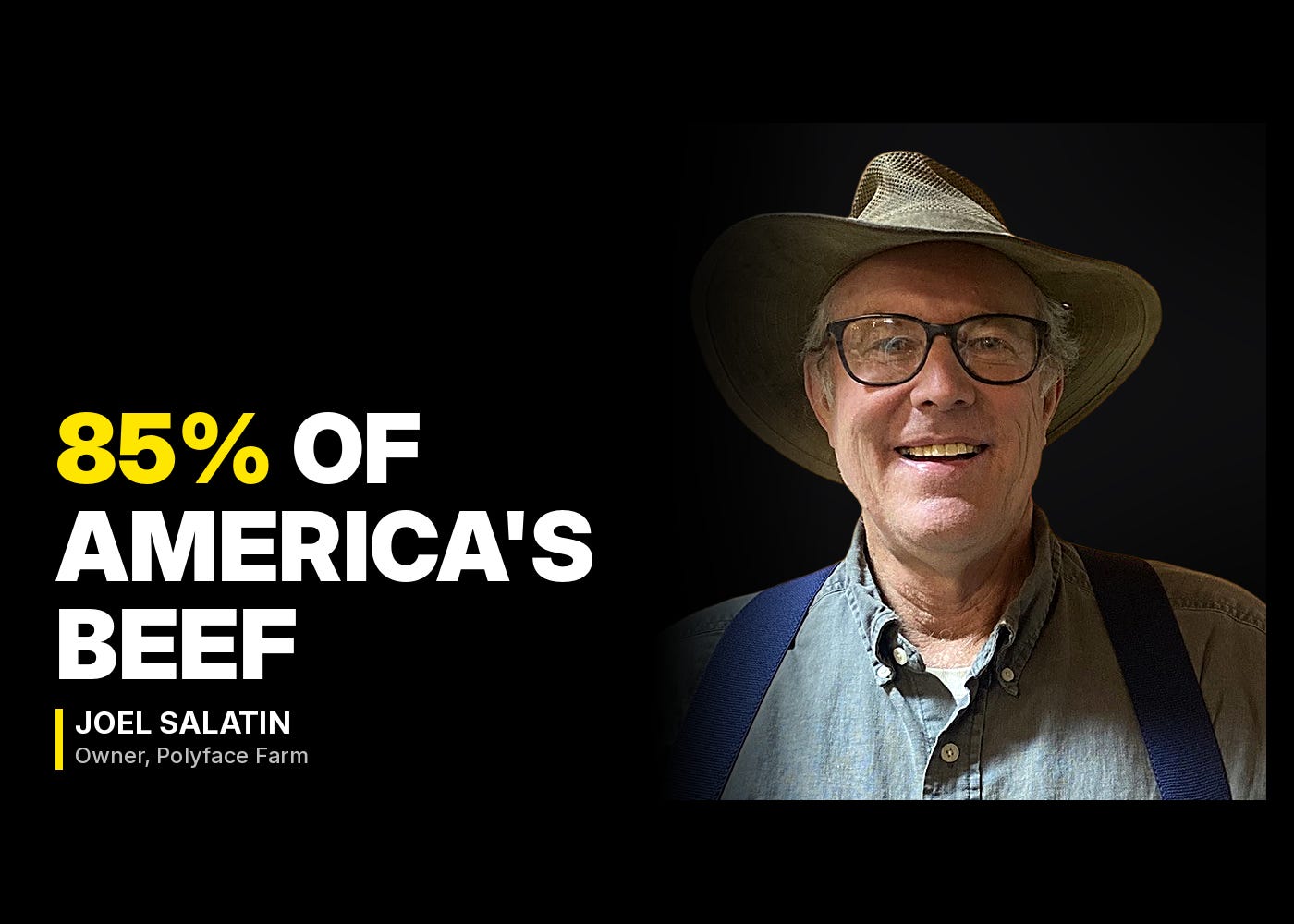
Photo via polyfacefarm.com
Farm bankruptcies doubled from 2024 to 2025, and the USDA expects corn farmers to lose $100 to $200 an acre this year.
Record beef prices look like a windfall for ranchers riding out that stress. Joel Salatin says the costs behind those prices have risen even faster.
"If you run a graph on labor, land, energy... and equipment [since] 2006... they have risen faster than these current, supposedly outrageous, beef prices." — Joel Salatin
Joel Salatin, owner of Virginia's Polyface Farm and editor of Stockman Grass Farmer magazine, told Wealthion's Maggie Lake that the stress showing up first in cattle is a preview of what's coming to the rest of American agriculture.
The full interview is covered here so you can skip it. 53 minutes of audio, 9 minutes of reading.
Here are the 6 takeaways that matter.
Wealthion · Oct 26, 2026 · 53m · 44m saved
With Joel Salatin, Owner of Polyface Farm and Editor of Stockman Grass Farmer Magazine
Key Takeaways
Farm bankruptcies doubled from 2024 to 2025, Joel says, and record beef prices are misleading because labor, land, energy and equipment costs have risen even faster since 2006
He calls cattle the "canary in the coal mine" because they return the least income per acre of any farm enterprise
Half the US soybean crop is exported and nearly half of corn goes to subsidized ethanol — a structural mismatch Joel says a $12 billion bailout only entrenched
In the last 70 years the farmer's share of a grocery dollar fell from 40 cents to 5.8 cents, he says
Federal subsidies on six crops directly inflate farmland values, Amish farmers told Joel, even when the land doesn't need to grow what's subsidized
Joel's own stacked-retail model nets over $30,000 an acre, against roughly $800 for a corn farmer
He credits his mentor Allan Nation: buy land for "economic defense," or learn to farm it well for "economic offense"
Four meatpackers — Tyson, Cargill, JBS and National Beef — process 85% of America's beef, and it costs Joel's small plant $650 to process one animal that costs Tyson $150
Asked where he'd put $1 million in agriculture, Joel said not land — find a farmer who's already direct-marketing and value-adding, and invest in their expertise instead
1. Cattle Feel It First
Joel opened by naming the scale of the stress across US farms: bankruptcies doubling year over year, soybean farmers losing about $100 an acre in 2025, and USDA projecting corn farmers will lose $100 to $200 an acre this year.
Farm bankruptcies doubled from 2024 to 2025, Joel says
"In 2025, the number of farm bankruptcies doubled from 2024... soybean farmers in 2025 lost on average $100 an acre [and] the prognosis right now from USDA is that corn farmers this year will lose somewhere between $100 and $200 per acre." — Joel Salatin
Record beef prices, he argues, don't contradict that picture — they're misleading, because labor, land, energy and equipment costs have climbed faster than beef prices since 2006. He also pointed to Trump's import of 300,000 metric tons of subsidized, below-market lean trim, which dropped the cattle market 10% overnight and prompted ranchers in his area to boycott the local sale barn. That's why he calls cattle the warning sign for the rest of agriculture.
Cattle are the "canary in the coal mine" for US agriculture, Joel says
"I think the cattle right now are the canary in the coal mine, because cattle return the least amount per acre compared to anything else... from produce to gardens to vineyards and dairy." — Joel Salatin
He expects the same stress to reach other sectors five to ten years out.
