

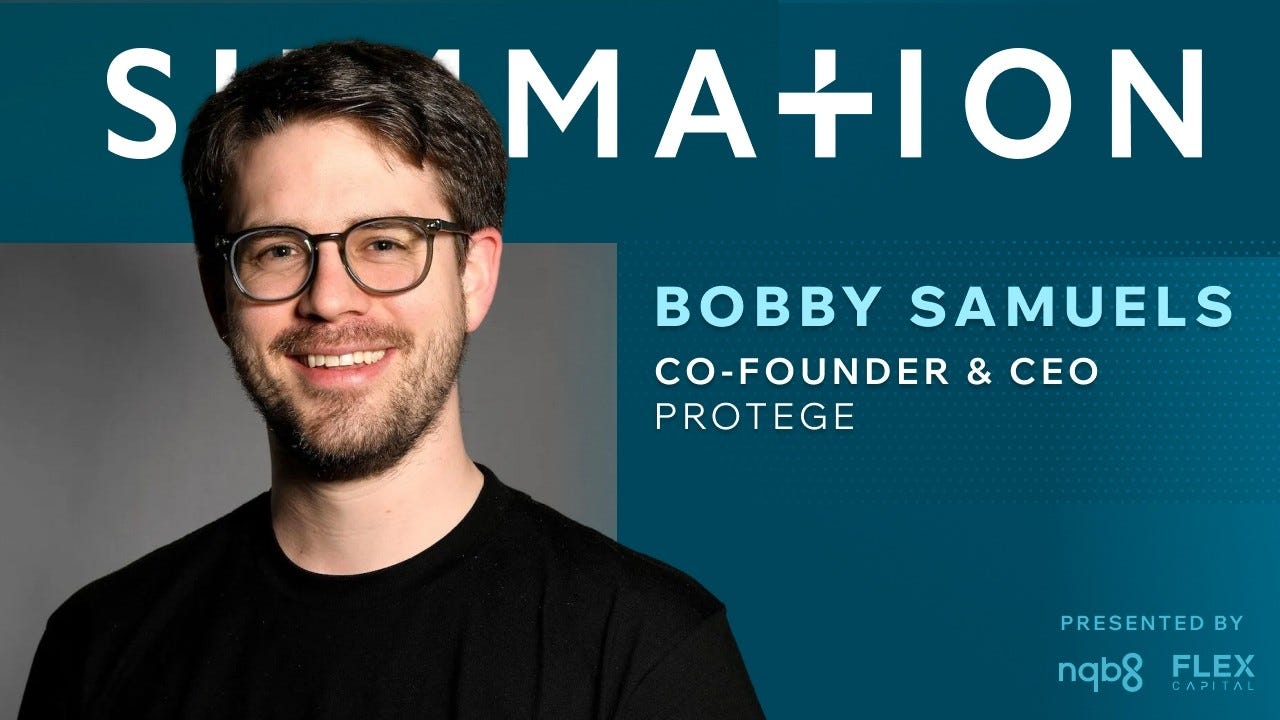
Bobby Samuels, co-founder and CEO of Protege, told Summation with Auren Hoffman that in AI, getting a dataset in one month rather than three can decide whether it makes a given training run. His company licenses real-world healthcare, media and enterprise data to the labs.
The labs could try to source that data themselves. Bobby says they lose on every count when they do.
"I would contend that it is faster, cheaper, and higher quality to go through us than to try to do it yourself." — Bobby Samuels
Bobby ran Privacy Hub at Datavant and led partnerships at LiveRamp before starting Protege, and his career in the data business includes selling data to hedge funds, a market he now warns founders away from.
The full interview is covered here so you can skip it. 1 hour 8 minutes of audio, 9 minutes of reading.
Here are the 10 lessons that matter.
Summation with Auren Hoffman · Oct 13, 2026 · 1h 8m · 59m saved
With Bobby Samuels, Co-Founder and CEO of Protege
Key Takeaways
Selling data to hedge funds is a trap, Bobby says, because few buy and prices get competed down
AI labs give the rich feedback hedge funds never did
Speed decides training runs: one month versus three can be the difference between making a run or missing it
Genetics is the most locked-up dataset, and unlocking it could push medicine toward drugs made for one patient
Health data does not lose value the way text data has, because patients and treatments keep changing
Bobby is "super skeptical" that the models will eat vertical applications
Salesforce lasts on decades of integrations, not technical edge
Synthetic data's big moment stayed "18 months away" for the four years Bobby was at Datavant
Bobby thinks about mercenary versus missionary hires ten times as much as he once did
1. Lessons From Horse Racing
Auren Hoffman, CEO of NQB8 and a general partner at Flex Capital, opened by recalling that he interviewed Bobby for a job at LiveRamp in 2013-14. Bobby was a college senior then and had written his college essay on betting on horse racing.
Bobby still sees parallels with his work today. Horse-racing data was hard and expensive to get, because a near-monopoly, the Daily Racing Form, controlled it. Bettors chronically undervalue favorites and overvalue longshots, a pattern known as the favorite-longshot bias, which Auren said now shows up in prediction markets such as Polymarket. The Beyer Speed Rating, a composite statistic, works for horses much as a FICO score works for borrowers.
Bobby also pushed back on the idea that founders are risk-seekers. His basic needs are secure, so starting a company was not a high-stakes bet for him. The bigger risk, in his view, would have been not pursuing something he wanted to pursue.
