

Ramp pays some of its sales development reps 2x what a standard rep makes and in return expects them to book 40 to 60 meetings, four to six times the usual load, Max Freeman, the fintech company's SVP of sales, said on The Twenty Minute VC.
That was one company's pay rule. Below are 27 more quotes from Freeman and 13 other speakers. Lance Roberts of RIA Advisors says a 10-year Treasury at 5.3% nearly doubles what he expects stocks to return over the next decade; Andrew Beer says managed futures need a new name, the way junk bonds became high yield; and Lazard's Peter Orszag says Social Security and Medicare will not be fixed until a crisis forces the issue.
"So the bet we took early on was to actually pay way above market rate for this talent. But in return, we were going to expect way above market rate when it comes to output. ... We'll pay 2x what a standard SDR is going to make. But guess what? You got to book 40, 50, 60 meetings, which is four to six times what a standard SDR has to book." — Max Freeman, SVP of Sales at Ramp, on The Twenty Minute VC (Read summary)
We scanned 566 shows and 11 hours of audio, wrote 11 summaries, and pulled 28 quotes into this 12-minute read.
Here is what mattered.
Macro
A 10-year Treasury at 5.3% nearly doubles what stocks should return over the next decade, Lance Roberts says
"if I can buy a five-year Treasury at 5%, which we just did last week, why wouldn't I do that when expected real yield, so sorry, expected real returns on stocks is going to be somewhere between -2 and 2% over the next decade, right? So I can buy a 10-year Treasury at 5.3 and nearly double my rate of return on stocks for the next decade. That's just what valuations tell you." — Lance Roberts, Portfolio Manager and CIO at RIA Advisors, on Thoughtful Money (Read summary)
Bonds now cover 53% of the return a portfolio needs, against about 12% three years ago
"And today, bonds will provide you 53% of the rate of the return that you need to reach your goal versus about 12% three years ago. So bonds are in a much better position to generate set rates of return over time for retirees, for people trying to grow their portfolio safely, etc. And there's too much focus set on the level of rates rather than the actual function of bonds in a portfolio." — Lance Roberts, Portfolio Manager and CIO at RIA Advisors, on Thoughtful Money (Read summary)
It is an okay or bad time to be a consumer but a phenomenal time to be an investor, Anastasia Amoroso says
"But what's happened also is that we are capacity constrained. Whether it's the travel industry, there was leisure, hospitality, whether it's the industrials industry. So as a result, corporations have pricing power. They're using that pricing power, which is why we're seeing those record earnings. So the bottom line, Tom, it is not a phenomenal time to be a consumer. It's an okay or maybe a bad time to be a consumer, but it's actually a phenomenal time, a very solid time to be an investor because if you can invest in the companies that are solving those capacity bottlenecks and they're delivering record earnings in the meantime, that's the way to I think even out the playing field and to have those consumers become investors." — Anastasia Amoroso, Chief Investment Strategist at Partners Group, on Bloomberg Surveillance
International
The rupee could crack through 100 despite the central bank's best efforts, Saurabh Mukherjea says
"And specifically back home we've seen the rupee lose 12% of its value. I think there's a real risk the rupee will crack through 100 right the rupee will crack through 100 in spite of the RBI's best efforts" — Saurabh Mukherjea, Founder and CIO at Marcellus Investment Managers, on Figuring Out with Raj Shamani (Read summary)
India's richly valued small and midcaps will suffer more than large caps as rates rise, Saurabh Mukherjea says
"Usually in every market I've ever seen, when interest rates rise, small and midcaps suffer more than large caps. I'll be amazed I'll be amazed if in this rate rise cycle as money gets nearer, I'll be amazed if small and midcaps in our country don't suffer more than large caps. Their valuations are clearly way richer than large caps. and therefore their their likelihood of suffering is greater." — Saurabh Mukherjea, Founder and CIO at Marcellus Investment Managers, on Figuring Out with Raj Shamani (Read summary)
Things valued in the trillions will end up valued in the billions once money stops being cheap
"I think the reckoning is coming on that. the result of this will be the result of this will be valuations. Valuations will get challenged. A lot of things which are valued at trillions of dollars will end up getting valued at billions of dollars. A lot of things which are valued at billions of dollars will get valued at millions of dollars." — Saurabh Mukherjea, Founder and CIO at Marcellus Investment Managers, on Figuring Out with Raj Shamani (Read summary)
Financials
StoicLane more than tripled its payroll and benefits business while going from 45 employees to 49, Al Goldstein says
"So, we've grown that business over 3x from when we bought it and it's got the same number of employees. We started with 45 employees. Today, it's got 49 employees." — Al Goldstein, CEO at StoicLane, on Non-Consensus Investing (Read summary)
Lending is the easy part of the business, Avant's co-founder says
"It's easy to lend money. It's harder to collect money." — Al Goldstein, CEO at StoicLane, on Non-Consensus Investing (Read summary)
AI agents will hunt down the best yield on deposits and squeeze bank valuations, Jordi Visser says
"I believe the banks now are going to go through a problem which is they're going to come under multiple compression over the course of the next year because of two factors. ... What I want to say is that agents are not going to make mistakes. They are going to search for the cheapest way to do thing and that means that as agents control more of the money decisions, banks are going to be in trouble." — Jordi Visser, Macro Investor at VisserLabs, on The Pomp Podcast (Read summary)
Crypto and Digital Assets
Next year will bring crypto's biggest moves, driven by AI agents, Jordi Visser says
"I want to make sure people realize when it comes to crypto, this is 100% for me about agents. And I'm telling you, the amount of traditional people that continue to bang on my door to talk about tokenization, to talk about how to make money on this, they're doing their homework now. I think next year is going to be the year that we see the biggest moves in crypto because of agents." — Jordi Visser, Macro Investor at VisserLabs, on The Pomp Podcast (Read summary)
Crypto will be the toll collector on AI agents' spending, Jordi Visser says
"I only believe there's two things to focus your attention on the toll collectors that's crypto as far as I'm concern. I want the digital money guardrails, the toll collectors." — Jordi Visser, Macro Investor at VisserLabs, on The Pomp Podcast (Read summary)
Alternatives and PE
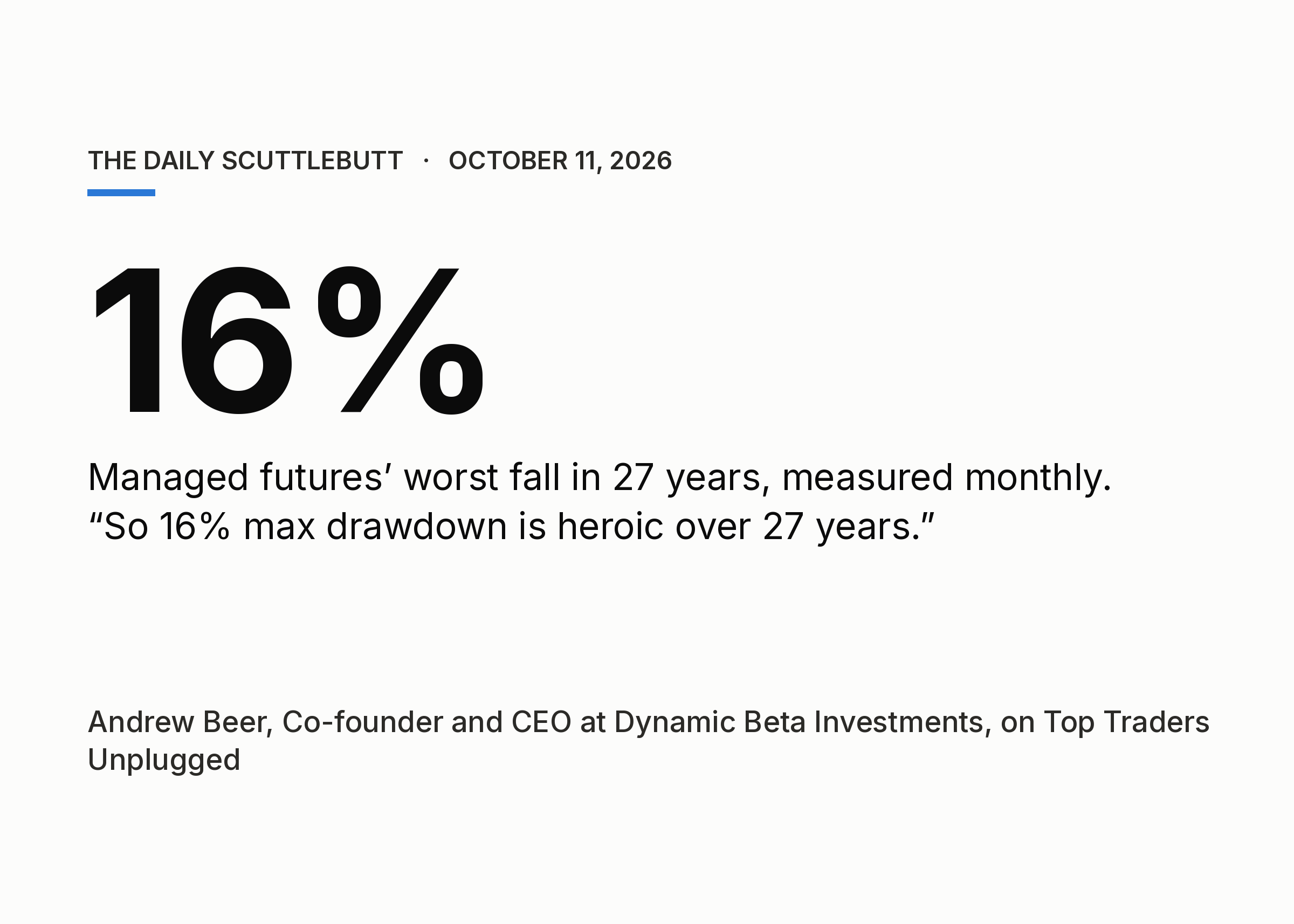
A 16% worst-case loss over 27 years is heroic for managed futures, Andrew Beer says
"So 16% max drawdown is heroic over 27 years. Why? Because the space is not built to hold losing positions with a white knuckle grip." — Andrew Beer, Co-founder and CEO at Dynamic Beta Investments, on Top Traders Unplugged (Read summary)
Managed futures need a new name, the way junk bonds became high yield, Andrew Beer says
"Hard money loans became private credit. Junk bonds became high yield. Cigar butts became value stocks. We collectively need to all sit in a room. I'll take out a hotel conference room. Everyone flies in, we all sit down, we say we are going to use this terminology for everybody." — Andrew Beer, Co-founder and CEO at Dynamic Beta Investments, on Top Traders Unplugged (Read summary)
The 60/40 portfolio rested on a 20-year bond bubble, Andrew Beer says
"And it was a bit of a historical accident. It was fueled by the 20 year bond bubble because bonds were the statistically perfect diversifier to your stock portfolios for 20 years. I used to call them the super meta diversifiers." — Andrew Beer, Co-founder and CEO at Dynamic Beta Investments, on Top Traders Unplugged (Read summary)
Consumer
Patagonia will grow only on terms it is comfortable with, its CEO says
"I don't think growth is good or bad. I think growth is just progress at a certain pace from a place to a place, and so I do prefer to grow than the opposite, but I absolutely insist that we grow on terms that we're comfortable with." — Ryan Gellert, CEO at Patagonia, on Bloomberg Television (Read summary)
Quarterly earnings pressure creates perverse incentives, Ryan Gellert says
"I think, to the tension that other businesses may feel, I think the system is broken. I think the focus on share price, the focus on quarterly earnings and performance, I think is way too short term, and I think it creates perverse incentive structures." — Ryan Gellert, CEO at Patagonia, on Bloomberg Television (Read summary)
Technology & AI
OpenAI merged ChatGPT's desktop app and website in 30 days, a job that would normally take at least 6 months
"So we decided to merge the desktop application and chatgpt.com, and this is something that would have traditionally taken at least six, maybe 12 months, and something that you would do very very carefully, because this is our main surface, we have hundreds of millions of users visiting this website, right? And so we just merged it, and we merged it in 30 days." — Tibo Sottiaux, Head of Product & Platform at OpenAI, on Masters of Scale (Read summary)
A slight slip on safety tests kept OpenAI's newest model from a broad release
"if we see an ever so slight regression, we didn't want to proceed with a broad release, and so it was withheld, and that's proof of a system working. It would have been incredible to be able to announce Astra 6.1, say at Dev Day, right, but we just never really want to compromise on safety or alignment." — Tibo Sottiaux, Head of Product & Platform at OpenAI, on Masters of Scale (Read summary)
Most of the AI bubble talk is wrong, though a bubble could still come, Ben Horowitz says
"And so that a lot of the narratives around the AI bubble I just think aren't correct. Now, will we hit a bubble at some point? Yeah, quite possibly. I mean, look, we had a bandwidth bubble. A bandwidth bubble in 2001. We had too much bandwidth." — Ben Horowitz, Co-founder at a16z, on a16z (Read summary)
Each of the new AI math proofs took under 3 hours of computing, David Friedberg says, citing a report
"The report is that each one of these proofs took less than three hours of compute time and that's the equivalent of hundreds or perhaps thousands of years of human labor being reduced down to 3 hours on a computer for each one of these major discoveries." — David Friedberg, Founder and CEO at The Production Board, on All-In (Read summary)
A frontier AI lab run like a religious cult carries real risks, David Sacks says
"So I do think market forces play a role here. But I do think that there are potential externalities from having the number one frontier model company run by a religious cult." — David Sacks, General Partner at Craft Ventures, on All-In (Read summary)
VC & Startups
Cowboy Space will try to beam power from orbit to the ground within weeks
"And so while the company started out with the idea of actually collecting power in space and beaming it down to the ground, We're actually gonna be demonstrating that for the very first time with our technology in the coming weeks here. So reason one is our first satellite went to orbit on a SpaceX rideshare. We've made contact with it. We're talking to it every day right now and getting ready for that first demonstration of optical power transmission from space to Earth." — Baiju Bhatt, Founder and CEO at Cowboy Space, on Bloomberg Television (Read summary)
Demand for computing is high enough that chips in orbit will be used until the end of their lives, Baiju Bhatt says
"Chip sets that came out even a handful of years ago are still actively used today, for AI workloads. And I think it's simply a byproduct of the fact that the demand is there. And, frankly, if the chips that already exists, it's better than one that hasn't been delivered yet. And so we actually think that the demand for a compute is so high that these chipsets will continue to get used until end of life in orbit." — Baiju Bhatt, Founder and CEO at Cowboy Space, on Bloomberg Television (Read summary)
Outbound selling is now an engineering job, Ramp's sales chief says
"So outbound used to primarily be a writing and a calling problem. I think increasingly it's becoming an engineering problem. In late 2020, early 21, even before the rise of AI, we built our own internal infrastructure to help automate a lot of our outbound." — Max Freeman, SVP of Sales at Ramp, on The Twenty Minute VC (Read summary)
Founders should skip a comp plan and pay first sellers full target earnings for at least 2 quarters, Max Freeman says
"I usually advise to not have a comp plan. I usually advise to do 100% OTE for at least the first two quarters. You just don't know what you don't know." — Max Freeman, SVP of Sales at Ramp, on The Twenty Minute VC (Read summary)
Back founders whose strengths are the best in the world and overlook the rest, Ben Horowitz says
"What matters is are their strengths world class? So, are they the best in the world at something? And then you overlook everything else. Like kind of going back to Elon, like he's got some personality issues. You know, like he upsets people from time to time, but like his strength is so ridiculous that you would put money on that every time." — Ben Horowitz, Co-founder at a16z, on a16z (Read summary)
Policy
Social Security and Medicare will not be fixed until a crisis forces it, Lazard's Peter Orszag says
"Both Social Security and Medicare have looming problems associated with their financing. They will have to be addressed. This is part of an overall fiscal imbalance of 6 to 7% of GDP. And history shows we don't deal with these problems until they're crisis. The last social security reform did not occur until checks were literally not about to go out the door." — Peter Orszag, CEO and Chairman at Lazard, on Bloomberg Surveillance
If this was worth your time, send it to someone who has to follow all of this too.
What did you think of today’s edition? Hit ‘reply’ to this email, send us a message, leave a comment, or join the chat!
Get the latest market chatter as it happens: