

This Week in Startups · Oct 14, 2026 · 1h · 48m saved
With Misha Laskin, Co-Founder & CEO of Reflection AI
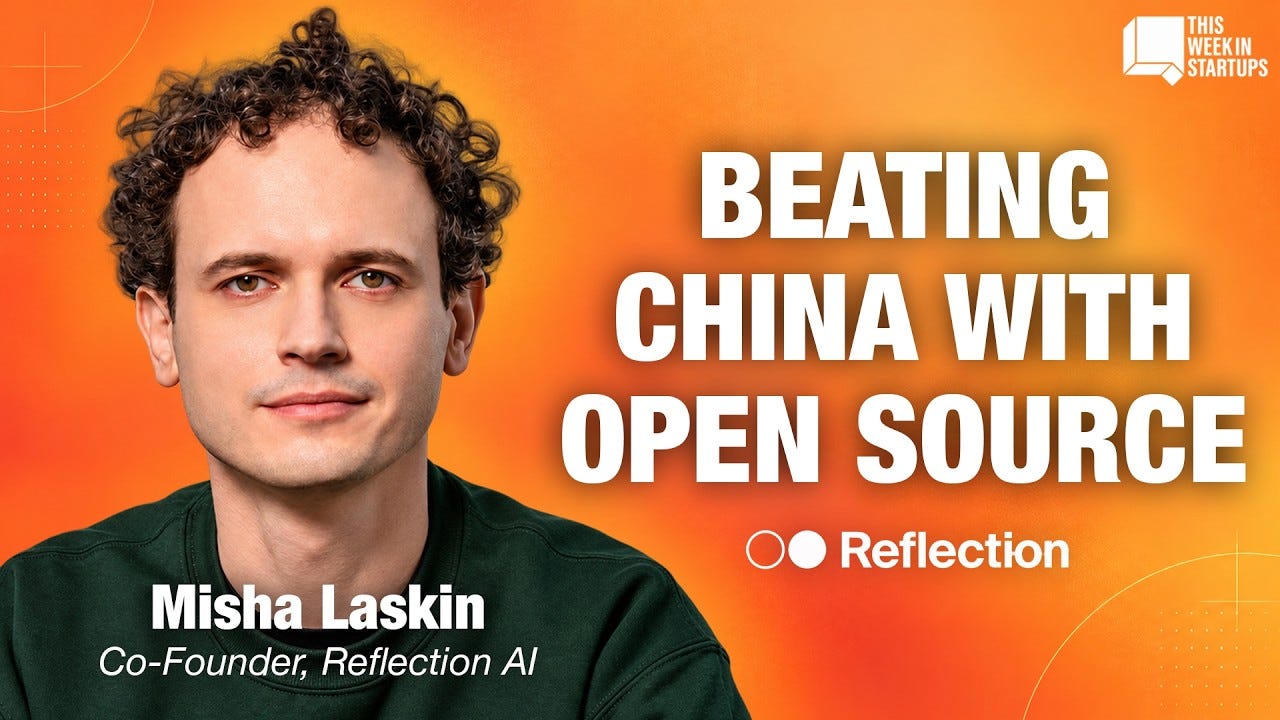
Reflection AI trained its first open-weight model, Beam, on about 10,000 GB300 chips in what it calls the largest documented open-source reinforcement learning run, spawning around a billion sandboxed agents.
Misha Laskin, co-founder and CEO of Reflection AI, told Jason Calacanis on This Week in Startups that the safest path for AI is the open one. Most frontier labs keep their models closed and say that is the responsible choice. Misha argues closed labs cannot staff enough people to secure what they are building.
"There are about 5,000 people in the world that have frontier access to frontier models within the closed labs. And of those, probably 10% do safety research. So in the whole world, our whole world is being secured today by 500 people." — Misha Laskin
Misha is a former DeepMind researcher who grew Reflection from 30 people to 300 in a year and shipped Beam in early October, three months after the company got its first large GPU cluster.
The full interview is covered here so you can skip it. 60 minutes of audio, 12 minutes of reading.
Here are the 13 insights that matter.
Key Takeaways
Only about 500 people secure frontier AI inside the closed labs, which Misha says makes open models the safer path
He cites Linus Torvalds: "With enough eyeballs all bugs become shallow"
US open-weight models could be "fully caught up" with China by Q4 2026 or Q1 2027
Beam sits a couple of months behind the Chinese frontier but uses three to four times fewer reasoning tokens
Companies rent AI to test it and own it once it is core IP, for control of data, costs and margins
Reinforcement learning now takes as much compute as pretraining, up from a "cherry on top"
DeepSeek V3 won China its lead by being open, though China's labs run like closed businesses at home
Concentrating compute in one or two labs makes self-improving AI more dangerous, not less
1. Rent to Test, Own to Scale
Jason opened with the case for open models. He described closed frontier models as a rental that the landlord can revoke, run by labs their own customers increasingly see as competitors.
Jason Calacanis says buyers of closed AI never own what they pay for
"You could be rugpulled at any time and the frontier model could take your model away from you... the frontier models are viewed increasingly as competition... you are renting your intelligence. You don't own it. You don't have sovereignty over your knowledge, over your business." — Jason Calacanis
Misha took the real-estate comparison further. A company testing AI starts in the rental market. Once a workload reaches production and becomes the company's core asset, the economics change.
Misha Laskin says ownership pays once an AI workload becomes core IP
"In real estate, you have both rental and ownership... by the time you've scaled something to production — this is basically almost your core asset, your core IP — ownership starts making sense: control of your data, lowering your costs, customizing the model against your data, optimizing your margins." — Misha Laskin
