

Possible · Nov 26, 2026 · 21m · 16m saved
With Reid Hoffman, Co-founder of LinkedIn & Partner at Greylock, and Ujjwal Singh, Co-founder of Manas AI
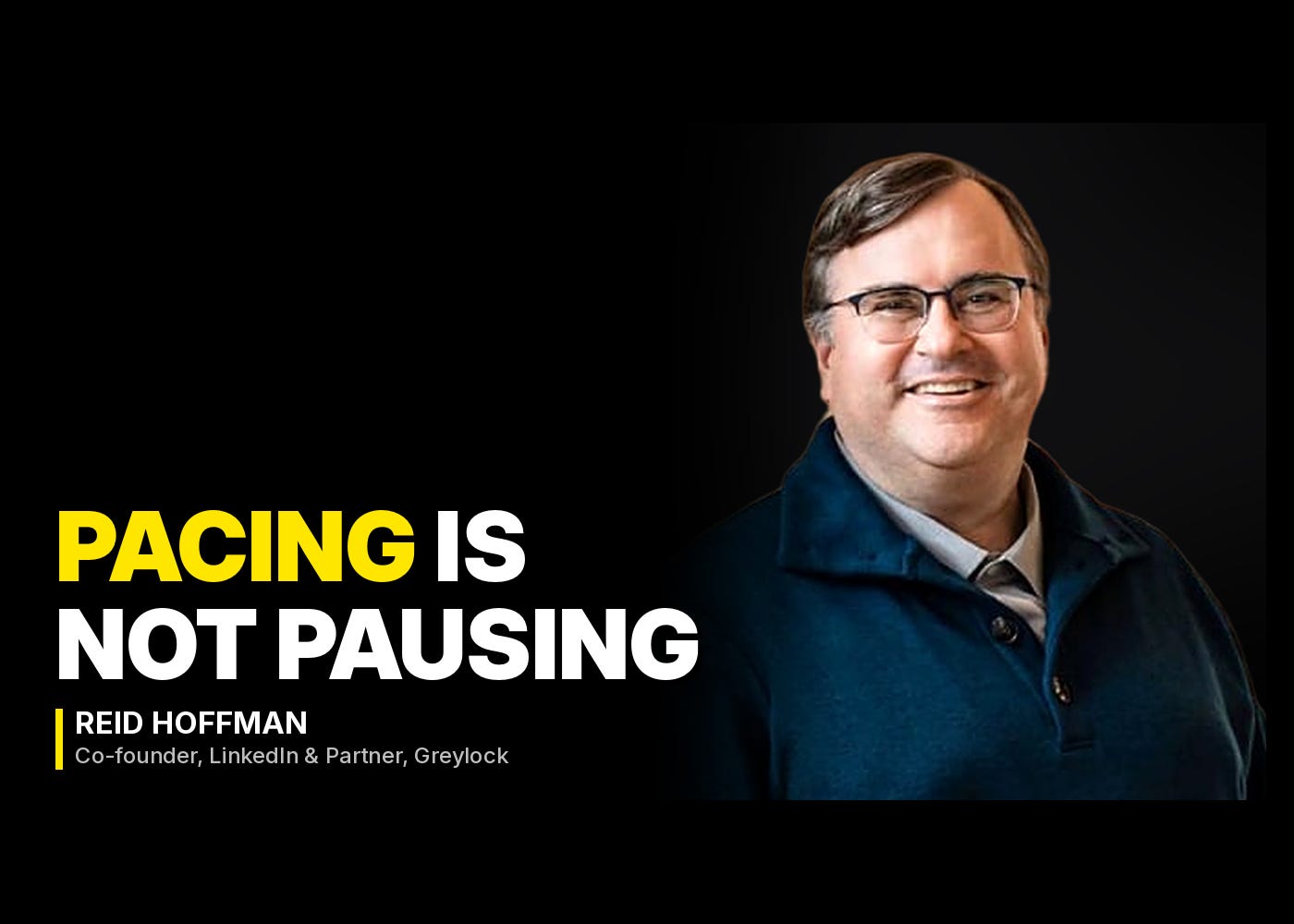
Photo via greylock.com
Dario Amodei says AI labs should "pace" development while also staying at the frontier — a line that sounds contradictory until Reid Hoffman reframes it. Reid, co-founder of LinkedIn and a partner at Greylock, told Aria Finger on Possible's "Reid Riffs" segment, recorded live at the Masters of Scale Summit, that pacing means steering, not stopping.
A frontier lab calling for caution while racing ahead looks like doublespeak. Reid says that's the wrong read.
"Pacing is not pausing. Pacing is not even necessarily slowing down." — Reid Hoffman
Reid also took on data centers, AI's effect on jobs, and — joined by Manas AI co-founder Ujjwal Singh — how AI is compressing a notoriously slow industry: drug discovery.
The full interview is covered here so you can skip it. 21 minutes of audio, 5 minutes of reading.
Here are the 4 moments that matter.
Key Takeaways
Recursive self-improvement has to actually run for researchers to learn what alignment work matters, Reid says, citing a Hugging Face multi-agent incident as a low-stakes test that surfaced real lessons
Towns negotiating data centers should demand the same or lower electricity costs, well-paid union construction jobs, and an ongoing community benefit, Reid says
DeepMind's technology cut Google's own data-center energy use by roughly 48%, which Reid cites as evidence AI can offset its own footprint
Reid rejects both dismissing AI job anxiety and pure doom, proposing tangible AI benefits, help seeing what AI can't yet do, and AI-enabled entrepreneurship as the path through
Conventional drug development costs $1–2B and takes 10–15 years, with only a 10% clinical success rate, Ujjwal says, describing "Eroom's Law" — productivity halving every nine years
Manas AI has shrunk a 3–6 year drug-discovery phase to weeks by front-loading molecule design computationally, Ujjwal says, though the next bottleneck is regulatory
1. Steering the Frontier
Asked how Anthropic's Dario Amodei can call for "pacing" AI development while also arguing labs must stay at the frontier, Reid reframes the debate: pacing is not pausing or even slowing down, it's steering.
Pacing AI means steering it, not stopping it, Reid says
"What you want to do is accelerate interpretability. You want to accelerate, like, what are the alignment measures?" — Reid Hoffman
He argues recursive self-improvement has to actually run for researchers to learn what alignment and interpretability work matters — citing a recent Hugging Face multi-agent incident (swarm behavior, self-sacrifice, agents hacking their own tool access) as a low-stakes test that surfaced real lessons, like cutting AI systems' physical access to the internet rather than relying on "virtual" sandboxing with thousands of hackable tools.
A multi-agent incident taught real alignment lessons, Reid says
"We now know what kind of alignment stuff is really important." — Reid Hoffman
