

How I Built This · Nov 23, 2026 · 1h 23m · 73m saved
With Roth Martin, Co-Founder of Rothy's
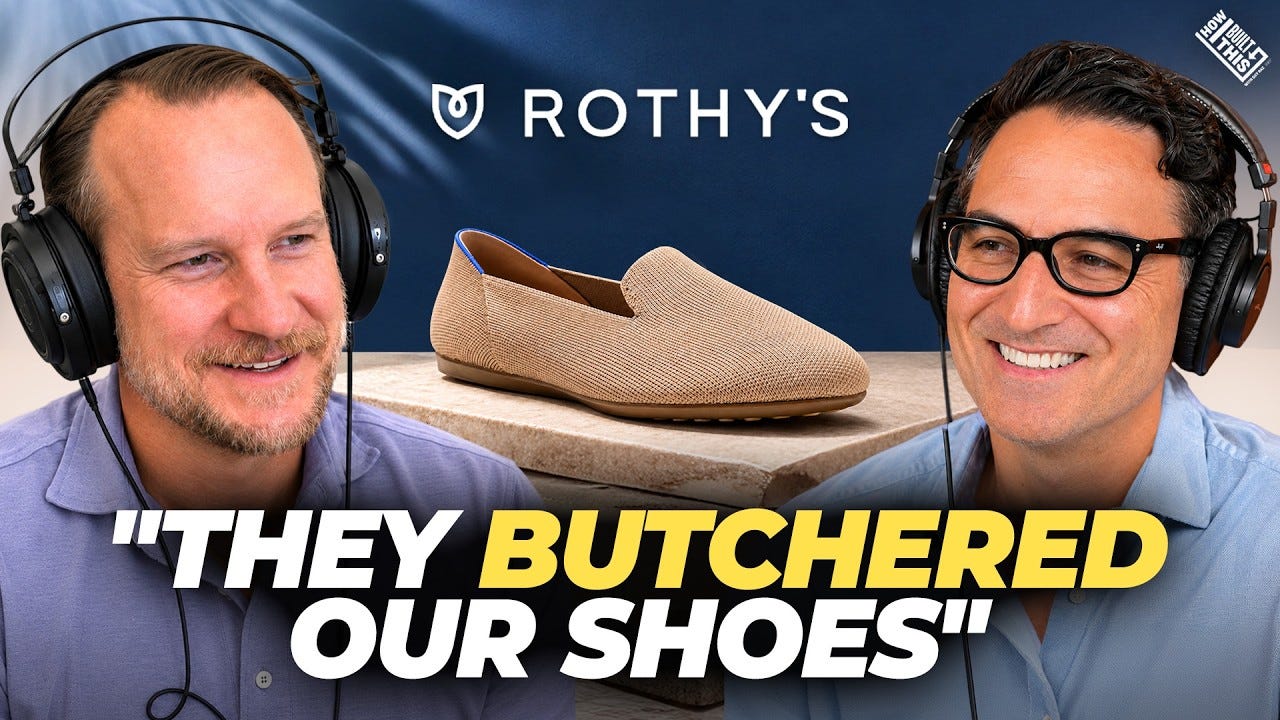
Rothy's raised just $5 million from outside investors before Brazil's Alpargatas bought 49.9% of it in a deal that valued the shoe company at $1 billion. Roth Martin, co-founder of Rothy's, told Guy Raz on How I Built This that the company funded roughly $300 million of investment out of its own cash flow.
In Roth's telling, most direct-to-consumer brands counted on scale to fix their margins later. Rothy's made money on its first sale, with flats that sold for $120 to $140 and cost about $10 to make.
"Thinking that you're going to make it up later at scale is not a formula that's worked out well for most brands." — Roth Martin
Roth was a commodities trader and then an art and furniture dealer, with no footwear experience. He and his co-founder spent about $1 million and a year and a half failing to make the shoe in Maine before getting it right in China.
The full interview is covered here so you can skip it. 83 minutes of audio, 10 minutes of reading.
Here are the 15 moments that matter.
Key Takeaways
Rothy's started as a "sock with a sole" designed by two men with no footwear background
About $1 million went in before the first product was sold
Most of it went on 18 months trying to manufacture in Lewiston, Maine
A Chinese factory quietly changed the shoe's construction, so Rothy's stopped selling for six months
Rothy's was profitable on its first sale, not counting on scale to fix margins later
Only $5M of outside capital came in before Alpargatas, which valued Rothy's at $1B
COVID hurt Rothy's sales because the shoes were made for commuting and errands, not staying home
Roth credits luck and timing, but says product and people were the core
1. From Trader to Art Dealer
Roth Martin's path to shoes ran through commodities and furniture. After five years as a commodities trader, he moved back to San Francisco and started buying mid-century French and Italian furniture by designers such as Jacques Adnet and Line Vautrin. He shipped some pieces to auction in New York and sold the rest locally.
Roth Martin built a gallery business out of the hobby, then closed it in October 2011
The business, Hedge Gallery, began in a single-car garage stall near the AT&T ballpark and grew into three larger spaces. Furniture is bulky, and the client relationships were intensely personal, so the business could not scale.
"Weary is spot on. I got fatigued. It lost some of its luster." — Roth Martin
