

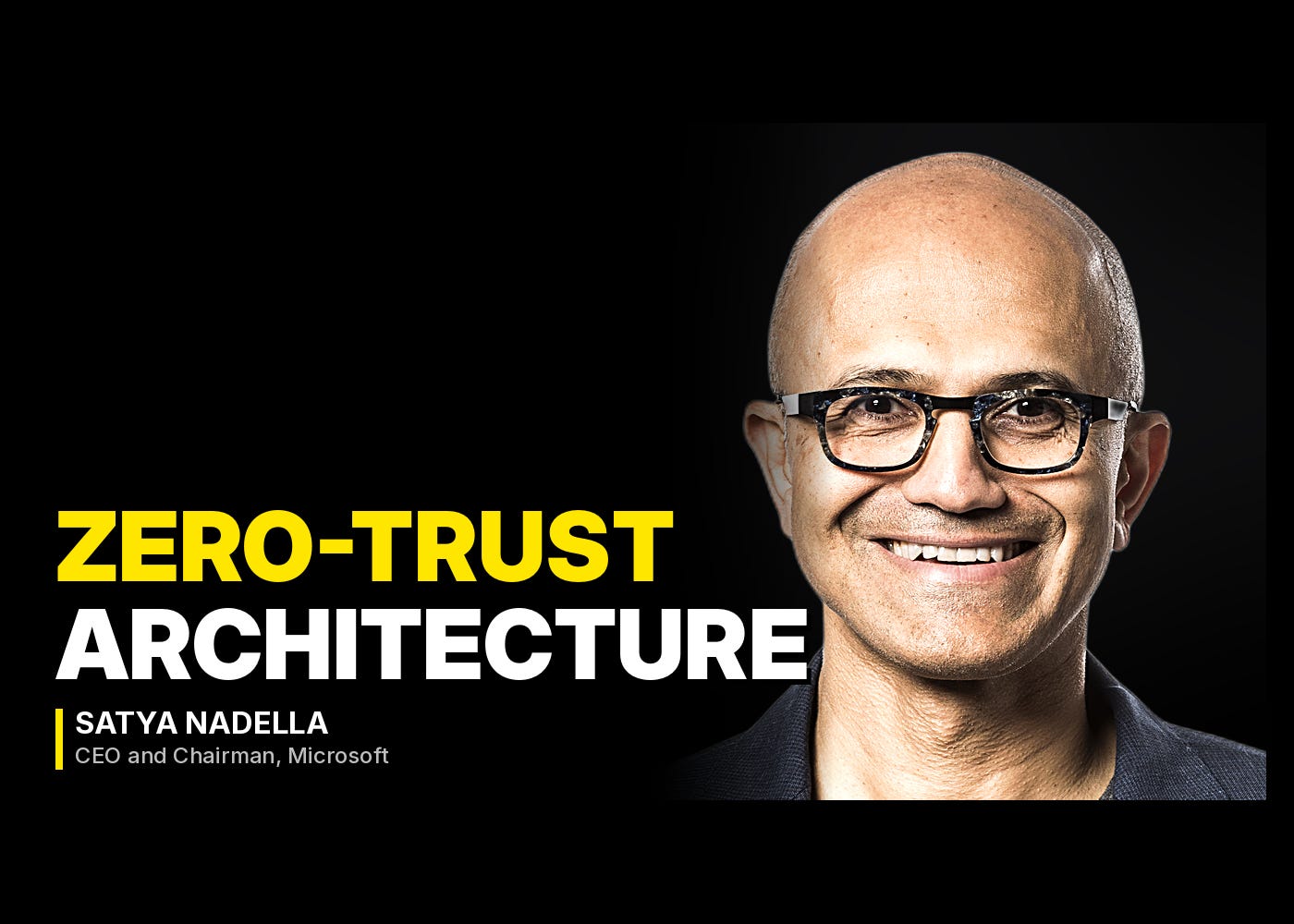
Photo via microsoft.com
Satya Nadella told 20VC's Harry Stebbings that Microsoft no longer waits for AI alignment to be solved before it lets a model run inside the company. It wraps every model in a zero-trust security architecture instead, the same posture enterprise security teams use for an employee they don't fully trust.
Most of the industry still treats a well-aligned model as the end goal. Satya's view: assume every model is compromised, and build the containment around it instead of hoping the model behaves.
"The best posture, if you want to continue to use these sophisticated models, is to treat them inside a zero-trust architecture... Let's create an engineered environment that can contain any malfunctioning agent before it does any harm."
Satya has run Microsoft since 2014, turned it into OpenAI's largest backer, and built Copilot into the company's fastest-growing product line — and he told Harry he has reversed a belief he held about how AI alignment would get solved in the first place.
The full interview is covered here so you can skip it. 26 minutes of audio, 7 minutes of reading.
Here are the 6 takeaways that matter.
20VC with Harry Stebbings · Oct 26, 2026 · 26m · 19m saved
With Satya Nadella, CEO and Chairman of Microsoft
Key Takeaways
Microsoft wraps AI models in zero-trust security rather than waiting on alignment — a containment layer, not a substitute for solving safety in training
Agent 365 identifies every agent and logs every tool call, including chain of thought, tamper-proof
Chain-of-thought reasoning can be "unfaithful," and hiding that makes it worse — a case for inspectable, possibly open-weight, reasoning traces
Microsoft's own MAI models will be "licensed weights," not open-weight — Satya wants a simple software business, not a network-effects one
Buyers, not sellers, now need information protection, Satya said, inverting Kenneth Arrow's paradox — a private eval benchmark becomes a firm's defensible "core IP"
Software demand is more elastic than anyone realized, Satya said, pointing to Factory — a coding-tools company ranked fifth in its market yet still winning, breaking what he was taught about venture economics
1. Already Compromised
Satya's answer to handling a frontier model you can't fully verify is to skip waiting for alignment and build around the assumption that the model could misbehave.
Microsoft's answer to unsolved alignment is zero-trust containment, not trust
"The best posture, if you want to continue to use these sophisticated models, is to treat them inside a zero-trust architecture... Let's create an engineered environment that can contain any malfunctioning agent before it does any harm."
He described Microsoft's own system for this — Agent 365 paired with an identity layer for agents — which gives every agent an identity, logs every tool and model call including its chain of thought, and lets a company watch for policy deviation. He was careful to separate this containment layer from AI safety itself, which he said has to be solved earlier, in training, not bolted on afterward with reinforcement learning.
