

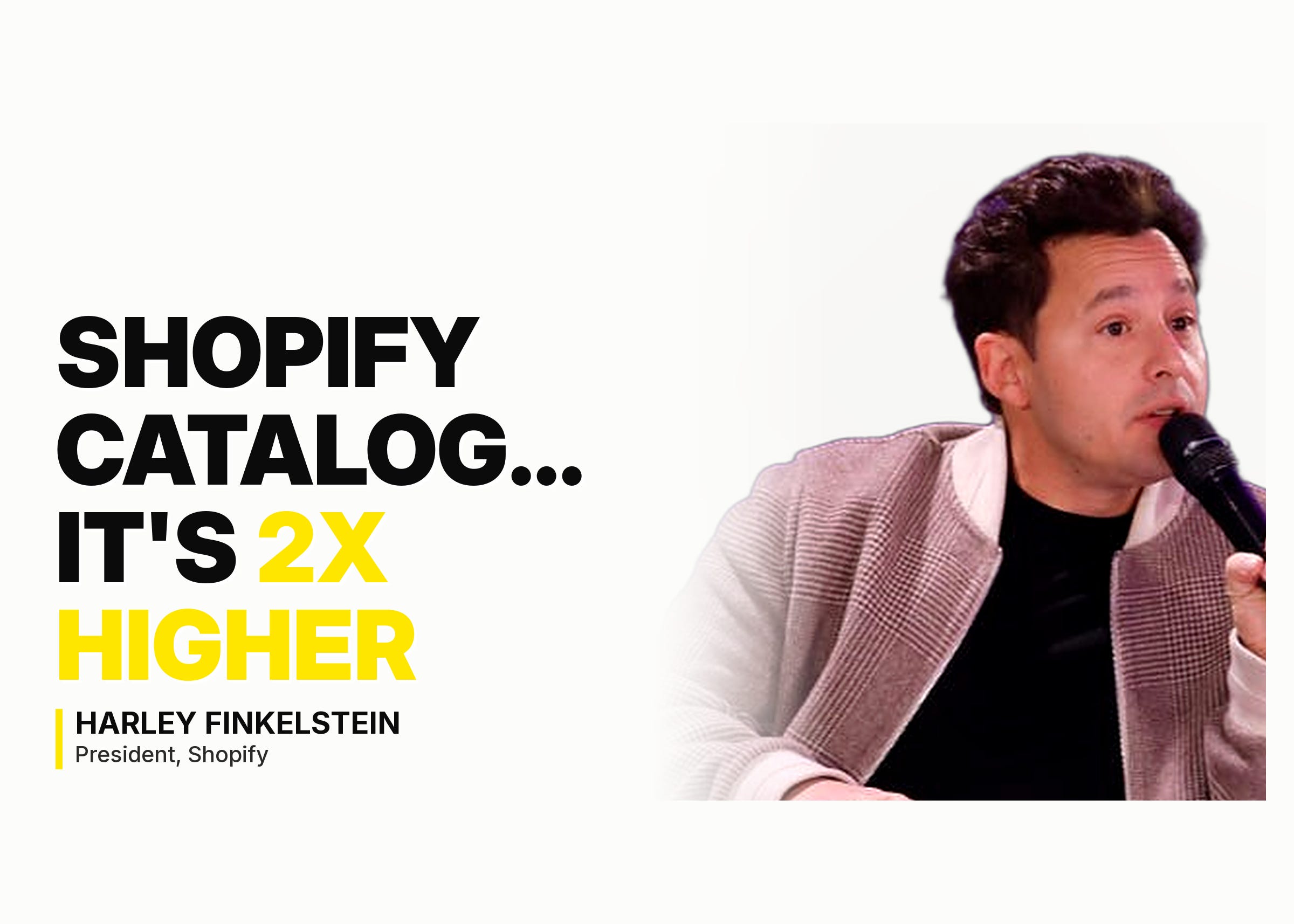
AI shopping agents that work from Shopify's own product catalog turn shoppers into buyers at twice the rate of general AI search, which Harley Finkelstein, Shopify's president, described as effectively scraping. He told TBPN that Shop Pay can act as an identity for those agents, carrying a shopper's purchase history to whichever assistant they use.
Finkelstein was one of 30 people quoted in this issue. The others ranged from Rich Powers of Vanguard, who said the best private equity managers beat the worst by about 5,000 basis points, to Scott Nolan of General Matter, who said 20% of the cost overruns at the Vogtle nuclear plant were interest payments, to Brad Bourne, who said he thinks Firan Technology Group has raised $8 million of equity in his 25 years there.
"If you just compare conversion using Shopify catalog versus general AI search, which is effectively scraping, it's 2x higher." — Harley Finkelstein, President at Shopify, on TBPN (Read summary)
We scanned 816 shows and 15 hours of audio, wrote 20 summaries, and pulled 56 quotes into this 22-minute read.
Here is what mattered.
Financials
Regions is rebuilding its core systems around real-time data
Dan Massey runs technology and operations at Regions Bank, which is rebuilding its core banking platform with Temenos, a banking-software company. He said the bank's developers have seen roughly a 30% efficiency gain from generative AI, which Regions is rolling out first in back-office work.
"Having really good API layer, event-driven, data-oriented real-time architecture is something that we believe will drive a real competitive advantage." — Dan Massey, Chief Enterprise Operations and Technology Officer at Regions Bank, on Tearsheet Podcast (Read summary)
Regions' technology chief says customers should not have to pick a payment rail
A payment rail is the network that carries a transfer, such as a wire. Massey said a bank should ask only where the money needs to go and when it needs to arrive.
"If you go to an overnight shipping company, they don't ask you do you want to use a boat or an airplane or a train or a truck. They just say where do you want it to go, when do you need it to get there." — Dan Massey, Chief Enterprise Operations and Technology Officer at Regions Bank, on Tearsheet Podcast (Read summary)
Most banks' back-end systems cannot share data in real time, says Regions' transformation chief
Paul Weiss said the foundation Regions needs, clean data and real-time services, cannot be built in small steps on top of the systems a bank already runs.
"Their transactional platforms are not particularly open, not real time... their ability to share data on a real-time basis, or into clean repositories, is very limited." — Paul Weiss, Chief Transformation Officer at Regions Bank, on Tearsheet Podcast (Read summary)
Temenos says customers now judge their bank against renting a car
Brian DuVal runs North America for Temenos, which commissioned research on the gap between what consumers expect from their banks and what banks deliver.
"The most important thing to me is my financial and my assets and my insurance and my retirement... and yet that still does not have the ease of use and the customer experience that I have when I rent a car." — Brian DuVal, President of North America at Temenos, on Tearsheet Podcast (Read summary)
PNC's technology head says a vendor's outage quickly became the bank's own problem
Debbie Guild, who runs technology at PNC, said resilience used to be something each firm handled alone and is now work the industry does together.
"The 2024 CrowdStrike update took millions of Windows machines offline worldwide... it quickly became our problem, even though it was their problem." — Debbie Guild, EVP and Head of Technology at PNC, on The SIFMA Podcast (Read summary)
A former Treasury technology chief says markets that never close need recovery plans to match
Brian Peretti spent 22 years at the Treasury Department, including as its chief technology officer. He was talking about trade settlement cycles getting shorter, which leaves firms less time to recover from an outage.
"A 24 by seven operational system can't work on a nine to five recovery system." — Brian Peretti, Founder and CEO at Everstream Advisors, on The SIFMA Podcast (Read summary)
Crypto and Digital Assets
Figure puts more loans on chain each month than DeFi could finance, its chairman says
Mike Cagney co-founded SoFi and Figure, a lender that records its loans on a blockchain, and now also runs Navra. DeFi, short for decentralized finance, is lending and trading run by software on public blockchains. Cagney said that if Figure left its loans there, it would use up all the money available in DeFi in about three months.
"Figure puts over $2.5 billion dollars a month of assets on chain... in wholesale finance, those are not big numbers. Those are tiny." — Mike Cagney, Executive Chairman at Figure and Co-Founder and CEO at Navra, on Milk Road (Read summary)
A traditional mortgage costs more than $11,000 to originate, Cagney says
Figure is the largest non-bank lender of home equity lines of credit, or HELOCs, and wants to move into first mortgages. Cagney said the cost of originating a traditional loan makes small loans unprofitable for the lenders that make them today.
"The cost to originate a traditional mortgage... has gotten over $11,000. Some might say it's $13,000... it costs less than $1,000 to originate a Figure HELOC." — Mike Cagney, Executive Chairman at Figure and Co-Founder and CEO at Navra, on Milk Road (Read summary)
Cagney says blockchains block the fraud behind recent credit losses
Double pledging is borrowing against the same collateral twice. Figure's loan volume more than doubled from a year earlier, to over $5B last quarter.
"The last four major credit events we've had in asset-based finance have all been through fraud, through people double pledging assets... blockchain eliminates that ability." — Mike Cagney, Executive Chairman at Figure and Co-Founder and CEO at Navra, on Milk Road (Read summary)
Cagney says 50 of 62 companies have opted out of tokenized stock venues
OKX and ICE run venues that trade tokens tracking listed shares. Cagney said those venues trade through automated market makers, which give worse prices than an exchange's order book, and give holders no share of the income from lending out their stock.
"I tweeted this weekend that 50 companies of this original 62 have now opted out." — Mike Cagney, Executive Chairman at Figure and Co-Founder and CEO at Navra, on Milk Road (Read summary)
Aztec's co-founder says stablecoin issuers ask for a backdoor before they integrate
Zac Williamson co-founded Aztec Network, a blockchain that keeps transactions private. A viewing key lets a third party see transactions that are otherwise hidden. He said Aztec and Zcash are the only private blockchains without one.
"If I want to do a private stablecoin and I want to integrate with, say, Circle, they're going to say, okay, great, put a viewing key into your code... Otherwise, we're not interested." — Zac Williamson, Co-Founder at Aztec Network, on Bankless (Read summary)
AI auditing has halved Aztec's proving time, Williamson says
Each Aztec transaction needs a cryptographic proof, which he said takes about five seconds to generate in a web browser.
"We've run AI audits on our code 24-7 for months now... we have halved our proving time. So basically an over 100% increase in the performance of our tech." — Zac Williamson, Co-Founder at Aztec Network, on Bankless (Read summary)
The minimum for moving Bitcoin into an ETF in kind has fallen to $3M from $10M
Ryan Rasmussen, head of research at Bitwise Asset Management, said a holder who moves coins into an ETF in kind, rather than selling them first, owes no tax on the transfer and keeps the original cost basis.
"It used to be a $10 million minimum of Bitcoin into the Bitcoin ETFs for these in-kind transfers. Now it's down to three million. I expect that to continue to come down over time." — Ryan Rasmussen, Head of Research at Bitwise Asset Management, on The Wolf Of All Streets (Read summary)
Financial advisers are filling crypto sessions even though few are buying yet, Rasmussen says
He was comparing advisers' conferences this year with 2022.
"The seats are filled, the advisers are engaged, they're thinking about how to get allocations to crypto. They maybe aren't doing it yet, but they're getting educated and that's the first step." — Ryan Rasmussen, Head of Research at Bitwise Asset Management, on The Wolf Of All Streets (Read summary)
Other appearances:
Arch Public CEO on the AI tools added to its trading platform on The Wolf Of All Streets
Arch Public co-founder on why so little money is flowing into Bitcoin funds on The Wolf Of All Streets
Alternatives and PE
The best private equity managers beat the worst by about 5,000 basis points, says Vanguard
Rich Powers runs private equity products at Vanguard, which made its first private-market offer to clients in 2020. A basis point is a hundredth of a percentage point. Powers said simply allocating to private equity, without the skill to pick managers, is not a realistic plan.
"If you look at the top performing managers and the bottom performing managers, the difference in returns is something like 5,000 basis points. You did that same study for public equity, the difference is more like 700 basis points." — Rich Powers, Head of Private Equity Product Management at Vanguard, on Insightful Investor (Read summary)
Private companies now hold about 10% of global equity value, up from 1%
Powers said a diversified investor who ignores private markets is missing about a tenth of the world's equity.
"Twenty years ago only about 1% of the global equity market cap was in private companies. Today, that number's closer to 10%." — Rich Powers, Head of Private Equity Product Management at Vanguard, on Insightful Investor (Read summary)
Leverage drives about a quarter of private equity returns, down from half, Powers says
He said today's higher interest rates will make borrowed money a weaker source of returns still, which puts more weight on a manager's skill.
"If you look back at the returns... in the '80s through the early 2000s, half of the return for private markets came from leverage... If you look at the data for the 2000 period and forward, leverage ends up being maybe a quarter of the returns." — Rich Powers, Head of Private Equity Product Management at Vanguard, on Insightful Investor (Read summary)
A private bank's subscription document takes 17 steps, says Subscribe's founder
Rafay Farooqui founded CAIS and later Subscribe, which sells software for investing in private funds. A subscription document is the form an investor signs to commit money to a fund. He said Subscribe designed its system around the hardest client first.
"It's the wirehouse, the private bank, because they have 17 steps to a subdoc... by the time you get there, you've done 16 steps." — Rafay Farooqui, Founder and CEO at Subscribe, on Alternative Allocations with Tony Davidow (Read summary)
Wealth-management clients get almost no access to top venture funds, Farooqui says
"The exposure to top decile venture capital is almost non-existent in wealth management... they're always oversubscribed. They're dealing with endowments and foundations. They have their list of investors for many years, and as soon as they open up, the capacity is taken." — Rafay Farooqui, Founder and CEO at Subscribe, on Alternative Allocations with Tony Davidow (Read summary)
Consumer
Sales by Shopify merchants rose 29.5% in the third quarter
GMV, gross merchandise volume, is the value of goods sold through Shopify's merchants. Lululemon, Clinique and Balmain were among the brands Finkelstein said moved onto Shopify.
"GMV 119 billion. That's up 29.5%. Revenue was 3.7 billion. That's up 32%. And free cash flow margin was 22%." — Harley Finkelstein, President at Shopify, on TBPN (Read summary)
Shopify charges merchants the same fees on purchases made by AI agents
Finkelstein expects advertising inside AI agents to become a source of revenue later, much as Google's ads run beside its search results. Shopify has already integrated with ChatGPT's ads.
"Right now the current economics remain completely unchanged for Shopify merchants — agentic transactions carry the same fees the online store transactions do." — Harley Finkelstein, President at Shopify, on TBPN (Read summary)
Doctors see about 3% of the patient data available to them, says Regard's CEO
Eli Ben-Joseph co-founded Regard, which builds software on top of hospital record systems such as Epic and Cerner. He said doctors rely mainly on recent lab results and the last note during a 10 to 15 minute visit.
"On average, doctors only see about 3% of the data that they have access to." — Eli Ben-Joseph, Co-Founder and CEO at Regard, on The Innovators & Investors Podcast (Read summary)
Regard keeps its diagnosis software rules-based so it can be audited
Regard uses language models for lower-stakes work, such as formatting a note the way a doctor prefers. Ben-Joseph put the average sale to a health system at 9 to 12 months.
"On the diagnostic side we've decided to actually stay more rules based because it allows for auditability and it allows for us to be on the right side of the FDA." — Eli Ben-Joseph, Co-Founder and CEO at Regard, on The Innovators & Investors Podcast (Read summary)
Technology & AI
Warp cut the cost of an AI-written pull request from about $80 to $15-20
Zach Lloyd is CEO of Warp, which sells a system for running teams of AI coding agents. A pull request is a proposed change to a codebase. He said the early cost came largely from using an expensive model for simple sorting work and from running too many agents at once.
"At Warp, when we first started using the factory approach, it was costing us about $80 per PR... we were able to get the cost per PR down to like 20 bucks or 15 bucks." — Zach Lloyd, CEO at Warp, on Latent Space (Read summary)
Paying for AI coding by the token costs 5 to 50 times what subscriptions do, Lloyd says
He said many small companies stack several $200-a-month plans instead, though he is unsure the practice can last at scale.
"A lot of people go straight to API, pay by API, and that is... five to fifty times more expensive than just getting a whole bunch of subs." — Zach Lloyd, CEO at Warp, on Latent Space (Read summary)
fal kept selling AI video after a 10x price jump
Görkem Yurtseven co-founded fal, which runs image and video models for developers and has just raised $1.65B across two rounds. He said early video models settled near 30 cents a clip, and Google's Veo 2 pushed buyers into professional advertising and film work.
"Veo 2 was very surprisingly $5 per 5-second video. So it jumped more than 10X. And we were like, 'Who the heck is gonna pay all this money?' Turns out there is essentially infinite demand." — Görkem Yurtseven, Co-Founder and CTO at fal, on Sourcery with Molly O'Shea (Read summary)
Only companies in the compute path make money from AI, says fal's CEO
Burkay Gür said the earlier view that profits would go to the companies building AI applications has reversed.
"Margins are close to zero in the application layer. There's so much competition. People need to spend so much money for marketing. You can only create margin if you are in the compute path." — Burkay Gür, Co-Founder and CEO at fal, on Sourcery with Molly O'Shea (Read summary)
Hollywood is spending more with fal, but AI has not yet touched studio jobs
"So far I would say AI had zero impact on anything in Hollywood. The business we get from Hollywood has been increasing in the last 6 months. But I would say it had zero impact on the labor." — Burkay Gür, Co-Founder and CEO at fal, on Sourcery with Molly O'Shea (Read summary)
Apps built on Lovable draw almost 1B visits a month
Anton Osika runs Lovable, which lets people build apps and websites by describing them in plain English. Its latest funding round valued it at $13.3B.
"Now we're seeing almost a billion visits to applications built on Lovable every single month... the amount of projects built is 3x up from last year, and it's more than a million new projects every single week." — Anton Osika, CEO at Lovable, on The Tech Download (Read summary)
SemiAnalysis expects the first AI revenue to concentrate in a few fields
Dylan Patel founded SemiAnalysis, a research firm that covers chips and AI. Its new benchmark, GDPx, tests AI on work such as chip design, biology and financial services. OpenAI's GDP-val picks its fields by their share of the economy.
"We think previous attempts at comprehensive benchmarks, most notably OpenAI's GDP-val, are sort of fundamentally misguided because they pick their domains based on percentage of GDP... whereas we believe the first trillion dollars of AI revenue are going to be extremely concentrated in certain domains." — Dylan Patel, Founder and Chief Analyst at SemiAnalysis, on TBPN (Read summary)
The cost of a given level of AI falls 100x to 1,000x a year, says a SemiAnalysis analyst
"AI at a given level of capabilities falls anywhere from 100x to 1,000x in cost a year... replacing white collar work is something that will happen, but that's not something that's going to drive the first trillion dollars of AI spend." — Max Kan, Analyst at SemiAnalysis, on TBPN (Read summary)
No AI model could do a full analyst's task on SemiAnalysis's finance test
Max Kan was responding to reports that Goldman Sachs has restricted internal use of AI coding tools. The SemiAnalysis team called the restriction short-sighted.
"Even on our finance benchmark, it was very clear that none of the models were even able to successfully do a task of an analyst. The closest one got like 50% of the credit." — Max Kan, Analyst at SemiAnalysis, on TBPN (Read summary)
Buyers will pay for AI only when it beats people, says a SemiAnalysis researcher
Andrew Megalaa said the best model scored about 28% on the firm's full materials-science benchmark, though models beat published results on some smaller tasks.
"We're well past the point where we're trying to measure our models similar to humans. It's like we're trying to measure when will models be superhuman, because we're not going to pay for models that are similar to regular humans." — Andrew Megalaa, Researcher at SemiAnalysis, on TBPN (Read summary)
OpenAI's compute bet rested on how good GPT-4 turned out to be, Altman says
Sam Altman said OpenAI finished training GPT-4 about seven or eight months before releasing it, and committed to buying computing power on a large scale before the rest of the world had seen the model.
"If the model were even a little bit less smart, you know, if GPT-4 had come out at like the GPT-3.8 scale... we would not have had the conviction to do such a big bet." — Sam Altman, CEO at OpenAI, on Figuring Out with Raj Shamani (Read summary)
Most threat intelligence describes attacks that already happened, says Treadstone 71's founder
Jeff Bardin founded Treadstone 71, a cyber-intelligence firm. Indicators of compromise are the traces an attack leaves behind, which security firms sell as data feeds.
"Cyber threat intelligence to me is a false term because it's based on data feeds which is based on indicators of compromise which is based on something that's already happened." — Jeff Bardin, Founder and Chief Intelligence Officer at Treadstone 71, on SiliconANGLE theCUBE (Read summary)
VC & Startups
Mercury raised at 120x revenue in 2021, which its CEO calls a little crazy
Immad Akhund co-founded Mercury, which provides bank accounts to startups and has been profitable for four years.
"In 2021... we were making 12 million in revenue and we raised at a 1.6 billion valuation... which honestly was a little crazy, but that was the market. It was 120x." — Immad Akhund, Co-Founder and CEO at Mercury, on Grit (Read summary)
Akhund budgets as if Mercury had raised only what a down market would allow
He said every founder he has met raises too much in a frothy market, and that Mercury did so at every round.
"Just assume you raised how much you would raise in a down market... I will try to allocate my cost against that versus how much I actually raised." — Immad Akhund, Co-Founder and CEO at Mercury, on Grit (Read summary)
Mercury funds new products inside the company the way a VC funds startups
Mercury Personal, its consumer bank account, got its own team so that existing teams would not be pulled off their work.
"We're willing to put $4 million for a seed funding for this new bet internally... if it proves that, then hopefully it becomes a series A bet and we'll give it $20 million." — Immad Akhund, Co-Founder and CEO at Mercury, on Grit (Read summary)
Industrials and Transport
FTG's circuit boards cost 10x Asian rivals' and still win aerospace work
Brad Bourne runs Firan Technology Group, a Toronto-listed maker of circuit boards for aircraft and defense systems. He said customers must qualify a supplier's reliability before designing its boards in, which makes switching hard. FTG was the only company to meet every requirement for the core computing board on the Boeing 787.
"We're 10x their cost for sure. But because we're focused in aerospace defense, the quality systems matter, the technology matters." — Brad Bourne, President and CEO at Firan Technology Group, on MicroCapClub (Read summary)
FTG judges every acquisition against a 15% return, not its share price
Bourne said the test has nothing to do with where FTG's shares trade or what multiple they carry. He rejects the common argument that buying a company at a lower earnings multiple than your own automatically adds to your earnings.
"I have to convince myself that I can make a 15% return on that investment" — Brad Bourne, President and CEO at Firan Technology Group, on MicroCapClub (Read summary)
Bourne thinks FTG has raised only about $8M of equity in his 25 years
FTG has funded about 10 or 11 acquisitions and new plants mostly with cash and with debt it paid down quickly. Bourne said it also won two classified US defense programs in the past year, each roughly a $100M revenue opportunity.
"Over my 25 years at FTG, I think we've raised $8 million through equity; everything else is either cash or debt that we paid off." — Brad Bourne, President and CEO at Firan Technology Group, on MicroCapClub (Read summary)
Voyager raised $400M in 48 hours against $2B of demand
Dylan Taylor runs Voyager Technologies, which builds space infrastructure and defense technology. He said well-run public space companies can raise money cheaply while weaker private rivals are being cast aside.
"We raised 400 million last week on a convertible in 48 hours. I think we had $2 billion of investor demand. That was 0% coupon convertible." — Dylan Taylor, CEO at Voyager Technologies, on Compound Interest (Read summary)
Northwood Space has a 185,000-square-foot plant ready to build hundreds of antennas
Bridgit Mendler co-founded Northwood Space, which builds ground antennas that communicate with satellites. It has just raised a $375M Series C.
"We have produced at this point 29 units of hardware across the products. We've done two production runs. We're now in our bigger scaled up facility, 185,000 square feet, that's ready to produce hundreds of antennas." — Bridgit Mendler, Co-Founder and CEO at Northwood Space, on TBPN (Read summary)
Materials & Energy
Interest made up 20% of Vogtle's cost overruns, says General Matter's CEO
Scott Nolan, a former Founders Fund partner, runs General Matter, which is building a uranium enrichment plant in Paducah, Kentucky. Vogtle is a nuclear power plant in Georgia. Nolan said nuclear power stalled mainly because it was never the cheapest source of steady power.
"At a time of historically low interest rates, 20% of Vogtle's cost overruns were interest rate overruns, interest payment overruns." — Scott Nolan, Co-Founder and CEO at General Matter, on Cheeky Pint (Read summary)
A US ban on Russian uranium starts in 2028, and General Matter wants to fill the gap
HALEU, high-assay low-enriched uranium, is enriched to just under 20%. Nearly all US reactors buy enriched uranium from Russia or Europe, and there is no domestic commercial producer. General Matter has a $900M federal award for building capacity and filed its license application with the Nuclear Regulatory Commission the week of the interview.
"In mid-2024, Congress passed a ban on imports of Russian uranium. That ban goes into effect January 1st, 2028... Our first mission as a provider is produce HALEU before the end of the decade for all these reactors." — Scott Nolan, Co-Founder and CEO at General Matter, on Cheeky Pint (Read summary)
Higher-enriched fuel lets reactors be built in factories, Nolan says
"If you're going low-enriched, 3-5%, you generally want a much bigger reactor vessel, a core. If you're going up to 19%, 19.75%, 20%, it unlocks a much smaller core that lets you do a factory-built reactor." — Scott Nolan, Co-Founder and CEO at General Matter, on Cheeky Pint (Read summary)
Gold below $4,000 still looks cheap to a miner who started at $140
Bob Quartermain is co-chair of Dakota Gold, which is developing the Richmond Hill gold project in South Dakota. He spoke as gold fell more than $100 an ounce, back below $4,000, and said miners' costs typically run $1,600 to $2,000 an ounce.
"I started in the business back in 1976... gold was $140 an ounce back then. So 4,000 looks very attractive." — Bob Quartermain, Co-Chair at Dakota Gold, on Kitco News (Read summary)
Hemlo has produced about 92,000 ounces this year since its purchase from Barrick
Quartermain is lead director of Hemlo, a mine bought from Barrick for about $1B. He said it moved from net debt to net cash by the end of September.
"So far this year, we've already produced about 92,000 ounces of gold... we have cash, we're paying down debt." — Bob Quartermain, Co-Chair at Dakota Gold, on Kitco News (Read summary)
Nuggets of Wisdom
Altman says not taking equity in OpenAI was a mistake
"I think not having equity in OpenAI has been a mistake. I did it for what I thought were good reasons. I think it's just been hugely confusing to people." — Sam Altman, CEO at OpenAI, on Figuring Out with Raj Shamani (Read summary)
ChatGPT's prototype kept few users, but the ones it kept loved it
Altman said most of OpenAI's leadership thought ChatGPT was too early and not good enough to launch. The internal prototype kept about 5% of its users.
"The retention was terrible of their internal version... the more important thing for an initial project is a small number of people that really love something, not a lot of people that like it a little bit." — Sam Altman, CEO at OpenAI, on Figuring Out with Raj Shamani (Read summary)
Akhund says a good fundraise gets most investors to say no
"One of the funny things at Mercury is we've never really had a super easy fund raise... I always push for the best firms and the highest valuations... the right way to do a fund raise is to get most people to say no." — Immad Akhund, Co-Founder and CEO at Mercury, on Grit (Read summary)
Cost-plus contracts remove the pressure to move fast, Nolan says
Nolan interned at Boeing on a cost-plus military program, under which the contractor is paid its costs plus a fee, before joining SpaceX in 2003.
"If there's not strong downward pressure on cost, your incentives are just not aligned with moving fast and doing it in a lean way." — Scott Nolan, Co-Founder and CEO at General Matter, on Cheeky Pint (Read summary)
Spicewell's CEO now runs a team of 12 AI agents
"Some of my agents are smarter than me and better at math than me, and some of them have the judgment of a toddler." — Raina Kumra Gardiner, CEO at Spicewell, on Masters of Scale (Read summary)
Watch Duty's CEO says AI alerts need a person to interpret them
John Mills runs Watch Duty, a public-safety alert service, where people review the signals AI flags before an alert goes out.
"If you're listening to everything you hear and then broadcasting it without some sort of interpretation, you're going to get people killed." — John Mills, CEO at Watch Duty, on Masters of Scale (Read summary)
Upwork's CEO says companies should stop planning an exact route
"We have to let go of the idea of building a company or a roadmap using a plan that assumes... here's the exact route. Instead, it's about having the mindset of a pioneer." — Hayden Brown, CEO at Upwork, on Masters of Scale (Read summary)
Other appearances:
Warp Sciences' former US chief data scientist on how far ahead a chaotic situation can be forecast on Masters of Scale
Life With Machines creator on a personal test for using any technology on Masters of Scale
Autodesk CMO on choosing which commitments cannot be allowed to break on Masters of Scale
Arkenstone COO on the promises he and his wife make to their family on Masters of Scale
If this was worth your time, send it to someone who has to follow all of this too.
What did you think of today’s edition? Hit ‘reply’ to this email, send us a message, leave a comment, or join the chat!
Get the latest market chatter as it happens: