

Votes & Verdicts · Oct 16, 2026 · 43m · 36m saved
With Kevin Lefton, Global General Counsel at Stream
Kevin Lefton, Global General Counsel at Stream, told Bloomberg Intelligence's Elliot Stein and Nathan Dean on Votes & Verdicts that 12 states now have earned-wage-access laws, up from zero three years ago.
Consumer groups keep describing the product as a payday loan. Kevin's argument is that a loan needs a debt, and a worker drawing pay already earned owes nothing back.
"A loan requires a debt, and a debt is an obligation to repay... There is no obligation to repay with earned wage access, so therefore there can be no debt, so therefore there is no loan."
Kevin has testified on the product in dozens of state legislatures and, earlier this year, before Congress. Stream serves about 5 million users across the US, Canada, the UK and the EU.
The full interview is covered here so you can skip it. 43 minutes of audio, 7 minutes of reading.
Here are the 5 arguments that matter.
This Scuttlebutt Summary is available in full to premium subscribers. If you're not one already, please consider subscribing to keep reading.
Key Takeaways
Stream earns its revenue from a flat fee of up to $3.29 for instant transfers; everything else is free
No obligation to repay means no debt, and no debt means no loan, in Kevin's reading
Stream does not chase, report or send unpaid advances to collections
The CFPB's position on earned wage access has reversed several times in five years
State laws went from zero to 12 in three years, and a federal bill has cleared a House committee
A Democratic House would make the federal bill "more of an uphill battle"
Kevin's main worry is misinformation that equates the product with payday lending
1. Access to Pay Already Earned
Elliot Stein opened by framing the product as a question of timing: if a worker has already earned the money, why wait until payday to get it. Kevin's definition follows the same line.
Kevin defines earned wage access as wages already earned, drawn early, not money borrowed
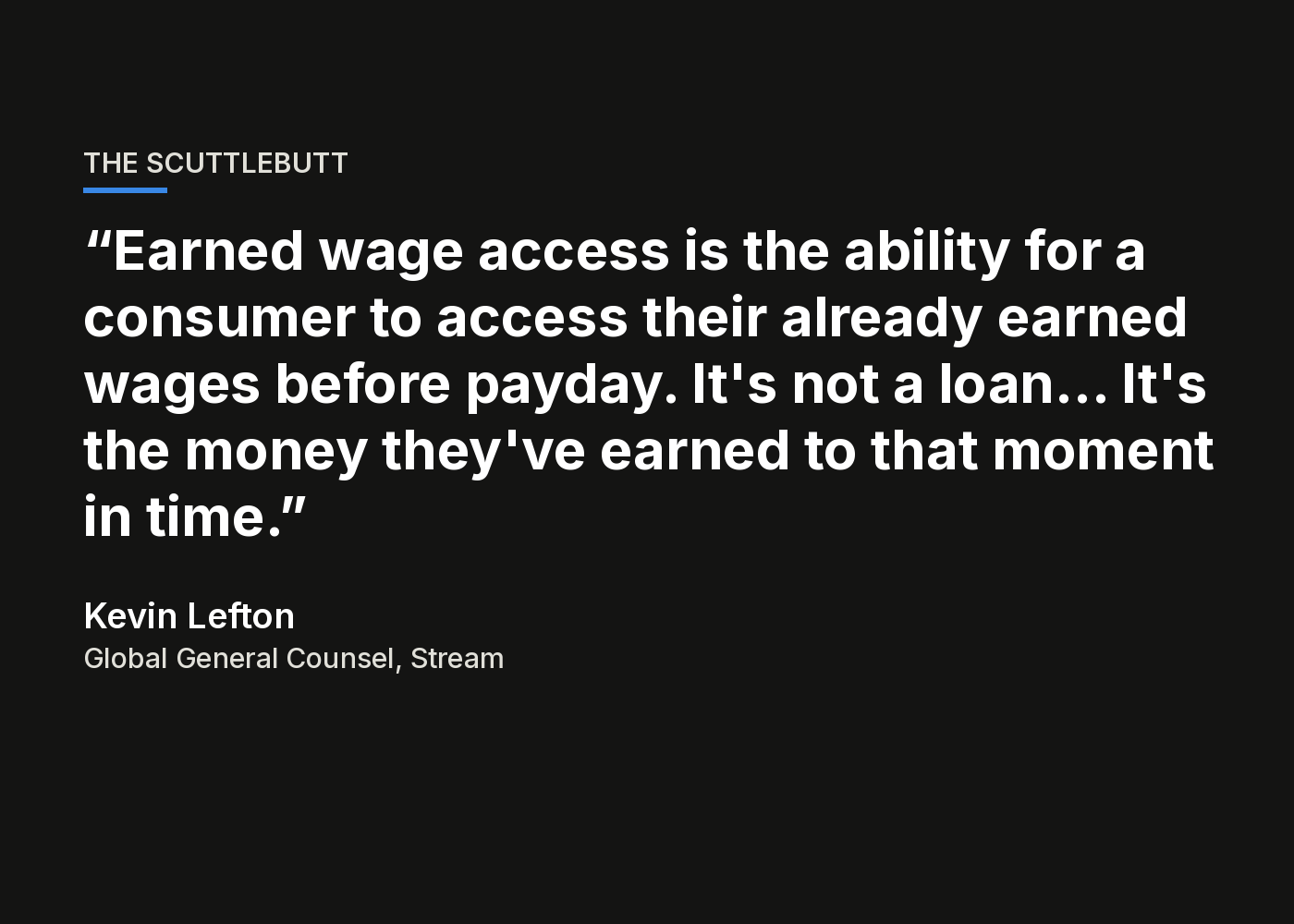
"Earned wage access is the ability for a consumer to access their already earned wages before payday. It's not a loan... It's the money they've earned to that moment in time." — Kevin Lefton
Stream was founded about eight years ago in London. Some of its investors are social-impact funds backed by charities, which Kevin said commits the company to put users' financial health first, something he believes no competitor shares. It has about 300 US employer clients, including Albertsons, Dollar General, Five Below and Wayfair, and more than 2,000 in the UK.
Stream charges nothing to employers or workers except a flat fee for instant transfers
"If you want to access your earned wages instantly, then there is a flat nominal fee of up to $3.29... 99% of the time it's within 24 hours." — Kevin Lefton
Standard transfers are free and clear in one to three business days. Kevin compared the model to Venmo, which he has used for five years without paying. US rivals include DailyPay, Payactiv and ZayZoon. He said Stream's budgeting and coaching tools set it apart, and that a feature for tracking earnings is the most-used part of its app.
