

The Meb Faber Show · Oct 9, 2026 · 46m · 33m saved
With Andrew Ang, Founder and President of Tau Balance, professor at Columbia Business School, formerly Head of Factor Investing Strategies at BlackRock
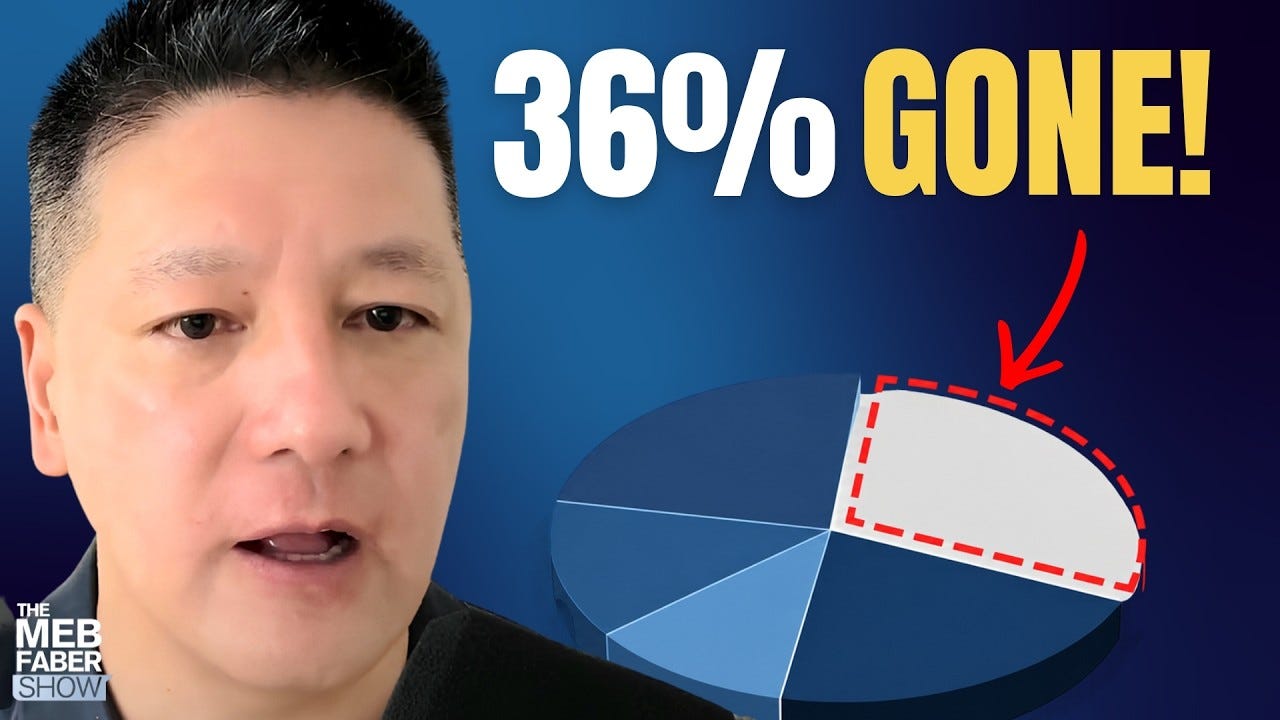
A tax drag of 160 to 170 basis points a year sounds small. Compounded over 30 years, Andrew Ang says, it erases 36% of a stock portfolio.
Most investors can say exactly how much of their income goes to taxes. Almost none can say how much of their stock return does — and Ang's research puts a number on it for the first time across a century of data.
"It sounds small, but you compound that over 30 years and that results in 36% of your portfolio that just disappears."
Ang wrote the paper behind that number, "Uncle Sam's Cut," after a breakfast conversation with Jason Zweig left him unable to answer a simple question. He previously ran factor investing at BlackRock and now runs Tau Balance, which builds AI agents meant to run an institutional investment committee's asset-allocation process end to end. He joins Meb Faber on his show.
The full interview is covered here so you can skip it. 46 minutes of audio, 13 minutes of reading.
Here are the 8 takeaways that matter.
Key Takeaways
A 160-to-170-basis-point annual tax drag compounds to 36% of a stock portfolio lost over 30 years, Ang's research found
That drag is historically low — the full-century average is about 350 basis points, and it topped 500 in the 1940s and 1950s
The highest marginal tax rate for an investor in New York City is 55.576%, versus 13.3% in California
Federal interest payments now run about 15% of the budget, more than defense spending, which is why Ang bets taxes are going up
A 10% private-credit yield is worth roughly 7% in after-tax equity terms, because it's taxed as income rather than as capital gains
His swarm of AI agents gives an investment process three things: scale (an agent specialized per asset class), interaction ("productive dissent" through voting on each other's proposals), and the ability to improve quickly
The top of an investment committee and entry-level analysts survive AI, he said — it's the middle that has to adapt
His ETF, ticker ANGU, holds four factors — momentum, quality, enhanced value and cyclical value — split a third, a third, a sixth and a sixth, and has about half a billion dollars in it
Tau Balance models every asset separately in every account type, because the after-tax cash flow of the same stock differs between a taxable account, a Roth and an IRA
1. Uncle Sam's 36% Cut
Ang set out to answer a question a colleague couldn't answer either.
Over breakfast, Jason Zweig asked what a taxable US equity investor actually keeps after taxes — and Ang couldn't answer it
"I was having breakfast with Jason Zweig and he asked this question — what does a taxable US equity investor actually keep after taxes? And I couldn't answer that, and it's an extremely important question, but it's a difficult one to answer because the tax code has changed." — Andrew Ang
The answer, from his paper "Uncle Sam's Cut": a drag of about 160 to 170 basis points a year over the last 30 years, which compounds to roughly a third of a portfolio's value
"The bottom line of this thing is, what's Uncle Sam's cut? And that number is about a third, right, over the last 30 years. It's the drag — that's the amount that you pay to Uncle Sam, it's about 160, 170 basis points per year. It sounds small, but you compound that over 30 years and that results in 36% of your portfolio that just disappears." — Andrew Ang
That figure doesn't include estate taxes or state-level taxes, which are levied on top of it.
