

The Founder Mindset with Reza Satchu · Nov 4, 2026 · 1h 1m · 54m saved
With Jon McNeill, Founder of DVx Ventures
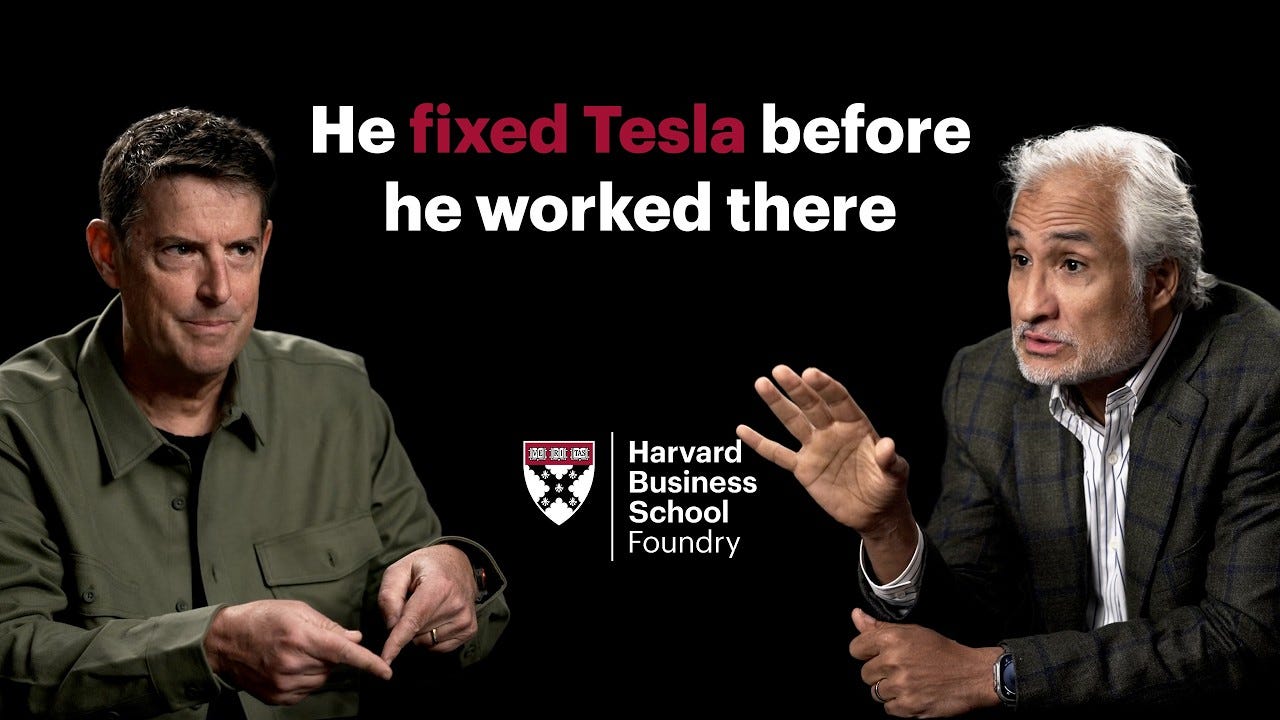
Jon McNeill helped grow Tesla's revenue from roughly $2 billion to $20 billion in about 30 months, running Elon Musk's global sales operation. He says the real engine behind that growth was not strategy but speed: Tesla made roughly 40 decisions on a given problem in the time a legacy automaker made one. Jon, founder of DVx Ventures and formerly president of global sales at Tesla and chief operating officer at Lyft, told Reza Satchu on The Founder Mindset that curiosity on its own never built anything.
"The first thing I wanted to do was solve a problem that hadn't been solved. And so that involves just a lot of curiosity." — Jon McNeill
Jon has built or scaled six startups across industries he had no prior experience in, working alongside Musk at Tesla and running operations at Lyft before founding his own venture studio.
The full interview is covered here so you can skip it. 1 hour 1 minute of audio, 7 minutes of reading.
Here are the 6 takeaways that matter.
Key Takeaways
Curiosity only works when it's pointed at large markets with large profit pools
Paired with an extreme bias to action, Jon says, in the best operators he's known
Jon's mother's mental illness left him with shame he spent decades trying to outrun
A teenage lawn-mowing business taught him more than his first consulting job
Musk wanted agency, not subordination, from the people who worked for him
Musk's refrain for people he trusted: "I trust their judgment"
Tesla made roughly 40 decisions on a problem before a legacy automaker made one
Amazon's "one-way door, two-way door" framework lowered the cost of being wrong
DVx was built with the same team that took Tesla from $2B to $20B in 30 months
It targets 5-to-10x returns, not 100x outliers, by avoiding crowded spaces
Jon's real scorecard is jobs created in his hometown of Kearney, Nebraska
1. Curiosity Alone Is Worthless
Curiosity is the one thing Jon says he has been actually committed to across six very different startups, a trait teachers noticed in him as a child who was "constantly churning on what if, what if, what if." But he drew a sharp line between that instinct and the version that actually builds something.
Curiosity only counts when it's aimed at a market worth building a moat in, Jon says
"I had to learn over time how to filter the curiosity to make sure I was pointing that curiosity into large markets with large addressable profit pools." — Jon McNeill
He said the second ingredient, seen consistently in the best operators he has worked with over 25 years, is an extreme bias to action once that insight arrives.
The best operators pair curiosity with speed, Jon says
"These people are insanely curious... and they combined this insane curiosity with an extreme bias to action." — Jon McNeill
