

Hard Fork Sep 25, 2026 1h 48m · 82m saved
With Jensen Huang, CEO of Nvidia
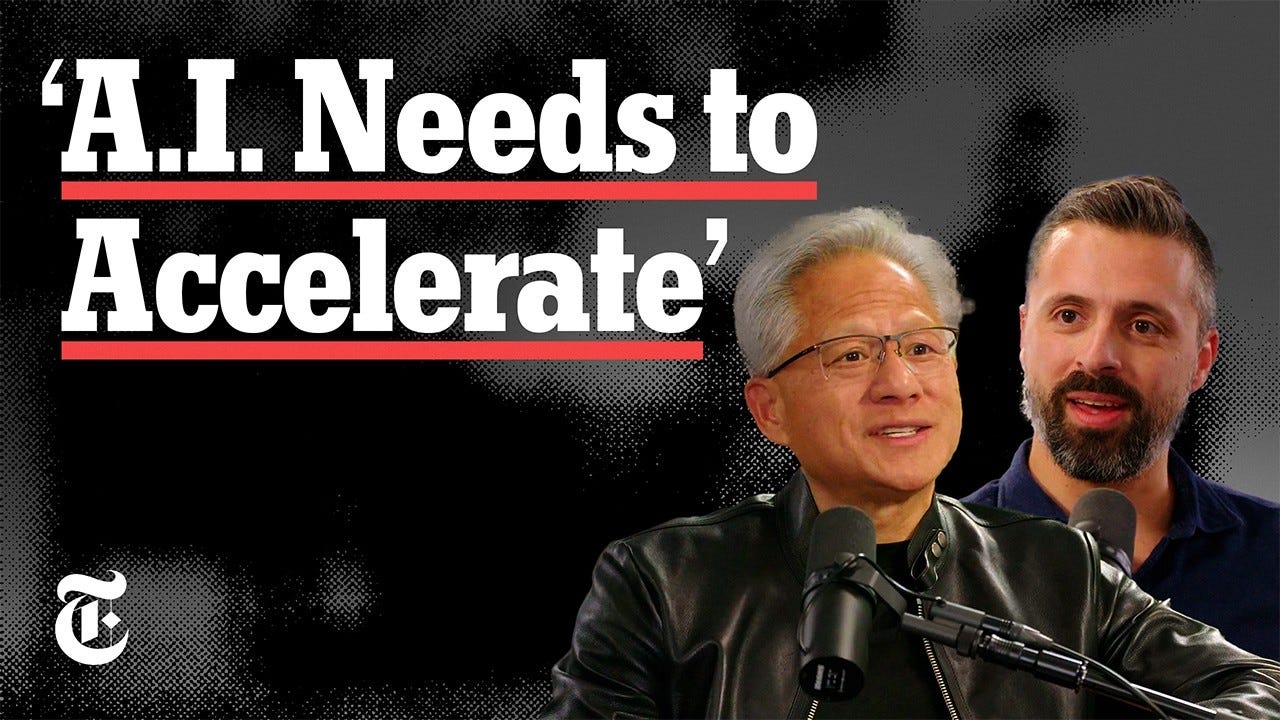
Nvidia puts about 80% of its chip work into verification and 10% to 20% into design, Jensen Huang said. Most AI labs, in his telling, run the reverse, with 80% on capability and 20% on safety testing.
Leaders and staff at the frontier labs have said publicly that competition is pushing them too fast and that they want help slowing down. Huang rejected the premise. A lab that believes it has lost control of its models, he said, should stop releasing them, and existing product liability law already gives it every reason to.
"If your product is not ready to ship, don't ship the product."
Jensen Huang, CEO of Nvidia, on The Ezra Klein Show, which Hard Fork cross-posted, runs the company that the show describes as designing nearly all the chips and infrastructure the rest of the AI industry relies on. The host put Nvidia's market value at $5.4 trillion, the largest of any company, and said 15 cents of every dollar the American stock market has returned since 2023 came from Nvidia stock. The interview was recorded at Nvidia's headquarters in Santa Clara, California.
The full interview is covered here so you can skip it. 1 hour 48 minutes of audio, 26 minutes of reading.
Here are the 19 arguments that matter.
Key Takeaways
Labs that believe they are out of control should not ship, Huang said, and existing liability law already punishes unsafe products
He opposes giving the labs antitrust or product liability relief to coordinate a slowdown
Geoffrey Hinton's 10% chance of societal destruction "is not grounded on science", in Huang's view
He pointed to Hinton's earlier call to stop training radiologists; demand for radiologists has since risen
AI will change every job but create more than it destroys, he said, because human ambition is missing from the forecasts
Nvidia spends most of its compute on verification, and Huang wants AI labs to shift the same way
He would not be surprised if development compute rose 10 times because of testing
Open models went from about 20% of tokens to a majority this year, by Huang's count
Nvidia's all-in ecosystem investment may be about $100B, a figure Huang said he would have to check
A 1-gigawatt AI factory costs $50B and rents for $40–50B a year, which is why he calls Nvidia compute an asset class like airplanes
An AI chip glut will come, but not in the next 2–3 years, followed by a digestion period he put at 6 months to a year
Denying China Nvidia chips costs the US a market, he said, and works against building the world on the American tech stack
The US will burn more fossil fuel for 4–5 years, and Huang called AI demand the best chance in a century to fund clean energy
1. AI as a Five-Layer Cake
The host opened by asking Huang to walk through his description of AI as a five-layer cake. Huang called AI a new industrial revolution that manufactures things and needs energy. Above energy sit the chips, then the AI factories that people know as infrastructure or cloud services, then the models, and on top the applications.
Models are not only language models
"And the important thing to realize there's language models, but there are models of all kinds of chemical models, biology models, physics models, articulation models, robotics, navigation models, self-driving cars, all kinds of different types of models." — Jensen Huang
The application layer matters most to him
"And then above that is the most important layer and the layer that I care most about that our country takes advantage of is the application layer and this is you know applications for legal services for health services for manufacturing so on so forth all every single industry is involved." — Jensen Huang
Asked what the world looks like if that top layer works, Huang said electricity let people power anything and the internet let them find anything. AI, in his view, will let them know everything and do anything.
Ask a question, get an answer
"In the future, you just ask it a question, it comes back with an answer. You give it a project, comes back with a solution, you give it a task, it comes back and gets it done, you know, and so and it comes out of the ether, comes out of the cloud." — Jensen Huang
