

Summation with Auren Hoffman · Sep 29, 2026 · 42m · 29m saved
With David Kirtley, Co-founder and CEO of Helion Energy
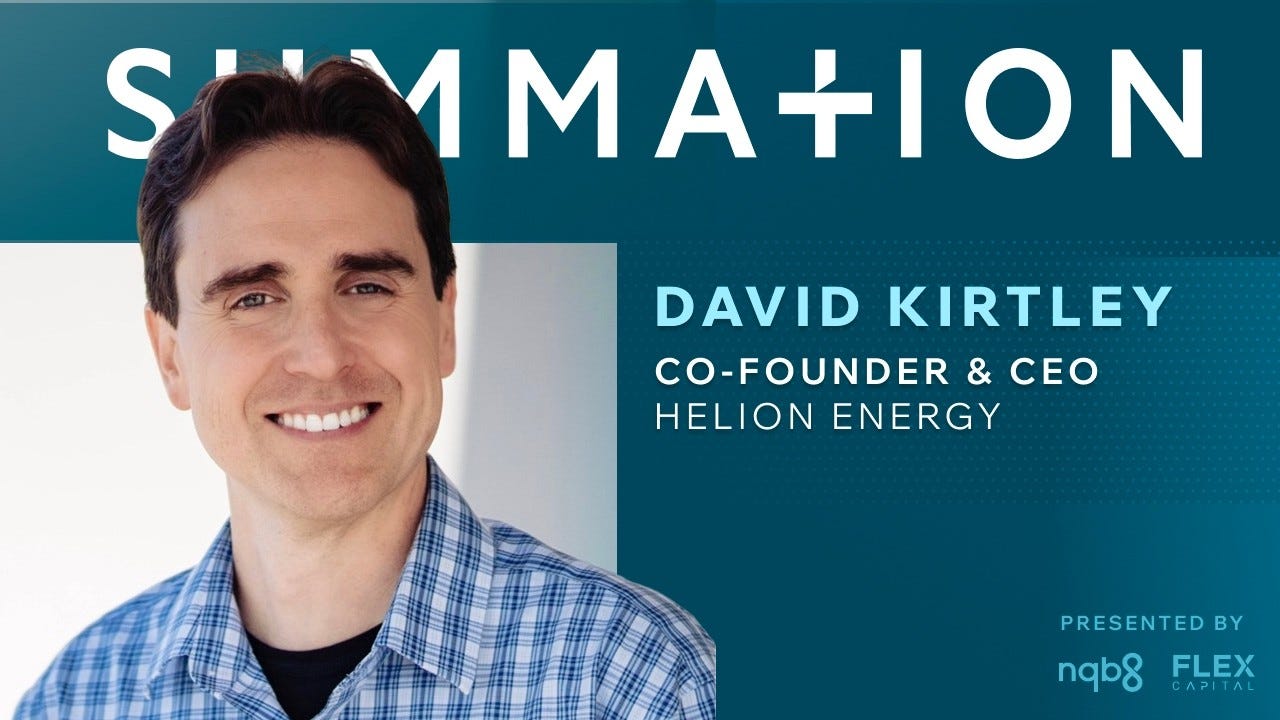
Helion Energy has raised more than $1.5 billion at a valuation above $15 billion, with Sam Altman as its largest investor and former chairman.
Most fusion companies aim for a self-sustaining reaction called ignition, then boil water with the heat to spin a steam turbine. Helion does neither. It pulses its reactor like a piston engine and pulls the electricity out directly.
"It's actually the fundamental thesis to what we do at Helion is directly recovering the electricity." — David Kirtley
Kirtley co-founded Helion after working on rocket and space propulsion, and has taken the company through seven generations of fusion machines, including Polaris, which he says became the first fusion device to exceed 150 million degrees while running on deuterium and tritium fuel. Helion has signed the industry's first commercial fusion power deal, a plant for Microsoft, plus a 500-megawatt agreement to power a Nucor steel mill.
The full interview is covered here so you can skip it. 42 minutes of audio, 13 minutes of reading.
Here are the 11 takeaways that matter.
Key Takeaways
Helion recovers 95% of the electricity it puts into each fusion pulse, roughly an order of magnitude above the single-digit round-trip efficiency Kirtley says is typical in fusion research
The reactor is regulated like a hospital particle accelerator, not a nuclear plant, because it uses no uranium or plutonium and cannot melt down
Fusion doesn't need to be "20 years away" anymore — modern semiconductors and gigahertz-speed electronics only became available during Kirtley's own career
A 50-megawatt facility fits in roughly 10 acres, and because there's no steam-turbine cooling loop, plants can be sited near data centers or factories instead of only on rivers
Helion can throttle output by changing its pulse rate, from one pulse every five minutes today toward one a second, so the plant can match grid demand instead of running flat out
Its first Series A investor, Mithril Capital, backed the company on a single proof point: that its pulse-power electronics could recover 95% of the electricity they put in
The company deliberately skips "ignition," the self-sustaining reaction most rival fusion approaches chase
Kirtley's response to critics: "I agree with you, except we don't do ignition"
Helion's cost target is one cent per kilowatt hour, against roughly 7 to 20 cents today, a bet tied to AI's growing power demand
Helion makes its own helium-3 fuel as a byproduct of fusing deuterium, rather than buying it, and won't sell the surplus until it has deployed many power plants
Sam Altman visited Helion early on with a stack of fusion textbooks and asked Kirtley to explain why they were wrong
Kirtley says the industry's real bottleneck was capital and patience, not physics — the core magnet-confinement concept was theorized in the 1950s, before the transistor existed
1. Skip The Steam Turbine
Auren Hoffman asked why Helion doesn't simply capture fusion heat the way most reactors do. Kirtley said the industry standard wastes a step.
Helion pulls electricity straight out of the plasma instead of boiling water with it
"It's actually the fundamental thesis to what we do at Helion is directly recovering the electricity." — David Kirtley
Most fusion projects measure success in heat, not electricity, he said, then run that heat through a steam turbine and a cooling tower — a process he called "pretty inefficient." Helion's reactor is already handling charged particles in an electromagnetic field, so it recovers electricity directly, the same way a car's regenerative brakes recapture motion as charge. That lets the company do less fusion overall, since only the energy lost in the process has to come from the reaction itself.
The company has demonstrated 95% round-trip electrical efficiency
"And in our systems, we have demonstrated 95% of the electricity you put in, you recover and recharge all that." — David Kirtley
