

The Fed has not seen inflation at its 2% target in more than five years, and Meghan Swiber, a U.S. rates strategist at Bank of America, said on WSJ's Take On the Week that Fed Chair Kevin Warsh is now watching the stock market for a sign that demand is slowing. Until it sees one, she said, the Fed is probably going to keep raising rates.
That was one argument from one interview. Ten other summaries from the day carried a claim worth weighing. Piper Sandler's chief investment strategist counted only 40 companies in the S&P 1500 that link their use of AI to better margins. A private credit investor said no new money is flowing into the strategy. An income investor said discounts on credit funds imply default rates of 20% to 40%, which have never happened.
"His focus really is on the market. It really is on the overall financial environment and whether or not that is slowing demand. And again, you look at equities, you look at risk assets, there's very little signal to the Fed right now that anything is slowing down. ... And likely some correction in equities, yes. Because if the Fed's waiting for that to happen, they're probably going to keep hiking until they get that signal back from the equity market." — Meghan Swiber, U.S. Rates Strategist at Bank of America, on WSJ's Take On the Week
We scanned 531 shows and 9 hours of audio, wrote 11 summaries, and pulled 21 quotes into this 11-minute read.
Here is what mattered.
Macro
BofA's 33% earnings forecast is already in the S&P 500's price
"It's a very dangerous market. And if you want proof of that, Andrew, there was a note that came out from Bank of America that said they're expecting 33% earnings growth year-over-year. You know the importance of that number. We usually see 8 and a half% annually. ... And Bank of America said they expect those earnings to continue through the year end, ... but their S&P target is 1% higher than it is now. So basically, they're saying that all of that earnings growth is 100% priced in." — Frank Curzio, Founder and President at Curzio Research, on The Disciplined Investor
Diesel is up 40% in a month, and companies will have to pass it on
"You have to look at diesel. Everything that you see in a store everything you see everywhere is driven there is you know shipped there and those prices in a month have gone up 40%. ... I'm just saying with the higher interest rates I'm very very nervous and also you throw in higher energy which doesn't seem like it's going away anytime soon but ... these companies are going to have to pass on these costs." — Frank Curzio, Founder and President at Curzio Research, on The Disciplined Investor
Warsh's promise to fight inflation is what drove yields up
"The Fed hasn't seen inflation come back to its 2% target in well over five years now, and it's the commitment that the market is hearing from Warsh to address this inflationary pressure that really is driving yields up in the US in particular." — Meghan Swiber, U.S. Rates Strategist at Bank of America, on WSJ's Take On the Week
1,200 companies said nothing about AI and are still running hot
"In fact, if we just look at the companies that did not say anything about benefiting from the AI buildout, which is again the bulk of the S&P 1500 today, their earnings PMI is at 60.6. Still a very strong number. So the statement that oh it's all AI holds more water in the context of the magnitude of the strength for sure but it is clearly not true that the economy and earnings have improved over the last 15 months just because of AI because there's 1,200 companies that have said zero about AI and are running pretty hot." — Michael Kantrowitz, Chief Investment Strategist at Piper Sandler, on What's Next For Markets
International
Managers of $2T are asking about Canada as never before
"Around the table in our meetings is $2 trillion US dollars in AUM and multi-asset funds. They have been asking me, us, questions about investing in Canada recently in a way that I have not heard in my 14 years at Fidelity. As you might imagine, not much of that 2 trillion USD has to move from the United States to Canada to make a big difference in our local markets." — David Wolf, Portfolio Strategist at Fidelity Investment Management Canada, on FidelityConnects
The Canadian dollar is likelier to reach 82 US cents than 62
"We don't have a Canadian dollar forecast. ... What we're saying with our overweight to the Canadian dollar is we think the balance of risks is to the upside. One way to think about that, so we're 72 cents-ish now, are we likely to go to 62 cents? That's the 2002 low. Is that going to happen when you have the US dollar going down and commodity prices going up? It seems very implausible. Could it go on the other side to 82 cents? Well, that's historic average, that's purchasing power parity, that is much more reasonable." — David Wolf, Portfolio Strategist at Fidelity Investment Management Canada, on FidelityConnects
8 super app stocks are down about 35% as a basket in 12 months
"The other thing that ties them all together is they have been beaten up over the past 12 months. ... If we roll that up, if that was an ETF of super apps, an equal weighted basket of those eight is down approximately 35% in the past 12 months." — Bryce Leske and Alec Renehan, Co-founders and Co-hosts at Equity Mates, on Equity Mates Investing Podcast
Financials
Owning bonds means giving up about 4 points a year of growth
"And I think it's all about your definition of risk. Like day-to-day bonds are less volatile than stocks. ... And you look at like the real return on stocks. So the return after inflation and it's about 7%. ... And then you compare that to bonds and depending on like what the duration of the bonds you're looking at are maybe the real returns are anywhere from like 1 to 3%. Let's be friendly and call it 3%. So, you're like knowingly accepting 4 percentage points less of long-term growth when you allocate to bonds." — Peter Lazaroff, CIO at Plancorp, on Bogleheads On Investing Podcast
Credit-fund discounts imply default rates of 20% to 40%
"And when you realize that for credit funds, a default rate from the like back in the great crash of 18 years ago or whatever it was, the defaults got as high maybe as 10, 11, 12%. ... you had 12% defaults and got back half your money, you'd have a 6% loss rate. ... that discount is presuming you'll have default rates of 20%, 30%, 40% which is unheard of in history." — Steven Bavaria, Founder at The Income Factory, on Thoughtful Money with Adam Taggart
PIMCO's PDI fund yields 19% and trades at an 8% discount
"PIMCO is one of the biggest names in bond funds and has been for years. ... I know a few that are that are at discounts now that haven't usually been at discounts. PDI is one of them. ... It's paying a yield now of 19%. I don't know how long they'll be able to hold that, but I think it's fully covered by their net investment income at the moment. And it's selling at an 8% discount, having been at a premium for a long time." — Steven Bavaria, Founder at The Income Factory, on Thoughtful Money with Adam Taggart
Alternatives and PE
Blackstone's credit fund got withdrawal requests for 10% against a 5% cap
"Gating is doing what it was designed to do. So, I think the bigger issue is that the product was sold as if the gate did not exist. ... So the gate is at 5% they received requests for 10% of the shares outstanding so about 8 billion. ... So I wouldn't say that there's trouble in the market. There's just a line for those that want out." — James Elbaor, Founder and Portfolio Manager at Marlton LLC, on Other People's Money with Max Wiethe
No new money is flowing into private credit, and mergers come next
"We all saw in Forbes recently around the Blue Owl founders, other founders of private credit firms becoming billionaires. That's done. There's no new money, no new capital flowing into that strategy right now. ... So where I think the next leg comes which will be probably starting next fiscal year I fully expect to see a lot of merger activity within the BDC space and private credit space." — James Elbaor, Founder and Portfolio Manager at Marlton LLC, on Other People's Money with Max Wiethe
Consumer
Consumer staples have the weakest pricing power, at 52
"At the bottom of the list, what companies have the weakest pricing? It's all about the consumer. It's consumer staples at a 52, which is a number that declined in Q2. And we're hearing plenty of consumer companies that are struggling now because their input costs are going up, but they can't continue to increase prices on the consumer because the consumer is either certain consumers are just tapped out or consumers are being looking to substitute cheaper products. ... And you heard it a lot where some companies took the strategy of lowering price to regain or maintain market share and very few companies have actually raised prices." — Michael Kantrowitz, Chief Investment Strategist at Piper Sandler, on What's Next For Markets
Technology & AI
Meta's US and Canada ad prices rose 20% while ads shown grew 9%
"However, if you split that up by region the US and Canada saw only 9% growth in impressions and prices jumped 20%. And then in Asia, impressions were up 17% and prices were up just 1%. So I know that's a lot of numbers, but to me that discrepancy suggests that pricing growth in the US is likely not going to be because the ads are actually becoming more effective, but rather that meta is sort of reducing advertisers return. ... Otherwise, I think why wouldn't prices also grow faster in Asia? ... So, I have to assume that Meta's sort of turning the dial in North America to get growth there right now." — Daniel Mahncke, Analyst at The Investor's Podcast Network, on The Intrinsic Value Podcast
Micron's 86% margin guide tops Nvidia's peak, but memory is cyclical
"Because last quarter they guided for 86% gross margins after printing 84.6. And so if we're in the 80s range, and that means that Micron right now has the highest gross margins in entire sector, even higher than Nvidia's own peak margins, which is crazy to think, right? Memory is still cyclical. It's crazy to think that margins are just gonna go up endlessly from here. ... And we don't think the market's gonna be very forgiving if ... Micron's gross margins aren't guided to expand again into the first quarter." — Sara Awad, Analyst at Tech Contrarians, on Investing Experts
Memory could swing from shortage to glut very quickly
"If we get more supply on the table the logic would only say that you're gonna have pricing cool off a bit. And at the same time, aside from supply coming on, you also have this weak end demand that we're talking about outside of the realm of AI. ... So when in our opinion, we could go very quickly from a shortage to a glut." — Sara Awad, Analyst at Tech Contrarians, on Investing Experts
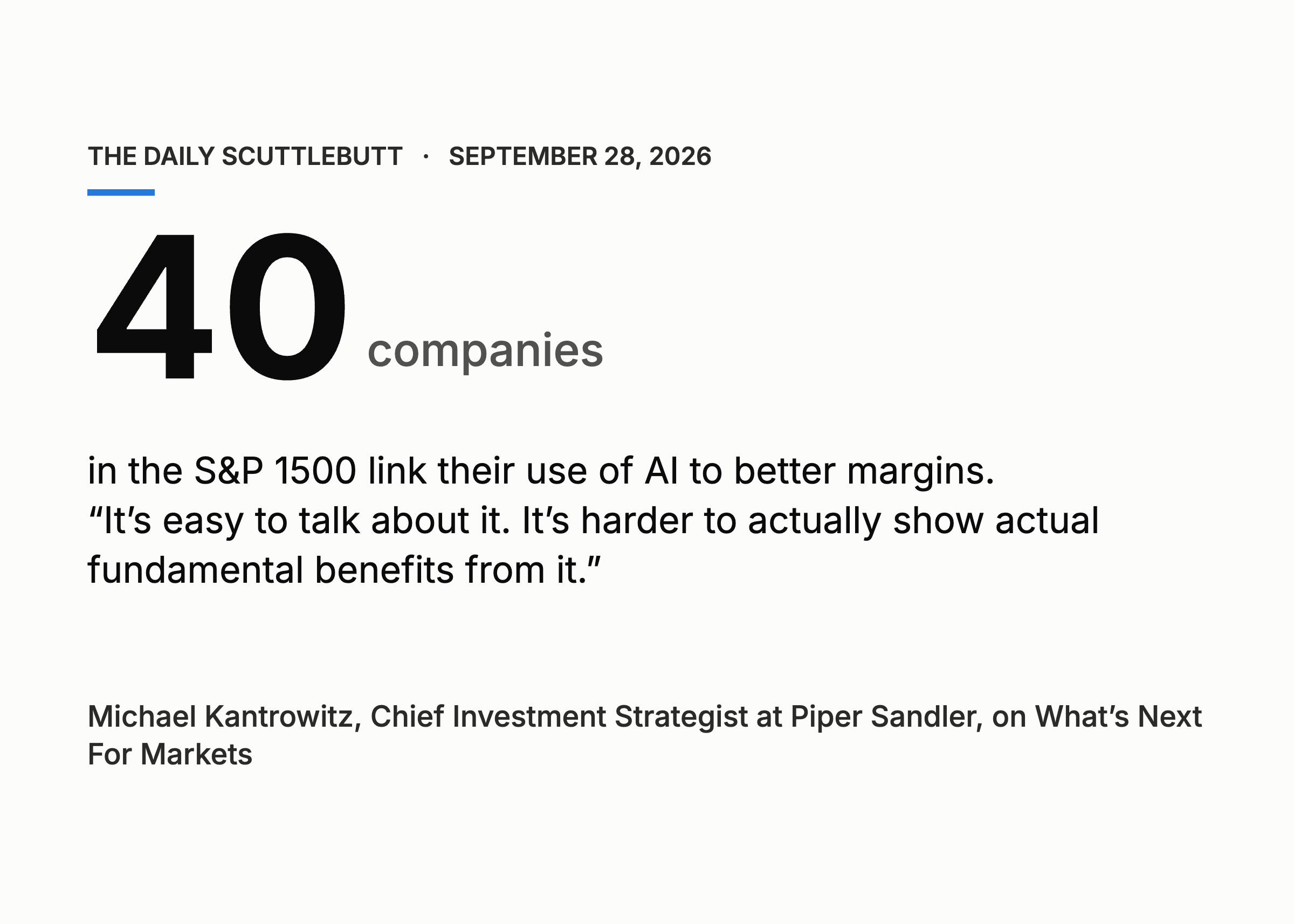
Only 40 of the S&P 1500 tie their AI use to higher margins
"So there's more companies talking about it just under half but only a small fraction of those companies are actually putting numbers behind it. And even a smaller fraction, only 40 companies in the S&P 1500 are actually putting a stated margin link between their use of AI and seeing actual EBITDA margins for example improve. ... But again, it's easy to talk about it. It's harder to actually show actual fundamental benefits from it. So, it's still pretty early on." — Michael Kantrowitz, Chief Investment Strategist at Piper Sandler, on What's Next For Markets
VC & Startups
More than 70% of Harvey's staff joined in 2026
"And yeah, we've added over a thousand employees since I've joined and will likely be about 2,000 employees before the end of this calendar year, which is insane. ... More than 70% of the company started after January 1st of this year." — Maggie Landers, VP of Talent at Harvey, on a16z
Harvey says it does in a month what others do in a quarter
"I think that Harvey is unique in certain ways. I think our pace is pretty unique. We move very quickly. ... Yeah, you're going to do more in a month at Harvey than you would in a quarter somewhere else." — Maggie Landers, VP of Talent at Harvey, on a16z
Nuggets of Wisdom
The story behind a market drop scares investors more than its size
"So, like just throwing some generalities out there, like the market falls 10% on average about every 12 months. It falls 20% on average every 3 and 1/2 years or so. And then it falls 30% or more about once a decade. ... I think you can get people comfortable with that and they can even live through some of them. ... But what I've gained a greater appreciation over the past two decades working with people is that it's not necessarily the percentage decline or even the dollar value loss. It's the narrative tied to it. ... I've just come to appreciate that the narrative is sort of what scares people." — Peter Lazaroff, CIO at Plancorp, on Bogleheads On Investing Podcast
Other appearances:
Gradient Investments senior portfolio manager on Nvidia growing more than 100% this year on Fox Business
Turtle Creek Wealth Advisors chief market strategist on a fourth-quarter rally driven by lower oil and lower rates on Fox Business
Palomar Capital founder on why Anthropic at a $2 trillion valuation never pays investors back on Patrick Boyle On Finance
Intelligent Internet founder on why a ban on superintelligence would be a ban on math on Moonshots with Peter Diamandis
Apple Store creator on why Apple never discussed its stock price in executive meetings on Motley Fool Hidden Gems Investing
New York Apartment Association CEO on vacant rent-stabilized units coming back to the market on The Journal.
Vivodyne co-founder and CEO on virtual cell models that stop improving after a small share of their data on The Cognitive Revolution
Archetype AI co-founder and CTO on training a physical AI model on close to 1 billion hours of sensor data on The Cognitive Revolution
Ornn co-founder and CTO on why bigger GPU orders cost more per hour, not less, on The Cognitive Revolution
Fiscal Policy Institute chief economist on New York City's rent freeze on The Journal.
Cooperative AI Foundation research director on AI labs and colluding agents on The Cognitive Revolution
Coefficient Giving grantmaker on why talent, not money, limits AI safety work on The Cognitive Revolution
If this was worth your time, send it to someone who has to follow all of this too.
What did you think of today’s edition? Hit ‘reply’ to this email, send us a message, leave a comment, or join the chat!
Get the latest market chatter as it happens: