

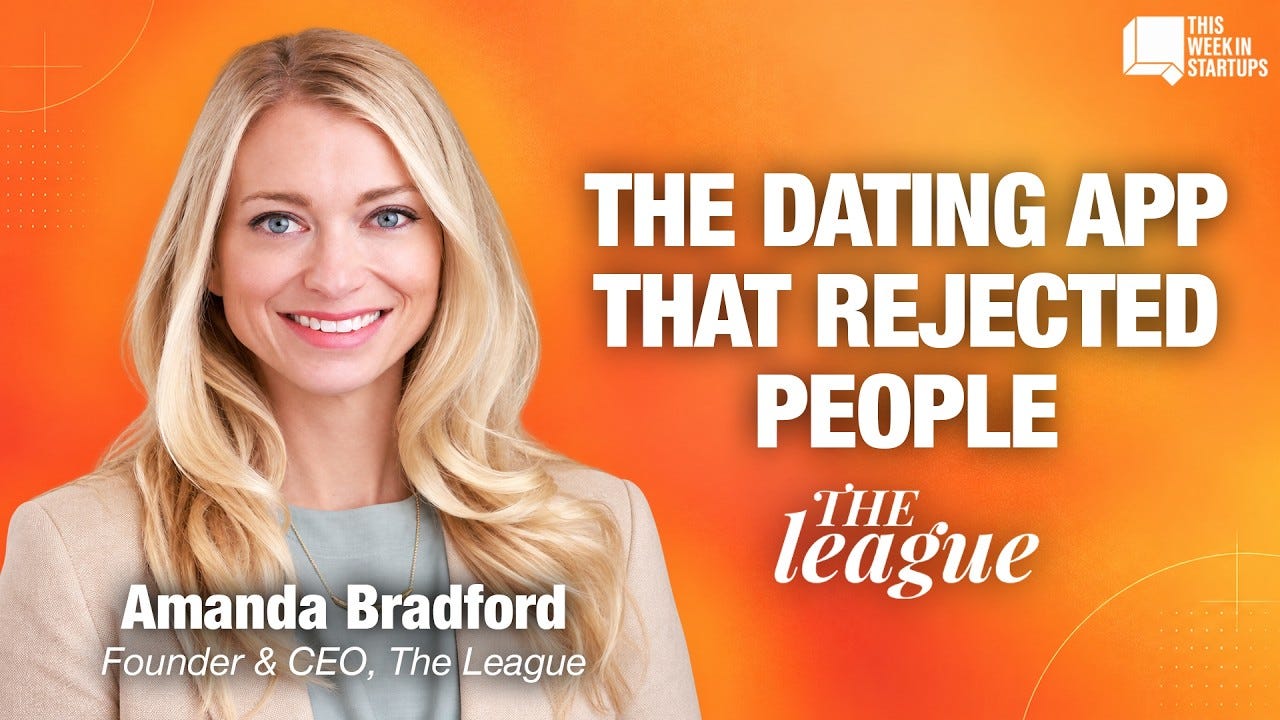
Amanda Bradford ran a dating app for five months before it had a single line of billing code, and she still knew 15% of users would pay for a premium tier she hadn't built yet.
Most startups wait until the product works before testing whether anyone will pay for it. Amanda Bradford, founder of The League, did the opposite: she told users their card had already been charged for a "Heavy Hitter" upgrade that didn't exist, just to see who clicked the button.
"Do you want to upgrade to heavy hitter?... we charged your card, now you're a heavy hitter... it was a total fake-out, but about 15% of people pushed the button." — Amanda Bradford
Amanda built The League as a solo founder, personally reviewing every application before hiring her best friend to help, and sold the company to Match Group in 2022 after growing it into 155 cities.
The full segment is covered here so you can skip it. 28 minutes of audio, 7 minutes of reading.
Here are the 6 takeaways that matter.
This Week in Startups · Oct 26, 2026 · 28m · 21m saved
With Amanda Bradford, Founder of The League (sold to Match Group in 2022)
Key Takeaways
Amanda tested willingness to pay with a fake "charged your card" button before The League had any billing system
About 15% of users clicked an upgrade button that told them they'd already been charged, nine months before real monetization existed
She ran five months of free parties before launch instead of one big event
Bars and gyms gave her discounted rooms and empty time slots in exchange for a minimum spend or free promotion
Capping the launch cohort at 500 users instead of 5,000 was deliberate
From roughly 419 waitlisted people, she picked 500 obsessed early users rather than opening the app to a crowd that would surface every flaw at once
The League was the first dating startup to verify users through LinkedIn, and the first to run an admissions-based process
That same LinkedIn data let her exclude matches with people at the same employer, a filter women cared about and men mostly didn't
Expanding to 155 cities was a mistake, Amanda now says
Revenue from cities 21 through 155 was negligible against the added operational complexity; she'd cap it at 20
She pitched roughly 30 journalists by hand before launch and never paid for press
Coverage leaned into an "elitist dating app" label that excluded some people while drawing in others who wanted to belong to an exclusive group
1. A Business-School Dating App
Amanda built The League after noticing that business school gave her a tight, ambitious, vetted peer group that disappeared the moment she graduated.
Business school gave her the exact dating pool that vanished after graduation
"I was in this pool of amazing, very eligible people, and now I'm in the real world and they all go away, and now you're back to like Tinder." — Amanda Bradford
She positioned herself as "technical enough that engineers don't like me, but not technical enough to do their job," and built the company alone rather than waiting to find a technical co-founder.
Being a solo founder, not the exception, is the point she makes to other founders
"I was not... the last speaker who had a co-founder. I was a solo founder. So shout out to anybody who's solo founding." — Amanda Bradford
