

DoubleLine Capital · Oct 9, 2026 · 1h 2m · 41m saved
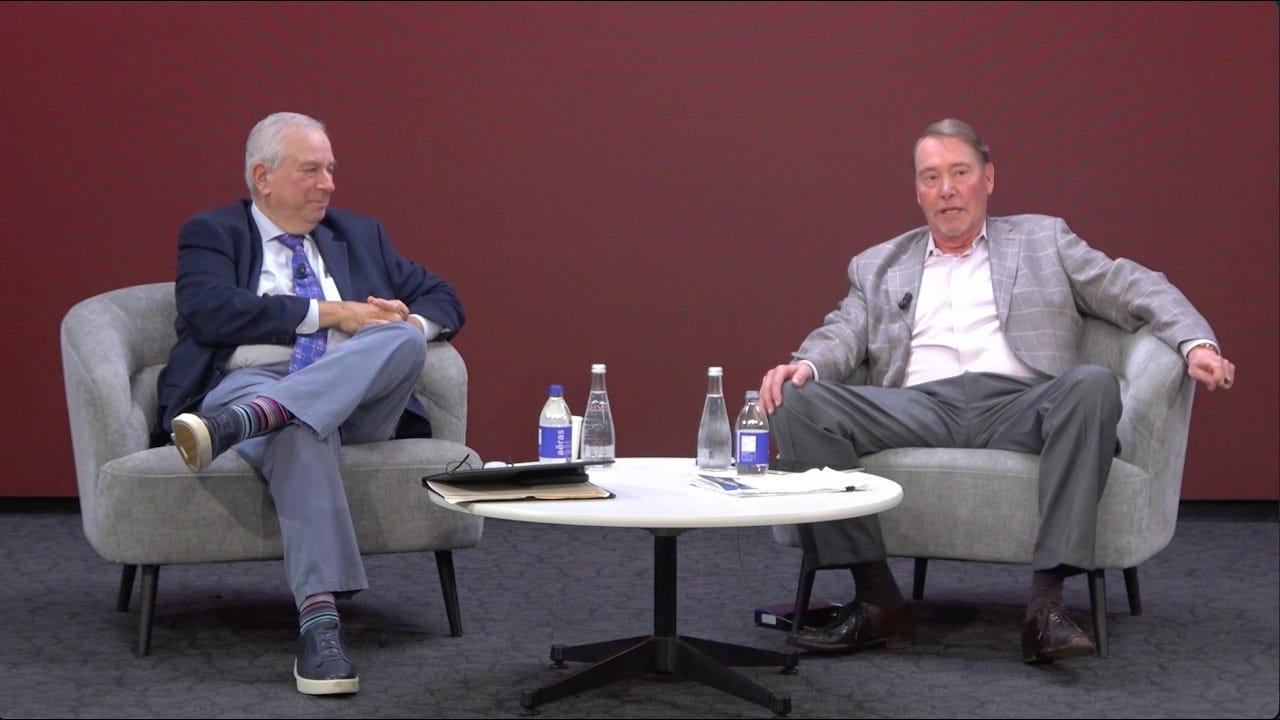
With Jeffrey Gundlach, CEO and CIO of DoubleLine · David Rosenberg, Founder and President of Rosenberg Research
The Federal Reserve cut rates by 175 basis points between September 2024 and January, and Jeffrey Gundlach said every maturity on the Treasury yield curve ended about 100 basis points higher.
Gundlach traced rising long-term yields to war-driven fuel prices, record government bond issuance and AI borrowing, and said the US interest bill leaves two ways out: printing money or restructuring the debt. David Rosenberg, who interviewed him on stage, blamed the Fed under Kevin Warsh and said he would buy bonds once a recession arrives.
"So, there's all this rot that's in the S&P 500, but it's not in plain sight." — Jeffrey Gundlach
Jeffrey Gundlach, CEO and CIO of DoubleLine, appeared on the cover of Barron's in 2011 as the new bond king. David Rosenberg, founder of Rosenberg Research, was chief economist at Merrill Lynch through the financial crisis. Their live conversation was published by DoubleLine Capital on YouTube.
The full interview is covered here so you can skip it. 62 minutes of audio, 21 minutes of reading.
Here are the 18 calls that matter.
Key Takeaways
Most stocks are already falling while the S&P 500 sits near its high, Gundlach said
He likened the market to the hollow 100-year-old maple at his Buffalo house
Gundlach sees only two ways out of the US interest bill: print the money or restructure the debt
Rosenberg said the bond market is the most unsettled he has seen in 40 years, and compared it with Canada's near-failed auction in 1994
Rosenberg blamed the bond sell-off on Kevin Warsh's Fed, not on deficits, and called Warsh dangerous
Spreads on AI-linked corporate bonds have widened while the rest of the credit market has barely moved
AI high-yield bonds are out by over 150 basis points, Gundlach said
Gundlach wants a 6% yield before he buys the 30-year Treasury, and said 30-year TIPS give no protection against it
Gundlach would buy gold "with both hands" below $3,800
Older mortgage bonds yield nearly 7% and are close to risk-free, in Gundlach's view, and he keeps at least 20% in short, high-quality bonds
Gundlach's model puts the fair 10-year yield near 4.95%, against about 5.25% today
He said private-equity-owned insurers are being loaded with weak private credit, as the CDO market was in 2005 and 2006
For anyone who must own US stocks, Gundlach prefers equal-weighted over cap-weighted
1. The Hollow Tree
Rosenberg opened by saying he did not remember "being this confused and in such a period of heightened uncertainty since I was at Merrill back during the financial crisis". He said he was not predicting a financial crisis but could not rule one out, and that trouble in the Treasury market does not stay there. A rise in bond yields usually reaches credit and stocks with about a three-month lag, he said.
Under the index, most stocks are already in a correction
Rosenberg said Gundlach had reminded him earlier that 75% of the stocks in the S&P 1500 are in a correction, and that the average and median stock is 10% to 15% below its 52-week high even as the cap-weighted indexes look fine.
Gundlach then told a story. His house in Buffalo, built in 1911, has a silver maple more than 100 years old that looked healthy. Less than a year ago a limb about 100 feet long fell off and nearly hit the chimney. His brother told him the whole tree had to come down because it was completely hollow.
"It was on the edge of complete failure." — Jeffrey Gundlach
Gundlach said the S&P 500 is the same tree
"Well, I saw a statistic today that when it gets to the S&P 500, which is very close to its all-time high, 440 of the stocks in the S&P 500 are down more than 21% from their high, which is pretty remarkable." — Jeffrey Gundlach
"And I feel like there's a direct parallel to all of this in the private markets." — Jeffrey Gundlach
