

TBPN · Sep 24, 2026 · 17m · 9m saved
With Erika Alden DeBenedictis, Co-Founder and CEO of Pioneer Labs
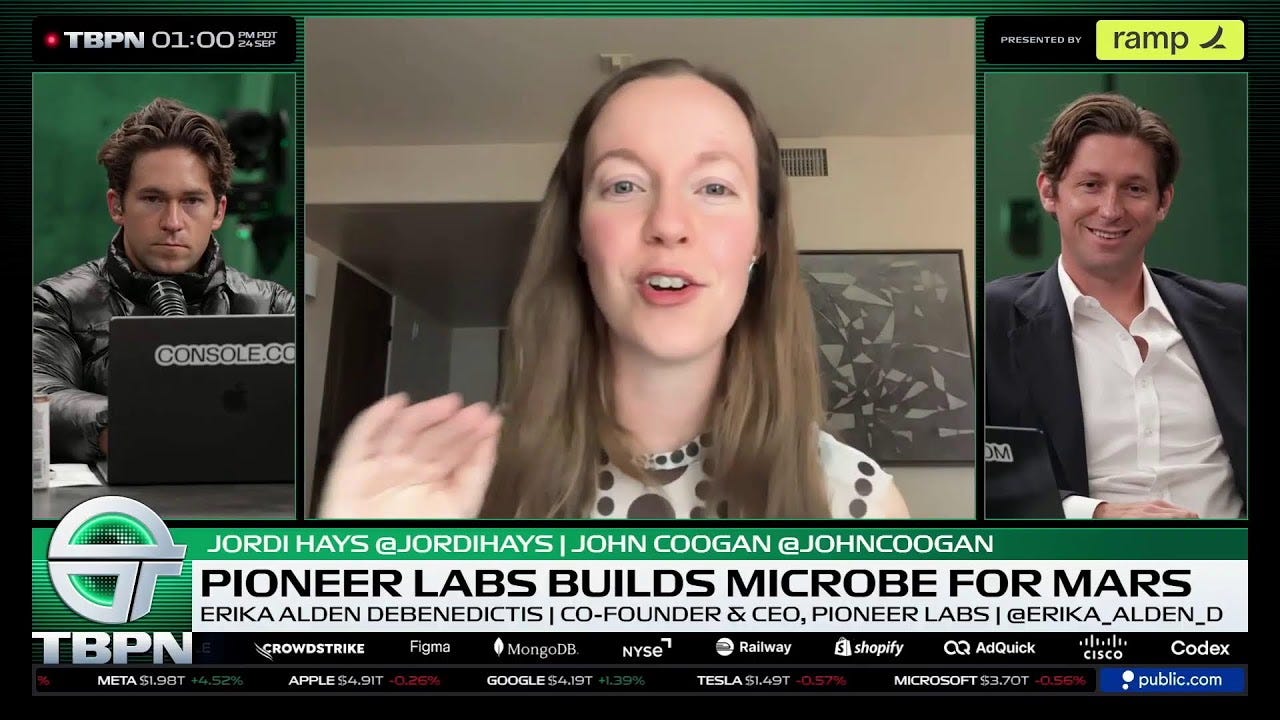
Pioneer Labs has engineered a microbe that lives on nothing but Martian dirt, water and air and turns them into bioplastics that could be used to build houses, its chief executive Erika Alden DeBenedictis said.
Most companies building for space sell rockets, satellites or data centers to customers who already exist. Pioneer Labs is working on what people would need to live on Mars, and it is a nonprofit because nobody there can buy anything yet.
"Mars like sucks at the moment."
DeBenedictis, co-founder and CEO of Pioneer Labs, on TBPN, took about two years to build the first of the five organisms she says are needed to make living space on Mars at scale, and expects to have a version of all five by about 2029.
The full interview is covered here so you can skip it. 17 minutes of audio, 8 minutes of reading.
Here are the 6 predictions that matter.
Key Takeaways
Mars had liquid water 4 billion years ago and could have hosted life before it diverged from Earth
Pioneer's first microbe eats Martian dirt, water and air and makes bioplastics for building houses
The lab is a nonprofit because there is no customer on Mars, though the case for one is building
Space will not be just NASA and SpaceX, and biotech is its own slice with little competition so far
All five organisms by about 2029, with a Mars launch window in 2028 and another in early 2031
Planetary protection rules were written for nuclear tests, and human microbiomes cannot be sterilized
1. Mars Was Once Like Earth
DeBenedictis introduced herself as CEO of Pioneer Labs, which engineers life for Mars so that people can go there and breathe, eat, grow flowers and live well.
The red planet is red, for now
Jordi Hays said he had seen a picture of Mars without the usual orange tint and asked whether Mars is really red. She said it currently is.
"Mars like sucks at the moment." — Erika Alden DeBenedictis
Two planets that diverged
About 4 billion years ago, she said, Mars was very similar to Earth. It had liquid water and should have been able to host life. About 3.5 billion years ago the two planets' paths diverged. Earth evolved photosynthesis and a biosphere that produces the oxygen people breathe.
The raw materials are still there
Mars is now very cold, she said, but still has the raw materials for life. Much of its northern hemisphere has permafrost, with a frozen glacier of water just below the surface. Billions of years of surface radiation have also left toxins in the soil, which would be very toxic to people if they grew potatoes in it directly.
"So there is work to do to go there at all or even more work to do to live there permanently or in great numbers." — Erika Alden DeBenedictis
