

In Good Company with Nicolai Tangen · Oct 14, 2026 · 44m · 35m saved
With Spencer Rascoff, CEO of Match Group and Co-Founder of Zillow
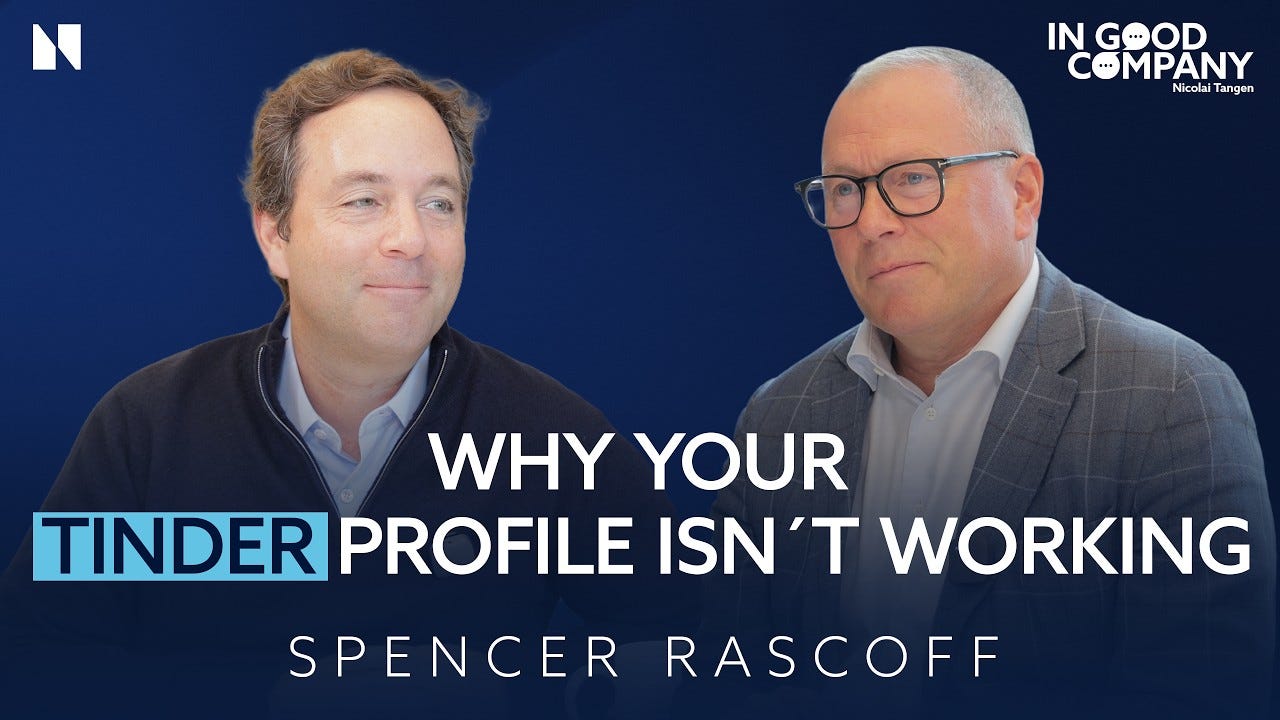
Tinder gained 17 points of employee engagement in a single year after a new chief executive took over its parent company in February 2025.
Spencer Rascoff, CEO of Match Group, told Nicolai Tangen on In Good Company that the owner of Tinder and Hinge had drifted toward short-term revenue. Most turnarounds start with pricing. Spencer started with a listening tour and a new product roadmap, and left monetization for last.
"The company had sort of lost its way. It had not been innovative, it had been run too much by Wall Street for Wall Street essentially, which to me means very short-term focused, very focused on squeezing every nickel out of our users." — Spencer Rascoff
Spencer founded Hotwire and sold it to Expedia for $700 million, then co-founded Zillow and took it public. He came out of retirement to run Match Group, which owns about a dozen dating apps.
The full interview is covered here so you can skip it. 44 minutes of audio, 9 minutes of reading.
Here are the 11 insights that matter.
Key Takeaways
Match Group merged its separate recommendation queues into one, and Spencer says matches and chats improved sharply
The matching algorithm is not yet real time, a gap Spencer expects to close by the end of the year
A one-photo gym selfie loses; seven or more photos and written content win
Spencer calls loneliness "an existential risk to society" and says it is what drew him to the job
Hinge gives up paying users when they find a partner, and Spencer says the word of mouth earns back more than it costs
Double Date reached 53% of Match Group's female Gen Z users in Norway, against about 25% of Gen Z users in the US
Spencer changed Match Group's culture within a year, against the two to three years he expected
1. One Queue Instead of Many
Match Group's recommendation engine, which Spencer called the "Rex Algo," starts from the premise that every user is a match for someone.
Spencer Rascoff says the algorithm treats no user as a lost cause
"There's no such thing as a loser. They're just somebody that hasn't met their right person yet." — Spencer Rascoff
He described the old system as a set of card decks. Each type of user was served from its own pre-sorted deck, one tuned to keep paying subscribers and another to get new users engaged for the first time.
Match Group combined those decks into one and re-sorted it
"What we've recently done was we've done what we call queue unification, where we've combined all of these decks into one and then resorted the cards, and that's radically improved the quality of recommendations as measured by matches and chats and sparks." — Spencer Rascoff
