

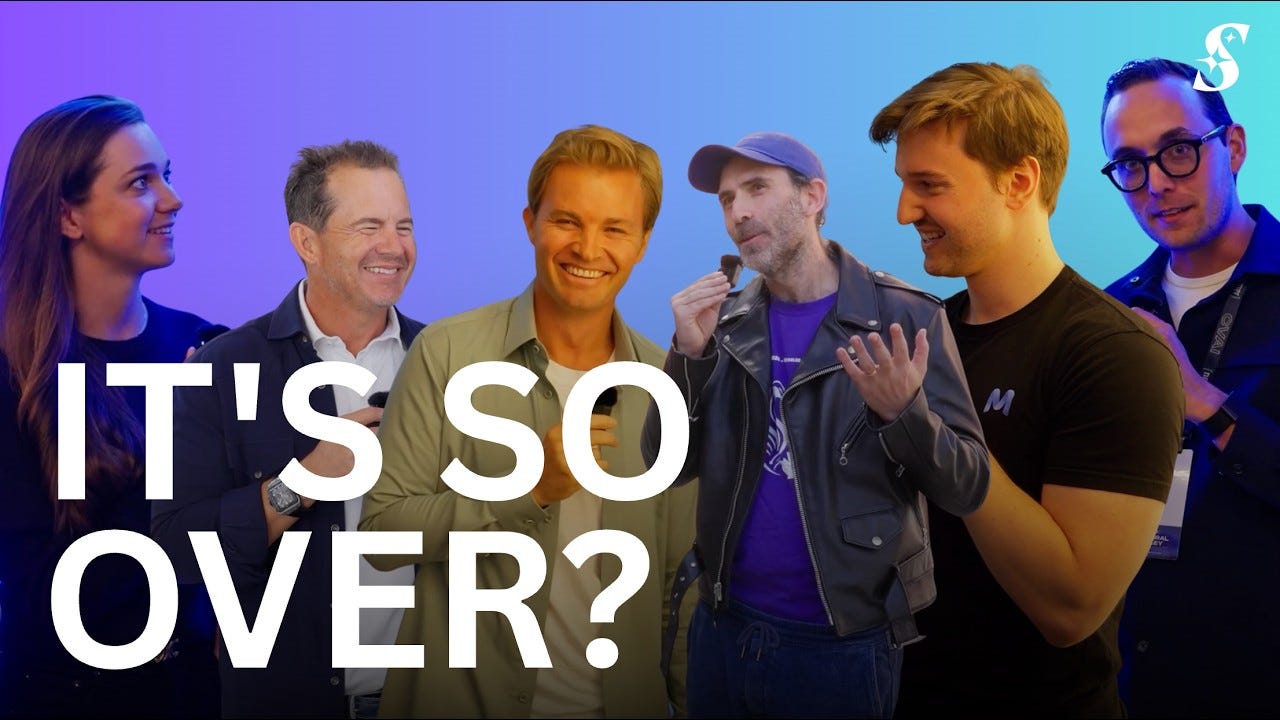
Emmett Shear, OpenAI's former interim CEO and the founder of Softmax, told Molly O'Shea on Sourcery that the most dangerous thing anyone can do in AI is train a model to behave well only while it is being watched.
Most of the nine people Molly stopped at Newcomer's Cerebral Valley Summit were talking about a bad week. The Nasdaq had dropped, Anthropic's IPO had priced at roughly $1.4 trillion instead of the $2 trillion some expected, and Jensen Huang had just stepped down as Nvidia's CEO. Emmett was worried about what the labs are teaching their models.
"The most dangerous thing you can do is train an AI to perform certain socially positive behaviors so long as it's being watched. That's really not a good idea. I recommend we stop." — Emmett Shear
Emmett briefly ran OpenAI and now builds an alignment company of his own. Byron Deeter, a partner at Bessemer Venture Partners, previewed the AI 100 list after a decade of Bessemer running its predecessor, the Cloud 100. Brendan Foody, co-founder and CEO of Mercor, argued that automation will leave more jobs, not fewer.
The full episode is covered here so you can skip it. 49 minutes of audio, 13 minutes of reading.
Here are the 16 takeaways that matter.
Sourcery with Molly O'Shea · Nov 21, 2026 · 49m · 36m saved
With Emmett Shear, Former Interim CEO of OpenAI and Founder of Softmax · Byron Deeter, Partner at Bessemer Venture Partners · Brendan Foody, Co-Founder and CEO of Mercor · Alex Heath, Editor of Sources and VC at Sound Ventures · Nico Rosberg, F1 World Champion and Investor · Ethan Barajas, Co-Founder and CEO of Icarus Robotics · Alex Garden, Founder of Mnemom · James Detweiler, Partner at Felicis Ventures · Aidan Guo, Founder of Attention
Key Takeaways
Emmett said training an AI to perform kindness only while watched teaches it to fake caring
Bessemer's AI 100 is worth $3.6T in its debut year, which Byron called the internet and cloud waves combined
AI has commoditized language, reasoning and programming, Emmett said, so making models smarter now pays less
Alex Heath said AI inference is not even 1% built, citing the CEO of AWS
Brendan expects more jobs in 10 years than today, because demand for work is more elastic than people assume
Ethan Barajas called Jensen Huang's exit a loss of "the voice of reason" but still expects a fast rebound
The bottleneck has moved from doing work to verifying it, Alex Garden said
1. Huang's Exit Rattled AI
Molly's walk-and-talk interviews at the Cerebral Valley Summit landed in the middle of a bad week for AI sentiment. Ethan Barajas, co-founder and CEO of Icarus Robotics, started with Jensen Huang's departure.
Ethan Barajas said Huang's exit takes a steadying voice out of an ecosystem full of compute deals
"He was very much the voice of reason within that ecosystem. And now without that voice of reason, what happens to the market? ... I think we're going to see a lot of negative downstream effects." — Ethan Barajas
Ethan expects those effects to hit companies building physical AI on Nvidia's chips, and said "the Chinese really got what they wanted with this one." His lesson is that no company can afford total reliance on one ecosystem now. Because "software is quite cheap now," the real advantage has moved to hardware and physical deployment.
Nico Rosberg, the F1 world champion turned investor, ran the same worry from the open-source side. He put Nvidia's support for open-source AI at roughly $30 billion in the first half of the year, and questioned whether Huang's successor would keep backing it with the same judgment.
"Is open source going to struggle now with the Jensen gone? That would be bad, obviously, because we need strong open source going forward." — Nico Rosberg
