

Reinvent Money · Sep 26, 2026 · 36m · 23m saved
With Marlo Oaks, State Treasurer of Utah and a former investment manager
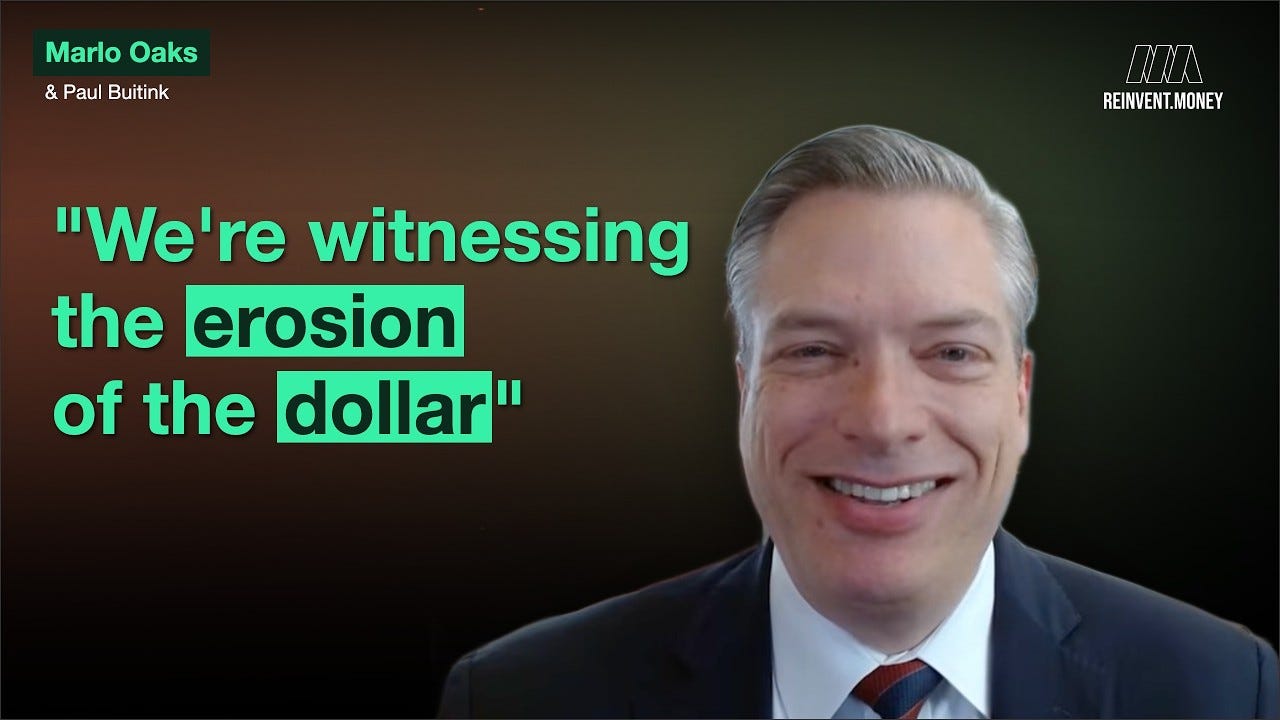
In 2023 and 2024 Utah's rainy-day funds sat entirely in the state's short-term money market fund, and Marlo Oaks said that money was losing purchasing power to inflation. His answer was to put up to 10% of it into physical gold.
The host said the largest Dutch pension fund has sold almost all of its US Treasuries. Oaks has kept a large share of Utah's short-term fund in them, because he sees nowhere better to put the money.
"I don't see a lot of great alternatives to Treasuries — they still are the foundation of financial markets."
Marlo Oaks, Utah's state treasurer, on Reinvent Money. He has held the job for five years after a career as an investment manager, runs a short-term fund the host put at about $37 billion, and organized the 2022 letter from Utah's elected leaders asking S&P Global not to give the state a separate ESG score.
The full interview is covered here so you can skip it. 36 minutes of audio, 13 minutes of reading.
Here are the 10 insights that matter.
Key Takeaways
Utah's rainy-day funds were losing purchasing power while held 100% in a money market fund in 2023 and 2024
The state put up to 10% of those funds into physical gold, bought gradually over several months and stored in Utah
The cap applies only at the time of purchase, so a rising gold price never forces a sale
Oaks sees no good alternative to Treasuries for a short-term fund, even as European pension funds sell them
A separate ESG score could have raised Utah's borrowing costs despite its AAA rating from all three agencies
A year after Utah's letter, S&P Global said it would stop issuing separate ESG scores
Oaks calls ESG top-down, centralized control that a market economy cannot coexist with
Utah plans to let state vendors be paid in gold and silver through a debit-card platform
The IRS treats gold and silver as collectibles, so every sale is taxable, which Oaks wants changed for metal used as money
1. Utah Borrows Short
The host said Utah ranks first or second among US states for responsible finances and asked why. Oaks said the state borrows less, over shorter terms, and pays debt off faster.
Utah rarely borrows for longer than 15 years
"We typically don't borrow beyond 15 years — I know a lot of states will go out 20 or 30 years when they borrow." — Marlo Oaks
He said the state borrows for large infrastructure projects such as roads and buildings, and tries to match the length of the debt to the life of the project. The host asked whether that meant borrowing only for investment and never for running costs such as Medicaid. Oaks said that was right.
Whether a state can go bankrupt has not been tested
The host noted that Detroit went bankrupt and that counties can, and asked whether a state can. Oaks said he did not know that it had ever been tested.
"It's hard to imagine a state going bankrupt, but we may be testing that here — I don't know, but I hope not." — Marlo Oaks
He said some state finances are "certainly being stretched in certain locales." The host said the last state to default on its debt was Arkansas in 1933, on highway bonds. Oaks called it an interesting data point from the Great Depression.
