

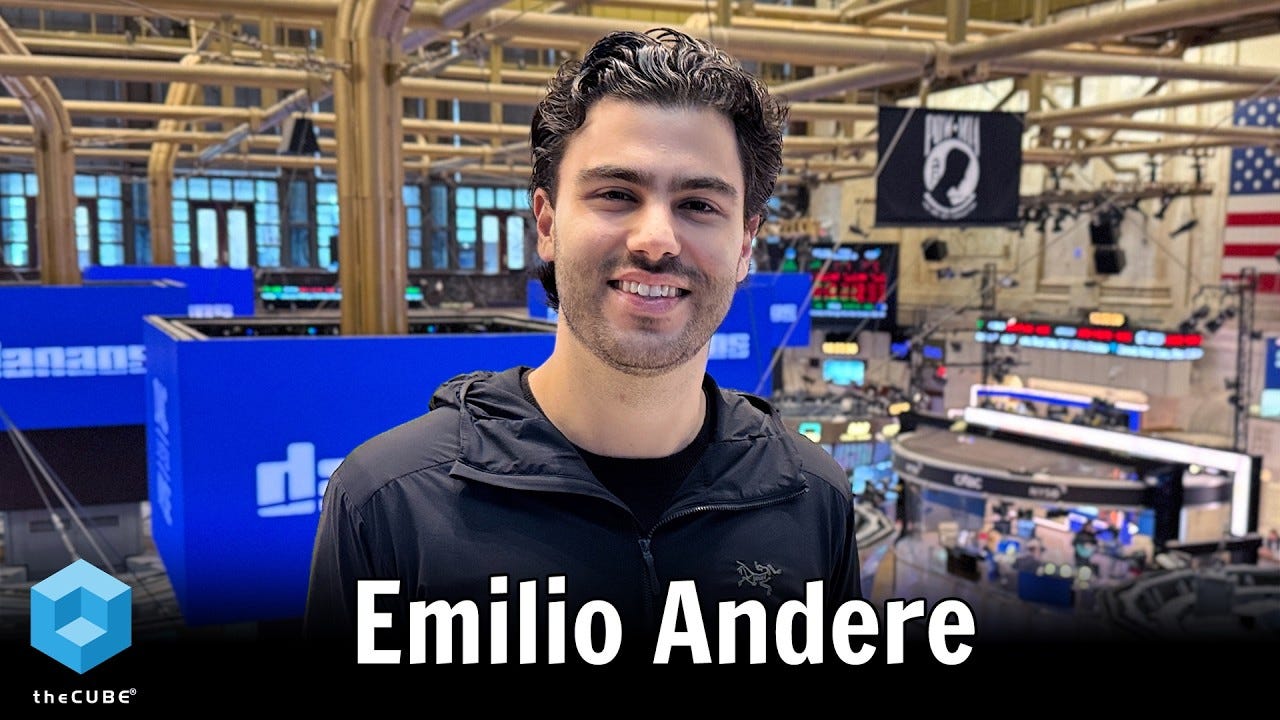
Wafer tells customers it can get them 30% to 50% better performance from their AI models about two months after they start, Emilio Andere, co-founder and CEO of Wafer, said on SiliconANGLE theCUBE. The gain comes from AI agents that keep tuning how a customer's model runs on its chips.
Most companies that run large language models on graphics chips hire specialist engineers to write the low-level code that makes them fast. Emilio said there are too few of those engineers, so Wafer hands the job to AI.
"We found this scarcity in the number of GPU engineers that could do this work... what you should be doing to optimize your GPU should be with AI itself. We call this AI to optimize AI." — Emilio Andere
Emilio started Wafer with his college roommate about a year and a half ago, went through Y Combinator and announced a $40 million Series A a month before the interview. Vercel is one of its largest customers.
The full interview is covered here so you can skip it. 22 minutes of audio, 7 minutes of reading.
Here are the 9 takeaways that matter.
SiliconANGLE theCUBE · Nov 20, 2026 · 22m · 15m saved
With Emilio Andere, Co-Founder and CEO of Wafer
Key Takeaways
The shortage is GPU performance engineers, not only the chips themselves
Wafer stopped licensing its agents to other inference companies because it expected to be squeezed out
Wafer now rents GPU capacity from neoclouds and resells it as tokens, tuned by its own agents
Emilio says customers get 30–50% better performance about two months in
Fine-tuning in-house takes five to ten engineers for one or two quarters, so try an open-source model first
Companies that own both the software and the compute will win, Emilio said
1. From YC to a $40M Series A
Emilio Andere told John Furrier and Dave Vellante, who host theCUBE, that Wafer's funding path was short. He and his co-founder were roommates at the University of Chicago and went through Y Combinator within weeks of starting the company.
Wafer raised a seed round three months after Y Combinator and announced a $40 million Series A a month before the interview
"We raised a seed — about four million — about three months after that, and then most recently... our forty million Series A." — Emilio Andere
The Series A pays for a larger team and more engineering.
