

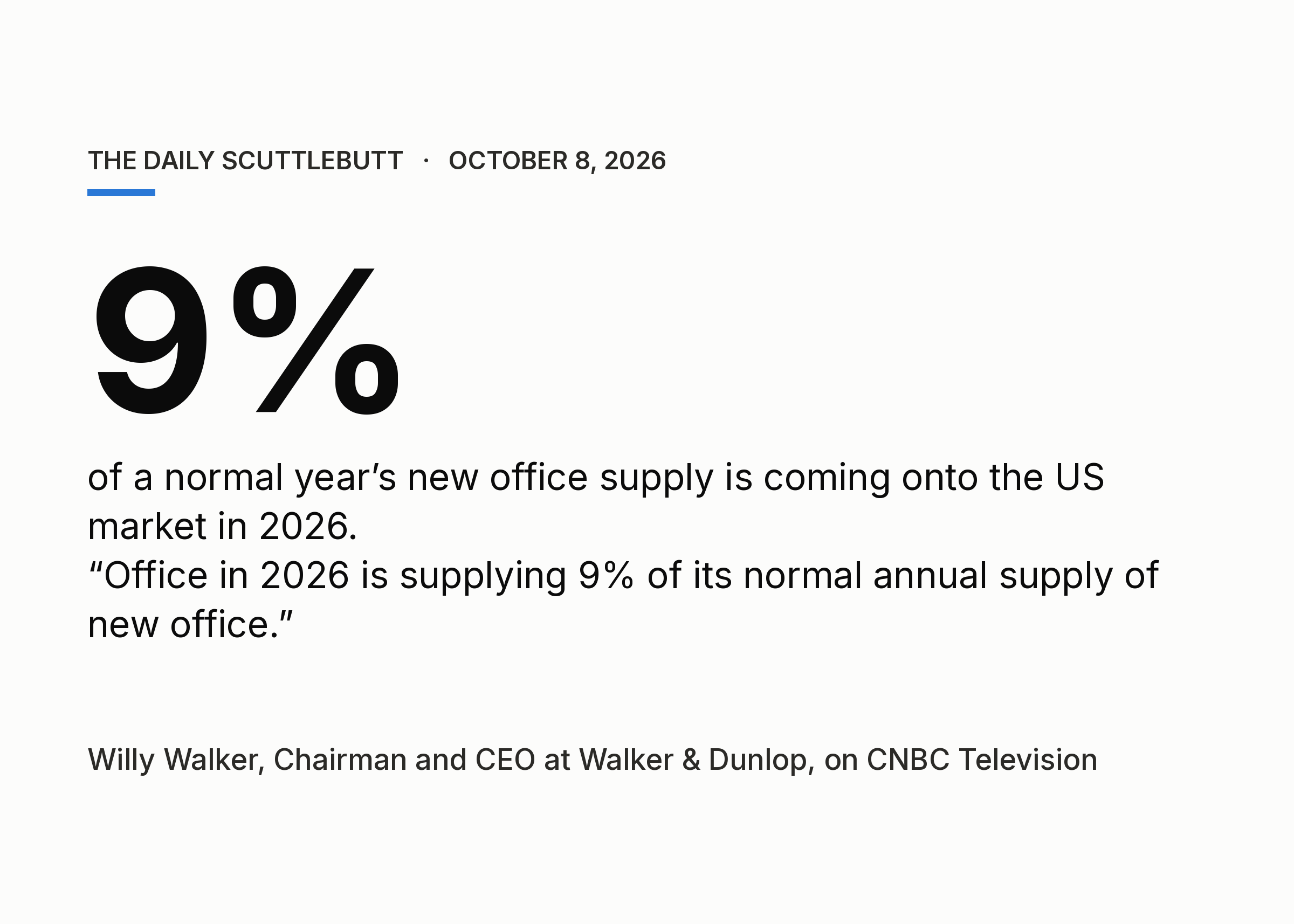
New office space coming onto the US market in 2026 is 9% of a normal year's supply, Willy Walker, chairman and chief executive of the commercial real estate finance firm Walker & Dunlop, said on CNBC. At the same time, $1.5 trillion of apartment-building debt has to be refinanced within four years, much of it borrowed when rates were far lower.
That was one lender's view of one corner of real estate. Below are 32 more quotes from 32 other speakers. Jim Bianco said every Treasury from 5 to 30 years now yields 5% or more for the first time in 20 years, and Chris Klomp of the Department of Health and Human Services said a federal drug-discount program now supplies about half of US hospitals' profit margins.
"IN MULTIFAMILY ALONE, MIKE, IN THE NEXT FOUR YEARS, THERE'S $1.5 TRILLION OF DEBT THAT HAS TO GET REFINANCED IN FOUR YEARS. ... NOW IS THE PERFECT TIME TO BE PUTTING A SHOVEL IN THE GROUND, EXCEPT NO ONE'S GOING TO DO IT. YOU LOOK AT THE SUPPLY SIDE ON MULTIFAMILY, ON OFFICE, OFFICE IN 2026 IS SUPPLYING 9% OF ITS NORMAL ANNUAL SUPPLY OF NEW OFFICE. THE OFFICE MARKET IS COMPLETELY UNDERSUPPLIED, AND REAL ESTATE IS ALL ABOUT SUPPLY AND DEMAND. MULTIFAMILY IS GONE FROM RECORD SUPPLY DOWN TO VERY SOON, RECORD LOW NEW SUPPLY." — Willy Walker, Chairman and CEO at Walker & Dunlop, on CNBC Television (Read summary)
We scanned 548 shows and 8 hours of audio, wrote 18 summaries, and pulled 33 quotes into this 17-minute read.
Here is what mattered.
Macro
Competition for capital, strong growth and deficits will keep a floor under bond yields, Citi Wealth's Kate Moore says
"YEAH, WE'RE GOING TO BE WATCHING THIS REALLY CLOSELY, I THINK, OVER THE NEXT COUPLE OF MONTHS IS, ARE THESE PARTS OF THE ECONOMY THAT WE'RE SPENDING WHERE WE'RE GETTING KIND OF A PICKUP IN capex FROM PRETTY LOW LEVELS? IS IT GOING TO BE SUSTAINABLE IF WE'RE AT A 5% OR HIGHER TEN YEAR? YOU GUYS WERE JUST TALKING ABOUT THIS, THE CONSENSUS ON THE STREET EXPECTING BOND YIELDS TO BACK UP INTO YEAR END. THAT'S NOT NECESSARILY OUR VIEW. WE MAY HAVE HIT A NEAR TERM TOP KIND OF TECHNICALLY, BUT ALL THE THINGS THAT ARE IN PLACE THE COMPETITION FOR CAPITAL, THE STRONG GROWTH ENVIRONMENT, THE FISCAL DEFICITS, I THINK THAT'S ALL GOING TO PUT A FLOOR ON YIELDS COMING LOWER." — Kate Moore, Chief Investment Officer at Citi Wealth, on Closing Bell (Read summary)
Measure higher rates against nominal growth, and corporate profits are booming, KKR's Henry McVey says
"SO TO ME, MY ONE THING I WOULD CAUTION INVESTORS, EVERYBODY IS RUNNING AROUND WORRIED ABOUT HIGHER RATES RIGHT NOW. LET'S MAKE SURE WE'RE LOOKING AT HIGHER RATES RELATIVE TO NOMINAL GDP. WE'VE GOT A PRETTY GOOD INCUBATION LAB. WE'VE GOT 200 COMPANIES AROUND THE WORLD. CORPORATE PROFITS ARE BOOMING RIGHT NOW. YOU GUYS REPORT ABOUT THIS REPORT ABOUT THIS ALL THE TIME. YOU'VE HAD A VERY LOW PREANNOUNCEMENT SEASON. THINGS ARE GOOD THAT PRODUCTIVITY IS FUNNELING THROUGH THE SYSTEM. SO I WOULD MAKE SURE THAT YOU'RE THINKING ABOUT WHO CAN DELIVER NOMINAL GDP, NOMINAL REVENUES, AND THEY'RE ABLE TO PASS THOSE COSTS ALONG. IF YOU HAVE NO PRODUCTIVITY AND YOU'RE FACING COST OF LIVING INCREASES, THAT'S A TOUGH SPOT." — Henry McVey, Head of Global Macro and Asset Allocation at KKR, on Closing Bell (Read summary)
Every Treasury from 5 to 30 years yields 5% or more for the first time in 20 years, and Bianco calls that fair value
"YEAH, I THINK THAT FINALLY THE BOND MARKET FROM THE FIVE YEAR TO THE 30 YEAR, ALL AT A 5% YIELD OR HIGHER, FIRST TIME IN 20 YEARS THAT THAT'S HAPPENED IS NOW REFLECTIVE OF THE OVERALL STATE OF THE ECONOMY. AND THAT IS A THREE ISH INFLATION RATE AND A TWO ISH REAL GROWTH RATE. SO A NOMINAL RATE OF ABOUT FIVE. SO IF YOU HAVE A 5% ECONOMY AND YOU HAVE 5% INTEREST RATES, THAT'S FAIR VALUE. AND THAT'S WHY AFTER SIX YEARS, I FINALLY SAID, OKAY, NOW'S THE TIME TO START MOVING BACK INTO THE BOND MARKET. SO WHERE IN THE CURVE ANYWHERE FROM FIVE YEARS ON OUT, I THINK IS REALLY FROM A FUNDAMENTAL STANDPOINT, IS THE APPROPRIATE LEVELS FOR THE INTEREST RATES. AND THAT'S WHY THERE ARE SOME VALUE NO LONGER THE BOND MARKET EXPENSIVE. IT'S NOW KIND OF GOT VALUE TO IT. AGAIN." — Jim Bianco, President at Bianco Research, on CNBC Television
Every item in the manufacturing survey is rising in price and none is falling, Carson's Sonu Varghese says
"Look at the prices index for services. It's at 72.6. ... You look at the ISM manufacturing prices index, that's at 77.9. Everything's smoking hot. Activity is hot. Prices are smoking hot. Not a single commodity that these surveys track, especially the manufacturing survey, things like aluminium, copper, copper products, diesel. Obviously, we know what's going on, but even electrical components, electronic components, BR, memory component, steel, aluminum, every single thing up in price. Not a single one down in price, every single thing short supply." — Sonu Varghese, Chief Macro Strategist at Carson Group, on Facts vs Feelings
The dollar is near the 103 level Pinkert has targeted for months, and he says that is no time to chase it
"103 doesn't have to be the top. There are other counts that take it higher, but 103 is a number that has been my target for a while. So, we're close to that. That's not a time to start chasing the dollar." — Dale Pinkert, Trading Coach at TradeGateHub, on Maggie Lake Talking Markets (Read summary)
International
More than 125,000 Canadians moved to the US last year, the most in any year, CVCA's Bergen says
"You know, I know Patrick mentioned that stat, 800,000 Canadians living in the US right now. Last year alone was the worst year in terms of a worst or maybe wrong way of phrasing it, but the most amount of Canadians who headed south, over 125,000 of them." — Benjamin Bergen, CEO at the Canadian Venture Capital and Private Equity Association, on BNN Bloomberg
With a 50% US tariff on Canadian steel, Ottawa should keep the Hamilton plant running for now, Lamp says
"But I think given these very unusual circumstances right where you have the trade war with the US 50% tariff on Canadian exports to the US which probably will come down in an eventual deal maybe to 25% as was negotiated in August. We also have these very high tariff barriers which mean that the price of steel is very high. And so there's a very good case that this is not the time to essentially let this steel plant die. This is a time to try to keep the workers there, keep the expertise in Hamilton in place to see what the long-term situation will be." — Nicholas Lamp, Associate Professor at Queen's University's Faculty of Law, on BNN Bloomberg
Financials
Small caps lagged large caps 9 years running, but their earnings are set to grow 15% this year and 17% next, Nelson says
"Small caps have lagged large caps for, it's actually been nine years in a row. If you can believe it, the Russell 2000 has lagged the Russell 1000. ... They're scheduled to grow, and these numbers change all the time, but small caps are scheduled to grow about 15% in 2026 and are poised to accelerate to about 17% last I looked in 2027." — Brandon Nelson, Senior Vice President and Portfolio Manager at Calamos Investments, on Inside Active by Bloomberg Intelligence (Read summary)
One or two Magnificent 7 stocks have been worth more than the whole small and midcap market, Maher says
"The second thing is, I and I haven't even kept up on these stats, but I did this a while ago, one or two of the Mag 7 had more market cap than our entire space. And there is something to be said about that extreme concentration in these stocks. ... Now from a supply demand perspective that's fantastic because again a little trickle out of the larger cap holdings are massive relative to the overall market space I deal in." — Tom Maher, Portfolio Manager at Hilton Capital Management, on Excess Returns (Read summary)
IPO proceeds have passed 2021 levels on far fewer, much larger deals, BofA's J.D. Moriarty says
"Well, listen, it's been a wonderful market, but not for everyone, right? So it is a market that is, we've exceeded 2021 levels of productivity in the IPO market on a proceeds basis. with many fewer deals, much larger deals, right? Software has been absent because of the potential disruption of AI." — J.D. Moriarty, Vice Chair and Head of Global Technology Equity Capital Markets at Bank of America Securities, on Bloomberg Tech
The hyperscalers have sold more debt this year than the Treasury has in 10-year notes, Headland says
"I don't think I'd take on much duration risk here. So I think we like the yield, but the yield curve is actually very flat. So the optionality right now is looking at credit. So you look at the hyperscalers for example, the hyperscalers have issued more debt year to date than US 10-year Treasury issuance. When I'm looking at that opportunity set, I said similar yield or even better yield with lower duration risk, lower volatility. I really like high quality credit, even higher quality, high yield right now." — Kevin Headland, Co-Chief Investment Strategist at Manulife Investments, on BNN Bloomberg
Other appearances:
Fidelity Portfolio Manager and Investment Director on a quant fund whose model overrides can be counted on one hand on FidelityConnects
Alternatives and PE
Retail investors are still pulling money from private credit funds, and that is not finished, Hunter Point's CEO says
"I think a lot of the headline noise, and we're still not through, the elephant is still being digested by the snake, if you will. And it's still going on. That is individual investors who were investing in interval funds, those investors started to want to redeem, whether it was for economic reasons or other. And that's not finished yet. And so, I think we need another few quarters of performance to let all of that pass and until we get to some kind of stasis. So, we're not done yet." — Avi Kalichstein, Co-Founder and CEO at Hunter Point Capital, on CNBC Television (Read summary)
Consumer
Levi's sales in China rose 13% after it changed what it sells there, Gass says
"YEAH, WE HAVE A LOT GOING FOR US IN CHINA. CHINA WAS UP 13% THIS QUARTER AND IT HAS BEEN DOING WELL ALL YEAR. FIRST, I WOULD SAY WE HAVE A GREAT LEADER. WE HAVE A GREAT TEAM AND THEY ARE EXECUTING. NUMBER TWO, WE'VE CHANGED THE PRODUCT STRATEGY AND WE HAVE MORE OF A FOCUS OF, I'LL CALL IT, GLOBAL ICONS BALANCED WITH PRODUCT MADE TAILORED TO THE CHINESE CONSUMER. AND I'D SAY IN THE PAST, THAT WAS A LITTLE BIT MORE FLIP FLOPPED. SO AS WE BROUGHT THAT MORE IN LINE, THE CONSUMER IS RESPONDING. WE'RE REALLY FOCUSING ON EXECUTION IN OUR STORES, MERCHANDISING THE STORES DIFFERENTLY. AND IN SOME CASES, WE'RE MOVING STORES. WE'RE GETTING OUT OF SOME REAL ESTATE. WE'RE GETTING INTO NEW HIGH PROFILE REAL ESTATE." — Michelle Gass, President and CEO at Levi Strauss & Co., on Mad Money (Read summary)
Angel Studios' 3 million paying members have sent $300M to filmmakers, Harmon says
"And so what the Angel Guild allows you to do is join about 3 million other people who are all paying 12 to 20 bucks a month and make movies like billionaires do. ... And so far that guild, the angel guild, those 3 million people have paid out $300 million to filmmakers." — Jeff Harmon, Co-Founder and Chief Content Officer at Angel Studios, on My First Million (Read summary)
A federal drug-discount program, 340B, now supplies about half of US hospital margins, HHS's Chris Klomp says
"Unquestionably, it is really hard to be the head of a hospital right now. And we see this when your whole business model is based on massively fixed cost and you're targeting on a good year 3% margin. You don't have a lot of room for error. And when you have all of these macro pressures coming down, you mentioned 340B. By our calculus, 340B dollars now account for about half of all hospital margin in the United States. There's nothing to do with their core business. Half of their margin is coming from this program." — Chris Klomp, Chief Counselor at the US Department of Health and Human Services, on WSJ Events
McDonald's is asking franchisees for $1.2M each to remodel, and few will pay it, Halen says
"Yeah, McDonald's is asking for 1.2 million which we think is a huge ask for franchises that are being squeezed by higher commodity costs right and also suffering from lower traffic ... We think there'll be some sort of negotiation and a much smaller remodel and investment package will be agreed upon." — Michael Halen, Senior Restaurant and Foodservice Analyst at Bloomberg Intelligence, on Bloomberg Intelligence
Disney has raised streaming prices about 80% to 85% in 4 years without a jump in cancellations, Ranganathan says
"So just over the past four years, they've raised prices something like about 80 to 85% on their streaming service. Compare that to Netflix, which over the same time period has only raised it about 25%. So definitely they've been really aggressive and really the motive there has been streaming has gone from being a loss leader and a loss maker to now becoming one of the biggest elements of the whole profitability story. And one of the ways that they get to profit and they keep increasing that profit is by raising prices. But what we've seen for Disney as opposed to some of their other rival streamers is that even when they raise prices, they do not necessarily have to contend with elevated churn. And that's really the power of the bundle." — Geetha Ranganathan, US Media Analyst at Bloomberg Intelligence, on Bloomberg Intelligence
Technology & AI
Marvell's $30B custom-chip target for 2030 is only 13% of a $235B market, its CEO says
"IF YOU GO BACK TWO YEARS AGO, THE DEBATE WAS ACTUALLY CAN CUSTOM EVEN MATERIALIZE AS A PORTION OF THE MARKET? NOW YOU FAST FORWARD AND IT'S NOT JUST US, RIGHT? THAT WHOLE SEGMENT HAS CLEARLY BEEN SOLIDIFIED AS A REAL THING. AND SO YOU ROLL FORWARD JUST A FEW YEARS INTO 2030, AND YEAH, YOU'RE LOOKING AT A $235 BILLION MARKET JUST FOR CUSTOM SILICON. ... IT'S ACTUALLY THE CRAZY THING IS WE SAID, HEY, OUR TARGET IS 30 BILLION IN REVENUES, RIGHT IN 2030 IN CUSTOM. YEAH. AND THEN SOMEBODY POINTED OUT IN THE MEETING, LOOK, IF YOU JUST DIVIDE THAT BY THE 235, IT'S ONLY 13% MARKET SHARE." — Matt Murphy, CEO at Marvell Technology, on CNBC Television
Most of the world's GDP comes from physical industries, and that is where AI goes next, Poupyrev says
"If you think about it, 85% of the world economy and this is kind of rough now but being thrown around 85% of the world economy by GDP coming from physical world ... think about manufacturing construction logistics the anything connected to the physical world that's where the most of the GDP is coming from" — Ivan Poupyrev, Co-Founder and CEO at Archetype AI, on Inside The Silicon Mind (Read summary)
About 40% of data center projects are being shut down, so approved land is getting scarce, Verma-Lallian says
"So if you can't get the land, you can't really build AI. You can have the best models. But if you don't have the infrastructure, you can't do much. And I think right now, with data centers becoming as controversial as they are the amount of sites that can actually get approval for data centers is really shrinking. I think the statistic is 40% of all data center projects are getting shut down. The governor of New York has issued a moratorium on new data center projects. And so I think the supply of land that makes sense to develop data centers on is really, starting to shrink." — Anita Verma-Lallian, Founder and CEO at Arizona Land Consulting, on Founder's Story (Read summary)
Anthropic's revenue grew 10x this year to more than $100B, and that pace has to slow, SemiAnalysis' Dylan Patel says
"I would say the other thing is like by definition, the numbers have to shrink. This year we have 10x growth, Anthropic, going from sub 10 billion dollars of revenue to north of 10, north of 100 billion. So they had 10x growth. Definitionally, they're just not going to have a trillion dollars for revenue by the end of next year. So yes, there's some decelerating growth there." — Dylan Patel, Founder and CEO at SemiAnalysis, on Big Technology Podcast
AI demand has to reach $1.4T by 2028, about $9,000 per worker, to justify the spending, Wells Fargo's Ohsung Kwon says
"AND WE'RE STARTING TO GET A LITTLE MORE CONCERNED ABOUT THE AI capex CYCLE BEYOND 2027. SO WE TRIED TO ESTIMATE HOW BIG AI HAS TO GET TO JUSTIFY capex THROUGH 27. AND THE OVERALL AI DEMAND HAS TO GET TO ABOUT $1.4 TRILLION BY 28. AND THAT'S ABOUT $9,000 PER WORKER PER YEAR. THAT'S A PRETTY SIGNIFICANT NUMBER. AND IF HYPERSCALERS WERE TO DO ANOTHER BIG capex IN 2028, THAT NUMBER JUMPS TO $2.2 TRILLION. SO THE BOTTOM LINE IS EVERY YEAR IT BECOMES INCREASINGLY MORE DIFFICULT FOR HYPERSCALERS TO JUSTIFY ANOTHER BIG capex BEYOND 27. SO I REALLY THINK THE RISK IS THAT capex CYCLE IS STARTING TO NOT ROLL OVER COMPLETELY, BUT FLAT LINES AFTER 27. AND I DON'T THINK THE build-out TRADE IS NECESSARILY PRICING IN THAT RISK YET." — Ohsung Kwon, Chief Equity Strategist at Wells Fargo, on CNBC Television
Other appearances:
8VC Founder and Managing Partner on why defense startups, not the Navy, will beat China at shipbuilding on Fox Business
Industrials and Transport
Protolabs' robotics and data center work doubled in a year, its CEO says
"THAT'S EVOLVING FAST, RAPIDLY IN THE LAST ONE YEAR. I MEAN, THE FIRST HALF OF THIS YEAR, WE WERE UP 100% ON ROBOTICS. SO WHEN WE LOOK AT DIFFERENT SECTORS, DRONES IS UP 90% OVER THE LAST THREE YEARS. ROBOTICS IS UP 100% OVER THE LAST YEAR. DATA CENTER IS UP 100% OVER LAST YEAR. ... ALL OF THEM NEED PARTS FAST. THEY ARE IN A RACE. SPEED WINS." — Suresh Krishna, President and CEO at Protolabs, on CNBC Television (Read summary)
A $20,000 drone can now shut down a refinery for a year, Mach Industries' Ethan Thornton says
"And that's folks a thousand miles away saying, you know what? If we hit this specific valve on our refinery, if we hit this specific high voltage power transformer, this will have this economic impact. ... And now that's a conflict bet, but when you think deeply from first principles about what happens when people can send something for $20,000 and go and shut down a refinery for a year." — Ethan Thornton, Founder and CEO at Mach Industries, on How I Invest (Read summary)
Materials & Energy
Solar and storage supplied 70% of new US grid power this year, and less than 1% of panels now come from China, Pawlenty says
"But in year-to-date, 2026, 70% of the new energy added to the grid, the new power added to the grid, is from solar in storage, a similar percentage in calendar year 2025, and not too much lower in 2024. ... It used to be that a lot of solar panels came from China. Now almost none do. Less than 1% of the solar panels being used in the United States come from China." — Tim Pawlenty, President and CEO at the Solar Energy Industries Association, on ESG Currents (Read summary)
Oil looks capped at $100 but will not get back to $60 without a recession, Stein says
"Price of oil is not going down as people I think expected in the summer months. The resolution of the Strait of Hormuz isn't going to happen in a long time is our belief. And oil prices, they bounce around. You got the chart up there. $100 seems to be the ceiling. We think 75 is maybe not a bad number, but we don't think we can get back to those $60 levels in the absence of a recession." — Lyle Stein, President at Forvest Global Wealth Management, on BNN Bloomberg
Tech used under 1% of US electricity for 30 years and could reach double digits, Burgum says
"SO NOW AND AGAIN, FROM A TECH STANDPOINT, 30 YEARS OF TECH NEVER USED MORE THAN 1% OF THE NATION'S ELECTRICITY. NOW, WHEN YOU COME IN AND NOW WE'VE GONE TO 2%, 4%, 8% COULD BE GOING MORE TO DOUBLE DIGITS OF WHAT THE TECH INDUSTRY NEEDS FOR ELECTRICITY." — Doug Burgum, US Secretary of the Interior, on CNBC Television
Policy
Only about 200,000 of 4.6 million Black-owned firms have employees, which is a scale problem, Cravins says
"We've got 4.6 million blackowned firms in this country. ... 200,000 of them are employers. Now, we don't have a numbers problem, but we definitely have a scale problem." — Don Cravins Jr., President and CEO at the National Minority Supplier Development Council, on Forbes: The Enterprise Zone (Read summary)
A Democratic sweep in the midterms would raise the odds of tighter local limits on data centers, Morgan Stanley's Salvatore says
"And lastly, we think a Democratic sweep would be the least constructive outcome for sentiment. Now, importantly, that doesn't mean that we expect a nationwide data center moratorium, as I said. Rather, investors could interpret Democratic outperformance as increasing the probability of tighter local restrictions in the near term, and potentially much more federal scrutiny after the next 2028 elections." — Ariana Salvatore, Head of Public Policy Research at Morgan Stanley, on Thoughts on the Market
Geopolitics
Grain and oil did not move until the moment Russia invaded Ukraine, though Ergo had called the day, Eddy says
"We described that he would invade Ukraine four months out with increasing probability starting at 60 getting to 85. Picked the day of the invasion. And if you remember, you guys are market participants. The market was flat. Grain didn't move, oil didn't move until the moment of the invasion. We did the exact same thing in Iran." — R.P. Eddy, Founder and CEO at Ergo, on On The Tape with Danny Moses
Nuggets of Wisdom
Coca-Cola has probably lagged the market for 25 years because it never found the next Coke, Armitage says
"But the nature of great companies changes over time. Look, Coca-Cola is a great company. And there isn't a substitute for Coke. But the fact is, it's probably underperformed the market in the last 25 years. And why is that? Because they haven't come up with the new Coke. Well, when they did, it didn't quite work." — John Armitage, Co-Founder at Egerton Capital, on In Good Company with Nicolai Tangen (Read summary)
Competition among AI companies will hand the gains to their customers, which makes AI stocks hard to pick, Yardeni says
"The hyperscalers and other AI-related companies, they're in a war with each other and competition is should reduce their margins and pass along the benefits to consumers in the sense of being able to use more and more compute at lower and lower prices. That's what competition does. That's why it's so hard to figure out where to invest in the AI universe because of that competitive pressure." — Ed Yardeni, President at Yardeni Research, on Excess Returns
If this was worth your time, send it to someone who has to follow all of this too.
What did you think of today’s edition? Hit ‘reply’ to this email, send us a message, leave a comment, or join the chat!
Get the latest market chatter as it happens: