

TBPN · Sep 30, 2026 · 1h 7m · 56m saved
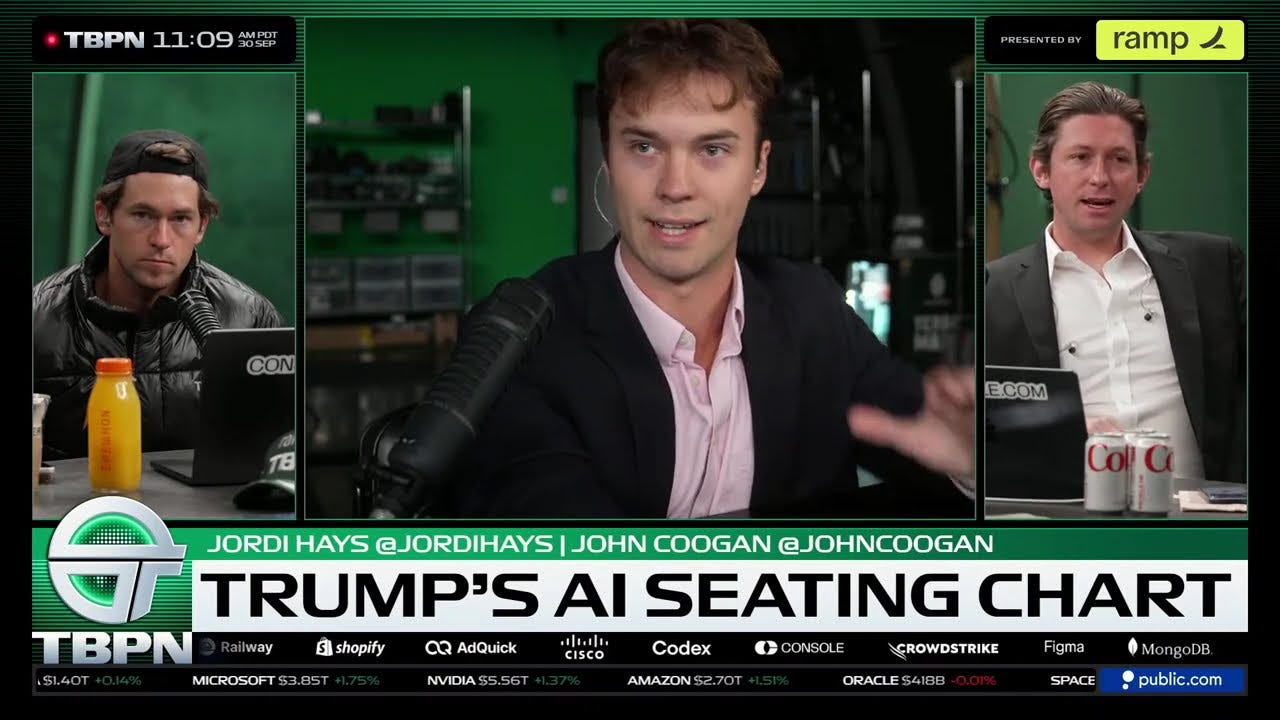
A gigawatt of power in the US economy produces about $65 billion of GDP a year, TBPN's hosts calculated, and OpenAI and Anthropic each report revenue in the same range from roughly one gigawatt of live computing power.
The night before, the chief executives of the biggest AI companies had signed a White House accord on superintelligence safety. Much of the commentary focused on who sat where. The hosts spent as much time on the economics underneath the build-out and on a public fight between two AI coding companies over an adviser.
"And it just happens that economically, you put a gigawatt in the economy, you get 65,000,000,000 out."
TBPN runs a daily live technology and business show, and Wednesday's news block ran from the White House dinner through Microsoft AI chief Mustafa Suleyman's essay on model welfare and Ken Griffin's $2 billion gift for a Carnegie Mellon campus in Miami.
The full segment is covered here so you can skip it. 67 minutes of audio, 11 minutes of reading.
Here are the 9 arguments that matter.
Key Takeaways
The White House accord commits signers to independent board committees that oversee AI safety and bypass the CEO
Open source could be restricted within six to 12 months over cyber risks, a SemiAnalysis writer warned; a host said certainly not this month
One host argued for a closed-model world with many competing front doors that would still leave every signer profitable
A gigawatt of US power yields about $65 billion of GDP, and a gigawatt at an AI lab about the same in revenue, the host calculated
Factory's CEO accused a departing adviser of misconduct; the hosts said Silicon Valley has always poached talent
Microsoft's Mustafa Suleyman wants AIs trained never to believe they are conscious, in a rebuttal to Anthropic
Bill Gates said lawsuits cannot police AI, calling it the most dangerous thing humans have gone near
Miami lacked a technical university to feed tech hiring, which Ken Griffin's $2 billion campus could fix, a host said
1. Supper and Open Source
David Sacks described the White House dinner of AI chief executives as "the Bretton Woods of Supper Intelligence," a play on the administration's new preference for "superintelligence" over "AI." The hosts said observers were studying who got the best seats.
A host mapped the attendees by their stance on open-source models: Jensen Huang clearly in favor, Anthropic at the far end on cybersecurity worries, and OpenAI in the middle. He read a post from Max Kan of SemiAnalysis saying most people underestimate the chance that open-source models are restricted or banned within six to 12 months because of cyber risks, as open models catch up with frontier models at finding unknown software flaws.
He said it would certainly not happen this month, because the people closest to President Trump have been promoting open source.
"At the same time, open source is amorphous. It is not a business by definition." — TBPN host
A closed world with many front doors
Even companies that favor open source do so because it helps their business, he said. Jensen Huang's worry was a world where one company takes all the profit.
"There's a world where the actual models are closed source, but there are so many front doors and the front doors are in such competition with each other that there's enough revenue distribution and profit distribution that everyone at this table at least is happy." — TBPN host
A colleague said open source is very hard to ban if the concern is safety, because a determined bad actor can download open weights and run them locally for tens of thousands of dollars of hardware. The host said serious hacking needs rack-scale computing run many times over, so know-your-customer checks on hardware and data centers may be one control.
