

Squawk on the Street · Oct 2, 2026
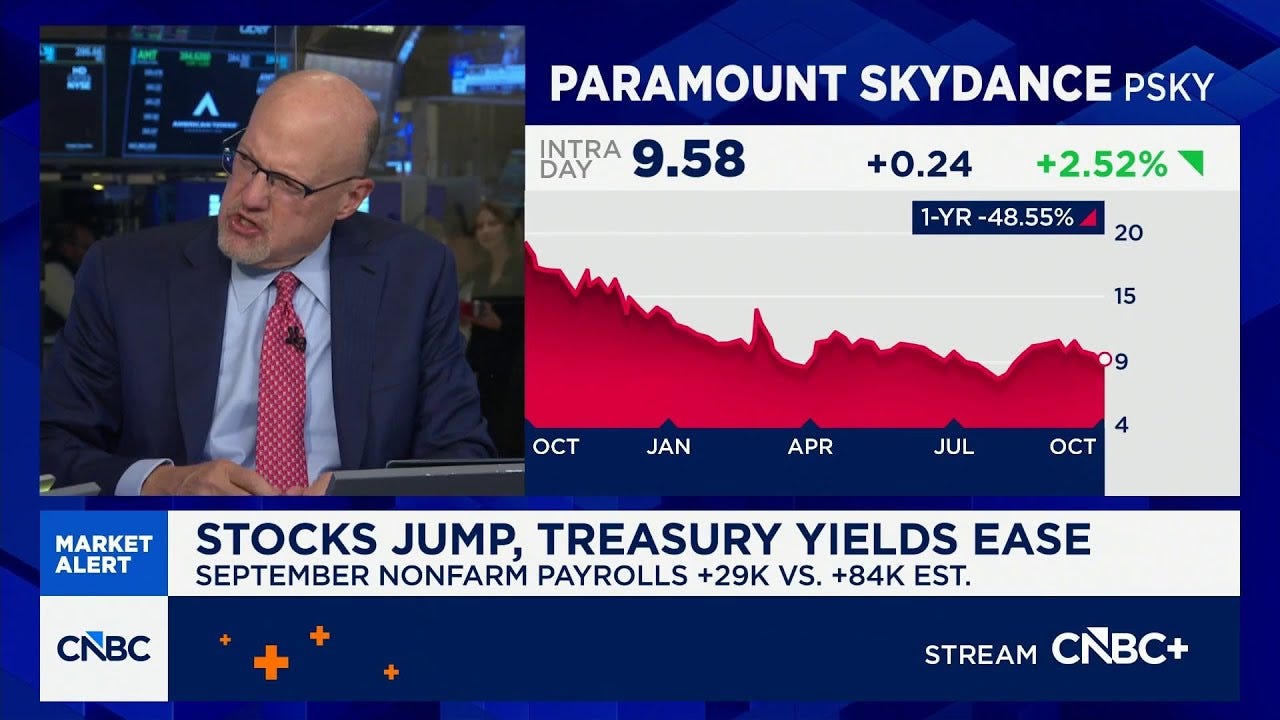
David Ellison referred to the newly combined Paramount and Warner Bros. Discovery as "Skydance" in a social post that morning, and Jim Cramer's reaction on air was that the deal is harder to pull off than it looks.
Most leveraged media turnarounds get judged on the stock chart. Cramer judged this one on a dinner he had years earlier with David Zaslav, who told him a $7 stock was going to $28 — and was right.
"I was telling your husband $7 stock go to 28." — Jim Cramer, quoting David Zaslav
Cramer has covered Warner Bros. Discovery's leverage and management changes for years on CNBC, including on Mad Money, and was recalling a conversation he had directly with Zaslav about the company's balance sheet, on Squawk on the Street.
The full segment is covered here so you can skip it.
Here are the 2 takeaways that matter.
Key Takeaways
David Ellison's "Skydance" rebrand post prompted Jim Cramer to say he'd rather own the stock at 9 than at 12
Higher rates make this deleveraging harder than Warner Bros. Discovery's last one, Carl Quintanilla said
Cramer defended the incoming co-CEO, Kreiz, saying "there was some worth to what Kreiz did there"
He still called anyone who bought the stock in 2018 "absolutely justified to feel terrible"
1. A Deleveraging Climate
Carl Quintanilla opened by noting David Ellison's social-media post that morning referring to the combined Paramount and Warner Bros. Discovery as "Skydance," with new studio leadership already being named. Cramer's first reaction was about valuation, not branding.
"I'd rather look at the stock at 12 than I would all those different things and it's at nine." — Jim Cramer
Quintanilla then pointed out that the macro backdrop makes this restructuring harder than the last one the company went through.
"The rate environment's a little different now if you're highly leveraged, Jim. How much do you have to cut more now than you would have then?" — Carl Quintanilla
He compared a highly leveraged media company today to a homeowner facing a higher mortgage rate: the debt itself doesn't change, but the cost of carrying it does.
