

AI agents made 3% of the deployments to Vercel's cloud platform at the start of the year and make 60% now, its founder and CEO, Guillermo Rauch, said on This Week in Startups.
That was one line from one interview. Another 13 people in this issue said something worth a reader's time. Lance Roberts of RIA Advisors said a total loss on Nvidia's $105B of financing to OpenAI would cost its stock $4 a share, Juicebox's CEO said his first sales reps got 20% commission against the 8-12% typical in software, and a Goldman Sachs managing director said most of US stocks' outperformance over 35 years came from rising valuations rather than earnings.
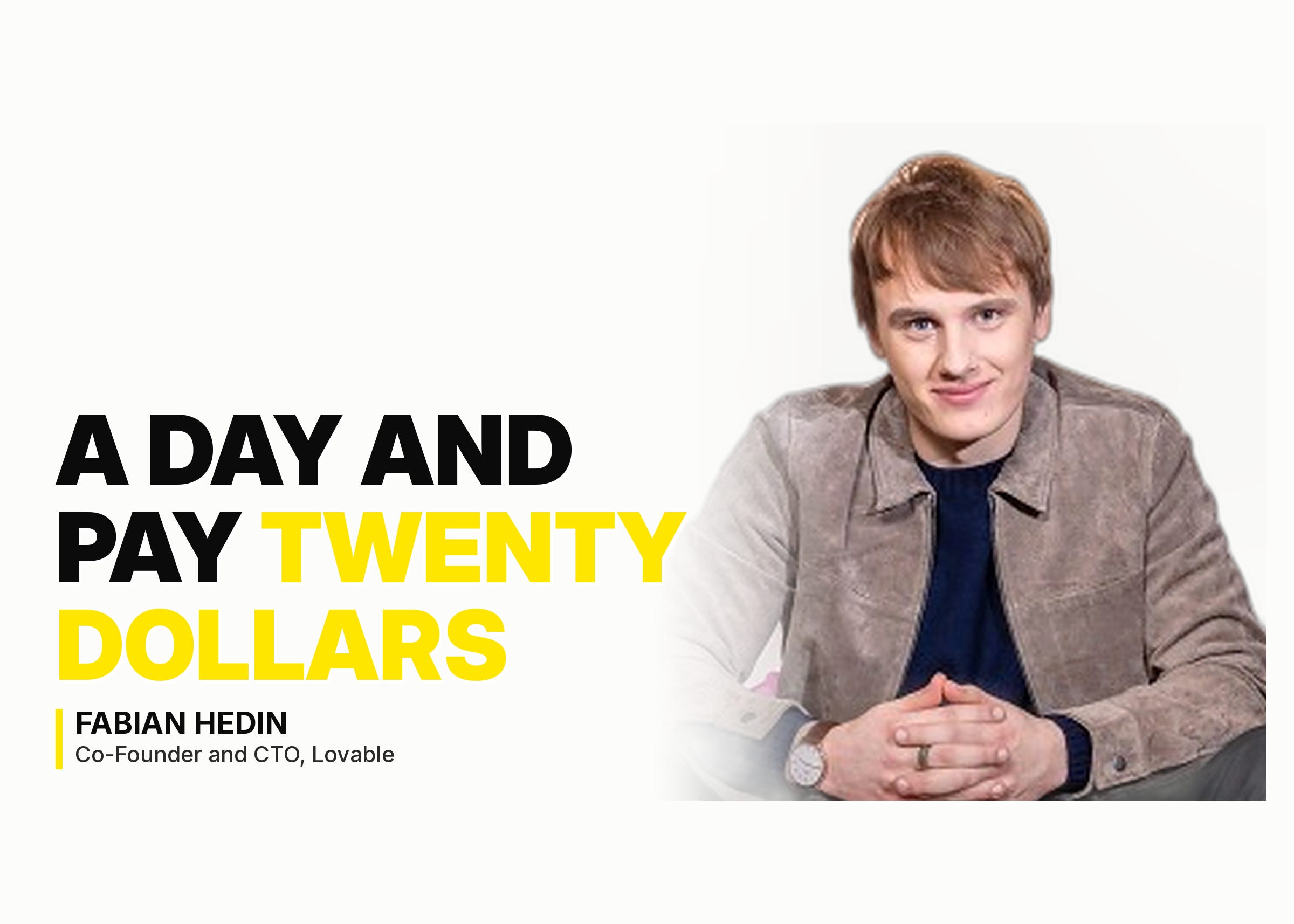
"It takes weeks or months and it cost thousands of dollars even to just get an initial prototype. Now you can do that within a day and pay twenty dollars." — Fabian Hedin, Co-Founder and CTO at Lovable, on The Cognitive Revolution (Read summary)
We scanned 819 shows and 12 hours of audio, wrote 12 summaries, and pulled 32 quotes into this 10-minute read.
Here is what mattered.
Macro
A Fed that really ends inflation would bring a crash and bank failures, Schiff says
"So if the Fed's really going to get rid of inflation, then we're going to have a collapse. The stock market's going to crash ... It means banks are going to fail. It means pension funds are going to fail. And it also means that nobody gets a bailout." — Peter Schiff, Founder and Chief Economist at Euro Pacific Asset Management, on The Peter Schiff Show Podcast (Read summary)
RIA holds about 30% bonds, short-dated, and is overweight cash paying 3.5%
"When you look at our 60/40 allocation, we're about 30% bonds. We're short duration and we're underweight our bond exposure. We're overweight cash right now because I can sit in cash and get paid 3 and a half percent." — Lance Roberts, Portfolio Manager at RIA Advisors, on Thoughtful Money (Read summary)
Rising valuations, not earnings, drove most of US stocks' 35-year outperformance
"Over the last 35 years, the outperformance of US, the classic exceptionalism, actually came primarily from overvaluation. So they became more expensive. So 4.7% per year is broken down to 3.8 coming from rising valuations as a valuation expansion and then 1.1 came from earnings growth." — Nick Baltas, Managing Director at Goldman Sachs, on Top Traders Unplugged (Read summary)
The US stock-bond correlation swung from -42% in the 2010s to +28% in the 2020s
"Some of the more extreme that we are seeing here is actually in the US going from minus 42% to plus 28%. That's 2010s and then the 2020s." — Nick Baltas, Managing Director at Goldman Sachs, on Top Traders Unplugged (Read summary)
Crypto and Digital Assets
NEAR Intents keeps more of each dollar traded and spends it buying back NEAR
"NEAR Intents has been growing amazingly as a business. It's generating more revenue. The take rate increased, same dollar of volume, NEAR Intents is taking more home from that and buying back NEAR." — Illia Polosukhin, Co-Founder at NEAR Protocol, on The Rollup (Read summary)
AI agents exploit whatever system they run on, so they need a neutral market
"If they don't have a neutral ground, they'll try to exploit whatever infrastructure they use. That's what agents do. They try to exploit it to maximize the reward." — Illia Polosukhin, Co-Founder at NEAR Protocol, on The Rollup (Read summary)
Baillie Gifford's onchain fund settles same day and prices within 15 minutes
"The fund is basically T plus zero. We have a NAV available within 15 minutes. It can operate 24/7. It's fully native, and it's just a different experience in terms of utility." — Katherine Hamilton, Partner, Digital Assets at Baillie Gifford, on Real Vision (Read summary)
The triple-B-rated fund sits between money market funds and high-yield bonds
"The fund is triple-B rated, and it really fits into your allocation at a point where you want a little bit more yield than a money market fund, but you don't necessarily want the volatility associated with high yield bonds or with equities." — Katherine Hamilton, Partner, Digital Assets at Baillie Gifford, on Real Vision (Read summary)
Bhutan mined bitcoin with surplus summer hydropower to pay for winter electricity
"The idea came that why don't we use the excess power to mine Bitcoin and we use Bitcoin as a store of value to then buy electricity in the winter time." — Tommaso Mancuso, President and CIO at 3iQ, on Bitcoin Magazine Podcast (Read summary)
Bitcoin's 10-year return falls from about 60% to 8% without its best months, 3iQ's CIO says
"If you look at the returns of Bitcoin over the last 10 years, so 120 months, it's roughly 60%. If you take out the 10 best month, so 12 out of 120, the return is 8%." — Tommaso Mancuso, President and CIO at 3iQ, on Bitcoin Magazine Podcast (Read summary)
Visser splits bitcoin into 30% liquidity and 70% innovation, both at the year's worst
"Bitcoin in my opinion is about 30% liquidity and 70% innovation. We have innovation trading at the lows of the year and unfortunately we have liquidity trading at the tightest of the year." — Jordi Visser, Macro Investor at 22V Research, on The Pomp Podcast (Read summary)
Strategy's Stretch preferred returned about 12% while its common stock fell almost 50%
"Over the past year where Stretch has returned about 12 percent, Strategy common stock is down almost 50 percent." — Peter Schiff, Founder and Chief Economist at Euro Pacific Asset Management, on The Peter Schiff Show Podcast (Read summary)
Technology & AI
Customers prepay 50-60% of capex on 70% of Nebius's closed deals, its bull says
"70% of Nebius's closed customer deals feature massive upfront customer payments. ... Enterprise customers prepay, get this, 50 to 60% of total capex upfront before the GPUs are even deployed." — Ralph Summerford, Forensic Accountant and Value Investor, on The Investor's Podcast (Read summary)
GPU buyers bid 15-20% over list, so Nebius sells assured capacity, not a commodity
"Customers that were desperate for compute, which they are, bid it up by 15 to 20% above the peak list prices. ... Nebius is not selling a commodity product in a competitive race to the bottom. It's actually selling capacity certainty in a compute-starved world." — Ralph Summerford, Forensic Accountant and Value Investor, on The Investor's Podcast (Read summary)
Microsoft and Meta are close to 45% of Nebius's revenue, the bear estimates
"For Nebius, I think Microsoft and Meta are large customers representing close to, I believe, 45% of revenue this year." — Manish Karira, Member of The Investor's Podcast Inner Circle, on The Investor's Podcast
Financing, funding needs and execution leave Nebius too uncertain to value, the bear says
"Given the complexities around the financing structures, the funding requirements, and most importantly the risk of executing and running a complex infrastructure business, makes the range of future outcomes too wide for me to make a reasonable judgment." — Manish Karira, Member of The Investor's Podcast Inner Circle, on The Investor's Podcast
Writing off Nvidia's $105B of OpenAI financing would cost the stock $4, Roberts says
"Nvidia has a lot of circular financing. They have 105 billion in circular financing out to OpenAI. Let's assume that goes to zero. That's a $4 hit to the price of the stock. The stock is down 43% in the last four weeks." — Lance Roberts, Portfolio Manager at RIA Advisors, on Thoughtful Money (Read summary)
CoreWeave's debt yields 15%, and even Oracle's yields more than 9%
"Companies like CoreWeave, their debt's yielding 15%. Even companies like Oracle... which is tried and true blue chip tech stock historically with fantastic database business and clients, their debt's yielding over 9%." — Tim Travis, Co-Author of the Value Options Letter, on The Acquirers Podcast
Travis would own Anthropic through Amazon or Alphabet, which hold large stakes in it
"I think it's a call option on the AI. ... The more sensible way to play it is via Amazon or Alphabet, which have large stakes in Anthropic. And then you're getting the rest of these fantastic businesses very inexpensively when you back that out." — Tim Travis, Co-Author of the Value Options Letter, on The Acquirers Podcast
Anthropic's IPO stirred little public interest because most people use free AI, Carlisle says
"One is that Musk looms much larger in people's imagination than Dario and Anthropic. ... Most people aren't paying for AI, aren't paying for ChatGPT, aren't paying for anything. They're using the free version." — Tobias Carlisle, Principal at Acquirers Funds, on The Acquirers Podcast (Read summary)
Chegg, which sold answers to college students, lost its business once chatbots arrived
"There are going to be businesses that, like Chegg, ... they were selling the answers to college students, and as soon as chat appeared, just vaporized. $14 billion company gone. Fiverr, similar sort of story." — Tobias Carlisle, Principal at Acquirers Funds, on The Acquirers Podcast (Read summary)
VC & Startups
AI agents made 3% of Vercel's deployments at the start of the year and 60% now
"At the beginning of the year, 3% of deployments to Vercel ... were agentic. Now it's 60% and growing, meaning the most common buyer ... of our platform is these robots that are writing software on behalf of people." — Guillermo Rauch, Founder and CEO at Vercel, on This Week in Startups (Read summary)
Tencent's new coding model costs 42 cents per million input tokens, against $4 for Opus
"Today Tencent has a new model that has some really amazing coding capabilities and it's really cheap. ... inputs, 42 cents per million inputs, outputs $1.25 per million output tokens. ... Opus, $4 and $20." — Guillermo Rauch, Founder and CEO at Vercel, on This Week in Startups (Read summary)
Vercel's hacking contest found a Linux flaw that hit almost every infrastructure provider
"A gentleman actually ended up discovering a vulnerability in Linux as part of this contest that impacted almost every infrastructure provider in the world." — Guillermo Rauch, Founder and CEO at Vercel, on This Week in Startups (Read summary)
A software prototype that took months and thousands of dollars now takes a day and $20
"It takes weeks or months and it cost thousands of dollars even to just get an initial prototype. Now you can do that within a day and pay twenty dollars." — Fabian Hedin, Co-Founder and CTO at Lovable, on The Cognitive Revolution (Read summary)
Lovable has about 400 staff, 800,000 paying customers and $600M of annual recurring revenue
"We have about four hundred people working at Lovable full time, we have around eight hundred thousand paying customers on the platform, and the latest public ARR number is six hundred million at this point." — Fabian Hedin, Co-Founder and CTO at Lovable, on The Cognitive Revolution (Read summary)
8 in 10 Lovable users arrive wanting to make money from what they build
"Eight out of ten of our users, they come to Lovable with some sort of intention to create value for others or making money off of their idea." — Fabian Hedin, Co-Founder and CTO at Lovable, on The Cognitive Revolution (Read summary)
Juicebox paid its first sales reps 20% commission, against 8-12% at most software firms
"We overpaid heavily in the beginning and I think that was a good thing. We just said 20% of whatever you close was our commission model, and traditional B2B SaaS hovers between eight and 12% on the high end." — David Paffenholz, Co-Founder and CEO at Juicebox, on The Twenty Minute VC (20VC) (Read summary)
Juicebox turned down an offer at more than double its valuation the day its Series A closed
"The day we received the wire from Sequoia, we already had a paper term sheet more than doubling the valuation for an A extension, which we did not take." — David Paffenholz, Co-Founder and CEO at Juicebox, on The Twenty Minute VC (20VC) (Read summary)
The most-contacted engineer in Juicebox's data got 240 recruiter messages and answered 3
"The number one candidate got, I believe, 240 outreaches within that six-month period, and they responded to three of them." — David Paffenholz, Co-Founder and CEO at Juicebox, on The Twenty Minute VC (20VC) (Read summary)
Nuggets of Wisdom
Revenue per employee is a vanity metric and only revenue growth counts, Juicebox's CEO now says
"ARR per employee is a vanity metric in almost all cases, and actually the only thing that matters is ARR growth." — David Paffenholz, Co-Founder and CEO at Juicebox, on The Twenty Minute VC (20VC) (Read summary)
If this was worth your time, send it to someone who has to follow all of this too.
What did you think of today’s edition? Hit ‘reply’ to this email, send us a message, leave a comment, or join the chat!
Get the latest market chatter as it happens: