

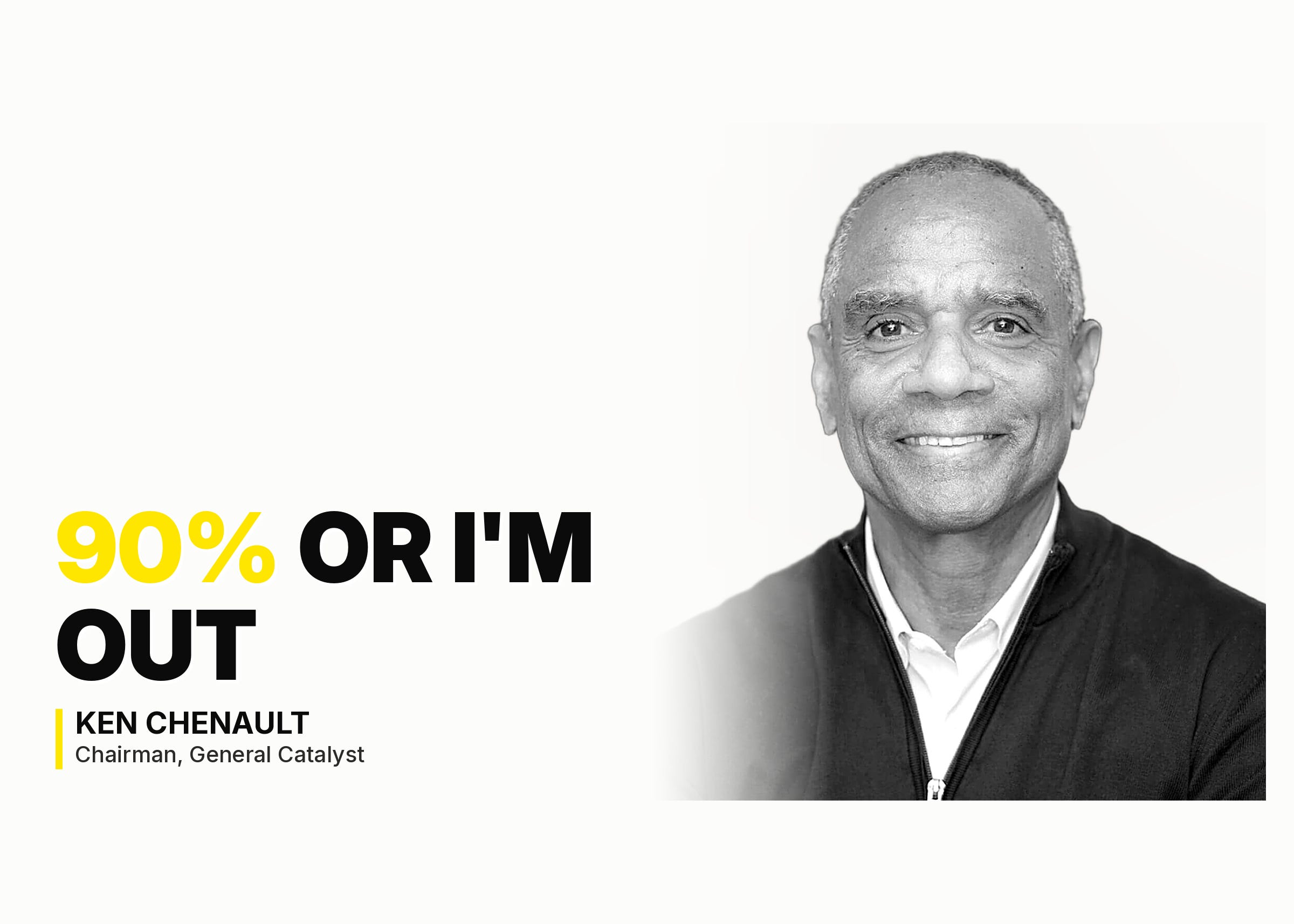
Ken Chenault told Newcomer he agreed to join General Catalyst full time on one condition: he had to enjoy at least 90% of the work, or he was out, no hard feelings. The former American Express CEO, who now chairs the venture and growth firm, said he laid that term out explicitly before he left Amex two years early.
That was one line from one interview. Across tonight's 28 shows, 23 other people said something worth the reader's time, from Zillow's CEO arguing America is 4.5 million homes underbuilt, to a corporate-governance veteran arguing Nvidia's own board should suspend its CEO immediately, to Axon's CEO recalling the year his father put in his last $500,000 to keep the company from folding.
"I don't want to go into an organization at this stage of my life where I don't trust the people a lot... second, 90% of what I do, I have to really enjoy. If I don't hit that standard, no hard feelings, I'm out." — Ken Chenault, Chairman and Managing Director at General Catalyst, on Newcomer (Read summary)
We scanned 813 shows and 10 hours of audio, wrote 12 summaries, and pulled 39 quotes into this 15-minute read.
Here is what mattered.
Macro
The Fed has "barely taken away" its 2024-25 stimulus, Lazar says
October's CPI came in hotter than forecast — headline up 0.4%, core up 0.3% — and futures moved to fully price a December rate hike, with some Fed officials now floating a bigger, 50-basis-point move. Piper Sandler's Nancy Lazar argues the bigger mistake would be reading today's strong hiring as proof the Fed has already done enough.
"The Fed's just raised rates 25 basis points. They've barely taken away any of the stimulus that they put in place in [20]24, [20]25. You see it in money supply growth." — Nancy Lazar, Chief Global Economist at Piper Sandler, on The Exchange
The economy can handle back-to-back hikes, Treasury's Zervos says
David Zervos, who advises Treasury Secretary Scott Bessent, isn't worried the economy can't absorb it.
"The answer to your question is absolutely yes, we can handle it [consecutive hikes], because we've already seen the storyline from this year... stock market's up, I don't know, 9, 10% for the year. Growth is running at a full 3% if not more." — David Zervos, Counselor to Treasury Secretary Scott Bessent, on Squawk on the Street
International
CIBC is splitting index funds into factor tilts for Canadian investors, Gipson says
CIBC built a billion-dollar ETF faster than almost anything else in Canadian fund history this year. Greg Gipson, who runs the bank's ETF business, says the opportunity for Canadian investors isn't picking a broad benchmark — it's breaking one apart.
"You can buy a Russell 3000 ETF for next to nothing... but you could also decompose that into Russell one growth and value, Russell two growth and value. So now instead of accepting that all-cap US exposure, I now have the ability as an investor to tilt along size and style." — Greg Gipson, Managing Director and Head of ETFs at CIBC Global Asset Management, on Insight is Capital
Financials
Revolut will keep lending under 10% of its balance sheet, Storonsky says
Revolut's Nik Storonsky has kept his bank out of the lending business on purpose for years.
"I think our business model, and then my personal opinion, is we want to have the least amount of risk. Even if we lend, it won't be a large portion of the balance sheet. At the moment, target state is less than 10%, and then the rest we would securitize." — Nik Storonsky, Co-Founder and CEO at Revolut, on Cheeky Pint (Read summary)
Banks get a 10x multiple; tech gets 40 to 50x, Storonsky says
The reasoning is arithmetic, not caution.
"If you look at tech business multiple, you can usually get like 40-50 PE. In the banking business, you'll be lucky if you get 10 PE." — Nik Storonsky, Co-Founder and CEO at Revolut, on Cheeky Pint (Read summary)
Walmart's 150 million weekly shoppers give OnePay zero-cost customer acquisition, Ismail says
OnePay's Omer Ismail built the company's growth around Walmart's foot traffic instead of paid marketing.
"We have partnered with Walmart — 150 million weekly shoppers, 90% of the US lives within 10 miles of one... we have the ability to use that ecosystem to acquire customers into our financial services platform from OnePay at zero customer acquisition cost." — Omer Ismail, CEO at OnePay, on Summation with Auren Hoffman (Read summary)
An AI agent gets its own bank account at OnePay, Ismail says
His bigger worry is what happens when a customer hands an AI agent too much access to their money.
"I think if you think about hundreds of millions of Americans, they are still worried about giving financial information or access to your full bank account or to your full credit card to an agent that could hallucinate. We have created inside of OnePay banking a sub account... we call it the bank account for your agent." — Omer Ismail, CEO at OnePay, on Summation with Auren Hoffman (Read summary)
Citi serves 70% of China's Fortune 500 companies, Fraser says
Citigroup's Jane Fraser calls China one of the biggest opportunities in financial services, now that the bank has finally won approval to own a securities business there outright, after roughly five years of trying.
"Citi serves 70% of the global Fortune 500 here in China... what's different we've seen over the last three years is how many of the Chinese companies are expanding globally." — Jane Fraser, Chair and CEO at Citigroup, on Bloomberg Talks (Read summary)
Crypto and Digital Assets
Only $40B of a $150 trillion equity market is tokenized, Chalom says
Joseph Chalom spent 20 years at BlackRock, where he helped launch its Bitcoin ETF, before becoming co-CEO of SharpLink. He argues almost none of the stock and bond market has actually moved onto a blockchain yet.
"There's about $150 trillion of public market equities globally... The total amount of tokenized real world assets is only 40 billion. So you're in batting practice, not even in the first inning of the wave of tokenized assets." — Joseph Chalom, Co-CEO at SharpLink, on The Wolf Of All Streets (Read summary)
Buy Bitcoin at $77,000 the way you'd have bought it at $120,000, Chalom says
On the sell-off itself, his rule is simpler.
"If you think Bitcoin was great to own at 120,000, you want to own it at 77,000. I feel the same about Ethereum. I feel the same way about gold." — Joseph Chalom, Co-CEO at SharpLink, on The Wolf Of All Streets (Read summary)
Alternatives and PE
General Catalyst's roll-up won't cut jobs to hit its numbers, Chenault says
General Catalyst has built an acquisition-led roll-up spanning several industries, run on the opposite logic from a standard private-equity playbook.
"I asked him, is the objective that you're going to make these companies more productive, cut costs? He said, no, Ken — if we have to lay off many people, that means we failed at our strategy." — Ken Chenault, Chairman and Managing Director at General Catalyst, on Newcomer (Read summary)
Consumer
America is 4.5 million homes underbuilt, Zillow's CEO says
Zillow CEO Jeremy Wacksman says the housing market's real problem isn't the interest rate.
"The challenge for buyers, and the affordability challenge, is really an availability challenge. The for-sale market, we are probably 4.5 million homes underbuilt. We've been chronically under-building since the global financial crisis." — Jeremy Wacksman, CEO at Zillow Group, on Squawk on the Street
Private equity has destroyed great restaurant concepts, Mazumdar says
Roni Mazumdar, founder of the restaurant group behind Adda, Dhamaka and Semma, has turned down outside money more than once.
"Many PEs have destroyed many great concepts... because they don't have a Dr. Arya sitting in the room. There's an exit. I need to make as much money as possible, as fast as possible." — Roni Mazumdar, Founder and CEO at Unapologetic Foods, on Forbes (Read summary)
A landlord turned down Unapologetic Foods over how the building would "smell," Mazumdar says
He says the bias his restaurants face is still live, not historical.
"Indian restaurants are never full. They're always empty... Two years later, he came to me and said, I apologize for my decision." — Roni Mazumdar, Founder and CEO at Unapologetic Foods, on Forbes (Read summary)
Store size signals brand size, which is why the first Apple Store was big, Johnson says
Ron Johnson built the first Apple Store under Steve Jobs, at a moment when the mall industry thought the idea was absurd for a product people buy every four or five years.
"Unfortunately in retail, the size of the store correlates with the size of the brand. So if we build a small store... it's gonna feel like a small idea." — Ron Johnson, former SVP Retail at Apple, on 3 Takeaways
Technology & AI
Nvidia CEO Jensen Huang has been tied to a woman U.S. investigators have identified as a suspected Chinese intelligence operative, and the company's board is now weeks into an independent investigation while a hot CPI print and Anthropic's IPO pricing compete for the same week's attention.
AWS is still "not even 1%" into AI inference demand, Garman says
Away from the Nvidia headlines, AWS CEO Matt Garman says cloud spending on AI is nowhere near where it eventually goes.
"I think you're almost doing a disservice to say that it's at the 1% of what it's going to be... I don't think it's even 1%." — Matt Garman, CEO at Amazon Web Services, on Sources Podcast (Read summary)
The AI compute trade is a localized risk, not a systemic one, Garman says
He's also pushing back on the idea that CoreWeave's debt-fueled buildout is a warning sign for the rest of the industry.
"I don't think it's systemic risk, actually. I do think that the risk is localized, because the bets that people are making are materially different." — Matt Garman, CEO at Amazon Web Services, on Sources Podcast (Read summary)
Memory costs, not margins, pushed up Oracle's AI pricing, Maxson says
Oracle CFO Hilary Maxson, defending the jump in the company's own AI contract pricing, says the increase is mostly memory costs working through its cost-plus deals.
"I think it's primarily cost inflation. So we do have inflation, particularly in the cost of memory... we have cost-plus pricing in our big AI contracts, and then I also think that the market has strengthened in terms of overall pricing for AI compute." — Hilary Maxson, CFO at Oracle, on Squawk on the Street (Read summary)
Oracle already has five data centers under construction in the US, Maxson says
She says the political backlash against new data centers isn't new to Oracle either.
"We have five large data centers under construction already in the U.S. One of those is nearing completion... it's not like anti-data-center sentiment just arose last Tuesday. This is an environment we've been dealing with for at least the past 8 to 10 months." — Hilary Maxson, CFO at Oracle, on Squawk on the Street (Read summary)
AI compute demand "is not going away," Fraser says
Citigroup's Jane Fraser, back on the AI trade itself rather than her own bank, isn't buying the panic.
"The need for compute is not going away. This is a multi-year AI infra build. Not everyone will be a winner in that dimension." — Jane Fraser, Chair and CEO at Citigroup, on Bloomberg Talks (Read summary)
Nvidia's board should suspend Huang immediately, Minow says
Not everyone is calm about the company at the center of the selloff. Nell Minow, a longtime corporate-governance adviser, says the board has already waited too long.
"The board should suspend him immediately. That's the only way to reassure the shareholders and the customers that they are on top of it. The board has done everything wrong so far." — Nell Minow, Chair at ValueEdge Advisors, on Squawk on the Street
CoreWeave is "a sailboat in a category five hurricane," Ives says
Wall Street's Dan Ives is just as blunt about Nvidia's biggest cloud customer.
"Right now they're [CoreWeave is] a sailboat in a category five hurricane relative to neo clouds and what they're going to do in terms of the debt... Neo clouds are on the wrong side of the trend, and I think that's why it continues to be a challenging environment." — Dan Ives, Partner and Senior Managing Director at Yorkville, on Fast Money
No person is bigger than Nvidia as an institution, Cramer says
CNBC's Jim Cramer, defending Huang, argues the company has to be bigger than any one executive.
"There have been more opportunities to trash Jensen Huang this week than I have ever seen, and everyone is being taken. Jensen's hard to replace if he has to go... but no one person is bigger than the institution — something I know Jensen would agree with." — Jim Cramer, Host at CNBC's Mad Money, on Mad Money
Anthropic's IPO could value it at $1.4 trillion, Faber says
Anthropic priced its own IPO roadshow this week at a scale that could make it the largest ever. CNBC's David Faber laid out the math.
"If you take the fully diluted number, you're talking about a range of, let's call it, between 1.3 and 1.4 trillion... they're going to have over $200 billion on that balance sheet in cash after the offering is completed." — David Faber, Co-Anchor at CNBC, on Squawk on the Street
Anthropic's IPO is "healthy price discovery," not a rejection, Toney says
Plexo Capital's Lo Toney, an existing investor in Anthropic, reads the pricing as a sign of discipline rather than weak demand.
"Anthropic moving forward with the IPO despite volatility with the AI stocks, and we're seeing what I think is a very healthy price discovery and not a rejection of the company." — Lo Toney, Founding Managing Partner at Plexo Capital, on Squawk Pod
Axon uploads more video a day than YouTube gets in views, Smith says
Away from the Nvidia story, Axon CEO Rick Smith says the scale of enterprise video his own company handles has already passed a familiar benchmark.
"We manage, I think, more video every day than YouTube — now, they have a lot more viewers, but we have over a million police officers uploading two hours of video every day from one of these body cameras." — Rick Smith, CEO at Axon, on All-In (Read summary)
VC & Startups
99% of knowledge still lives in people's heads, Mercor's CEO says
Mercor just raised $750 million at a $20 billion valuation to keep building the data sets used to train AI models. Its CEO, Brendan Foody, argues the category is growing even as AI gets better at the work itself.
"99% of knowledge still lives in people's heads, and if we just make it more effective and productive to have humans teaching models, that just increases the amount that people teach models throughout the economy." — Brendan Foody, Co-Founder and CEO at Mercor, on Sourcery with Molly O'Shea (Read summary)
Mercor pays experts $5 million a day, up from $1 million a year, Foody says
The scale of what now moves through Mercor's own payments system is the clearest evidence.
"If we're paying out call $5 million a day, 24 months ago we were paying out a million dollars a year." — Brendan Foody, Co-Founder and CEO at Mercor, on Sourcery with Molly O'Shea (Read summary)
Over 70% of new US companies are expected to stay one-person shops, Shah says
HubSpot co-founder Dharmesh Shah says the biggest opportunity in software right now is the same one SMB software was 20 years ago: a market everyone else was dismissing.
"The percentage of those new company formations that are expected to remain one-person companies is the highest it's ever been and it's increasing... that percentage is now — it's over 70%." — Dharmesh Shah, Co-Founder and CTO at HubSpot, on a16z (Read summary)
HubSpot's newest product is its most successful launch yet, Shah says
The proof point is a product barely a month old, built by a team inside HubSpot with no obligation to use the company's own brand.
"The thing I've been really surprised by is the willingness of people to put a credit card down on a consumption-based model... I've launched lots of projects over the years at HubSpot. This has been in that regard the most successful." — Dharmesh Shah, Co-Founder and CTO at HubSpot, on a16z (Read summary)
Industrials and Transport
Tesla's one-piece casting gave it an 8-year lead, McNeill says
Jon McNeill, Tesla's former president, says the company's hardest manufacturing bet is also its most durable one: casting an entire chassis from molten aluminum instead of welding roughly 300 stamped parts.
"It was literally the physics were impossible. People didn't know how to do it... but they figured it out. And it's created an 8-year competitive advantage for Tesla." — Jon McNeill, Co-Founder and CEO at DVx Ventures, on The Knowledge Project (Read summary)
Materials & Energy
BP bet $500 million on Russia and nearly lost it all, Browne says
Lord John Browne built BP into one of the world's largest oil companies and, in 1997, broke with the rest of the industry to call climate change a business risk. Some of his biggest bets were simply bets on surviving.
"We're going to put 500 million in Russia. We explained why we could lose it all. We nearly did, but we didn't. ... Very often the courtroom was protected by people with Kalashnikovs, not allowing you in." — Lord John Browne, former CEO at BP, on Executive Decisions with Steve Sedgwick
Policy
Violating export-control law on chips can mean 20 years in prison, Alperovitch says
Dmitri Alperovitch, the CrowdStrike co-founder who now chairs the Silverado Policy Accelerator, separates the optics of the Huang story from its legal exposure.
"It's not illegal to have an affair with a Chinese intelligence officer, as objectionable as we might find it. What is illegal is to violate U.S. export control laws... and the penalties for some of these violations could go up as high as 20 years in jail." — Dmitri Alperovitch, Chairman at Silverado Policy Accelerator, on Closing Bell
Nvidia tried to influence a federal investigation into Megaspeed, Alperovitch says
He says the exposure doesn't stop at one relationship.
"One of the things that has come out just yesterday in the New York Times and Bloomberg is that NVIDIA was trying to influence the Commerce Department and trying to shut down their investigations into Megaspeed — incredibly troubling and potentially illegal on its own." — Dmitri Alperovitch, Chairman at Silverado Policy Accelerator, on Closing Bell
Nuggets of Wisdom
General Catalyst's chairman set one condition before joining: enjoy 90% of it
Ken Chenault's own list of conditions for joining General Catalyst full time was short.
"I don't want to go into an organization at this stage of my life where I don't trust the people a lot... second, 90% of what I do, I have to really enjoy. If I don't hit that standard, no hard feelings, I'm out." — Ken Chenault, Chairman and Managing Director at General Catalyst, on Newcomer (Read summary)
Overstepping his authority at Tesla got him called a great decision, McNeill says
Jon McNeill nearly lost his footing in his first weeks at Tesla, after shutting down a sales process without asking Elon Musk first.
"I shut off all new leads until they asked for the order... There was this long silence on the other end of the phone. And then he finally said, 'That was a great decision. You're going to fit in here just fine.'" — Jon McNeill, Co-Founder and CEO at DVx Ventures, on The Knowledge Project (Read summary)
Rick Smith's father put in his last $500,000 to keep Axon alive
Axon's Rick Smith has a similar story from decades earlier, when the company — then called Taser — was days from running out of money.
"It would have been nice to figure that a couple years ago, because we owe Silicon Valley Bank about $2 million. I have $500,000 and I'm on the hook... if we shut down, the bank has taken everything. I'm putting my last $500,000 in." — Rick Smith, CEO at Axon, on All-In (Read summary)
A Holocaust survivor's lesson kept Lord Browne closeted for decades
Lord John Browne traces his decision to hide his sexuality for decades to a single lesson from his mother, who survived Auschwitz.
"Never tell anyone a secret, because they will certainly use it against you, and never be too visible as a member of a minority, because when the going gets tough, the majority always hurt the minority." — Lord John Browne, former CEO at BP, on Executive Decisions with Steve Sedgwick
If this was worth your time, send it to someone who has to follow all of this too.
What did you think of today’s edition? Hit ‘reply’ to this email, send us a message, leave a comment, or join the chat!
Get the latest market chatter as it happens: