

David Senra · Nov 8, 2026 · 1h 2m · 51m saved
With Nikesh Arora, Chairman and CEO of Palo Alto Networks
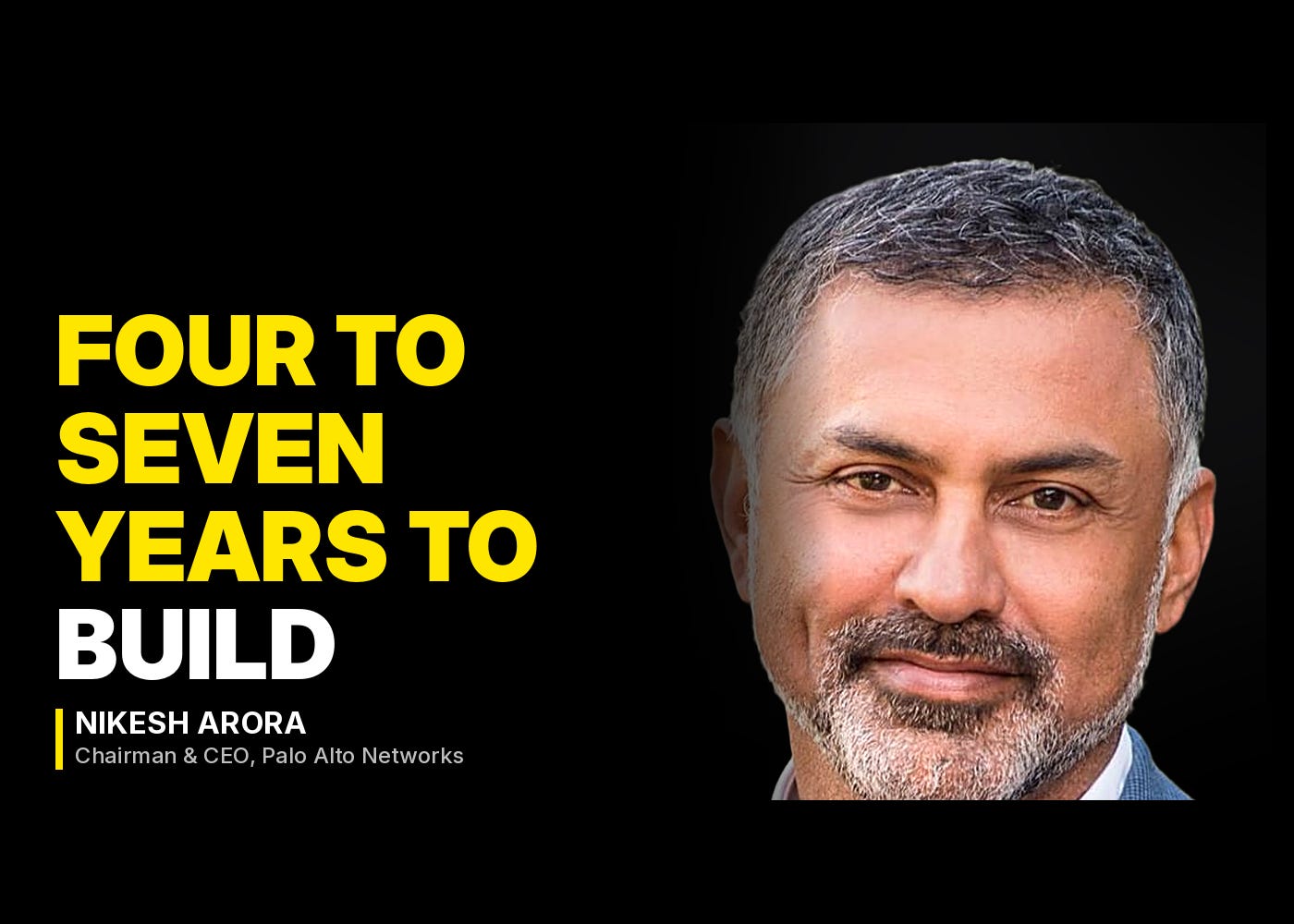
Photo via paloaltonetworks.com
Palo Alto Networks was an $18 billion, largely single-product firewall company when its current CEO arrived in 2018. Nikesh Arora, chairman and CEO of Palo Alto Networks, told David Senra on his podcast that roughly 35 acquisitions and more than 70 products later, he puts the company in the $300 billion range. Most acquirers buy companies. He says he buys teams, and only the top two in any category.
"Number one and number two end up with disproportionate share of the profits in the category... If you're going to go win, you want to be number one and two in the long term. If you're not going to be number one and two, you got a problem." — Nikesh Arora
Nikesh spent ten years at Google as it grew from roughly 2,000 employees to 60,000, then two years as president of SoftBank, before he set out to rebuild Palo Alto on enterprise economics rather than security ones.
The full interview is covered here so you can skip it. 62 minutes of audio, 11 minutes of reading.
Here are the 11 principles that matter.
Key Takeaways
Nikesh's thesis: cut sales, marketing and support from 60% of costs to 20% and a security company can run at a 40% operating margin
Palo Alto buys only the number 1 or number 2 player in a category, because they take most of its profits
Building a good product takes 4 to 7 years, so buying a team that already has one puts Palo Alto ahead
No deal closes until the founder signs a joint product roadmap, built in the 30 days before closing
No founder has backed out; Palo Alto has walked away twice
AI makes cybersecurity more valuable, because every new way to log in is another way to attack
AI's per-token pricing makes it far too expensive to replace Palo Alto's $25-a-year endpoint monitoring
Nikesh says he only adopted his fatalism in the last 5 years, not during his years of hypergrowth at Google
1. Lessons From Google's Growth
Nikesh spent ten years at Google, where he ran Google Europe and later became chief business officer. Over that time the company grew from roughly 2,000 employees to 60,000, and from $2 billion in revenue to $62 billion.
At Google, Nikesh controlled neither price nor volume
Bidders set the price of an ad and searchers set the volume. The job of the ad-sales business was therefore to remove friction and build scale, not to manage demand. After Google, Nikesh spent two years as president of SoftBank and joined Palo Alto Networks in 2018.
