

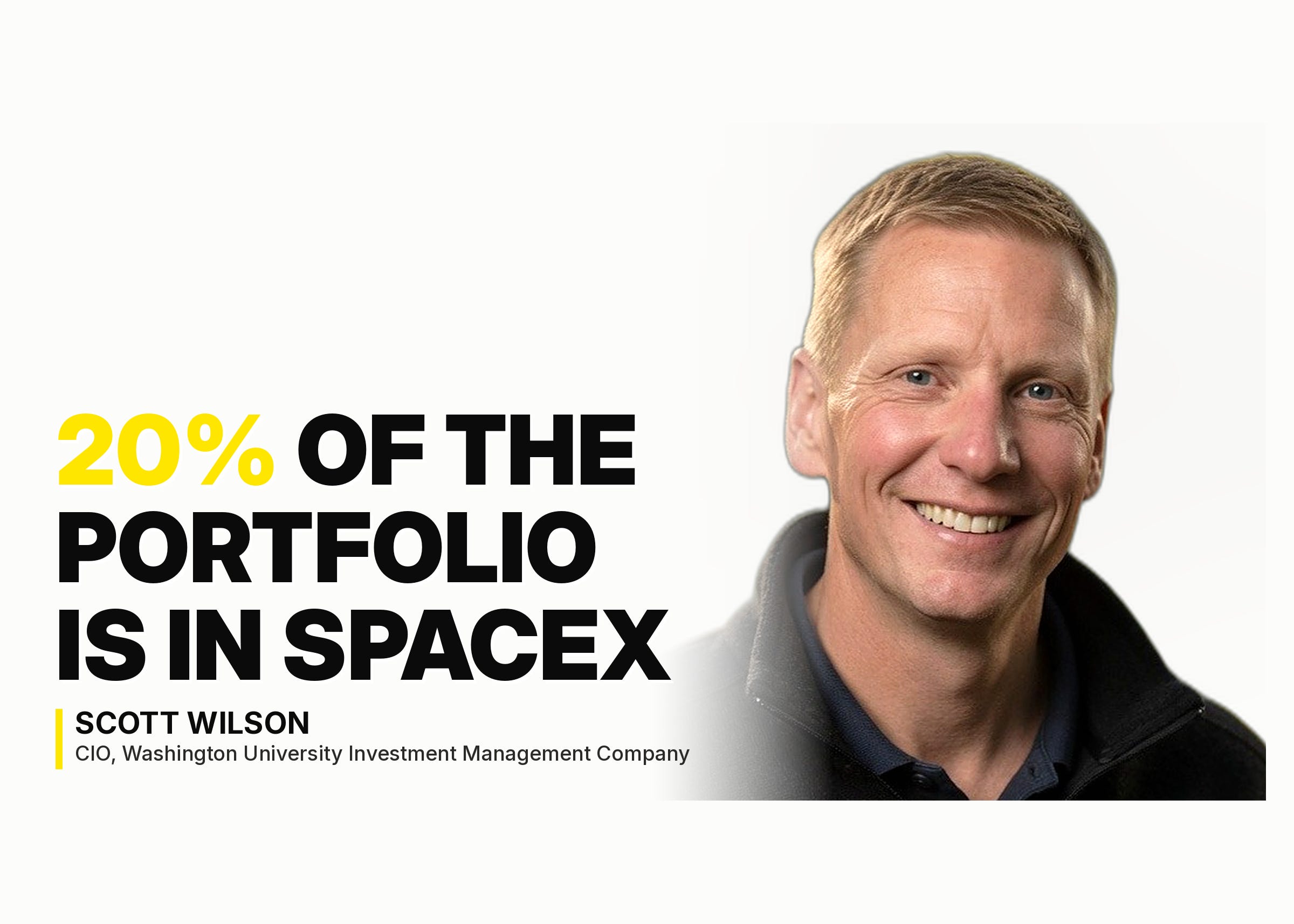
SpaceX grew to more than 20% of Washington University's endowment at one point, and the endowment kept holding it through the company's IPO, Scott Wilson told 20VC. Wilson, WashU's chief investment officer, said its board backed the decision even though WashU had many chances to sell.
Wilson was one of 20 people quoted in this issue. The others ranged from Jamin Ball of Altimeter Capital, who said Anthropic brought in $16.8 billion of revenue in a single quarter against $7 billion of lifetime cash burn, to Sean Evers of Gulf Intelligence, who said a $110 barrel of Brent costs about $200 delivered to China, to Tom Pikett of DTCC, who said its new tokenization service could bring about $30 trillion of assets onchain.
"At one point, north of 20% of the portfolio is in SpaceX... we had conviction as a team, and we had many chances to take lots of liquidity in that name, but we advocated for holding it." — Scott Wilson, CIO at Washington University Investment Management Company, on 20VC (Read summary)
We scanned 760 shows and 15 hours of audio, wrote 15 summaries, and pulled 50 quotes into this 21-minute read.
Here is what mattered.
Macro
Karsan puts US public and private equity at $300T, too big to fail
Cem Karsan founded Kai Volatility Advisors. He said US stock markets have grown so large that the economy now depends on them, and listed that as one of four pressures on the US, with the national debt, populism and China.
"We now have a $300 trillion equity, private and public market. It goes up 20%, we have $50 trillion liquidity. We come down 20%, that's $50 trillion of liquidity pulled out of the system." — Cem Karsan, Founder at Kai Volatility Advisors, on Top Traders Unplugged (Read summary)
Karsan expects a crisis to be allowed to happen before June 2027
Karsan said the policy response those pressures require cannot win political agreement without one. He summarized that response as printing money to buy stocks, pointing to the government's stakes in Intel and MP Materials and to Japan, where he said the central bank owns about 8% of the Nikkei.
"Before June of '27, we believe there'll be a meaningful crisis that will be allowed essentially to happen... to respond with what is needed in terms of a massive response to a building set of pressures that are unsustainable otherwise." — Cem Karsan, Founder at Kai Volatility Advisors, on Top Traders Unplugged (Read summary)
International
Most of Mercado Libre's margin drop comes from booking card losses upfront
Daniel Mahncke and Shawn O'Malley co-manage The Investor's Podcast Network's Intrinsic Value Portfolio, which has just raised Mercado Libre from 5% to 7% of its holdings. Mercado Libre's operating margin has fallen from 12% to a little under 7%. Its payments and lending arm, Mercado Pago, books a new credit card's expected losses on day one, while the interest comes in later.
"Of the five points of margin that Mercado Libre gave up, the biggest piece is this day-one loss provisioning on credit cards, which is really an accounting timing issue more than anything, and not due to competition from Shopee." — Shawn O'Malley, Analyst at The Investor's Podcast Network, on The Investor's Podcast (Read summary)
Mercado Pago's card margin after losses fell to -2.5% as it issued cards faster
Mercado Pago is the sixth-largest credit card issuer in Brazil. Mahncke said management expects each batch of new cards to break even within 12 to 18 months, and the card business as a whole to break even by 2028.
"Its net interest margin after losses was minus 2.5% last quarter, versus roughly break-even a year earlier, because card issuance had accelerated." — Daniel Mahncke, Analyst at The Investor's Podcast Network, on The Investor's Podcast (Read summary)
Shopee can copy free shipping but not Mercado Libre's lending, Mahncke says
Mahncke called Shopee, which is owned by Sea Limited, Mercado Libre's fiercest competitor; he owns Sea shares himself. He said Mercado Libre has about 43% of Brazil's online retail market against 18% for Shopee. Neither company is cutting the fees it charges sellers, the two hosts said.
"Shopee can match Mercado Libre on shipping, but it's much harder to match it on credit." — Daniel Mahncke, Analyst at The Investor's Podcast Network, on The Investor's Podcast (Read summary)
Financials
Assured Guaranty's Brightline exposure is to the operating company's senior loans
Tim Travis runs T&T Capital Management and has followed Assured Guaranty, a municipal bond and financial guaranty insurer, for more than a decade. Brightline's Florida rail holding company is bankrupt. Travis said the loans Assured Guaranty insures sit with the operating company and are secured by rail cars and land.
"AGO insures the senior first lien loans of the operating company, which is very different... it's not the one that went bankrupt." — Tim Travis, Founder, CEO and CIO at T&T Capital Management, on The Acquirers Podcast (Read summary)
Crypto and Digital Assets
DTCC's tokenization service could bring about $30T onchain, Pikett says
Tom Pikett is an executive director at DTCC Digital Assets. DTCC's service, which records securities as tokens on a blockchain, went live with 34 securities, a mix of stocks, ETFs and US Treasuries. That is the range a no-action letter allowed DTCC last year.
"That unlocks in the region of about 30 trillion that could come on chain." — Tom Pikett, Executive Director at DTCC Digital Assets, on The Rollup (Read summary)
The product is collateral that moves at any hour, not the token, Pikett says
Collateral is what one firm posts to another to secure a trade or a loan. Pikett said tokenized assets can be posted anywhere, including when their home market is shut. In July DTCC ran a one-day production test in which a prime broker delivered margin to CME using DTCC tokens.
"The fact is that the token itself is not the product, right?... Collateral mobility, the reason it's important is... your assets are effectively stuck as that market is closed." — Tom Pikett, Executive Director at DTCC Digital Assets, on The Rollup (Read summary)
Tokenized money market fund shares can be posted as margin directly
Today a margin call usually forces a fund manager to redeem money market fund shares for cash first.
"Tokenized money market funds are interesting because that actually changes some of the dynamic in the collateral markets... you have the potential to then deliver that as collateral itself." — Tom Pikett, Executive Director at DTCC Digital Assets, on The Rollup (Read summary)
DTCC nets down 98% of the trades it sees, Pikett says
Netting offsets each firm's purchases against its sales, so only the difference changes hands. Pikett said there are probably not enough assets in the world to settle every trade one at a time.
"If you think of our role in the market from a netting perspective, we actually net down 98% of the trades that we see coming through." — Tom Pikett, Executive Director at DTCC Digital Assets, on The Rollup (Read summary)
Schiff says bitcoin's rally was a bet on Trump that the midterms ended
Peter Schiff runs Euro Pacific Asset Management and SchiffGold, a dealer in physical gold and silver. Bitcoin fell about 3% last week to roughly $75,900, close to the average price Strategy has paid for its bitcoin over six years. Schiff told listeners to sell bitcoin and buy gold and silver.
"Bitcoin sided with Trump and made this political... You live by politics, you die by it." — Peter Schiff, CEO at Euro Pacific Asset Management, on The Peter Schiff Show Podcast (Read summary)
Alternatives and PE
Without its payout, WashU would put 70% to 80% in private assets
Washington University draws about 5% a year from its endowment, so WashU targets roughly half public and half private assets. Wilson said its private holdings have compounded in the low-to-mid 20s a year over the past decade, against about 10% for public stocks.
"If you didn't have the required net outflows, we would probably have 70, 80% targeted privates." — Scott Wilson, CIO at Washington University Investment Management Company, on 20VC (Read summary)
WashU stays out of mega-funds, which need neither its money nor its co-investing
Wilson said doubling a fund's size usually means paying more for the same companies, and WashU avoids funds larger than about $10 billion. More than half of its private portfolio is now in direct investments and co-investments alongside its managers.
"Our model doesn't really work with the mega funds. They don't need our capital, and they certainly don't really need us for co-investment unless it's some massive round." — Scott Wilson, CIO at Washington University Investment Management Company, on 20VC (Read summary)
Wilson says European companies trade at earnings multiples where US peers get revenue multiples
WashU has invested in a fintech company based in Spain and in another based in London and Singapore. Unit economics are what a company earns on each customer after the cost of serving that customer.
"For the same quality of asset... if they were based in the US and had the same KPIs, growth and unit economics, they would trade at huge revenue multiples, and in Europe they trade at... small earnings multiples." — Scott Wilson, CIO at Washington University Investment Management Company, on 20VC (Read summary)
Consumer
A CMS billing change could cut some ENT surgeons' pay by 50%, Powell says
Scott Powell is an ear, nose and throat surgeon and a partner at Florida ENT and Allergy in Tampa, which a merger will take to 31 ENT doctors across three counties. CMS is the Centers for Medicare & Medicaid Services. Powell said the change due in January concerns a billing code known as the 25 modifier.
"Coming January, there's a big CMS ruling where they are going to change the 25 modifier in the ENT world. That is the hill we die on... it would be a 50% pay cut potentially. It is that dramatic, that drastic." — Scott Powell, ENT Surgeon and Partner at Florida ENT and Allergy, on The LegacyRx Podcast (Read summary)
Orthopedic surgeons expect another 20% cut on joint replacements in 2027
Kyle Stephenson, the show's host, is an orthopedic surgeon. He said about 82% of physicians are now employed by a hospital system or by private equity.
"Over the last 20 years, our reimbursement has gone down 30-something percent. And then in 2027, it's going to be even worse... a total joint replacement, the reimbursement is going down another 20%." — Kyle Stephenson, Orthopedic Surgeon, on The LegacyRx Podcast
Stephenson expects orthopedic practices to go back to cash pay
He said insurers have consolidated to the point of near-monopoly, pointing to UnitedHealthcare's ownership of OptumHealth, physician groups and pharmacy middlemen.
"I truly think in the next five years, at least in the orthopedic space, five to 10 years, cash pay practice is back. I think insurance companies, we got to cut them out." — Kyle Stephenson, Orthopedic Surgeon, on The LegacyRx Podcast
Technology & AI
Anthropic's S-1 shows $16.8B of revenue in a quarter against $7B of lifetime burn
Jamin Ball is a partner at Altimeter Capital, which holds a large stake in Anthropic. Anthropic has filed its S-1, the registration statement for an initial public offering, and Ball expects trading to start in mid-to-late November. He said Anthropic has raised $141 billion and holds $134 billion in cash. The $16.8 billion is third-quarter revenue reported outside the filing.
"$16.8 billion of quarterly revenue off of $7 billion of lifetime burn." — Jamin Ball, Partner at Altimeter Capital, on Latent Space (Read summary)
Anthropic's revenue rose 14x while its serving compute rose 2.3x
Serving means running models for paying customers; the rest of Anthropic's computing goes to training, safety and research. Ball read the gap as a roughly 7x gain in efficiency, with no price increases. He said the filing shows 85% gross margins and an 8% operating margin under standard accounting rules.
"Only 27% of their compute today is going towards serving models... their compute that went towards serving models has gone up by 2.3x. Their revenue over the same period has gone up 14x." — Jamin Ball, Partner at Altimeter Capital, on Latent Space (Read summary)
Anthropic's $108B note liability reflects about $11B of convertibles, Ball says
Convertible notes are loans that can turn into shares. Anthropic issued them mostly to Amazon and Google as early investors, and their recorded value has risen with Anthropic's valuation. About $5 billion has already converted into shares.
"About 108 billion of convertible notes payable as a liability... the reality is they didn't raise $108 billion of debt. There was about 11 billion in those combined convertible notes." — Jamin Ball, Partner at Altimeter Capital, on Latent Space (Read summary)
Anthropic's roughly $80B first-half loss is the same markup, Ball says
Accounting rules count the rise in the notes' value as a loss. Without it, he said, the operating business is profitable.
"100% of the loss in the first six months is just the value appreciation of their converts. If Anthropic never issued converts to Amazon and Google... that loss wouldn't be there." — Jamin Ball, Partner at Altimeter Capital, on Latent Space (Read summary)
Data-center lenders are already full on Anthropic and OpenAI, Ball says
Neoclouds are companies that rent out AI computing, and several of them count the same two labs as their main customers. Ball said debt deals for them are struggling to find buyers, with some priced above 10%, because a lender is really betting on the customer at the end of the contract.
"Because that's actually who I'm underwriting, that's the customer, that's the end payer of the bill... right now the end payers of the bill are Anthropic and OpenAI." — Jamin Ball, Partner at Altimeter Capital, on Latent Space (Read summary)
Wilson says the top AI models are interchangeable; Ball says the newest earn most of the revenue
WashU holds Anthropic through several of its fund managers, and it trimmed and hedged its Cerebras position around Cerebras's IPO. Ball read Anthropic's revenue mix the other way: as evidence that staying at the frontier, not selling older models cheaply, is what drives revenue.
"If you take the top five large language models and they all had the same user interface, for 99% of problems... you probably couldn't tell the difference... I can't describe another industry like that has a big, deep profit pool." — Scott Wilson, CIO at Washington University Investment Management Company, on 20VC (Read summary)
"For the three months ending September, 80% of their revenue was driven by models that were six months old or younger." — Jamin Ball, Partner at Altimeter Capital, on Latent Space (Read summary)
Three buyers have reserved nearly all US computing capacity, Blundin says
Dave Blundin founded Link Ventures. He said one of its portfolio companies was turned away by a cloud provider for not being a big enough customer.
"The big buyers — Google, Anthropic, XAI — have reserved basically all the compute in the country for years, and all of TSMC's capacity. If you want a thriving entrepreneurial America, you have to have some kind of a right to compute, and government hasn't begun to tackle that yet." — Dave Blundin, Founder and General Partner at Link Ventures, on Moonshots (Read summary)
Google took over a Crusoe data center from its tenant, Sacks says
David Sacks, a general partner at Craft Ventures, cited it as an early sign that the largest cloud companies are already squeezing out middlemen.
"Google just took over a Crusoe data center. They co-opted the renter. They're like, you're gone. We're going to take it over." — David Sacks, General Partner at Craft Ventures, on All-In (Read summary)
Halting new data centers would barely slow AI now, Wissner-Gross says
Alex Wissner-Gross is a computer scientist and the founder of Reified. The show discussed an independent 11-week study by METR that found Anthropic's AI research running at about 1.9x its historical pace, mostly because AI is now helping with the research.
"We're at superintelligence escape velocity at this point. You could stop all data center construction tomorrow — yes, it would be painful... but so much of AI R&D is now itself driven by AI, so I'm not sure it would matter. It would be a blip." — Alex Wissner-Gross, Computer Scientist and Founder at Reified, on Moonshots (Read summary)
VC & Startups
Big companies are replacing $10M software projects with $250K of Replit
Amjad Masad co-founded and runs Replit, whose AI agent writes and runs software. He said banks, manufacturers and telecoms find employees who build internal tools with it, and that use spreads from there.
"They would tell us, 'We've actually scoped this project out — it would have been $10 million. We spent $250,000 on Replit.'" — Amjad Masad, Co-Founder and CEO at Replit, on Y Combinator (Read summary)
Masad says companies should measure AI's return per employee instead of rationing it
Many companies give each employee a fixed AI budget, such as $100 a month. Masad said the gap in value between employees has widened from about 10x to 100x and now 1,000x.
"I disagree with rationing tokens... What we see from our customers is there's a parallel of ROI inside companies — one person could drive 100x the next person." — Amjad Masad, Co-Founder and CEO at Replit, on Y Combinator (Read summary)
A telecom's staff went from 80% anxious about AI to 80% optimistic
The survey was taken before and after a hackathon Replit ran with the company. Masad said most banks still use AI the way they did in 2023.
"We did this hackathon with a very large telecommunications company — they surveyed people before and after using Replit. Pre, about 80% were anxious and worried about their jobs. After, it flipped: 80% were optimistic." — Amjad Masad, Co-Founder and CEO at Replit, on Y Combinator (Read summary)
Industrials and Transport
Plumbers will charge what they want as tradespeople get scarce, Hoskins says
Keaton Hoskins has started or bought more than 60 businesses. He said a plumber who charges $200 an hour today will be able to charge $500 to $1,000 within 10 years, because too few young people are learning trades.
"Right now you have a plumbing problem, you call six plumbers, you get six bids. In 10 years that's not going to be a thing... Trade-specific businesses will make the most millionaires in the next 10 to 15 years, 100%, because they'll be able to charge whatever they want." — Keaton Hoskins, Entrepreneur and Owner of More Than 60 Businesses, on Wealthy Way (Read summary)
Travis backs the case for Uber at 16x earnings; Carlisle points to Tesla's robotaxi
Bill Ackman has been writing about Uber, and Travis summarized his case. Travis said cost and convenience will decide whether robotaxis take Uber's rides. Tobias Carlisle, who founded Acquirers Funds and hosts the show, called Uber's valuation reasonable but is more cautious about the threat.
"You've got a stock trading at like 16 times earnings, and they're growing their profitability by about 25% per year, and that's kind of expected to stick over the next couple of years." — Tim Travis, Founder, CEO and CIO at T&T Capital Management, on The Acquirers Podcast (Read summary)
"The rate at which the Tesla cyber cab scaled in Austin... it's just gone vertical, and it's bypassed Waymo in a very short period of time for rides." — Tobias Carlisle, Founder at Acquirers Funds, on The Acquirers Podcast
Materials & Energy
A $110 barrel of Brent costs about $200 delivered to China, Evers says
Sean Evers founded Gulf Intelligence in 2009 after two decades in journalism, including at Bloomberg and the Financial Times. He said refined fuel, not crude, is what is short: about 5 million barrels of refining capacity sit inside the Strait of Hormuz, and crude is still leaving while refined products largely are not.
"The Brent futures contract today is trading at about $110 a barrel. But if you wanted to buy a physical barrel... send it to China... the real price is about $200 a barrel because shipping costs and insurance costs are at about a multiple of 20." — Sean Evers, Founder and Managing Partner at Gulf Intelligence, on SmarterMarkets (Read summary)
Gas costs about 10x more outside the US than inside it, Evers says
LNG is natural gas cooled to a liquid for shipping by sea, priced per million British thermal units (mmBtu). With Qatar's exports largely shut in, the US is now the dominant supplier.
"LNG is trading at near record levels, $25 plus for mmBtu... The rest of the world is paying a multitude of probably 10 times what you pay for gas in America." — Sean Evers, Founder and Managing Partner at Gulf Intelligence, on SmarterMarkets (Read summary)
UK gas storage is at 30% of its usual level heading into winter
Evers said a severe winter could push Europe to look to Russia for supply again.
"Underground gas reserves storage in United Kingdom is at 30% of what it usually is. If Europe was to get a cold winter... they would start maybe be looking at that red hot phone line to Putin." — Sean Evers, Founder and Managing Partner at Gulf Intelligence, on SmarterMarkets (Read summary)
Sacks says Brent would fall from $110 to $70 if the Iran war ends
He said cheaper oil would bring down gas, diesel and food costs and give the Fed room to cut rates.
"On the day of the election, the price of Brent crude dropped 10%... It'll go from 110 to 70 if this war ends." — David Sacks, General Partner at Craft Ventures, on All-In (Read summary)
Schiff expects copper to rise because a new mine takes 5 to 10 years
He said too little copper, raw material and factory capacity could hold back the AI buildout, however it is financed.
"We haven't built a copper mine in decades, and it takes 5 or 10 years to bring a new one online... so copper prices are going a lot higher." — Peter Schiff, CEO at Euro Pacific Asset Management, on VRIC Media (Read summary)
Policy
A state permit freeze could strand $50B data centers, Palihapitiya says
Texas's governor-elect, Gina Hinojosa, has promised to freeze new permits for data centers. Chamath Palihapitiya, who founded and runs Social Capital, said that could strand half-built gigawatt-scale projects still waiting on permits such as air-pollution approvals. He expects 2027 spending to hold and the 2028 pipeline to shrink.
"These gigawatt power data centers, they cost around $50 billion, okay? Nobody can make that investment in conditions of uncertainty." — Chamath Palihapitiya, Founder and CEO at Social Capital, on All-In (Read summary)
Federal AI rules would entrench the closed-model labs, Palihapitiya says
He expects Democrats in Congress to push for a federal body that reviews AI models for safety before they are released.
"The quid pro quo is this. The government gets more power and the duopoly of closed model companies get more regulatory capture or moats around their business." — Chamath Palihapitiya, Founder and CEO at Social Capital, on All-In (Read summary)
A US freeze would move data centers abroad, Calacanis says
Jason Calacanis, who runs LAUNCH, named Canada, Mexico, Singapore, Malaysia and the Gulf. Tokens are the units of text that AI models read and write; he meant the US would buy AI output from other countries rather than sell it.
"We're going to be a net importer of tokens... all those $300,000, $400,000 jobs building these data centers are going to go away." — Jason Calacanis, Angel Investor and Managing Partner at LAUNCH, on All-In (Read summary)
Data centers will move to states that want them, Blundin says
Colossus, Elon Musk's AI computing cluster, is in Tennessee.
"Elon, as always, has insane foresight — he put all of Colossus in Tennessee, not in Texas. And Tennessee's like, 'let's move it all over here, this is great.'... The buildout is just going to shift to the states that have a desire to have it happen." — Dave Blundin, Founder and General Partner at Link Ventures, on Moonshots (Read summary)
Towns should trade data-center approvals for public benefits, Wissner-Gross says
He suggested free school lunches, medical care or tax rebates, paid for by the hyperscalers, the largest cloud companies.
"There is a grand bargain to be struck. What I worry about is municipalities not looking to the endgame of what bargain to strike with terrestrial data centers before it all just moves to orbit." — Alex Wissner-Gross, Computer Scientist and Founder at Reified, on Moonshots (Read summary)
Other appearances:
The Production Board CEO on the odds of sweeping limits on AI development and use on All-In
Nuggets of Wisdom
Spreading across 60 businesses cost Hoskins at least one $50M company
Hoskins calls his approach the shotgun approach, against a business partner who went deep on one or two companies.
"If I would have doubled down and doubled down, I know 100% I would at this point have had at least one company I could have sold for $50 million... I would probably be a billionaire right now if I didn't do it that way." — Keaton Hoskins, Entrepreneur and Owner of More Than 60 Businesses, on Wealthy Way (Read summary)
Hoskins measures a business by the cash its owner keeps
His peptide company paid him $42,000 in its first month.
"I know lots of companies that don't make any money and do $15 million a year in revenue. That's not successful to me. You drive a 1998 Corolla and have a $15 million business and no money... Success is the amount of money you actually put in your pocket." — Keaton Hoskins, Entrepreneur and Owner of More Than 60 Businesses, on Wealthy Way (Read summary)
Wilson's costliest mistake was not adding to winners once they grew large
He said the mistake, made with positions that had already reached 1% to 2% of the portfolio, has cost WashU billions.
"The biggest mistake that I've made since I've been at WashU is not adding capital to our winners just because... they became a relatively sizable position early on." — Scott Wilson, CIO at Washington University Investment Management Company, on 20VC (Read summary)
The biggest winners routinely fall 60% to 70% along the way, Mayer says
Chris Mayer co-founded Woodlock House Family Capital and wrote “100 Baggers,” a study of every US stock that rose 100-fold or more between 1962 and 2014. His new book is “The Investor’s Odyssey.” Berkshire Hathaway, the best performer in his study, was cut in half three times.
"There's classic examples of Apple and Amazon... suffering 60, 70% plus drawdowns, but that actually is pretty common — these big winning stocks have many, many drawdowns." — Chris Mayer, Co-Founder and Portfolio Manager at Woodlock House Family Capital, on Planet MicroCap (Read summary)
Buying Monster Beverage at its yearly high still returned 100x, Mayer says
"With Monster Beverage, you could have bought at the 52-week high a number of years in a row... and still made 100 times your money if you had left it alone. The really great ones are forgiving that way." — Chris Mayer, Co-Founder and Portfolio Manager at Woodlock House Family Capital, on Planet MicroCap (Read summary)
Mayer mocked Google's valuation in 2004 and was wrong
He said SpaceX's debut at roughly 145 times revenue is a modern parallel.
"I remember mocking Google's valuation on the stage, saying for $40 billion you could build yourself a heck of a search engine and have money left over. I thought it was pretty clever. And boy, was that wrong." — Chris Mayer, Co-Founder and Portfolio Manager at Woodlock House Family Capital, on Planet MicroCap (Read summary)
If this was worth your time, send it to someone who has to follow all of this too.
What did you think of today’s edition? Hit ‘reply’ to this email, send us a message, leave a comment, or join the chat!
Get the latest market chatter as it happens: