

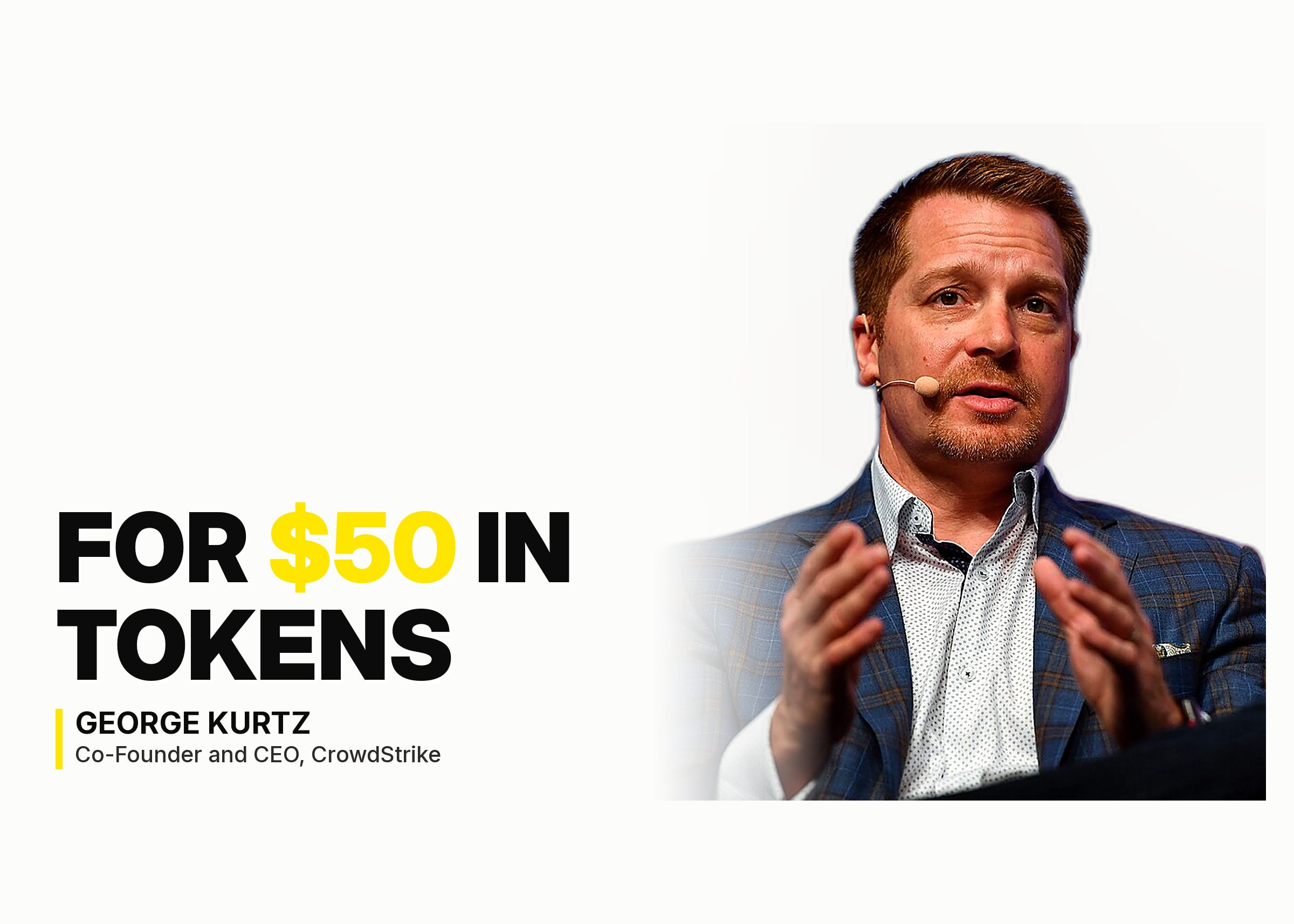
An attacker can let AI agents run overnight on $50 of tokens and wake up to a batch of companies they have broken into, George Kurtz, CrowdStrike's CEO, said on Masters of Scale.
That was one line from one interview. The other 24 people quoted tonight included the founder of a market for AI computing who says many of the companies that rent out chips lend them to AI labs without checking whether they can pay, the head of Chase Auto on working with 14,000 car dealers, and a venture capitalist whose partners voted down SpaceX until he added protections to the deal.
"You can spend as much money as you want. You can't make the fabrication line at TSMC move faster." — Kush Bavaria, Co-Founder and CEO at Ornn, on 20VC (Read summary)
We scanned 813 shows and 15 hours of audio, wrote 20 summaries, and pulled 56 quotes into this 17-minute read.
Here is what mattered.
Macro
Fourth-quarter earnings estimates are still rising, which Roberts says argues against a deeper market correction
"If this was the beginning of a bigger overall market correction, then we should be seeing earnings being cut, economic weakness across the board — rising unemployment, rising jobless claims. There's some of that out there, but earnings estimates for the fourth quarter are still rising right now." — Lance Roberts, Chief Investment Strategist at RIA Advisors, on Thoughtful Money (Read summary)
Futures-market liquidity all but disappeared until the close in the November 5 sell-off, because market makers stopped quoting prices, Bhansali says
"You could see liquidity basically evaporated until the very last minute until the close... because market makers are not going to make markets." — Vineer Bhansali, Founder and CIO at LongTail Alpha, on Alpha Exchange (Read summary)
Visser expects a year-end rally that few funds will chase; McNamara says positioning is light and this is no time to take big risks
"The ultimate pain trade is that the market has a big rally into the end of the year, because no one's going to jump on it." — Jordi Visser, Head of AI Macro Nexus Research at 22V Research, on The Pomp Podcast (Read summary)
"Positioning is very light... that's what I'm hearing, what I'm seeing... it's not a time of year to stick your neck out as far as I'm concerned." — John McNamara, CIO at Hedgeye Asset Management, on Hedgeye (Read summary)
International
Asia's reliance on the Strait of Hormuz for oil and gas was its main exposure to the Middle East conflict, Duran says
"Before the Middle East conflict, about 60% of Asia's crude oil and a quarter of its LNG supply passed through the Strait of Hormuz." — Stephanie Duran, Acting CEO at the Asia Natural Gas & Energy Association, on SmarterMarkets (Read summary)
Japan and China adjusted faster in the crisis because they had built gas storage, Duran says
"You've seen countries like Japan and China who have spent time building that storage into their energy systems that have been able to shift much more readily during times of crisis." — Stephanie Duran, Acting CEO at the Asia Natural Gas & Energy Association, on SmarterMarkets (Read summary)
Australia and Singapore are discussing a deal that would let Singapore send its carbon dioxide to Australia for storage
"Now Australia and Singapore have been discussing a bilateral agreement on cross border CCS where Singapore could over time send its CO2 to be stored in Australia." — Stephanie Duran, Acting CEO at the Asia Natural Gas & Energy Association, on SmarterMarkets (Read summary)
Financials
Chase Auto has a relationship with most car dealers in the US, Wims-Morris says
"Today we work with 14,000 dealers across the country. So about 75% of dealers we have a relationship with." — Leslie Wims-Morris, CEO at Chase Auto, on Forbes (Read summary)
Wims-Morris expects many car buyers to start their search with AI assistants such as ChatGPT or Claude
"I think a lot of consumers are going to start to look to figure out what's the right option for them in agentic channels, whether it's starting with ChatGPT or Claude." — Leslie Wims-Morris, CEO at Chase Auto, on Forbes (Read summary)
Companies do not sell their shares at a discount in an IPO, Roberts says, and he calls the deals initial premium offerings
"Companies don't go to market to sell their shares at a discount... Are you going to sell it to me at a discount, or should we call these offerings what they really are, which is an initial premium offering?" — Lance Roberts, Chief Investment Strategist at RIA Advisors, on Thoughtful Money (Read summary)
Some AI-stock options 150% out of the money carry a delta above 0.5, which Bhansali says makes no sense
"You can have a 150% out of the money option with a delta over .5, which makes no sense because delta is supposed to be the probability of you ending up in the money." — Vineer Bhansali, Founder and CIO at LongTail Alpha, on Alpha Exchange (Read summary)
Crypto and Digital Assets
Samsung Wallet's integration of USDC, a dollar-backed stablecoin, puts it in 82M wallets, Liu says
"That's 82 million wallets that are using USDC built natively into the wallet." — Lily Liu, President at the Solana Foundation, on Real Vision (Read summary)
The DTCC, which settles US securities trades, plans to integrate Solana in 2027
"For the DTCC to be integrating Solana in 2027 is a very meaningful step." — Lily Liu, President at the Solana Foundation, on Real Vision (Read summary)
Investors are selling crypto to pay for their Anthropic IPO orders, Liu says
"People are liberating cash in order to fund their allocation request for the Anthropic IPO, and that's all coming out of risk capital... the biggest pile that comes out of is blockchain." — Lily Liu, President at the Solana Foundation, on Real Vision (Read summary)
Visser owns bitcoin only while real 2-year rates are falling; Calacanis does not expect it to reach a new high for years, if ever
"The only time to own Bitcoin, the only time since 2014, has been when real two-year rates are going down." — Jordi Visser, Head of AI Macro Nexus Research at 22V Research, on The Pomp Podcast (Read summary)
"I think Bitcoin is not going to see an all-time high ever again. Or if it does, it might be 10 years from now... it's not going to beat the Magnificent 10." — Jason Calacanis, Founder at LAUNCH, on This Week in Startups (Read summary)
Alternatives and PE
Only 3 of 50 attendees at Family Office Club's sessions had all 6 items Wilson says a pitch needs
"Three people out of the 50 had those six things in place." — Richard Wilson, Founder at Family Office Club, on Centimillionaire Strategies (Read summary)
Multi-manager hedge funds cut a manager who loses 3% and share in the profits of one who gains 20%, which Bhansali compares to owning call options
"They're running a portfolio of call options... If it goes down 3%, you're out, you're fired. If you go up 20, great, you get a nice chunk of that profit." — Vineer Bhansali, Founder and CIO at LongTail Alpha, on Alpha Exchange (Read summary)
An equity investor is better off with less stock-market trend following in a fund, because it adds market exposure the investor already has, Carver says
"If we ignore convexity, you're actually better off buying less equity trend following in your fund — because otherwise you're just getting additional beta to add to beta you already have." — Rob Carver, independent systematic trader and former fund manager at AHL, on Top Traders Unplugged (Read summary)
Carver asked an AI model to review his trading code; 3 of its 4 suggestions were good and the fourth would have wrecked it
"Three of the suggestions that it came back with were good suggestions. They found a couple of bugs in my code... Unfortunately, the fourth thing it suggested would completely and utterly destroy the code." — Rob Carver, independent systematic trader and former fund manager at AHL, on Top Traders Unplugged (Read summary)
Consumer
Strive Pharmacy grew from about 100 employees to over 1,100 in 3 to 4 years on demand for GLP-1 weight-loss drugs
"When that GLP-1 wave started coming through, we were probably around a hundred employees. And then we've grown to over 1,100 employees over the course of three to four years." — Nate Hill, CEO and Co-Founder at Strive Pharmacy, on Founder's Story (Read summary)
Strive tests the potency of its compounded drugs several times a week, against a requirement of once or twice a year
"We do go above and beyond, especially with potency testing — it's required of us to do that maybe once or twice a year, but we're doing it multiple times a week." — Nate Hill, CEO and Co-Founder at Strive Pharmacy, on Founder's Story (Read summary)
Disney can cut pre- and post-production costs by as much as 30% using AI for rendering, Rahman says
"When they use AI for their video rendering, both in animation but also just in live-action special effects, they can cut the cost down by as much as 30% of pre- and post-production costs combined." — Sam Rahman, Portfolio Manager at Hedgeye Asset Management, on Hedgeye (Read summary)
Licensing old Star Wars films to Netflix would probably earn Disney close to 100% gross margin, Rahman says
"If Disney sells their old Star Wars trilogy to Netflix, that's probably 100% gross margin." — Sam Rahman, Portfolio Manager at Hedgeye Asset Management, on Hedgeye (Read summary)
Technology & AI
For $50 in AI tokens, an attacker can let agents run overnight and wake up to a batch of hacked companies, Kurtz says
"You can go to bed, let your agents run, and for $50 in tokens, you come back the next morning and you've got a new bounty of riches from companies that the agents have broken into." — George Kurtz, Co-Founder and CEO at CrowdStrike, on Masters of Scale (Read summary)
Kurtz thinks about a quarter of all software vulnerabilities ever found were found in the past year
"Over the last year, I think we've had 25 percent of all the vulnerabilities ever created found in the last year." — George Kurtz, Co-Founder and CEO at CrowdStrike, on Masters of Scale (Read summary)
IT teams now choose between rushing a patch and risking an outage, or waiting and risking a breach, Kurtz says
"They're making the decision: breach or break, breach or break. That is, are we going to get breached because we can't patch fast enough, or are we just going to break something and hopefully fix it if we roll it out?" — George Kurtz, Co-Founder and CEO at CrowdStrike, on Masters of Scale (Read summary)
CrowdStrike built its own AI lab rather than rely on the frontier labs, and Kurtz says it gets comparable models for a fraction of the cost
"There's a reason why we created our own labs, because we're not going to just depend on the frontier models... we're getting frontier-level or better offensive models and defensive models at a fraction of the cost." — George Kurtz, Co-Founder and CEO at CrowdStrike, on Masters of Scale (Read summary)
Bavaria would not be surprised if Nvidia's next chip, Rubin, rents for $20 to $30 per GPU hour
"I would not be surprised if their Rubin costs are $20, $30 per GPU hour." — Kush Bavaria, Co-Founder and CEO at Ornn, on 20VC (Read summary)
Many neo-clouds, the companies that rent out GPU computing, lend chips to AI labs without checking whether they can pay, Bavaria says
"I would argue that it is a lot of these Neoclouds that are not actually looking at the tenants that they're lending to, and just saying, 'Okay, great, this company's raised 100 million, have the compute.' They don't actually do enough diligence before lending out the compute." — Kush Bavaria, Co-Founder and CEO at Ornn, on 20VC (Read summary)
Cerebras has won AWS, Microsoft and Oracle as customers in the past 6 months, on top of OpenAI
"We have OpenAI as a customer, but in the last six months we won AWS and Microsoft and Oracle." — Andrew Feldman, Co-Founder and CEO at Cerebras Systems, on Sourcery with Molly O'Shea (Read summary)
Feldman says Cerebras's AI computers run 10 to 15 times faster than anyone else's
"We build the fastest AI compute on Earth. Not by a little bit, but 10 or 15x." — Andrew Feldman, Co-Founder and CEO at Cerebras Systems, on Sourcery with Molly O'Shea (Read summary)
Archetype AI's models are built to run inside machines in the field rather than in data centers, so they have to be small
"These models would not live in data centers... they're going to be living in the environment, on edge devices, which means it has to be extremely compact." — Ivan Poupyrev, Founder and CEO at Archetype AI, on Forbes (Read summary)
Foody expects more jobs in 10 years than today, and says people underestimate how much demand for work can grow
"I think there's going to be more jobs in 10 years than there are today. ... People always underestimate the elasticity of demand for jobs." — Brendan Foody, Co-Founder and CEO at Mercor, on Sourcery with Molly O'Shea (Read summary)
Training an AI to behave well only while it is being watched is the most dangerous thing a lab can do, Shear says
"The most dangerous thing you can do is train an AI to perform certain socially positive behaviors so long as it's being watched. That's really not a good idea. I recommend we stop." — Emmett Shear, Founder at Softmax and former interim CEO of OpenAI, on Sourcery with Molly O'Shea (Read summary)
Users are connecting AI agents to a16z's Cosign network and sending them to find people to meet, Booth says
"People have connected their agents to Cosign — you can give it to a Grok bot and tell it to go find people that you should know." — David Booth, Ecosystem Lead at a16z, on a16z (Read summary)
Jurvetson calls Anthropic the current leader and puts Google's Gemini in the top 3, ahead of OpenAI, partly because Google designs its own chips
"For Anthropic, you have the current belle of the ball, but Gemini is nipping at their heels. I'd put Gemini in the top three ahead of OpenAI, given the pace of progress and their internal silicon — the TPUs — as a point of leverage." — Steve Jurvetson, Co-Founder at Future Ventures, on Moonshots with Peter Diamandis (Read summary)
Even if AI spending stopped, Nvidia's forward P/E would rise to about 36, still below Walmart's 47, Roberts says
"Nvidia is closer to 10 times forward P/E now, but that would jump to about 36. Walmart trades at 47, just to keep that in context. Walmart grows their earnings at 10% a year and Nvidia grows theirs at 60% a year." — Lance Roberts, Chief Investment Strategist at RIA Advisors, on Thoughtful Money (Read summary)
Carlisle, a former lawyer to company boards, says Nvidia's board had no choice but to remove Jensen Huang, given the risk to the company
"As a former lawyer who used to advise boards on these sort of issues, there's just no question for something like that, because it just exposes the company to too much risk. Boards are risk first — that's really all they can be. Risk and compliance, that's what they do." — Tobias Carlisle, Principal at Acquirers Funds, on The Acquirers Podcast (Read summary)
Nvidia's software advantage looks smaller now that engineers can more easily be trained on AMD's chips, Travis says
"The CUDA, the software that was the huge competitive advantage because it's so dominant in the GPU space... it's now much easier to train people on the AMD chips, or the organizations on the AMD chips. So the switching costs don't seem as high." — Tim Travis, Co-Author of the Value Options Letter, on The Acquirers Podcast (Read summary)
Rahman says Anthropic has to sell applications, not only tokens; McNamara says companies rarely switch tools once one is installed
"If this business is just going to be a token manufacturing company, then I don't think it's a good long-term business... It doesn't mean that it won't survive, I just don't think it's a great business." — Sam Rahman, Portfolio Manager at Hedgeye Asset Management, on Hedgeye (Read summary)
"Don't underestimate the laziness of corporate America, because it's pretty lazy. And if a company gets integrated with a solution, they just use that solution forever, because changing would be a disaster." — John McNamara, CIO at Hedgeye Asset Management, on Hedgeye (Read summary)
Investors have suddenly started scrutinizing financing deals among AI companies, which Tepper calls the biggest issue for AI stocks
"The biggest issue is a lot of the circular financing deals, which all of a sudden no one really paid attention to them... now all of a sudden everything's under the microscope." — Mark Tepper, CEO at Strategic Wealth Partners, on The Big Money Show (Read summary)
Calacanis estimates that 1% of corporate knowledge workers use AI as heavily as he does, and expects 80 times as many to follow
"I believe 1% of corporate America's knowledge workers are using it like you and I are. What that means is 80 times the number of people are going to start using it this way." — Jason Calacanis, Founder at LAUNCH, on This Week in Startups (Read summary)
VC & Startups
Bavaria chose boutique investors over larger funds because their returns depend more on each startup
"I do all these reference calls for these investors — the boutique investors care about you a lot more because their success is tied inherently to your success." — Kush Bavaria, Co-Founder and CEO at Ornn, on 20VC (Read summary)
Two of Jurvetson's partners saw no more than 2 to 3 times their money in SpaceX in 2008, until he added deal protections Musk accepted
"Two of my partners could not see any scenario where the company was going to be worth more than two to three times our entry price ... I'm like, that's not the game here. We'll add all that structure. Elon's like, whatever, sure — because all those outcomes are under his control." — Steve Jurvetson, Co-Founder at Future Ventures, on Moonshots with Peter Diamandis (Read summary)
The average company on Bessemer's first AI 100 list is valued at $36B, Deeter says
"The average company to get onto the AI 100 list this year is valued well over a billion dollars, which means that dozens of companies already valued into the billions couldn't make the list. ... The average valuation on that list is 36 billion." — Byron Deeter, Partner at Bessemer Venture Partners, on Sourcery with Molly O'Shea (Read summary)
Industrials and Transport
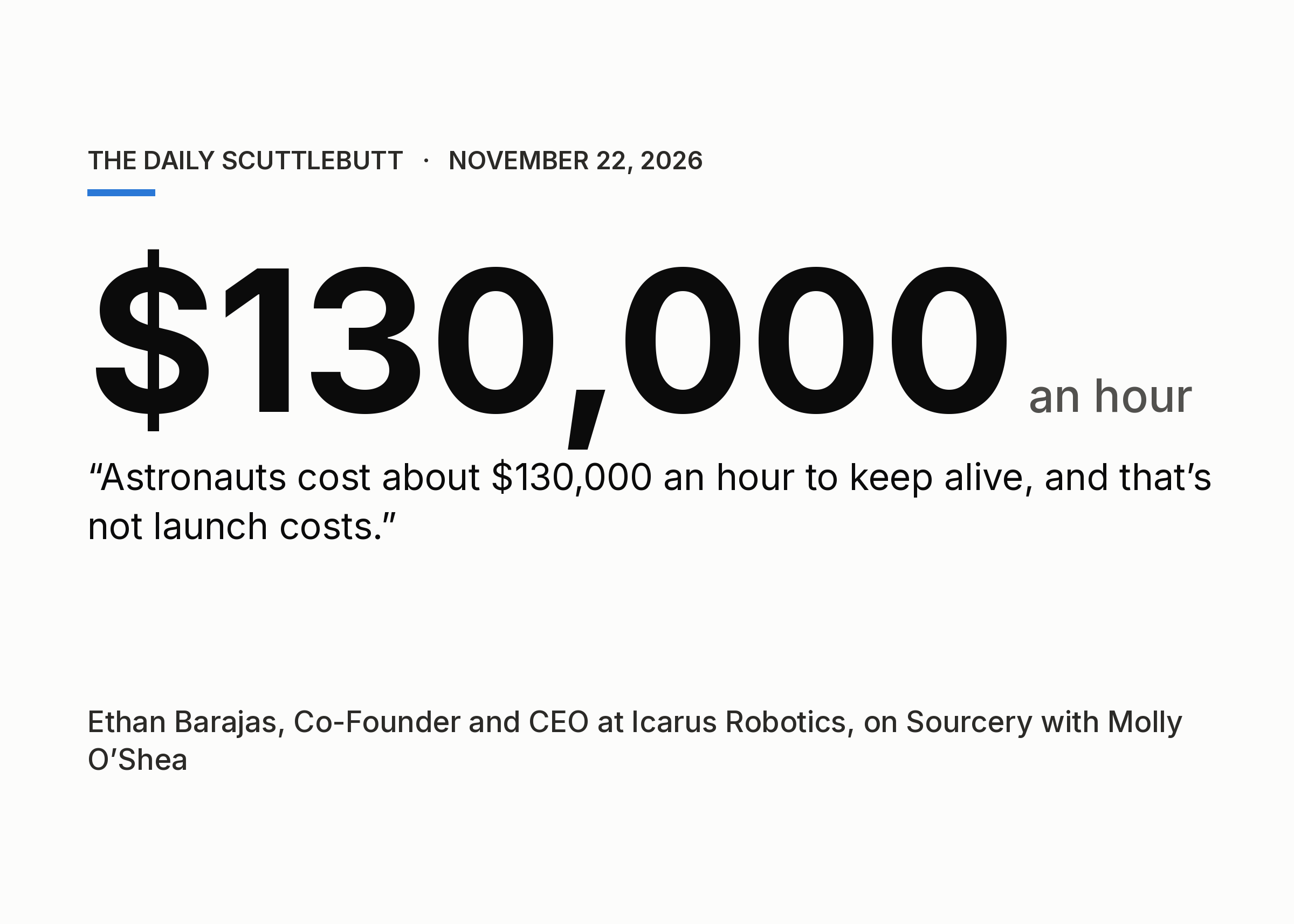
Astronauts moving cargo on the space station cost $3.2M a day, which is the work Icarus Robotics wants its robots to do
"Astronauts cost about $130,000 an hour to keep alive, and that's not launch costs. We send up about three and a half tons of cargo every 60 days, and you have four guys that are worth $3.2 million a day moving cargo." — Ethan Barajas, Co-Founder and CEO at Icarus Robotics, on Sourcery with Molly O'Shea
Materials & Energy
Margin calls, not fundamentals, are driving gold and silver down in a self-reinforcing cycle, Roberts says
"Once you start to compress that premium in the markets and that margin call triggers, it lowers the asset value, which triggers more margin calls... it's a self-fulfilling cycle." — Lance Roberts, Chief Investment Strategist at RIA Advisors, on Thoughtful Money (Read summary)
Policy
The federal investigation is into Megaspeed, an Nvidia customer, not into Nvidia, Tepper says
"The investigation has never been into Nvidia. It has been into Megaspeed... They haven't even... fully convinced that Megaspeed has done anything wrong." — Mark Tepper, CEO at Strategic Wealth Partners, on The Big Money Show (Read summary)
After California barred Waymo from freeways, Calacanis proposed a 45 mph limit for robotaxis without a safety driver
"These things should not go above 45 miles an hour. If they do, they should have a safety driver. It's no cost... if it takes another two years or five years... it's probably a good thing." — Jason Calacanis, Founder at LAUNCH, on This Week in Startups (Read summary)
Nuggets of Wisdom
Feldman tells Cerebras employees made rich by its IPO not to keep 99% of their wealth in one stock
"There's no reason for you to have 99% of your wealth in one stock. Professional investors don't do it." — Andrew Feldman, Co-Founder and CEO at Cerebras Systems, on Sourcery with Molly O'Shea (Read summary)
Poupyrev advises young people to work in physical industries, which he says are 80% of the world economy
"I actually encourage young people to go to the physical industries and work there together with AI, because 80% of the world economy still runs on... physical world industries." — Ivan Poupyrev, Founder and CEO at Archetype AI, on Forbes (Read summary)
Jurvetson's rule since the 1990s: invest in things unlike anything he has seen, but close to what he knows
"The actual trigger for me leaving internet investing in the '90s for deep tech was when I saw that gazelle.com got funded — pantyhose on the web, the fourth pantyhose-on-the-web company I'd seen. I stumbled upon the guideline that's governed my investing ever since: invest in things unlike anything I've seen before, yet adjacent to where I've been." — Steve Jurvetson, Co-Founder at Future Ventures, on Moonshots with Peter Diamandis (Read summary)
Carlisle says whether a technology is useful and whether investors make money on it are separate questions
"The question of whether something is going to be useful and impactful is entirely different from whether you can make money investing in it." — Tobias Carlisle, Principal at Acquirers Funds, on The Acquirers Podcast (Read summary)
If this was worth your time, send it to someone who has to follow all of this too.
What did you think of today’s edition? Hit ‘reply’ to this email, send us a message, leave a comment, or join the chat!
Get the latest market chatter as it happens: