

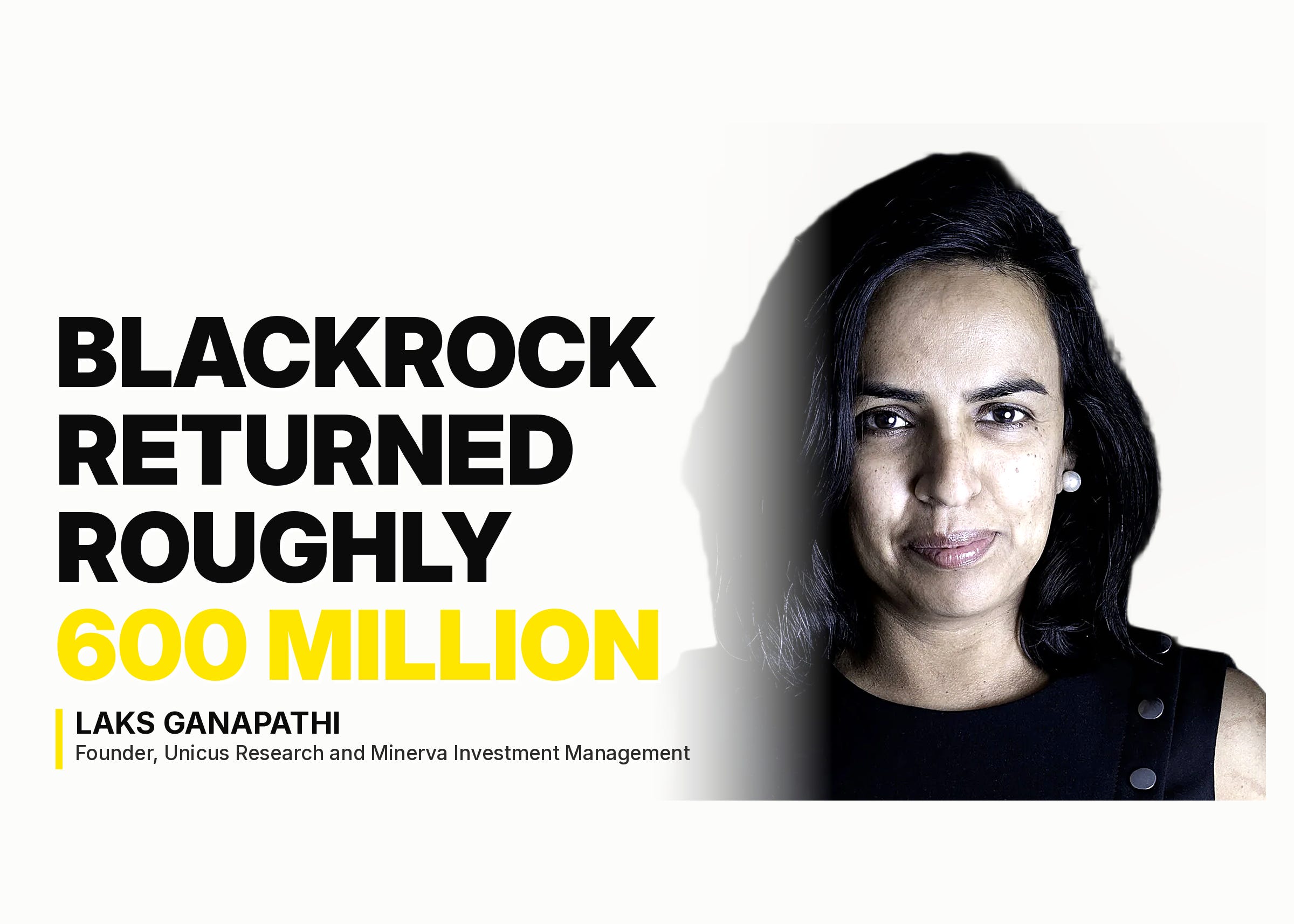
On March 7, BlackRock's HPS Corporate Lending Fund limited withdrawals for the first time in its 4-year history. Investors asked for $1.2 billion back and received roughly $600 million, Laks Ganapathi told Monetary Matters. Ganapathi founded Unicus Research and the short-biased fund Minerva Investment Management, and her team lines up private credit funds' loan books to find the same loan valued differently.
She was one of 14 people quoted in this issue. The others ranged from Nikesh Arora, chairman and CEO of Palo Alto Networks, who said running his endpoint security through an AI model would cost $5,000 a day, to Ice Cube, who said BIG3's first 4 basketball teams sold for $10 million each, to Jack Gamble, who said local data-center bans passed in all but one of 45 or 46 ballot votes.
"On March 7th, they gated for the first time in their four-year history. Investors submitted 1.2 billion in redemption requests. BlackRock returned roughly 600 million." — Laks Ganapathi, Founder at Unicus Research and Minerva Investment Management, on Monetary Matters (Read summary)
We scanned 814 shows and 9 hours of audio, wrote 13 summaries, and pulled 32 quotes into this 15-minute read.
Here is what mattered.
Macro
Strong economies are soaking up liquidity that markets used to get, Howell says
Michael Howell runs CrossBorder Capital, which tracks global liquidity as a signal for markets 6 to 9 months ahead. He said liquidity peaked in late 2025 and has fallen all year, even though the Federal Reserve, the European Central Bank and the Bank of Japan have not tightened policy.
"Liquidity is tightening mainly because the real economies are so strong, and they're just absorbing liquidity... all money that's anywhere must be somewhere. So if it's in the real economy, it's not in the financial markets." — Michael Howell, Managing Director at CrossBorder Capital, on Market Talk with George Noble (Read summary)
Johnson says the trouble starts if the dollar breaks above 105
Brent Johnson, who runs Santiago Capital and devised the Dollar Milkshake Theory, put the dollar index near 102 when he taped the interview on November 5. Inside that range, he said, countries can keep servicing both their dollar debts and their debts in their own currencies. Above it, he expects margin calls to force borrowers to sell whatever they can.
"If the dollar stays between approximately 90 and 105 on a relative basis, the whole system can kind of work... But if the dollar breaks out to the upside of that band, that's when bad things start to happen, and we're getting relatively close to where that is now." — Brent Johnson, CEO at Santiago Capital, on Thoughtful Money (Read summary)
International
Horowitz's firm cut its emerging-markets holdings in half
Andrew Horowitz runs the advisory firm Horowitz & Company. He said it sold as the VIX volatility index rose to about 26, citing the midterm elections, a possible slowdown in data-center borrowing and last week's 4.1% unemployment rate.
"We sold a big chunk of our emerging markets that we've been really excited about for a very long time just about two weeks ago. We cut our emerging markets in half." — Andrew Horowitz, President and Founder at Horowitz & Company, on The Disciplined Investor (Read summary)
Renehan would sell Sea Limited if it becomes an AI cloud company
Sea Limited fell about 25% in October after a memo from its CEO, Forrest Li, leaked to The Wall Street Journal. The memo reportedly floated spinning off Sea's digital-banking unit, which grew revenue almost 60% last quarter. Alec Renehan co-hosts the Australian investing show Equity Mates and owns the stock.
"If they do it, I'm selling, I think. No, I probably am. They intend to become an AI-orientated cloud computing company." — Alec Renehan, Co-host at Equity Mates, on Equity Mates (Read summary)
Financials
Auto lenders are growing new loans so defaults look smaller, Ganapathi says
Ganapathi said some auto lenders, Ally among them, were told by their repossession contacts not to take back cars from borrowers who had stopped paying. Taking a car back puts the loss on the lender's books; repo in the quote means repossession.
"If the banks take the repo, they have to show it in their books. Then you have to increase your provision for credit losses or take a charge-off. So what do you do? We were told it's a denominator game: the more originations you increase, the lesser the default looks." — Laks Ganapathi, Founder at Unicus Research and Minerva Investment Management, on Monetary Matters (Read summary)
Crypto and Digital Assets
Kraken's tokenized US stocks passed $1B in assets
Dave Ripley is co-CEO of Kraken and its parent company, Payward. Its xStocks are tokens backed one for one by US shares. Ripley said buyers in Latin America, the Asia-Pacific region and Africa are taking them up the way they took up dollar stablecoins.
"By most measures, market leader in tokenized equities, that is xStocks... we hit the billion mark recently for AUM, trade volumes in the 40 billion-plus range." — Dave Ripley, Co-CEO at Kraken, on Bitcoin Magazine Podcast (Read summary)
Spreading across products and countries kept Kraken growing, Ripley says
Ripley said Kraken has filed confidentially for an initial public offering but would not discuss timing.
"We definitely had... pullbacks in revenue... but given the fact that we're much more diversified across product area, across asset class, across geography, we're seeing really strong numbers. We grew in '25 and we're not planning on taking any... meaningful step back at all in '26." — Dave Ripley, Co-CEO at Kraken, on Bitcoin Magazine Podcast (Read summary)
D'Agostino expects round-the-clock markets to end the wait for Monday's open
John D'Agostino is head of strategy at Coinbase Institutional and previously held the same job at NYMEX, the New York Mercantile Exchange.
"The notion that if we launch a missile into Iran at 4:05 p.m. on a Friday, that I have to wait until Monday morning 9:30 to hedge my crude oil exposure will seem as ridiculous to us shortly as watching movies when the movie theater tells you you can watch a movie." — John D'Agostino, Head of Strategy at Coinbase Institutional, on The Rollup (Read summary)
Tokenized bank deposits are far larger than stablecoins today, D'Agostino says
He expects stablecoins to win in the long run because they work across systems. Until then, he said, trillions of dollars of tokenized deposits will run on banks' own private blockchains.
"We would be naive not to acknowledge that tokenized deposits are orders of magnitude larger than stablecoins." — John D'Agostino, Head of Strategy at Coinbase Institutional, on The Rollup (Read summary)
Strategy's STRC payouts lower the holder's cost basis, Horowitz says
STRC is a preferred share issued by Strategy, formerly MicroStrategy, that pays about 12% a year and funds more bitcoin purchases. Horowitz said its buyers carry both the company's risk and bitcoin's, and that anyone who wants bitcoin should simply own bitcoin.
"In 2025 all of the income and dividends were considered return of capital... meaning you don't pay tax... the distributions reduce your basis." — Andrew Horowitz, President and Founder at Horowitz & Company, on The Disciplined Investor (Read summary)
Alternatives and PE
Blue Owl's loan losses are mostly outside software, Ganapathi says
Blue Owl, a private credit manager, has blamed AI's disruption of software companies for its withdrawal requests. Ganapathi's team went through the loan book of its OBDC fund as of March 31 and ranked sectors by unrealized losses. Software did not make the top 9.
"The top five has been healthcare providers and services, consumer goods, human resource support services, joint ventures, education, household debt, household products. The top five is not even scratching the software." — Laks Ganapathi, Founder at Unicus Research and Minerva Investment Management, on Monetary Matters (Read summary)
Insurers have moved more of their assets into private placements
Ganapathi cited S&P data. She said the figures led her firm to hire an investigator to look into reinsurers in Bermuda and the Cayman Islands, where she said the reinsurance data is not public.
"Nearly 14%, give or take, of general account assets were in private placements in 2024... up from 10% in 2014. But here's the thing: 34% of 1.29 trillion in cash... and invested assets are invested across 122 Bermuda insurers." — Laks Ganapathi, Founder at Unicus Research and Minerva Investment Management, on Monetary Matters (Read summary)
Consumer
About 85% of US drug volume is generics, Gorsky says
Alex Gorsky ran Johnson & Johnson as chairman and CEO. He said most generic drugs are still sourced from outside the US and called that one of the key bottlenecks in the supply. J.P. Morgan's Security and Resiliency Initiative, which hosted the conversation, is working to spread sourcing beyond single sites.
"On any given day, almost 85% of the drugs... are generic, and about 15%... are in what I'd call branded drugs that are produced by the major strategics." — Alex Gorsky, Former Chairman and CEO at Johnson & Johnson, on Making Sense (Read summary)
AI could shrink a 3-year compound search to a couple of months, Gorsky says
He said drug discovery has been largely trial and error for decades, and that AI can combine genetic, physical-trait and imaging data at once.
"It could take us three years of prioritization and filtering to find a compound... that might be able to be done... in a couple of months." — Alex Gorsky, Former Chairman and CEO at Johnson & Johnson, on Making Sense (Read summary)
Intuitive Surgical's robot placements and procedures are still rising, Leske says
Bryce Leske co-hosts Equity Mates and keeps adding to his stake in the robotic-surgery company, which reported on October 20. Its profit dipped on an antitrust settlement.
"Revenue grew 22% up to 3.05 billion... in terms of key metrics, like how many robots are they putting into hospitals, how many procedures are these robots doing... the answer to all of those is they're all improving." — Bryce Leske, Co-host at Equity Mates, on Equity Mates (Read summary)
Weight-loss drugs brought in $16B of Eli Lilly's $24B quarter, Renehan says
Lilly's revenue rose 39%, as volumes grew more than 50% and prices fell 15%. Renehan said the company he bought as a diversified drugmaker is now mostly a GLP-1 business.
"16 billion of its $24 billion of revenue came from GLP-1s. It's now two thirds of its business is these weight loss drugs." — Alec Renehan, Co-host at Equity Mates, on Equity Mates (Read summary)
Sports
BIG3 sold its first 4 teams for $10M each and expects to charge more
Ice Cube co-founded the 3-on-3 basketball league BIG3 and runs it. The league is merging to list on Nasdaq under the ticker TONT. About half of its 8 teams are privately owned; the league owns the rest and plans to sell them.
"The first four sold for 10 million a piece, and with this capital, we can sell the next franchise for much more." — Ice Cube, Founder and CEO at BIG3, on Motley Fool Hidden Gems Investing (Read summary)
BIG3 still lacks a multi-year national media deal
Ice Cube said the money from the listing will pay for marketing and hiring the league held off on while it kept costs down.
"One of the things we have to land is a major media deal, multi-year. That's still in our future." — Ice Cube, Founder and CEO at BIG3, on Motley Fool Hidden Gems Investing (Read summary)
Technology & AI
Arora bet Palo Alto could run at a 40% operating margin
Nikesh Arora became CEO of Palo Alto Networks in 2018, after a decade at Google, when it had an $18B market value and sold mostly a single firewall product. He compared it with large enterprise software companies such as Cisco and Salesforce.
"If you can find a way of taking 60% of your costs, which typically live in sales, marketing, and customer support, take them down to 20, you could be a 40% operating margin business. That was my insight." — Nikesh Arora, Chairman and CEO at Palo Alto Networks, on David Senra (Read summary)
Arora will not sign an acquisition until the founder agrees on a product plan
Palo Alto has made about 35 acquisitions. Arora negotiates with founders directly and gives each deal 30 days to produce a joint product roadmap before it closes. He said no founder has ever backed out in that window, and Palo Alto has walked away twice.
"I don't sign the definitive term sheet until I get the founder to sign on a joint product roadmap... If you don't want to build what I want to build, then we shouldn't do this." — Nikesh Arora, Chairman and CEO at Palo Alto Networks, on David Senra (Read summary)
A $200M company is worth $800M to Palo Alto, Arora says
He said targets now cost 3 to 4 times what a company at the same stage cost 3 years ago.
"If something's worth 200 million dollars, it's worth 800 million dollars, because my job is to take the 200, 800 dollar asset and turn that into a 5 to 10 billion dollar asset." — Nikesh Arora, Chairman and CEO at Palo Alto Networks, on David Senra (Read summary)
Per-token AI pricing protects Palo Alto's endpoint business, Arora says
AI models charge for each unit of text they process, called a token. Arora said that makes them far too expensive to replace Palo Alto's continuous monitoring of laptops, phones and servers, which the industry calls endpoints.
"AI is set up to charge you every time you run traffic through AI, in terms of tokens... If AI tried to do my job at your endpoint, it would cost you 5,000 dollars a day... They can't do what I do at 25 dollars an endpoint." — Nikesh Arora, Chairman and CEO at Palo Alto Networks, on David Senra (Read summary)
Doshi builds products so 60% works with today's model
Tulsee Doshi is head of product for Google's Gemini models. Under her rule, another 20% of a feature should work well enough to use and the last 20% is a bet on where the model is going. She said nobody, including the people building the models, can reliably predict their capability 3 months out.
"I think what you want to do is actually build such that 60% of what you've built works now and your prototype is at least functional, then there's a set of maybe the 20% where it's not perfect but it works well enough... and then here's where I want the models to be." — Tulsee Doshi, Head of Product for Gemini at Google, on Lenny's Podcast (Read summary)
Google has roughly 14 products with more than 1B users, Doshi says
She said Google's edge in AI is that it builds everything from the chips to the consumer products, so it makes models at many price and quality levels rather than chasing only the most capable one.
"If you look at Google's strategy it really is full stack... all the way from hardware to end products that serve billions of users. I think the stat is like we have 14 products that are above a billion users." — Tulsee Doshi, Head of Product for Gemini at Google, on Lenny's Podcast (Read summary)
CoreWeave's credit lines depend on milestones it may miss, Gamble says
Jack Gamble, an engineer who worked in nuclear power for 15 years, has been tracking credit stress at AI data-center companies. He said much of CoreWeave's roughly $19B of undrawn credit is tied to project milestones he expects it to miss. Microsoft, CoreWeave's largest customer, has reportedly pulled back from projects with other AI cloud providers.
"They're going to borrow at 16%, or they're going to dilute the living hell out of their shareholders. Those are going to be their only options." — Jack Gamble, Engineer Who Worked in Nuclear Power for 15 Years, on Market Talk with George Noble (Read summary)
Other appearances:
Noble Capital hedge fund manager on why heavy buying of falling tech ETFs is a bearish sign on The Noble Update Podcast
Policy
Local data-center bans passed almost everywhere they were on the ballot
Gamble said the one exception was in North Dakota, where a ban failed by about 75 to 25. He expects new data-center permits to stop in Texas, with projects already approved likely to go ahead.
"There was 45 or 46 local initiatives, data center bans and moratoriums, on the ballot nationwide. And out of all of them, only one failed to pass... Everywhere else, the data center bans passed." — Jack Gamble, Engineer Who Worked in Nuclear Power for 15 Years, on Market Talk with George Noble (Read summary)
Materials & Energy
China's money printing is behind gold's rise, Howell says
Howell said China has to print money to manage a very large debt load while growth is weak, and compared its 10-year government bond yield with the US 10-year.
"The Chinese bond market, the ten-year, is yielding 1.6. The US Treasury market at the ten-year level is yielding about five... It's not Western debasement, it's Chinese debasement." — Michael Howell, Managing Director at CrossBorder Capital, on Market Talk with George Noble (Read summary)
Howell sees $10,000 gold within 5 years
For now he prefers long-dated Treasuries to gold, while markets go through what he expects to be a rough stretch.
"China is the economy that's got to do massive monetization, and that's what's going to underpin the gold price looking forward over the next few years... I think $10,000 an ounce of gold is relatively easy over the next five years." — Michael Howell, Managing Director at CrossBorder Capital, on Market Talk with George Noble (Read summary)
Fermi's 4-reactor plan repeats a project that bankrupted Westinghouse, Gamble says
Fermi, which trades as FRMI, plans to build 4 Westinghouse AP-1000 nuclear reactors at a single site in Amarillo, Texas. Gamble expects it to finish around 2040 at best.
"We tried to build four Westinghouse reactors in the United States. We got two of them finished before it caused the biggest bankruptcy in history when Westinghouse went under, and the other two we gave up when they were 40% completed." — Jack Gamble, Engineer Who Worked in Nuclear Power for 15 Years, on Market Talk with George Noble (Read summary)
Nuggets of Wisdom
A 60/40 portfolio earned nothing after inflation for 60 of 80 years, Karsan says
Cem Karsan founded Kai Volatility. He said the mix of 60% stocks and 40% bonds worked as well as it did after 1980 only because interest rates fell from about 20% to zero. He prefers hedges that cost a little in good years and pay off when markets fall.
"60/40 made 0% returns from 1900 to 1920... 1929 to 1949, another 20 years that made 0% in real terms. 1962 to 1982, another 20 years, 0% returns." — Cem Karsan, Founder at Kai Volatility, on Real Vision (Read summary)
Johnson keeps cash so a sell-off cannot force him out of the market
Johnson said holding cash costs a little when prices are rising and pays off in a drawdown, when it lets an investor buy from forced sellers instead of becoming one.
"The whole point is that if you remain invested, the compounding effect of returns over time will help you win the game. But if you get knocked out, then the compounding doesn't matter because you're no longer in the game." — Brent Johnson, CEO at Santiago Capital, on Thoughtful Money (Read summary)
If this was worth your time, send it to someone who has to follow all of this too.
What did you think of today’s edition? Hit ‘reply’ to this email, send us a message, leave a comment, or join the chat!
Get the latest market chatter as it happens: