

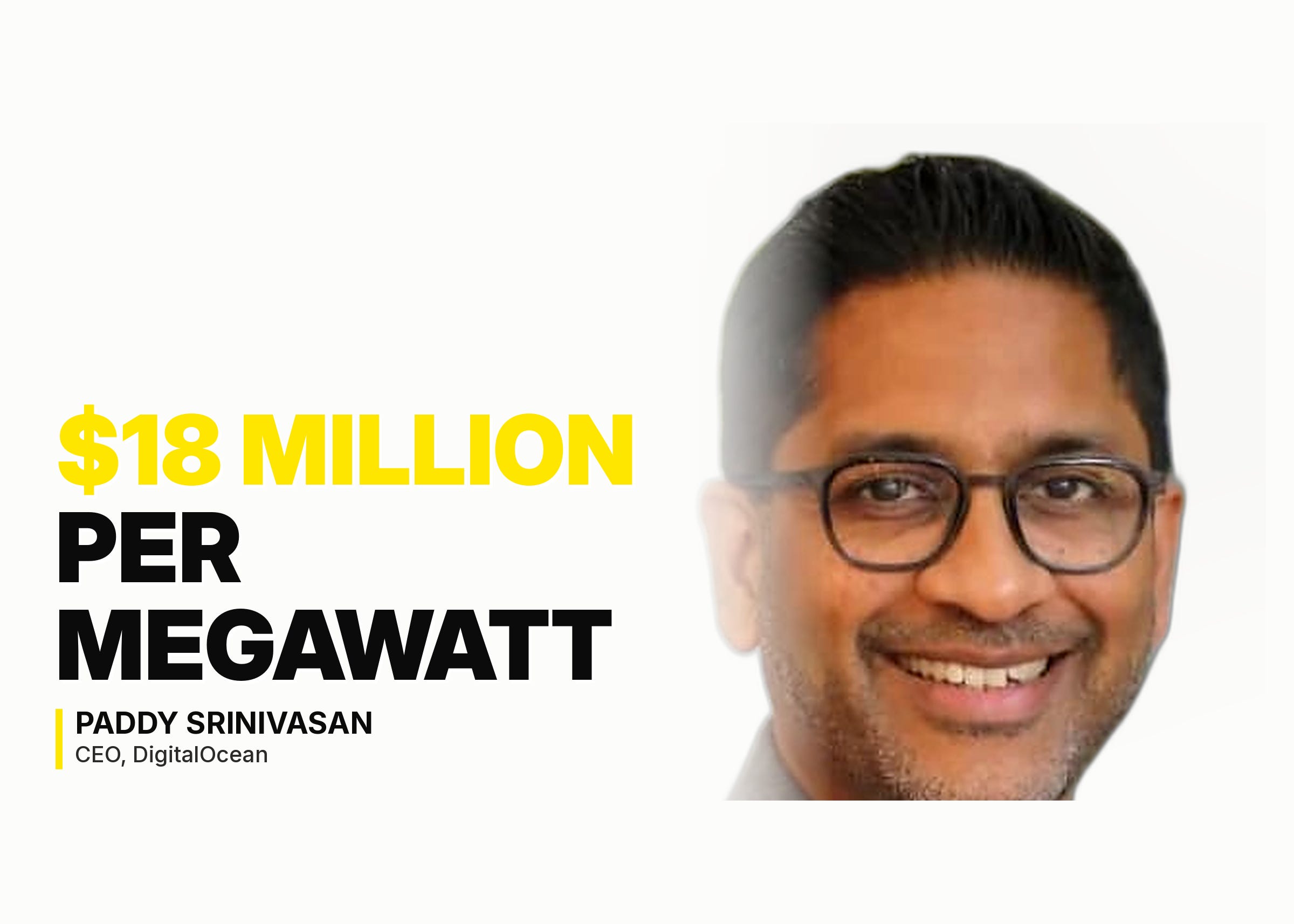
DigitalOcean gets $18 million per megawatt across its entire fleet of data-center capacity, Paddy Srinivasan, its chief executive, told The Information. He said that is well above what other providers get, because DigitalOcean sells software on top of the hardware rather than renting out chips alone.
Srinivasan was one of 35 people quoted in this issue. The others ranged from Heath Terry of Citi, who said 40 gigawatts of data-center projects were announced a year ago and 11 were built, to Jason Robins of DraftKings, who said this year's new customers will bring in $350 million of gross profit next year, to Glenn August of Oak Hill Advisors, who said only 9% of the liquid loan market trades below 80 cents on the dollar.
"We are already at $18 million per megawatt for our entire fleet, which is significantly more than the other providers... because we monetize software and not just raw hardware." — Paddy Srinivasan, CEO at DigitalOcean, on The Information (Read summary)
We scanned 812 shows and 13 hours of audio, wrote 18 summaries, and pulled 69 quotes into this 26-minute read.
Here is what mattered.
Macro
Citi's CEO says hedge funds cutting risk drove the selloff
Jane Fraser spoke from Citigroup's technology conference in Pebble Beach the morning after the Nasdaq's worst session in years. She said institutional investors and retail traders did comparatively little of the selling, and she does not expect the correction to run deeper or longer.
"It's really this action taken by the hedge funds to de-risk." — Jane Fraser, Chair and CEO at Citigroup, on Squawk on the Street (Read summary)
Well-known hedge funds unwound their positions after a bad October, Lebenthal says
Jim Lebenthal said forced selling by heavily borrowed long/short hedge funds did more damage on Thursday than any political worry. Some of those funds shut down entirely, he said.
"Yesterday the truth came out and it was ugly. A lot of really well-known names were down big in October, continuing into November, and they unwound their positions, which resulted in a deluge of selling." — Jim Lebenthal, Chief Market Strategist at Cerity Partners, on Halftime Report (Read summary)
A falling AI trade could reach consumer spending through wealthier households
Bob Elliott said the economy now leans on two supports that both depend on high asset prices: AI-related investment, and spending by households whose wealth rides on the stock market.
"Given how highly levered and financialized households are these days, how sensitive they are to the stock market, particularly higher-income households, the result is that they could start to cut back their spending." — Bob Elliott, Co-Founder, CEO and CIO at Unlimited Funds, on Closing Bell Overtime (Read summary)
Factory construction jobs are up about 120,000 since Trump took office, Hassett says
Kevin Hassett spoke the morning October payrolls rose by 165,000, beating every forecast. He said drug-company and car-plant expansions account for much of the factory building, and that it undercuts the case that 3.4% GDP growth was a peak.
"Factory construction jobs are now up to about 120,000 since President Trump took office... and it's not just data centers. Not at all." — Kevin Hassett, Director of the White House National Economic Council, on Squawk on the Street
The San Francisco Fed's president expects to raise rates further
Mary Daly said inflation has been too high for almost six years, and that a solid labor market gives the Fed room to keep tightening.
"My expectation is we're going to have to tighten policy further. Exactly when and how much is still to be decided, because we just have to take all the variables that are coming in." — Mary Daly, President of the Federal Reserve Bank of San Francisco, on The Exchange
Daly says investors are now testing the debt behind AI spending
She said the Fed's test for risk from AI financing is whether private investors are pricing it, and that the selloff so far has been orderly.
"One of the things we look for is, is the private sector pricing in the risk that they see. In the last several weeks, you've seen investors saying, well, let's do some more evaluation of this... is the debt load sustainable." — Mary Daly, President of the Federal Reserve Bank of San Francisco, on The Exchange
Other appearances:
Former Minneapolis Fed president on why the case for rate hikes is strong on Squawk on the Street
Financials
PayPal neglected shoppers while it served merchants, its CEO says
Enrique Lores became PayPal's chief executive eight months ago. PayPal earns money from both sides of a purchase, the merchant and the shopper. He said a complicated structure that slowed decisions made the problem worse.
"One of the key strengths that PayPal has had for a long time is that we are a two sided network, and we lost the focus on the consumer." — Enrique Lores, CEO at PayPal, on Squawk on the Street (Read summary)
PayPal has banked $800M of its promised $1.5B in savings
Lores said the turnaround will take two or three years and PayPal is finishing the first. Its board rejected a takeover approach from Stripe and Advent at $60.50 a share.
"We have told the market that we see at least $1.5 billion of savings. By the end of the year, we'll have achieved $800 million. So we still have some work to do." — Enrique Lores, CEO at PayPal, on Squawk on the Street (Read summary)
Every acquisition adds fund administrators the buyer later cuts, says SEI's CEO
Ryan Hicke runs SEI Investments, which administers funds and keeps the back-office records for banks and asset managers. He said asset managers that buy rivals end up calling the few large providers, SEI among them, to consolidate.
"Let's say you and I were running the original firm and we had two fund administrators, but then we made six acquisitions... all six of those asset managers had three different fund administrators. Well, now we have 20." — Ryan Hicke, CEO at SEI Investments, on After Earnings
Private-market managers bring 71% of SEI's fund-servicing revenue
That split is inside SEI's investment-manager-services business, its largest. Hicke said those managers would rather spend on raising money and picking investments than run their own back offices.
"71% of that revenue comes from alternative managers or private markets. The other 29% is traditional investment managers." — Ryan Hicke, CEO at SEI Investments, on After Earnings
SEI's AI team built a working prototype that could not scale
In May, SEI took eight people out of their jobs to test what AI could do to its largest business, with two large clients taking part. Hicke said the new workflow cut across six internal teams, more change than the clients could absorb.
"What they proved was they were able to build a prototype, a working prototype. What they weren't able to prove was that it could scale." — Ryan Hicke, CEO at SEI Investments, on After Earnings
Kalshi's markets gave Democrats better than even odds of a sweep in April
Tarek Mansour runs Kalshi, a federally regulated exchange where people trade contracts on the outcome of events. He said the markets weigh information from a far broader group than pollsters do.
"The markets were saying there's over 50% chance of a blue tsunami back in April... the consensus was like the markets are wrong" — Tarek Mansour, Co-Founder and CEO at Kalshi, on Squawk Pod (Read summary)
A $1.5M to $2M push moved a Kalshi market for 9 seconds
The market was on a Los Angeles mayoral race. Mansour said money-backed prices correct faster than rumors on social media.
"Someone basically dumped close to a million and a half to two million dollars to move the price from 25% to 40%. And they moved it. But guess how long that lasted? Nine seconds." — Tarek Mansour, Co-Founder and CEO at Kalshi, on Squawk Pod (Read summary)
PEAK6 ran prediction markets for its own traders 15 years ago
Matt Hulsizer co-founded PEAK6, an options trading firm that later started Apex Fintech Solutions. He said demand to bet on companies most people cannot buy, such as Anthropic before its IPO, made prediction markets inevitable.
"We were doing prediction markets in-house, with our traders, fifteen years ago — before it had a name." — Matt Hulsizer, Co-Founder at PEAK6, on RiskReversal Pod (Read summary)
Small holders cannot sell options against fewer than 100 shares, Just says
Jenny Just, PEAK6's other co-founder, said fractional options are a missing product. Overwriting means selling call options against shares already held, to collect income and partly protect the position.
"If you happen to own 78 shares of Meta — which is fifty thousand dollars — and you want to protect that, you might want to overwrite against it... you actually can't do it, because options only trade in 100-share multiples." — Jenny Just, Co-Founder at PEAK6, on RiskReversal Pod (Read summary)
Wells Fargo and Bank of America now make customers liable for their AI agents
Yueqi Yang covers crypto for The Information. She said smaller banks such as Lead Bank and Column are going the other way, giving agents access to a capped pool of money instead of a whole account.
"If a customer is giving their login access to their agents and then the agents get hold of their account, then the customers are responsible for any actions taken by the agents." — Yueqi Yang, Crypto Reporter at The Information, on The Information
Crypto and Digital Assets
NEAR's tools make formal verification about 200x cheaper
Illia Polosukhin co-wrote "Attention Is All You Need," the paper behind the Transformer models that run today's AI. Formal verification is a mathematical proof that code does what it should, for example that funds deposited in a smart contract can always be withdrawn. NEAR is applying it to its own blockchain and plans to sell it as a service.
"My co-founder Alex scored number one on two different benchmarks on Lean proving by building the harness... made this 200 times cheaper by using open-source models and a more intelligent harness orchestration." — Illia Polosukhin, Co-Founder at NEAR Protocol and CEO at NEAR AI, on Milk Road (Read summary)
Patching AI-found bugs with AI creates new bugs, Polosukhin says
He said AI systems will find software flaws faster than people can fix them, which he calls a coming "security Armageddon."
"As you fix them, you actually introduce more bugs, because the fixing AI doesn't fully understand all the context... the way out of that loop is formal verification." — Illia Polosukhin, Co-Founder at NEAR Protocol and CEO at NEAR AI, on Milk Road (Read summary)
Other appearances:
Superstate CEO on the odds of any crypto bill passing a divided Congress on The Chopping Block
Dragonfly Capital general partner on prediction markets calling the midterms hours early on The Chopping Block
Alternatives and PE
Private assets have not yet reached workplace retirement plans, T. Rowe's CEO says
Rob Sharps said T. Rowe Price and Goldman Sachs have launched model accounts and two interval funds together, and expect a jointly built retirement-date trust to be funded by year-end. Defined contribution plans are workplace accounts such as 401(k)s.
"The wealth channel is further along than retirement... for retirement, we haven't even thrown out the first pitch yet with regard to defined contribution." — Rob Sharps, CEO at T. Rowe Price, on Forbes (Read summary)
Adding private assets raised returns and slightly cut losses in T. Rowe's tests
"We could get elevated returns and diversification, so slightly lower downside volatility... a lot of the work we did in conjunction with Goldman, using historical data, really proved that out." — Rob Sharps, CEO at T. Rowe Price, on Forbes (Read summary)
Goldman's Waldron expects uneven results from $4T of US private equity holdings
John Waldron said much of what private equity firms own was bought when interest rates were low and lending spreads were tight.
"There's $4 trillion of enterprise value sitting in private equity portfolios right now in the United States alone... not all that stuff that was bought with low interest rates at tight spreads is going to perform the way we would all like it to." — John Waldron, President and COO at Goldman Sachs, on Forbes (Read summary)
Big institutions are buying evergreen funds built for wealthy individuals
Evergreen funds take in money continuously instead of in one fundraising round, which shortens the early years of low returns known as the J-curve.
"The evergreen structure is a good innovation because it helps you manage that J-curve impact... interestingly, a lot of us thought it would be suited for retail and wealth only, and it's actually turning out to be very attractive to the institutional market." — John Waldron, President and COO at Goldman Sachs, on Forbes (Read summary)
Only 9% of the liquid loan market trades below 80, Oak Hill's CEO says
Glenn August has run Oak Hill Advisors since 1987. He used the liquid loan market, where loans trade like bonds, as a stand-in for private credit. A price below 80 means below 80 cents on the dollar.
"There's been a lot of noise. In my own view, the noise is overdone... today in the liquid loan market, as a proxy for private credit, only 9% is trading below 80, which is near historical averages." — Glenn August, CEO at Oak Hill Advisors, on Forbes (Read summary)
Oak Hill is earning 25 to 50bps more than comparable liquid credit
A basis point is a hundredth of a percentage point.
"We're deploying an $18 billion institutional fund, a $3 billion wealth fund, and we're actually picking up incremental return today of 25 to 50 basis points... in my 39 years of doing this, that is very reasonable compensation." — Glenn August, CEO at Oak Hill Advisors, on Forbes (Read summary)
Withdrawal limits are how individuals earn the illiquidity premium, August says
Business development companies, or BDCs, are funds that lend to midsize private companies. Several limited withdrawals this year after a rush of redemption requests.
"Every client needs to understand what they're buying... they were not gates. They were the structure of the vehicle to provide individual investors to get access to capture that illiquidity premium." — Glenn August, CEO at Oak Hill Advisors, on Forbes (Read summary)
Consumer
Grindr's new AI tier costs $120 a month, triple its top plan
George Arison said Edge, which uses what Grindr infers from members' behavior in the app to improve matches, drew 400,000 pre-registrations in 72 hours. Grindr raised its full-year revenue forecast to $560 million.
"We're going to price it at $120, which is three times the price that we've charged people before for our most expensive tier so far." — George Arison, CEO at Grindr, on Bloomberg Talks (Read summary)
A PrEP patient brings Grindr $4,800 a year
Last quarter Grindr bought Freddie, a telehealth provider of PrEP, the HIV-prevention medicine. Arison said Freddie's patients overlap heavily with Grindr's users.
"Revenue per patient, if they're with you for a full year, that's $4,800 per patient per year." — George Arison, CEO at Grindr, on Bloomberg Talks (Read summary)
Nearly half of Grindr's US users are 18 to 29
Arison said the app's real drop-off is among users 35 and older, whom Edge is partly meant to win back.
"About 46% of Grindr's user base in the US and over 50% worldwide is between 18 and 29 in age." — George Arison, CEO at Grindr, on Bloomberg Talks (Read summary)
Siegelman Stable has never paid an athlete to wear its clothes
Max Siegelman's streetwear brand is worn by New York Knicks players including Jalen Brunson and holds a local in-arena Knicks license.
"We've never paid anyone to ever wear our stuff. We've had this amazing organic adoption of athletes... we've become like an additional logo of the New York Knicks." — Max Siegelman, Founder at Siegelman Stable, on TBPN (Read summary)
Chinese labs do early drug research at a quarter of the US price, says a biotech investor
D.A. Wallach runs Time BioVentures, which invests in biotech. He said big drugmakers now license a double-digit share of their new drugs from China, and called that a bigger shift for the industry than AI.
"In China, what they have tried to do is all of that work at a quarter of the price... and it turns out the quality of the work is outstanding, because a lot of Chinese scientists got their PhDs in the United States and then we kicked them out." — D.A. Wallach, Co-Founder and General Partner at Time BioVentures, on TBPN (Read summary)
Each day saved on a blockbuster drug is worth millions, Wallach says
He expects AI to take years off drug development, not to cure diseases overnight.
"The average blockbuster drug is selling, I think, $3 billion a year. So more or less every day you can accelerate its time to market is worth millions of dollars." — D.A. Wallach, Co-Founder and General Partner at Time BioVentures, on TBPN (Read summary)
Other appearances:
Bernstein analyst on Eli Lilly's December 7 capital markets day on Closing Bell Overtime
Sports
DraftKings' new customers will bring $350M of gross profit next year, its CEO says
DraftKings spent $650 million to $700 million on prediction markets this year, mostly on marketing to win customers and well above the $200 million to $300 million it had guided. Its shares fell 26% to 29% after it cut its 2027 earnings forecast.
"The customers we acquired... are going to generate $350 million of gross profit next year." — Jason Robins, Co-Founder and CEO at DraftKings, on Bloomberg Talks (Read summary)
DraftKings would still recoup the spending in about 4 years if courts ruled against it
Whether prediction markets on sports are legal is headed to the Supreme Court. Jason Robins said this was his downside case.
"We still will be able to pay back these cohorts in roughly four years." — Jason Robins, Co-Founder and CEO at DraftKings, on Bloomberg Talks (Read summary)
Technology & AI
No DigitalOcean customer is more than high single digits of its business
Neoclouds are companies that mainly rent out GPUs, the chips that run AI models, and investors have been selling DigitalOcean's shares along with theirs. Srinivasan said its 680,000 paying customers and the software it sells set it apart.
"We have 680,000 paying customers, and no customer is bigger than high single digits in terms of concentration for us." — Paddy Srinivasan, CEO at DigitalOcean, on The Information (Read summary)
DigitalOcean is adding capacity at sites that already have power and permits
Srinivasan said DigitalOcean adds halls at existing campuses run by established data-center partners, which keeps it clear of the permitting fights that have grown since the midterms. It guided to more than 60% revenue growth next year.
"Most of the data center capacity that we have announced coming online in 2027 are already in campuses that are already energized and permitted... we are not in this 'let's bring on a gigawatt of new facility' situation." — Paddy Srinivasan, CEO at DigitalOcean, on The Information (Read summary)
OpenAI's business grew 70% in the third quarter, its CFO says
Sarah Friar said 1.2 billion people use OpenAI's products every week, and that JPMorgan Chase joined as an enterprise customer for cybersecurity work.
"Our business grew 70% quarter over quarter. Our enterprise business doubled." — Sarah Friar, CFO at OpenAI, on Squawk on the Street (Read summary)
Friar says 90% of her finance team's tasks are now done through AI agents
She said the people who use ChatGPT at work are taking on more than their job descriptions, not losing their jobs.
"In my finance team, 90% of the tasks they do are agentic in nature. They're coding. They just don't know it." — Sarah Friar, CFO at OpenAI, on Squawk on the Street (Read summary)
Figma's revenue rose 43% to $391M last quarter
Praveer Melwani is Figma's CFO. Net dollar retention of 131% means existing customers spent 31% more than a year earlier. Figma also raised its full-year operating profit forecast by $30 million.
"We put up $391 million in revenue, we grew the business 43% year over year, and our net dollar retention rate's at 131%." — Praveer Melwani, CFO at Figma, on TBPN (Read summary)
5% of Figma's AI usage now starts from outside AI tools
MCP, the Model Context Protocol, lets an AI assistant such as ChatGPT operate another company's software. Melwani said Figma's MCP server has just over 1 million weekly users and treats that traffic as a reason customers stay.
"About 5% of all credit consumption in the quarter was actually orchestrated via an MCP. So it's actually people kicking off a first-party workflow, which is pretty unique." — Praveer Melwani, CFO at Figma, on TBPN (Read summary)
Fin resolves 65% of Salesforce's help-site questions without a person
John Somorjai has run Salesforce's acquisitions and its venture arm for more than 20 years. Fin is the AI customer-service agent Salesforce gained when it bought Intercom, and customers pay it per resolved question rather than per seat.
"Fin, you can get up and running on average in 16 days... it's now handling over 40% of the traffic and delivering 65% resolutions without going to a human." — John Somorjai, EVP of Corporate Development at Salesforce, on a16z (Read summary)
AI search should hand agents one paragraph, not a PDF, Parallel's founder says
Parag Agrawal, Twitter's former CEO, founded Parallel three years ago on the bet that AI agents will use the web 1,000 times as much as people do.
"Our job is to not send the agent to this PDF. Our job is to take the paragraph from page 77 from the most authoritative source document and bring it into the context window of the agent, with clear attribution." — Parag Agrawal, Founder at Parallel, on Mixed Signals (Read summary)
Ads let Google and Twitter lose money on 90% of users, Agrawal says
He said agents see no ads and buy no subscriptions, so a publisher's rational response is to block them. Parallel already pays publishers such as Fortune and The Atlantic for their content.
"The impressive thing about ads is that it is, in my opinion, the best engine we have created for differential pricing. A Google or a Twitter can lose money on 90% of users... but make so much from the other 10% to want to keep it available to everyone for free." — Parag Agrawal, Founder at Parallel, on Mixed Signals (Read summary)
Baron says Musk builds a data center for $35B where rivals spend $60B
Ron Baron, 83, has invested for 56 years and says Baron Capital has made about $30 billion on Musk's companies. He was comparing the cost of building a gigawatt data center.
"What our guy does, he said he doesn't need to borrow money... instead of spending 60 billion, we spend 35. Instead of taking two and a half years to build it, we did it in four months, we're now doing it probably in eight months." — Ron Baron, Founder and CEO at Baron Capital, on Squawk Pod (Read summary)
Baron says xAI rents spare computing to Anthropic for $3.1B a month
He said xAI will take the capacity back for its own Grok models when Anthropic's leases end.
"Anthropic comes and they say, 'I'd like to rent your compute'... he's getting $3.1 billion a month... until Elon needs it for Grok." — Ron Baron, Founder and CEO at Baron Capital, on Squawk Pod (Read summary)
State limits on data centers let hyperscalers slow spending without blinking first
Hyperscalers are the largest cloud companies. Lebenthal expects newly elected Democratic governors and legislatures to slow the AI buildout but not stop it, because stopping it would cost jobs and local tax revenue.
"That cures the prisoner's dilemma that many of these hyperscalers have been in for many months — are they going to be the first ones to flinch on capital spending? Now the politicians will do it for them." — Jim Lebenthal, Chief Market Strategist at Cerity Partners, on Halftime Report (Read summary)
Lebenthal calls chip valuations too gloomy; Elliott says AI expectations are still extraordinary
Two investors on CNBC read the same chip selloff in opposite ways.
"We're looking at Nvidia, I believe, 14 times forward earnings. I believe Micron, maybe lower, four times earnings... these are multiples that are now expressing sentiment that is simply, in my opinion, far too negative." — Jim Lebenthal, Chief Market Strategist at Cerity Partners, on Halftime Report (Read summary)
"Remember, expectations are that Nvidia is going to sell $1 trillion of chips on an annual basis in '29. It doesn't take much in terms of stalling of the AI trade to disappoint relative to those relatively extraordinary expectations." — Bob Elliott, Co-Founder, CEO and CIO at Unlimited Funds, on Closing Bell Overtime (Read summary)
Chip stocks gained 2% in a year while their earnings rose 135%
Steven Wieting is chief investment strategist at Citi Wealth. EPS is earnings per share.
"Semiconductors... had a 2% gain over the past 12 months. Earnings are up 135%. If they grow 60-type EPS next year, it's ridiculous to think that they won't participate in some sort of recovery." — Steven Wieting, Chief Investment Strategist at Citi Wealth, on Closing Bell Overtime (Read summary)
40GW of data-center projects were announced a year ago and 11GW got built
Heath Terry, Citi's head of AI research, said construction was already slowing before the election because of regulation, labor, power and shortages of electrical equipment.
"This time last year we had over 40 gigawatts worth of new capacity projects announced. We built 11 last year. There was never a scenario where we were going to see 40 built." — Heath Terry, Head of AI Research at Citi, on Squawk on the Street (Read summary)
Investors were asked for more than $200B in a single week, Citi's Terry says
He said the selloff came from how much capital the market had to supply, not from weaker demand for AI.
"The market was asked to come up with $200 billion, really more than that, last week between Meta raising money, Broadcom raising money, SpaceX raising money." — Heath Terry, Head of AI Research at Citi, on Squawk on the Street (Read summary)
Moody's needs heroic assumptions to make the AI buildout pay, Zandi says
Mark Zandi said he was describing Moody's own forecasting of AI investment.
"It still feels like to me the AI market industry is getting ahead of itself... you've got to make some pretty heroic assumptions about demand and compute and cost of capital and financing to make it all work out." — Mark Zandi, Chief Economist at Moody's Analytics, on Closing Bell Overtime (Read summary)
Microsoft's $5B capex shortfall traces to delays at Iren's Texas campus
Aaron Holmes covers Microsoft for The Information. Iren is a neocloud that was due to hand Microsoft a Texas data-center campus this year, and Microsoft pays for leased capacity only once it moves in.
"Iren has had delays with a data center campus in Texas that they had planned to deliver to Microsoft this year... that campus is running into delays, and as a result Microsoft has not yet spent this money." — Aaron Holmes, Microsoft Reporter at The Information, on The Information
Other appearances:
Julius AI CEO on a benchmark that tests AI models on real banking and buyout deals on TBPN
Humilis Investment Strategies CEO on why Thursday's selling may not be finished on Halftime Report
VC & Startups
Founders who track only ARR hide lost customers, Salesforce's dealmaker says
ARR is annual recurring revenue. Somorjai said Salesforce has invested in more than 750 companies and bought 29.
"One of the things we found is a lot of times companies don't have strong controls over their financials, or they don't have data on their customer contracts... a lot of founders focus on one metric alone, which is ARR. ARR is a wonderful metric, but it masks attrition." — John Somorjai, EVP of Corporate Development at Salesforce, on a16z (Read summary)
A failed security test once killed a Salesforce acquisition outright
Somorjai said security is the one diligence team that can stop a deal on its own. Fixable problems become conditions for signing or closing.
"We were able to not just access all their source code but even get into the CEO's laptop and get information about their employees... it was so bad, some of the worst we'd ever seen, that it was unrecoverable." — John Somorjai, EVP of Corporate Development at Salesforce, on a16z (Read summary)
Industrials and Transport
Blue Origin's new engine costs 25% of its current one and takes under a day to build
Dave Limp runs Blue Origin. The new Northstar engine is mostly 3D-printed and uses the same combustion cycle as Blue Origin's BE-4.
"715,000 pounds of thrust... 25% of the cost of our other booster engine... we can build this thing in less than a day." — Dave Limp, CEO at Blue Origin, on CNBC Television (Read summary)
Blue Origin's first outside fundraising, aimed at $10B, is oversubscribed
Limp said demand for launches is unlike anything he has seen, driven by large satellite constellations and data centers in space.
"Our target was to raise $10 billion... we're well oversubscribed." — Dave Limp, CEO at Blue Origin, on CNBC Television (Read summary)
Big rocket makers are keeping their launches for themselves, Bhatt says
Baiju Bhatt co-founded Robinhood and now runs Cowboy Space, which plans to put data centers in orbit on rockets it builds itself. He said SpaceX controls about 84% of global launches.
"We spotted almost a little less than a year ago that the commercial availability of rocket launch was actually going to go the way of the dodo bird, because the big companies making their own rockets wanted to use it primarily for their own uses." — Baiju Bhatt, Founder and CEO at Cowboy Space, on The Best One Yet (Read summary)
Zipline will deliver by drone from 300 Walmart supercenters
Keller Cliffton runs Zipline, which announced a $1.5 billion financing at a $21.5 billion valuation the day before.
"We're expanding nationally with Walmart, starting with 300 supercenters, in the largest autonomous vehicle contract in human history." — Keller Cliffton, Co-Founder and CEO at Zipline, on TBPN (Read summary)
Zipline's drones can carry 90% of the products a Walmart supercenter stocks
A SKU is one distinct product on a store's shelves.
"We deliver 90,000 of the 100,000 SKUs in a super center. We deliver two rotisserie chickens, birthday cakes, 36 eggs." — Keller Cliffton, Co-Founder and CEO at Zipline, on TBPN (Read summary)
Materials & Energy
Streaming deals carry no mine building or running costs, Wheaton's CEO says
Haytham Hodaly runs Wheaton Precious Metals, which pays miners upfront for the right to buy part of their future gold and silver at a fixed price. He said that structure gives Wheaton margins of about 85%.
"No capital cost exposure, no operating cost exposure." — Haytham Hodaly, President and CEO at Wheaton Precious Metals, on BNN Bloomberg (Read summary)
Wheaton expects its production to grow almost 50% by 2030
About nine projects drive the growth, including Montage Gold's Koné mine, which has just started pouring gold.
"Going to grow almost 50% between now and the end of the decade." — Haytham Hodaly, President and CEO at Wheaton Precious Metals, on BNN Bloomberg (Read summary)
Policy
Larger AI models can strip safety limits from smaller ones, Gauntlet's CEO says
Tarun Chitra runs Gauntlet. A Foundation for American Innovation paper argued that open-source models with their safety refusals removed should be regulated, with liability for the companies that host them.
"You can use larger models to remove obliteration from smaller models very easily right now... I don't think you're going to ever regulate this type of thing out of existence no matter what Anthropic tells you." — Tarun Chitra, CEO at Gauntlet, on The Chopping Block (Read summary)
US security teams, not North Korea, pay for Venice's uncensored models, Qureshi says
Haseeb Qureshi is a general partner at Dragonfly Capital, which has invested in Venice, a service that hosts such models. He said defensive security work needs them when mainstream models refuse.
"It's obviously not North Korea that's using Venice. North Korea is hosting that stuff themselves. It's people who are using these models defensively in the US who are signing up with their credit cards." — Haseeb Qureshi, General Partner at Dragonfly Capital, on The Chopping Block (Read summary)
About 40 ballot measures tried to limit data centers, Hassett says
Hassett said any town that does not want a data center does not have to allow one, and that projects will move to states that welcome them.
"The bottom line is that we saw something like 40 ballot initiatives that were trying to constrain data centers... but America's a big place." — Kevin Hassett, Director of the White House National Economic Council, on Squawk on the Street
More than 500 local data-center moratoriums predate the election, Citi's Terry says
"Americans have been rejecting data center build outs for a while now. We had over 500 different moratoriums before Tuesday." — Heath Terry, Head of AI Research at Citi, on Squawk on the Street (Read summary)
Nuggets of Wisdom
Without Musk, Baron's $100M would have grown to $40B, not $70B
Baron said $10 million in 1982 grew to $100 million by 1992. He said the only macroeconomic variable he watches is inflation.
"Without Elon Musk, instead of being 100 million to 70 billion, it's 100 million to 40 billion. So the difference is between making 21% a year and 19% a year." — Ron Baron, Founder and CEO at Baron Capital, on Squawk Pod (Read summary)
Bhatt plans for rockets to explode by keeping each one cheap
"We're going to blow some up. It's a part of doing this... you try to get the cost of the things that you build down as far as possible, so that if it blows up, you've got enough money to make another one." — Baiju Bhatt, Founder and CEO at Cowboy Space, on The Best One Yet (Read summary)
Siegelman Stable started with $300 of hats and sweatshirts
Siegelman started the brand in 2020. It has since done a licensing deal with Mitchell & Ness.
"Invested $300, made some hats and sweatshirts, gave it to family and friends." — Max Siegelman, Founder at Siegelman Stable, on TBPN (Read summary)
If this was worth your time, send it to someone who has to follow all of this too.
What did you think of today’s edition? Hit ‘reply’ to this email, send us a message, leave a comment, or join the chat!
Get the latest market chatter as it happens: