

Restaurant traffic from high-income customers is up by a mid to high single-digit percentage, and traffic from low-income customers is down by about as much, Chris Kempczinski, chairman and chief executive of McDonald's, said on Semafor. He said the cost of housing, medical care, child care and transport makes eating out, breakfast included, the first thing lower-income households cut.
Kempczinski was one of 24 people quoted in this issue. The others ranged from Will Marshall of Planet Labs, who said a solar panel in orbit gets five times the power it would on the ground, to Brie Carere of FedEx, who said the company cannot afford to give all 450,000 of its people a frontier AI model, to Juan Loaiza of Oracle, who said an AI model found dozens to hundreds of security flaws in Oracle's own code.
"Traffic with high-income consumers in our industry is still up mid to high single digits. But if you look at traffic with low-income consumers, traffic is down mid to high single digits." — Chris Kempczinski, Chairman and CEO at McDonald's, on Semafor (Read summary)
We scanned 814 shows and 10 hours of audio, wrote 18 summaries, and pulled 52 quotes into this 22-minute read.
Here is what mattered.
International
Thailand and Australia have paused data-center projects over power
Sjoerd Leenart runs J.P. Morgan's banking business in Asia Pacific. He said Asia will take most of the world's data-center investment outside the US, with large Chinese companies and the US cloud giants competing for land and grid capacity.
"Like in the US, we do see some pushback from governments in places like Thailand, Australia, where governments and regulators have put certain projects on pause to assess whether demand for energy does not affect other industries, or most importantly the consumer." — Sjoerd Leenart, CEO of Asia Pacific Banking at J.P. Morgan, on Making Sense
Hedge funds are trading China while long-only investors wait
Leenart said long-only funds want more clarity on China's consumers and its property market before they commit. US-China summits had brought stability without settling anything, he said.
"We do see a lot of activity in China. I would say particularly from hedge funds, given the enormous liquidity of the China-Hong Kong market and the volatility of those markets. Long-only investors, I would say, it is still more cautious." — Sjoerd Leenart, CEO of Asia Pacific Banking at J.P. Morgan, on Making Sense
Germany competes with China more directly than the US does, Chang says
Joyce Chang, J.P. Morgan's chair of global research, called it a second China shock: Chinese factories exporting the output their home market cannot absorb. She said Europe is the most exposed region, though China and the European Union still favor negotiation.
"We are seeing that Germany has greater direct competitive overlap with China than the US does, across autos, manufacturing, machinery, chemicals and other sectors. And that's made China's export gains more of a problematic for Europe." — Joyce Chang, Chair of Global Research at J.P. Morgan, on Making Sense (Read summary)
Dell builds 95% of what it sells in Brazil inside the country
Diego Puerta runs Dell Technologies in Brazil, where it supplies the AI servers of Locaweb, a hosting and software company for small businesses that listed in 2020. He said local manufacturing has kept Dell's supply of chips and parts steady there while supply elsewhere has been tight.
"We are taking advantage of our scale there. We are the market leaders on all the categories and we do local manufacturing for 95% what we sell in the country." — Diego Puerta, Brazil General Manager at Dell Technologies, on theCUBE (Read summary)
Graphics chips are scarce, but Dell Brazil has seen only minor delays
Puerta said Dell is now shipping Nvidia's Vera Rubin rack-scale systems in Brazil.
"GPU is scarce, yes, it is but we have an amazing relationship with Nvidia as well. We haven't seen any major problem. Maybe some extended delay, lead time here or there." — Diego Puerta, Brazil General Manager at Dell Technologies, on theCUBE (Read summary)
Financials
J.P. Morgan now runs 170 ETFs holding more than $400B
George Gatch runs J.P. Morgan Asset Management, which oversees $4.5 trillion. He said $1.9 trillion has left actively managed mutual funds over the past decade while $1.5 trillion went into exchange-traded funds, and that he expects ETFs to become the main pooled vehicle for both institutions and individuals.
"Today, we have 170 ETFs around the world, over $400 billion in assets with a leading provider of active capabilities in ETF structures." — George Gatch, CEO at J.P. Morgan Asset Management, on Insights Now (Read summary)
J.P. Morgan's asset manager is staying out of index funds
Gatch said most large competitors have spread their money across active and passive funds. He argued that the more of the market tracks an index, the more mispricing is left for active managers to find.
"Rather than extend into passive, we're focused 100% on active management, great opportunities to exploit market inefficiencies if you resource it sufficiently enough." — George Gatch, CEO at J.P. Morgan Asset Management, on Insights Now (Read summary)
J.P. Morgan's fund business has 1,500 engineers of its own
The tools they build include an AI assistant trained on how each portfolio manager works, and a system meant to stop investors repeating their own past mistakes.
"We have 1,500 engineers in the asset management business. We leverage the $20 billion that the bank spends in this space." — George Gatch, CEO at J.P. Morgan Asset Management, on Insights Now (Read summary)
Mastercard broke its global network into local pieces after COVID
Michael Miebach became Mastercard's chief executive on 23 February 2020, weeks before the US lockdowns. He said the payments business stands on in-person and online spending, and losing the first made results drop sharply. Mastercard used the shock to rebuild its technology so it can tell a government, such as Australia's, that its network runs inside the country.
"We started to build these, I would call it digital islands, that gave us more flexibility and resilience." — Michael Miebach, CEO at Mastercard, on Capital Ideas (Read summary)
150,000 Robinhood customers have opened AI agent trading accounts
Vlad Tenev runs Robinhood. In these accounts a customer's AI agent places trades, kept apart from the main balance and, by default, approved by the customer. Tenev said the agents now make about 30 million requests to Robinhood's systems a day.
"We're seeing really strong adoption, like over 150,000 customers have opened agentic trading accounts with us in the months since launch." — Vlad Tenev, Co-Founder and CEO at Robinhood, on No Priors (Read summary)
ICE wants to set a public price for computing power
Trabue Bland runs the futures exchanges at Intercontinental Exchange, which is building futures contracts on an index of actual rental rates for AI chips, compiled by a startup called Ornn. He was talking about AI companies preparing to go public, and named SpaceX and Anthropic. The contracts are still awaiting regulatory approval.
"One of the big questions everyone has is how much are they paying for compute and it's a big differentiator between the two companies, and so us creating a transparent price... is going to actually factor into how those companies grow." — Trabue Bland, SVP of Futures Exchanges at Intercontinental Exchange, on theCUBE (Read summary)
Crypto and Digital Assets
Coinbase holds more than 75% of all Bitcoin by value
Adam Judd is chief operating officer of Coinbase in Australia. He said investors get the same price exposure whether they buy Bitcoin directly or through an exchange-traded fund, and Coinbase is the custodian in either case.
"We currently custody five out of six Bitcoin ETFs in Australia. We provide custody for nine out of the 12 ETFs in the US. Over 75% of Bitcoin value is custodied with Coinbase." — Adam Judd, COO at Coinbase Australia, on Equity Mates (Read summary)
A stablecoin transfer on Coinbase costs 5bps
Judd was describing money sent home to family abroad. The relative can convert the stablecoin, a token pegged to the US dollar, back into dollars for free. Coinbase plans to offer tokenized shares in Australia within the next year.
"I could go onto the Coinbase app and exchange Australian dollars to a US dollar stablecoin for five basis points. And then, I could almost instantly transfer from my wallet to my family member's Coinbase wallet." — Adam Judd, COO at Coinbase Australia, on Equity Mates (Read summary)
Alternatives and PE
Private funds sold to wealthy clients are illiquid, says Gatch
Gatch said these funds offer higher returns and diversification in exchange for giving up access to the money, and buyers need to know that going in. J.P. Morgan's public and private research teams now share their work, he said.
"Many in the industry have referred to these products as semi-liquid. I don't think there is such a thing. These are illiquid strategies." — George Gatch, CEO at J.P. Morgan Asset Management, on Insights Now (Read summary)
Consumer
About 30% of McDonald's restaurants skipped the value deal they promised
The April launch offered 10 items under $3, aimed at the lowest-income customer. McDonald's had near 4% comparable sales in the first quarter before the business slowed in the second, which Kempczinski also tied to the start of the Iran war and weak awareness of the offer.
"We had a misfire on some value stuff that we were launching in April... we had about 30% of our restaurants were not actually executing what they had committed." — Chris Kempczinski, Chairman and CEO at McDonald's, on Semafor (Read summary)
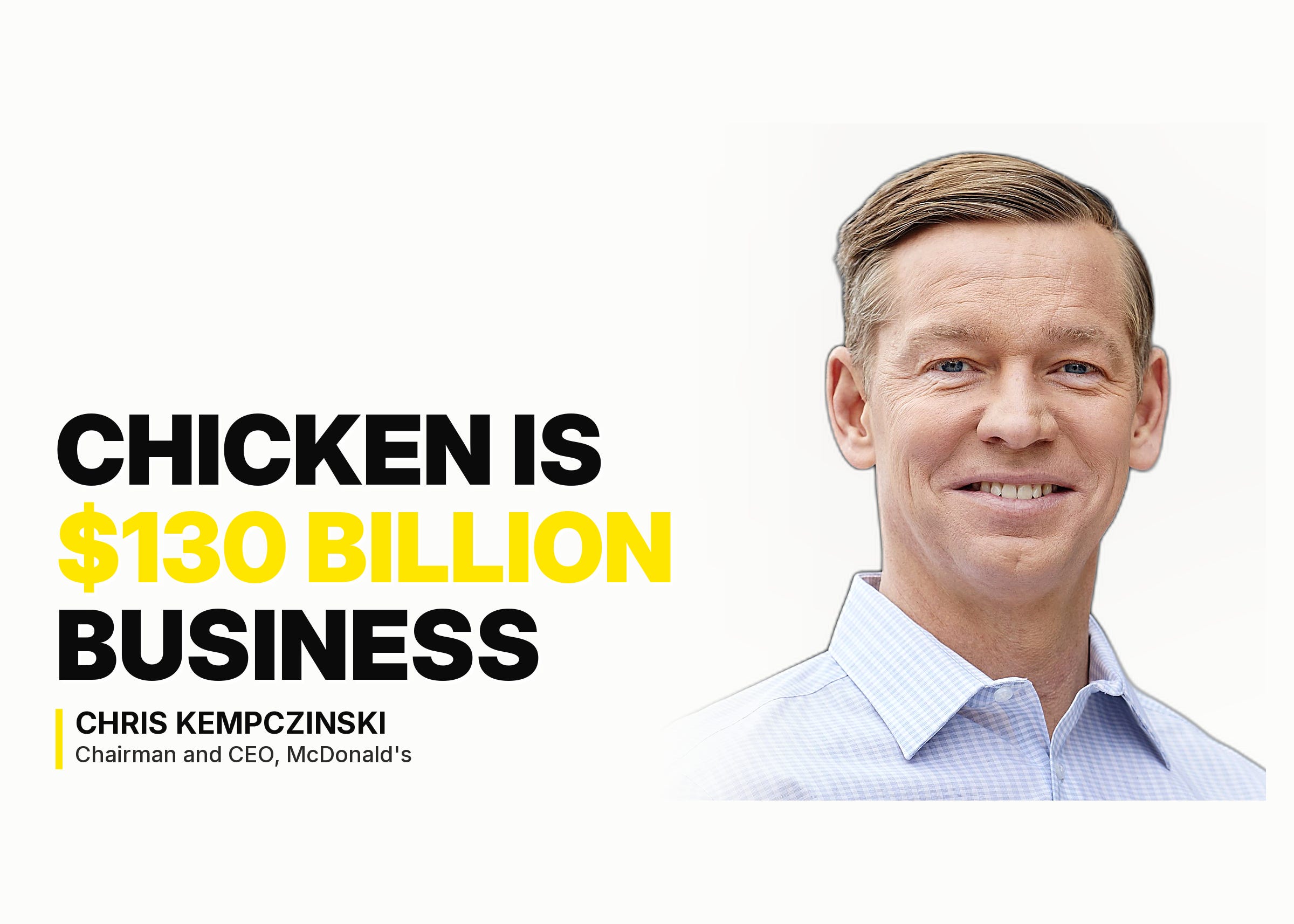
McDonald's holds 20% of a $130B chicken market growing 3% a year
That is in McDonald's 10 largest markets. In beef, a market of about $50 billion, it holds more than 40% and the category grows just over 1%. It already sells more chicken than beef worldwide, mostly McNuggets.
"Chicken is $130 billion business in our top 10 markets. We have a 20 share of chicken as opposed to a 40 share and it's growing 3%." — Chris Kempczinski, Chairman and CEO at McDonald's, on Semafor (Read summary)
Creators now do part of the work of a big ad budget
Kempczinski said the April offer's marketing leaned too much on traditional channels. He also named the risk of handing a brand's message to individual creators.
"Big ad budgets are valuable, but less valuable than they used to be because you can generate quite a bit of consumer awareness... off of social media creators." — Chris Kempczinski, Chairman and CEO at McDonald's, on Semafor (Read summary)
AlphaFold is used by about 4M researchers, Hassabis says
Demis Hassabis co-founded Google DeepMind, whose AlphaFold model predicts the shapes of proteins, a problem biology had worked on for 50 years. He said the next step is using the same approach to predict toxicity and other safety properties of drugs.
"4 million researchers around the world use it. Pretty much every biology and medical researcher in the world, almost every drug in future will have made use of alpha fold." — Demis Hassabis, Co-Founder at Google DeepMind, on Masters of Scale (Read summary)
Sports
The Raiders went from about $325M to $13B in 15 years
Mark Davis took over the team when his father, Al Davis, died. The $13 billion figure is from Sportico's valuation model. Davis said private equity firms would have paid much more for his recent stake sales than the individual investors he picked, among them Tom Brady and Silver Lake's Egon Durban.
"15 years ago, when my father passed away, the team was trading at about 325 million dollars... now the Wizard of Oz has valued us at 13 billion dollars." — Mark Davis, Owner of the Las Vegas Raiders, on CNBC Sport (Read summary)
Ticket resale profits go to season-ticket holders, not the team
The team has not yet given its fans a reason to keep their seats away from visiting supporters, he added.
"The secondary market money... are going to the season ticket holders themselves. So that's something I don't think people realize. They think that we're making all the money on these high ticket prices, but that's not the case." — Mark Davis, Owner of the Las Vegas Raiders, on CNBC Sport (Read summary)
A stadium in use 365 days a year reverses the NFL revenue mix
Davis said an NFL team usually gets 60% to 65% of its revenue from leaguewide deals such as national television and about 35% locally. In Las Vegas the split runs the other way. The team could rent its Oakland stadium about 10 times a year.
"Moving to Las Vegas now, we have the stadium 365 days a year, so we get to promote concerts. We get the Rolling Stones. We get Taylor Swifts." — Mark Davis, Owner of the Las Vegas Raiders, on CNBC Sport (Read summary)
Gambling is the risk to franchise values, Davis says
He was asked what could slow the rise in team valuations. He said he is not a fan of proposition bets on single players and could not say whether betting revenue is worth the risk to the games' integrity.
"My gut always says gambling... I just know that we went from all these sports leagues... saying we're never going to get involved in sports... and now they're all in, 100%." — Mark Davis, Owner of the Las Vegas Raiders, on CNBC Sport (Read summary)
WNBA playoffs belong on the main networks, says a Dream co-owner
Renee Montgomery played in the WNBA before buying into the Atlanta Dream. She said attendance and engagement are up, but fans need to be able to find the games.
"You can't beat visibility, and the more eyes that are on the game... I think the playoff games need to be ESPN, ABC, USA Sports, NBC, CBS. It needs to be on your broadcast, or your main channel." — Renee Montgomery, Co-Owner and Vice President at the Atlanta Dream, on The Deal (Read summary)
Technology & AI
40% of the data-center capacity due by 2027 is in 2 flipped states
On the day Bloomberg Tech covered, the Nasdaq 100 at its lows had its worst intraday drop since March 2020, on bets that a Democratic Congress will regulate data-center construction. Mandeep Singh of Bloomberg Intelligence said investors took about a day to work out what the result meant for data centers.
"When you look at expectations for the remainder of 2026 and 2027 in terms of just the data center build out, there is expectation that certain gigawatts would come online and a bulk of that, I would say 40% of that, is in two states which got flipped over." — Mandeep Singh, Analyst at Bloomberg Intelligence, on Bloomberg Tech
Voters made Big Tech's existing computing power worth more, Lessin says
Jessica Lessin founded The Information. She said the winners are the companies that already own data centers, and the losers are chip suppliers such as Nvidia and the neoclouds, smaller companies that rent out AI computing capacity. Singh made the same point: if new data centers cannot open, the ones running now become more valuable.
"I think the voters handed at least the big tech companies a gift by basically saying, in the short term, it's going to be harder to get new compute. If you have it, it's way more valuable and your margins are going to be better." — Jessica Lessin, Founder and CEO at The Information, on Squawk Pod (Read summary)
Microsoft has soured on renting from neoclouds, Bloomberg reports
Brody Ford of Bloomberg News reported that Microsoft is shifting toward building its own data centers. CoreWeave's shares were down roughly 75% from their high of the past year.
"Microsoft really helped create the Neocloud boom. Way back in 2023, they signed a big deal with CoreWeave... now we're reporting that Microsoft is getting sick of the Neoclouds. They're finding that they can't control the delays, that the costs are higher than their internal projects." — Brody Ford of Bloomberg News, on Bloomberg Tech
Solar panels in orbit get 5x the power, says Planet Labs' CEO
Will Marshall co-founded Planet Labs, which photographs all of Earth's land every day. Last week it launched a test for Google, called Sun Catcher, that runs one of Google's AI chips on a Planet satellite. In orbit, he said, chips need radiators rather than water to stay cool, and no batteries.
"Data centers is all an energy problem. In space, for each solar panel, you get five times more power than you get on the ground because you can put them in a sun-synchronous orbit that is always looking at the sun." — Will Marshall, Co-Founder and CEO at Planet Labs, on Sourcery (Read summary)
Cloud giants buy Planet's images to watch rivals build
Marshall said Planet's customers also include farm companies such as John Deere and hedge funds trading on signals from crops and infrastructure.
"We've even had some of the hyperscalers around here buy our data. Why? Because they want to monitor not just their data center construction, but they want to monitor their competitors' data center construction." — Will Marshall, Co-Founder and CEO at Planet Labs, on Sourcery (Read summary)
AI spending will reach about $1.5T, J.P. Morgan's Chang expects
Chang said the bottlenecks will last two to three more years, and that the profits will go mostly to hardware suppliers in North Asia.
"We actually think that AI capex is going to increase to somewhere around $1.5 trillion or higher, from about $900 billion this year. We see that the demand for computing capacity still exceeds available supply." — Joyce Chang, Chair of Global Research at J.P. Morgan, on Making Sense (Read summary)
Memory chips are now nearly 50% of data-center spending
Chang put memory at the center of the hardware buildout.
"Memory chips have also emerged as a really critical component of AI infrastructure, with their share of data center spending growing to nearly 50%." — Joyce Chang, Chair of Global Research at J.P. Morgan, on Making Sense (Read summary)
An AI model found dozens to hundreds of flaws in Oracle's code
Juan Loaiza runs Oracle's mission-critical database technology. In March Oracle got early access to an AI model he calls Mythos and ran it against its own code. He called it a code-red moment, and said it is better for Oracle to find the flaws than for attackers using the same tools.
"This is not a normal event we can just kind of schedule anytime we want. I mean, this thing is finding dozens to hundreds of security vulnerabilities. Our number one job has to be to fix it." — Juan Loaiza, EVP of Mission-Critical Database Technologies at Oracle, on theCUBE (Read summary)
Oracle's quarterly patches have grown with the fixes
Loaiza said Oracle is trying to keep each patch small enough to avoid breaking something else.
"The vast bulk of this is going into the quarterly patches and it's just the quarterly patches have gotten a lot bigger... because we're fixing tons of security vulnerabilities." — Juan Loaiza, EVP of Mission-Critical Database Technologies at Oracle, on theCUBE (Read summary)
Customers cannot trust AI-written code in production, says Oracle
Hasan Rizvi runs database engineering at Oracle, which built a product called Apex Lang to put AI-written code into production under its security and governance rules.
"Our customers really struggle with putting AI generated code into production. That's a very difficult proposition. You can't trust the code. You don't know how to secure it, how to govern it." — Hasan Rizvi, EVP of Database Engineering at Oracle, on theCUBE (Read summary)
Most AI cyber incidents were engineering failures, Hassabis says
Hassabis called for hardened test environments, better monitoring so AI agents cannot run unnoticed for weeks, and outside auditors for AI systems, much like auditors in finance.
"I think a lot of the cyber issues that we've seen in the last six months or so could have been addressed with better engineering, more robust engineering." — Demis Hassabis, Co-Founder at Google DeepMind, on Masters of Scale (Read summary)
Figma tests a takeover target by trying to rebuild its product with AI
Praveer Melwani is chief financial officer of Figma. Its corporate development staff use AI coding tools such as Codex to build rough copies of a target's product, as a test of how hard its technology really is. Vibe coding means building software by describing it to an AI model in plain language.
"Can you vibe code a product is one of the checks that we use in diligence now... it gives you like a solid intuition there." — Praveer Melwani, CFO at Figma, on a16z (Read summary)
Figma's finance team would shrink if the business stood still
Melwani said new products, acquisitions and growth keep adding work faster than AI takes it away.
"If our biggest complexity was staying the same, I think we probably wouldn't need the same number of people a year from now." — Praveer Melwani, CFO at Figma, on a16z (Read summary)
01.AI installs open models inside the client's own walls
Kai-Fu Lee founded 01.AI and chairs Sinovation Ventures. His company's product reads a company's meeting notes, emails, chats and sales calls. He said an open model still trails the best closed model by 6 to 12 months, which most companies can live with.
"Our position is we recommend open source models. Our deployment is completely on-premise, open source. We put the whole model in your company. There's no data going to Anthropic, OpenAI... certainly not going to China." — Kai-Fu Lee, Founder and CEO at 01.AI, on Squawk Pod (Read summary)
VC & Startups
Shield AI is buying a counter-drone radar maker for about $5.3B
Gary Steele runs Shield AI, a defense technology company. It announced the Echodyne deal with a $2.5 billion funding round that values it near $29 billion, more than double the $12.7 billion valuation from a raise earlier this year.
"Echodyne is a great set of capabilities and enters a very important market for Shield. Echodyne is an industry leader in counter UAS or counter drone technology. And we think there's a tremendous amount of growth there." — Gary Steele, CEO at Shield AI, on Bloomberg Tech (Read summary)
Zipline drones deliver most of a Walmart supercenter's 100,000 items
Keller Rinaudo Cliffton runs Zipline, a drone delivery company now valued at $20 billion after raising about $1 billion. It is expanding with Walmart to 300 supercenters and builds all 43 major parts of its aircraft at its own factory near San Francisco's airport.
"At this point, Zipline has built out many super centers with Walmart over the last two years. And I think both we and they have been quite startled by the level of customer demand... we deliver the vast majority of the 100,000 SKUs in that super center to your home in a way that, again, feels like teleportation." — Keller Rinaudo Cliffton, CEO at Zipline, on Bloomberg Tech (Read summary)
Industrials and Transport
Agility Robotics went public with $300M of pending orders
Peggy Johnson runs Agility Robotics, which makes humanoid robots and began trading on the Nasdaq after merging with Churchill Capital 11, a special-purpose acquisition company. Its next robot, due in the first half of next year, is designed to work near people across several shifts.
"This is an existential problem for many companies who can't find this labor. So the time was now, we have 300 million in pending orders. We're ramping up our factory, which can make a total of 10,000 units annually." — Peggy Johnson, CEO at Agility Robotics, on Bloomberg Tech (Read summary)
Planet Labs grew 58% last quarter, led by defense
Marshall said countries now want to own their satellites outright rather than buy the data.
"We reported significant growth last quarter, 58% growth year on year. But I think the biggest part of that was the defense growth. So the other sectors are growing as well, but the defense piece is growing the fastest." — Will Marshall, Co-Founder and CEO at Planet Labs, on Sourcery (Read summary)
FedEx cannot afford a frontier AI model for all 450,000 staff
Brie Carere is FedEx's chief customer officer. She said FedEx makes AI training mandatory for its front line, sales staff and leadership, and decides which model, such as ChatGPT or Gemini, does which job.
"We cannot, with 450,000 team members, let everyone have access to a frontier model. We could not afford that." — Brie Carere, Chief Customer Officer at FedEx, on After Earnings (Read summary)
Boardrooms will not trust a pause in tariffs, FedEx's Carere says
Carere said companies are adding factories outside China rather than leaving it, India is FedEx's fastest-growing country and Southeast Asia is booming. Her boss calls it re-globalization.
"Even if there is a moment of stability from a tariff perspective, I do not think that boardrooms will trust that moment." — Brie Carere, Chief Customer Officer at FedEx, on After Earnings (Read summary)
FedEx's healthcare shipping is growing at double digits
FedEx does about $10 billion of healthcare business in a market of about $80 billion growing roughly 7% a year. Carere credited weight-loss drugs sold direct to consumers and more temperature-controlled drugs.
"We now have got 30 locations around the world certified by IATA to move pharmaceuticals, which is fantastic, and we are seeing double-digit growth." — Brie Carere, Chief Customer Officer at FedEx, on After Earnings (Read summary)
Materials & Energy
ICE's power markets have grown fast with the data-center boom
ICE started as an energy exchange and now runs energy contracts in the US, London, Amsterdam, Abu Dhabi and Singapore. Bland said its power contracts picked up the surge in demand near Dallas before other benchmarks did.
"We've seen with the AI and the data center boom, we've seen our power markets basically explode over the past couple of years." — Trabue Bland, SVP of Futures Exchanges at Intercontinental Exchange, on theCUBE (Read summary)
Policy
Big Tech has quietly hired Democratic lobbyists, Lessin says
Lessin said the companies are keeping the staff they hired to work with the Trump administration, and that Elon Musk is the most exposed to hearings if Democrats run the committees.
"They have been quietly hiring up Dem lobbyists behind the scenes. This didn't surprise them, but... they're really trying to rebalance." — Jessica Lessin, Founder and CEO at The Information, on Squawk Pod (Read summary)
Trump accounts could lift stock ownership from 65% to 95%, says Tenev
Robinhood is the sole initial trustee and broker for Trump accounts, which put $1,000 into a low-cost S&P 500 fund for every child born from January 2025.
"I think it's the best thing for actually getting household stock ownership from 65% to 95%." — Vlad Tenev, Co-Founder and CEO at Robinhood, on No Priors (Read summary)
Geopolitics
Planet Labs launched Sweden's first satellite 4 months after signing
Japan is buying Planet's satellites and Germany is paying for a fleet; Germany's first went up two months after signing, Marshall said. He tied the demand to the US pushing allies to carry more of their own defense.
"In the case of Sweden, we managed to launch the first satellite for them in four months after we signed the contract, which normally in the aerospace industry would have taken five or 10 years." — Will Marshall, Co-Founder and CEO at Planet Labs, on Sourcery (Read summary)
The US leads China in AI by 6 to 12 months, says Kai-Fu Lee
Lee said the US should negotiate AI rules with China rather than set them among democracies and expect China to accept them.
"There's no doubt that US leads in the AI breakthroughs, and China is very clever in being a strong follower at one-tenth the price. So I think US now leads six to twelve months in any given scenario." — Kai-Fu Lee, Founder and CEO at 01.AI, on Squawk Pod (Read summary)
Nuggets of Wisdom
A CEO should not expect to know everything, Miebach says
Since 2022, half of each Mastercard employee's annual review rests on three written behaviors rather than on hitting numbers, Miebach said. A good year on the numbers with poor behavior counts as a mediocre year.
"I don't have the aspiration to know everything, so I should have people around the table that in the aggregate, we know as much as we can." — Michael Miebach, CEO at Mastercard, on Capital Ideas (Read summary)
Women's sports investors have to deal without much capital
Montgomery invested with Mark Cuban in Campus Ink, which sells merchandise tied to college athletes, after a cold approach to its founder.
"Women's sports, we don't necessarily have the capital. So for me, a lot of the deals that I've had to make, I have to get creative and I have to do those cold reach-outs... because I don't necessarily have the funds to build the empire that I want to build." — Renee Montgomery, Co-Owner and Vice President at the Atlanta Dream, on The Deal (Read summary)
If this was worth your time, send it to someone who has to follow all of this too.
What did you think of today’s edition? Hit ‘reply’ to this email, send us a message, leave a comment, or join the chat!
Get the latest market chatter as it happens: