

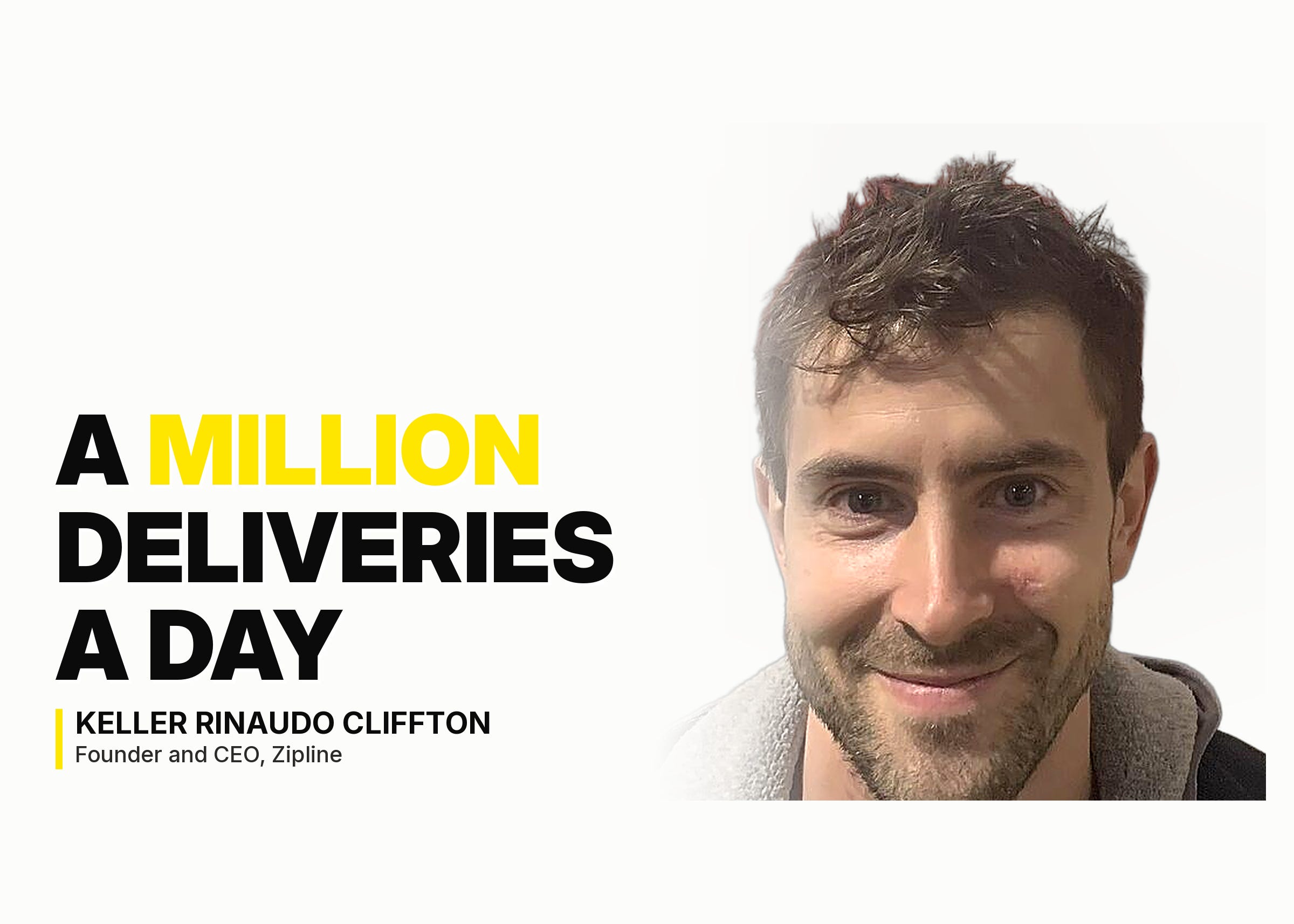
Zipline's partnership with Uber Eats aims to reach 1M deliveries a day, about a quarter of Uber Eats' US deliveries, Keller Rinaudo Cliffton, Zipline's founder and CEO, said on Sourcery with Molly O'Shea.
That was one deal from one interview. The other 21 people quoted tonight included the head of the Electric Power Research Institute on why the grid takes 10 to 15 years to supply what a data center builds in 18 months, a fund founder who resells Birkin bags for $35,000, and a short seller asking what cheap AI stocks are worth if their earnings go away.
"If I am Google, I can get 100 megawatts of compute ready in a data center in 18 months. The clock for transmission and power five years ago would take 10 to 15 years." — Arshad Mansoor, President and CEO at EPRI, on Making Sense (Read summary)
We scanned 817 shows and 9 hours of audio, wrote 16 summaries, and pulled 51 quotes into this 17-minute read.
Here is what mattered.
Macro
A JPMorgan salesperson saw 50 to 60 hedge-fund clients in a week and none were buying, which Dayan calls a buyer strike
"He went to see 50, 60 clients in the last week, all hedge funds. None of them are buying this... So we effectively have a hedge fund buyer strike. They like the market, they think it's cheap, they think this is overdone. They're not getting involved." — Danny Dayan, Founder and CIO at DWD Partners, on Market Talk with George Noble (Read summary)
Trend-following funds will not buy until the market is at least 5% to 6% higher and daily swings of 1% to 2% calm down, Dayan says
"The systematic community is not buying. CTA trigger levels are very far from here... at least five, six percent higher... and they won't buy yet until realized volatility comes down. We're still moving one to two percent per day." — Danny Dayan, Founder and CIO at DWD Partners, on Market Talk with George Noble (Read summary)
Fund managers get new money only after a good year, so few will add risk in the last 5 weeks of this one, Dayan says
"As an institutional investor, you don't get capital coming in unless you performed well. Nobody's willing to jump in here in the last five weeks of the year." — Danny Dayan, Founder and CIO at DWD Partners, on Market Talk with George Noble (Read summary)
Schiff says US rates should be far higher because the country is less creditworthy; Johnson says investors give the US a pass anyway
"Rates have a long way to rise from here. Yes, rates are back to where they were 20 years ago, but they should be a lot higher than they were 20 years ago, because we're nowhere near as creditworthy as we were 20 years ago." — Peter Schiff, Founder and Chief Economist at Euro Pacific Asset Management, on Thoughtful Money (Read summary)
"We have a bigger debt-to-GDP. Our budget deficits are a larger percentage of GDP than a lot of these other countries... but we get the benefit of those flows right now because it's out of a reflexive Pavlovian kind of movement: 'I'm worried about France, I'm going to buy dollars.'" — Brent Johnson, CEO at Santiago Capital, on Thoughtful Money (Read summary)
Financials
A company's name no longer shows how exposed it is to AI spending, so fund managers must know what they do not own, Laud says
"The name will not give away how much a company's exposed to the AI buildout. For a fund manager, it really requires you to understand not only what you own, but what you don't own." — Sonja Laud, Co-Head of Investment at UBS Asset Management, on The Bulletin with UBS (Read summary)
The AI trade adds correlation risk to every asset class, from power equipment to real estate, Gill says
"The correlation risk from the AI trade exists in every single asset class you can think of — infrastructure, power connectors, real estate, data centres. It is literally everywhere." — Barry Gill, Co-Head of Investment at UBS Asset Management, on The Bulletin with UBS (Read summary)
Crypto and Digital Assets
Johnson says dollar stablecoins shift monetary power to the US; Schiff says nothing pegged to the dollar can be stable
"Those citizens... are willingly adopting US dollar stablecoins as their preferred currency. Nobody's forcing it on them... and that then steals monetary sovereignty from those local governments, and this power accretes to the United States." — Brent Johnson, CEO at Santiago Capital, on Thoughtful Money (Read summary)
"Since the dollar itself is not stable, nothing tied to the dollar can be stable... if you own a US dollar stablecoin, it's no better than the fiat dollar, which we know is designed to fail." — Peter Schiff, Founder and Chief Economist at Euro Pacific Asset Management, on Thoughtful Money (Read summary)
More than 200 gold stablecoins exist and almost nobody uses them, says Frisby, who dropped plans to launch one in 2015
"The evidence of the last 10, 12 years is that, however good the idea of a gold stablecoin is, there are more than 200 of them and nobody uses them... if you look at what the market has decided, it uses dollars." — Dominic Frisby, financial writer at MoneyWeek, on Thoughtful Money
Alternatives and PE
Sagard's own teams, shareholders and the Desmarais family supply 10% to 20% of the capital in most of its strategies
"For most of our strategies, between 10 and 20% of the capital in the strategy comes either from our teams, our shareholders, or my family businesses. That is a level of alignment that is very different from most of the industry." — Paul Desmarais III, Founder and CEO at Sagard, on Private Capital (Read summary)
Sagard's credit funds hold none of the software, business-services and data-center loans that fill most private-credit books, Desmarais says
"If you're an allocator in the credit world, you're mostly allocated to sponsor lending... a lot of software, a lot of business services, and now a lot of data centers. When you invest in our credit products, you have none of that." — Paul Desmarais III, Founder and CEO at Sagard, on Private Capital (Read summary)
Sagard's venture studio, Diagram, gives founding management teams 70% of the economics up front
"We give them 70% of the economics up front... we have a philosophy at Sagard: you'll only create huge pies if you share that pie." — Paul Desmarais III, Founder and CEO at Sagard, on Private Capital (Read summary)
A Birkin that retails at about $13,500 can resell for $35,000, and Auslander still calls the bags luxury's most attractive asset class
"A Birkin 30 or 25 will usually retail at around $13,500 plus tax, but we can resell it on the secondary market for $35,000. It's a really intense spread — it's been coming down, but it's still the most attractive asset class in luxury, in my opinion." — Dana Auslander, Founder at Luxus, on WSJ's Take On the Week (Read summary)
Luxus's first Birkin fund, launched in May 2025, is up 23.8% net, and the supply of bags is its constraint, not investor demand
"The first fund launched in May of 2025. It's up 23.8% net of everything. We just finished our second distribution — it was only 15 months, so a very liquid fund. We're launching a third share class now; we're much more supply-constrained than demand." — Dana Auslander, Founder at Luxus, on WSJ's Take On the Week (Read summary)
Consumer
Michaels is moving into party goods and sewing supplies after Joann and Party City went bankrupt
"You've got Joann's going bankrupt, you've got Party City that's going bankrupt. Both are categories that Michaels had historically dabbled in but had not specialized in and are uniquely adjacent to the value proposition of Michaels." — Nick Bertram, President and COO at Michaels, on Omni Talk Retail (Read summary)
Shoppers testing markers on store fixtures led Michaels to build a try-before-you-buy Marker Bar
"Shoppers... had been trying out markers on our base plates. It looks like graffiti, but it's actually a real need that we had just not answered. So we now have this new signature moment called the Marker Bar." — Nick Bertram, President and COO at Michaels, on Omni Talk Retail (Read summary)
Bertram thinks Michaels leads an analog revolution, keeping technology in the background because shoppers are tired of screens
"I think what's unique about Michaels is that we are at the forefront of the analog revolution... people are tired of being on screens all the time. For us, technology is very much an enablement of it, but it's not the forefront of what we want to be seen." — Nick Bertram, President and COO at Michaels, on Omni Talk Retail (Read summary)
Hermès sales rose 6% last quarter and its leather goods 10.8%, yet the stock has fallen hard, Auslander says
"Hermès is actually doing pretty well — it was up 6% year over year in the last quarter, leather goods up 10.8%. The stock has gotten really hammered, though." — Dana Auslander, Founder at Luxus, on WSJ's Take On the Week (Read summary)
Resale sites such as The RealReal and eBay focus on the cost of bringing one bag to market, while big brands spend on VIP events and influencers, Auslander says
"The RealReal and eBay are much more focused on unit economics... The larger brands spend a lot on experiences for their top clients, on sponsorships, on influencer marketing, and that hurts them on the margin side." — Dana Auslander, Founder at Luxus, on WSJ's Take On the Week (Read summary)
Sports
Smith's college knee injury dropped him from a projected top-3 pick to the second round and cost him about $17M
"I went from being a projected top three pick... to the second round. I missed out on about $17 million." — Jaylon Smith, former Dallas Cowboys linebacker and investor, on WSJ Events (Read summary)
Smith invested in Oura, the smart-ring maker, at its Series C and sold at its Series E
"Oura ring was the second I got in, as a Series C, and exited... in the Series E." — Jaylon Smith, former Dallas Cowboys linebacker and investor, on WSJ Events (Read summary)
Technology & AI
Lütke rewrote the system that hosts all of Shopify's code over a weekend, work he says once meant a multi-year project
"I completely rewrote our system of internal source repositories that hosts all the code in Shopify — that was a weekend project, not a multi-year rewrite." — Tobi Lütke, CEO at Shopify, on David Senra (Read summary)
AI coding agents work best under strict rules that engineers dislike, and will write tens of thousands of lines of explicit code, Lütke says
"No engineer wants to work in a codebase with insanely strict rules. The agents love them — they love rules, but not abstractions, because they're perfectly happy to write tens of thousands of lines of code that are correct for the thing they're doing." — Tobi Lütke, CEO at Shopify, on David Senra (Read summary)
Vercel's new Security Review found 1,000 critical and high-severity flaws in customer code in its first 24 hours
"We announced Vercel Security Review... within the first 24 hours it identified a thousand critical and high vulnerabilities in code that customers were attempting to deploy." — Guillermo Rauch, Founder and CEO at Vercel, on Sourcery with Molly O'Shea (Read summary)
Rauch says writing code is now close to free, and cybersecurity is the problem left to solve
"We've solved coding — coding is now virtually free, abundant — but we really need to solve cybersecurity if we want the infrastructure to remain stable." — Guillermo Rauch, Founder and CEO at Vercel, on Sourcery with Molly O'Shea (Read summary)
CEOs are panicking because AI agents attack many weaknesses at once while defenders still patch one at a time, Blundin says
"We may be at peak fear, but we're nowhere near peak disruption. I've been talking to CEOs over the last few weeks and they're all in a complete panic on the cyber side, because cyber defense is still human in the loop plugging one vulnerability at a time, and cyber offense is agents attacking multiple vulnerabilities in parallel at scale." — Dave Blundin, Founder and General Partner at Link Ventures, on Moonshots with Peter Diamandis
An Atlassian test of AI-only builder squads showed the bottleneck was direction, not output, Mansour says
"We realized throughput's not our problem. Direction's our problem. Throughput's getting cheaper." — Sherif Mansour, Head of AI and Product Craft at Atlassian, on Lenny's Podcast (Read summary)
Juniors are roughly 38% more likely than seniors to adopt new tools, according to Atlassian's research
"Something like 38% of juniors are more likely to adopt new tools than the seniors, both internally and with customers. On the flip side, the seniors are getting more quality and better productivity out of the ones they're using, but they're less likely to try different ways of working." — Sherif Mansour, Head of AI and Product Craft at Atlassian, on Lenny's Podcast (Read summary)
For an established product, the fastest way to become AI-native is to add AI to the workflows customers already run, Mansour says
"It is very catchy to say, don't bolt AI onto your product, you should reimagine the workflow. However, if you have an established product, the best way to reinvent it to be AI native is to understand the flows that exist in your product and literally bolt on AI to them." — Sherif Mansour, Head of AI and Product Craft at Atlassian, on Lenny's Podcast (Read summary)
Tulchinsky says AI could raise WorldQuant's productivity 100 times, but his staff are aiming for 10% to 30% first
"I was saying even last year that productivity could rise easily 100 times. And it can. But people in my company are afraid to go to the 100-times level, so we're going to like 10, 20, 30% more first." — Igor Tulchinsky, Founder, Chairman and CEO at WorldQuant, on Forbes (Read summary)
AI's winners will be whoever spreads it through a company or an economy first, not whoever invents it, Gill says
"It's not about who comes up with the idea first, who invents stuff — it's who diffuses it through the company, through society, first. That comes down to culture, organisational will, and flexibility." — Barry Gill, Co-Head of Investment at UBS Asset Management, on The Bulletin with UBS (Read summary)
AI spending is now financed across the whole capital stack, with the same companies acting as lender, client and guarantor, Laud says
"We've moved beyond the equity story, where capex is financed by cash flow and equity, to a balance sheet story, using the entire capital stack. We now have circular references where the same companies provide the balance sheet, they're the client, they're the guarantor." — Sonja Laud, Co-Head of Investment at UBS Asset Management, on The Bulletin with UBS (Read summary)
Low price-to-earnings ratios on AI stocks mean little if the earnings disappear, Block says
"The big question is, on a PE basis so many of these companies are so cheap now — yeah, but what happens if the E goes away? It's not clear that the large-scale users of the frontier models are doing so profitably." — Carson Block, Founder at Muddy Waters Capital, on Other People's Money (Read summary)
NMC Health's real debt was $6.5B, not the $2.1B it disclosed, a lesson Block applies to Nvidia: a short seller can see rot without seeing how far it goes
"We knew it was a fraud, we knew there was undisclosed debt, but if you'd told me the real debt number was six and a half billion versus 2.1 billion, I would not have believed you... there's some rot here, you just don't know how far the rot goes." — Carson Block, Founder at Muddy Waters Capital, on Other People's Money (Read summary)
Google will receive 8M of its own TPU chips next year, a number Mostaque thinks many people miss
"I think that a lot of people miss how many TPUs are actually landing — they're landing 8 million next year." — Emad Mostaque, Founder at Intelligent Internet, on Moonshots with Peter Diamandis
VC & Startups
Tesla took 15 years and SpaceX 20 to reach meaningful scale, and Zipline has needed more than a decade, its CEO says
"Tesla took 15 years to really achieve meaningful scale. SpaceX took 20 years to achieve meaningful scale. Zipline — we've been at it for more than a decade to get to the scale where it starts to look relevant at a national level." — Keller Rinaudo Cliffton, Founder and CEO at Zipline, on Sourcery with Molly O'Shea (Read summary)
For Zipline's first 13 years, venture investors avoided hardware and businesses that need heavy spending on equipment
"For 13 years of Zipline, building a hardware company was the dumbest thing you could possibly do. Nobody was interested in robotics. Capex was like a radioactive zone for venture capital." — Keller Rinaudo Cliffton, Founder and CEO at Zipline, on Sourcery with Molly O'Shea (Read summary)
Industrials and Transport
Zipline's Uber Eats partnership aims for 1M deliveries a day, about a quarter of Uber Eats' US deliveries
"We announced a partnership with Uber Eats to grow with them to a million deliveries a day, which is about a quarter of their overall deliveries in the US." — Keller Rinaudo Cliffton, Founder and CEO at Zipline, on Sourcery with Molly O'Shea (Read summary)
Zipline is expanding from 22 Walmart Supercenters to 300 in the first phase
"We've been working with Walmart for the last couple years. We had grown to 22 Supercenters. We're now expanding to 300 Walmart Supercenters in the first phase." — Keller Rinaudo Cliffton, Founder and CEO at Zipline, on Sourcery with Molly O'Shea (Read summary)
Materials & Energy
New York's electricity use fell for 15 years and is projected to rise 25% in the next 15, Mansoor says
"For the last 15 years, the amount of electricity you use in New York has actually gone down. In the next 15 years, 25% up." — Arshad Mansoor, President and CEO at EPRI, on Making Sense (Read summary)
Skilled workers are the grid build-out's biggest constraint, ahead of parts and permits, Mansoor says
"People is the number one constraint we will have to address. Parts are number two, the supply chain is going to be huge. And then permit. I call it people, parts, permit." — Arshad Mansoor, President and CEO at EPRI, on Making Sense (Read summary)
US batteries could run the grid for maybe 30 minutes, so they will not replace natural gas, Mansoor says
"We'll have enough batteries for the US grid to run on batteries for maybe 30 minutes. It's never going to be natural gas. Today's batteries are sprinters, they will never run a marathon." — Arshad Mansoor, President and CEO at EPRI, on Making Sense (Read summary)
Policy
If Congress does nothing, Social Security benefits fall automatically by about 22%, Yass says
"If Congress does nothing, the benefits automatically decline — right now about 22%. They have enough money to pay out, but only 78% of it." — Jeff Yass, Co-Founder at Susquehanna International Group, on Generating Alpha Podcast (Read summary)
A typical retiree has maybe $300,000 of Social Security benefits; Yass says 45 years of private index accounts would have left well over $1M
"The typical person retiring today has maybe $300,000 of Social Security benefits coming to him. Had we done this plan 45 years ago, his benefits would be well over a million dollars. That's the divide." — Jeff Yass, Co-Founder at Susquehanna International Group, on Generating Alpha Podcast (Read summary)
Block thinks Treasury Secretary Scott Bessent leads the administration's China hawks, and says Bessent blamed Commerce Secretary Howard Lutnick for not enforcing Nvidia export controls
"Within the administration I think there are basically two factions on China... that's best exhibited by Secretary of Treasury Scott Bessent. Secretary Bessent has been very vocal, and the other week he actually threw Howard Lutnick under the bus for failing to enforce the export controls on Nvidia chips." — Carson Block, Founder at Muddy Waters Capital, on Other People's Money (Read summary)
A congressional hearing found no foreign attacker behind the recent bank and FAA outages, only outdated systems, McCaul says
"The good news is there's no adversarial threat here trying to hack into our systems. The bad news is they're antiquated." — Michael McCaul, Republican congressman from Texas, on Bloomberg This Weekend
Nuggets of Wisdom
Sagard's first deal, a chain of fertility clinics, went bankrupt; Desmarais says he had studied the numbers but not the doctors
"I bought a chain of fertility clinics and it went bankrupt and we lost all our money, and it was very confidence shaking... I'd spent a lot of time studying the macro and the dynamics of the industry and the financials, but I'd not spent a lot of time with the doctors." — Paul Desmarais III, Founder and CEO at Sagard, on Private Capital (Read summary)
Tulchinsky got into quantitative finance by mailing thousands of letters to CEOs; one reached Thomas Peterffy at Timber Hill
"I mailed out thousands of letters to rather random CEOs. One of them landed on the desk of Thomas Peterffy, who was running Timber Hill." — Igor Tulchinsky, Founder, Chairman and CEO at WorldQuant, on Forbes (Read summary)
Several of the best CMOs Hobley knows are introverts who dislike social events
"There are some incredible CMOs out there, and some are really dear friends, who would not call themselves extroverts and do not love social events like that. They're incredible leaders, but actually quite introverted." — Melissa Hobley, Global CMO at Tinder, on Forbes (Read summary)
If this was worth your time, send it to someone who has to follow all of this too.
What did you think of today’s edition? Hit ‘reply’ to this email, send us a message, leave a comment, or join the chat!
Get the latest market chatter as it happens: