

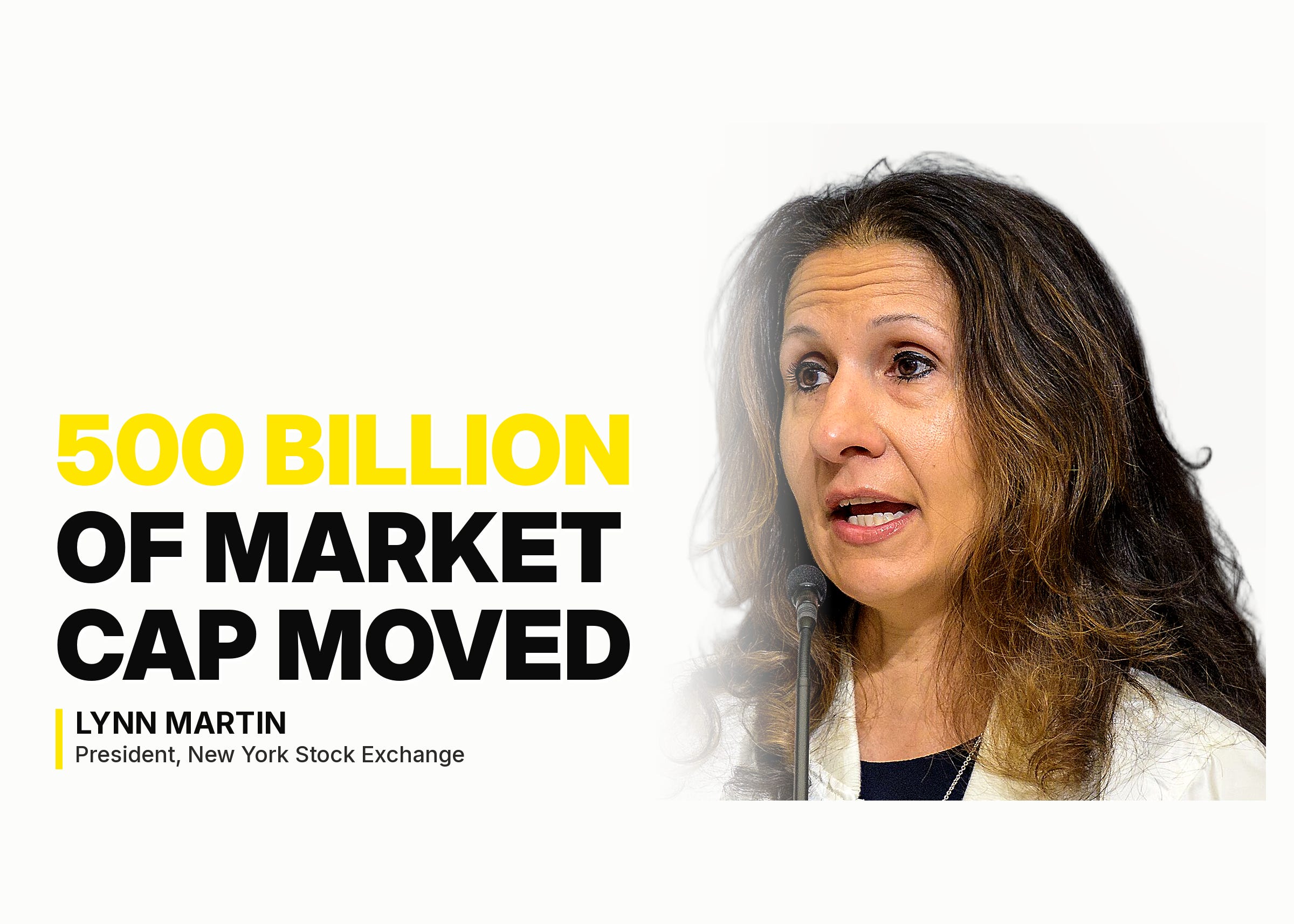
Lynn Martin, president of the New York Stock Exchange, said companies with $500B of market value have moved their stock listings from Nasdaq to the NYSE. She also called the quick route Nasdaq offered SpaceX into a stock index questionable.
That was one interview. The other 28 people quoted tonight included Amazon's CEO on AI revenue growing 440 times faster than AWS's own early business, and Apollo's CEO on what happens to smaller AI cloud companies if Nvidia stops guaranteeing their funding.
"If you don't bring Jensen back, I would not hire an outsider. Nvidia is too complicated. I think outside CEOs in a complex company have a vanishingly small chance of succeeding." — Jeff Bezos, Founder at Amazon, on Semafor (Read summary)
We scanned 810 shows and 9 hours of audio, wrote 17 summaries, and pulled 53 quotes into this 15-minute read.
Here is what mattered.
Macro
Home builders' trade group says immigration enforcement is deepening construction labor shortages
"Builders are confronting multiple challenges in today's economy. Stepped-up immigration enforcement is keeping legal workers off job sites, deepening labor shortages and driving up costs." — Bill Owens, Chairman at the National Association of Home Builders, in the group's November release, as reported on Squawk on the Street
One volatility specialist sees acute stress across large-cap stocks; another sees little fear
"SPX vol is expanding faster than NDX vol, as SPX vol is coming from a lower base. Today, the market is pricing acute near-term stress in large-caps broadly, but tech-specific fear is still notable." — Eric Metz, CIO at SpiderRock Advisors, as quoted in CNBC's Squawk on the Street coverage
"While vol is now at a relatively elevated level, we have not seen much fear in the options market... we have seen a pretty decent move higher in SPX fixed strike vol, however the move up in vol has been mostly orderly." — Matthew Nadel, Co-founder at VolSignals, as quoted in CNBC's Squawk on the Street coverage
Financials
Companies worth $500B moved their stock listings from Nasdaq to the NYSE, Martin says
"500 billion of market cap moved from NASDAQ to the New York Stock Exchange. It's a piece of information we're incredibly proud of." — Lynn Martin, President at the New York Stock Exchange, on Fortune Daily (Read summary)
Martin says fast-tracking SpaceX into a stock index after its Nasdaq listing was questionable
"Fast-tracking inclusion into an index — an index that is invested in by pensioners, firefighters, teachers — is... just questionable." — Lynn Martin, President at the New York Stock Exchange, on Fortune Daily (Read summary)
New listings paused ahead of Anthropic's IPO, which Martin thinks will be valued around $1.5T
"I think it's the sheer size... that company looks like it's going to be around one and a half trillion market cap. That is a very large public offering." — Lynn Martin, President at the New York Stock Exchange, on Fortune Daily (Read summary)
Approximately 60% of Goldman Sachs' revenue now comes from steadier, recurring businesses
"Approximately 60% of the revenues would be considered more durable revenues. And that's a big increase from where it was eight years ago." — David Solomon, Chairman and CEO at Goldman Sachs, on TBPN (Read summary)
New Street's Ferragu expects AI to take spending from knowledge work twice as fast as cloud took IT budgets
"Anthropic is a generational IPO — we expect AI to steadily grow as a percentage of spending on knowledge work over decades, the same way cloud grew as a percentage of IT spending since 2010. Only difference: the new technology spreads twice as fast, and its addressable market is 10 times larger." — Pierre Ferragu, Analyst at New Street Research, in a research note, as quoted in CNBC's Squawk on the Street coverage
Crypto and Digital Assets
Coinbase has an AI security model review every line of code before it reaches production
"Every line of code that we write at Coinbase before it goes to production gets reviewed by one of these cyber expert models." — Brian Armstrong, Co-founder and CEO at Coinbase, on TBPN
McDonald's draws outsized demand among Kraken's tokenized US stocks because of its global brand
"That's one of the names that we see that has a kind of outsized adoption in X Stocks — McDonald's... because of the brand recognition globally." — Dave Ripley, Co-CEO at Payward, the parent of Kraken, on The Tech Download (Read summary)
Weekend closures leave a stale Friday price that trading every day would replace, Kraken's Ripley says
"Whatever that price closed at on Friday... is no longer the price come Saturday midday. We just don't know what the price is... that's the dislocation. That's the stale Friday price." — Dave Ripley, Co-CEO at Payward, the parent of Kraken, on The Tech Download (Read summary)
Alternatives and PE
Apollo's CEO says AI cloud firms lose funding without Nvidia's guarantees; Goldman's CEO says capital is plentiful
"There was a strong incentive for Nvidia as a business matter to get these projects off the ground... If that banking function, that guarantor function, gets taken away, access to capital for a large number of neoclouds is going to disappear." — Marc Rowan, Co-founder and CEO at Apollo Global Management, on Squawk on the Street (Read summary)
"This whole ecosystem is much bigger than one guy, one company... there's a lot of capital out there in the world, and the best companies will continue to get funded." — David Solomon, Chairman and CEO at Goldman Sachs, on TBPN (Read summary)
Rowan expects specialist lenders for AI infrastructure that judge credit and what equipment is worth at the end
"It will not surprise me to see financial innovation take place, where more of a finance company mentality develops for this industry as an arbiter of credit and as a method of dealing with residuals." — Marc Rowan, Co-founder and CEO at Apollo Global Management, on Squawk on the Street (Read summary)
Hamilton Lane's 12 evergreen funds, which investors can enter and leave periodically, now manage over $20B
"We have 12 evergreen vehicles across a variety of strategies and geographies... that demand... has gone from zero... to today over 20 billion dollars of capital managed in that space." — Erik Hirsch, Co-Executive Chairman at Hamilton Lane, on After Earnings (Read summary)
Hamilton Lane put the odds of an AI valuation bubble at 42%, and Hirsch would raise that number today
"The 42 is a little bit tongue and cheek... if you asked me to re-evaluate that today... I'd actually raise that number." — Erik Hirsch, Co-Executive Chairman at Hamilton Lane, on After Earnings (Read summary)
Consumer
New Limit, the longevity biotech Armstrong co-founded, plans its first human clinical trials next year
"With New Limit, which is the longevity biotech that I co-founded... first human trials, clinical trials will be happening next year." — Brian Armstrong, Co-founder and CEO at Coinbase, on TBPN
Costco's buyback is under 1% of its $490B market value, so the special dividend matters more, Cramer says
"With all due respect to the buyback program, which represents less than 1% of Costco's $490 billion market cap, it's the special dividend that I'm excited about." — Jim Cramer, Host at CNBC, on Mad Money
Technology & AI
Nvidia's board does not intend to reinstate Jensen Huang, who says he would return if asked
"The Nvidia board unanimously accepted his resignation and does not intend to reinstate Jensen as CEO." — Harvey Jones, Board Chair at Nvidia, on Nvidia's earnings call, as covered on Fast Money
"If the Board of Directors decides that my return is in the best interest of our shareholders, our employees, the company, and America, I would be honored to answer these calls and return as CEO." — Jensen Huang, former CEO at Nvidia, in a written statement, as reported on Squawk on the Street
Nvidia now expects 75% growth in fiscal 2028, its interim CEO says
"We felt very confident, therefore, that we could establish that we will grow 75% over year over year in terms of fiscal year 28." — Colette Kress, Interim CEO at Nvidia, on Nvidia's earnings call, as covered on Fast Money
Nvidia's data-center leases run up to 20 years and start between late fiscal 2027 and fiscal 2033
"Our upcoming data center leases have terms up to twenty years and have not commenced. These leases are expected to commence between the fourth quarter of fiscal 2027 and fiscal 2033." — Colette Kress, Interim CEO at Nvidia, in Nvidia's CFO commentary, as covered on Closing Bell: Overtime
AWS's AI revenue passed $25B in 3 years, which Jassy puts at 440 times AWS's own early pace
"Incredibly early innings, in my opinion... In the first three years of this generative AI wave, our AI revenue in AWS is over $25 billion. So it's 440 times faster." — Andy Jassy, President and CEO at Amazon, on Halftime Report (Read summary)
Jassy says AWS's big blocks of computing are largely reserved for 2027, with a good part of 2028 and some of 2029
"The big chunks of compute are largely reserved for us in '27 and a good chunk of that in '28, and actually a fair bit in '29." — Andy Jassy, President and CEO at Amazon, on Halftime Report (Read summary)
Amazon's own chips, Trainium and Graviton, passed a $25B annual revenue run rate
"We shared that it was over a $25 billion annual revenue run rate, our chips business, between Trainium and our CPU chip, Graviton." — Andy Jassy, President and CEO at Amazon, on Halftime Report (Read summary)
Three leading AI models each found roughly a third of the flaws in Palo Alto's code; open-source tools found about 10%
"We ran all three of them in a harness to test code and we discovered... roughly a third, a third, a third, right? And about 10% from open source." — Nikesh Arora, Chairman and CEO at Palo Alto Networks, on Newcomer (Read summary)
AI lets an attacker find a flaw, break in, take data and leave in 18 minutes, Arora says
"In 18 minutes... enough compute and persistence can actually go find a vulnerability, daisy chain it, get inside, exfiltrate data and leave. 18 minutes is not a long enough time." — Nikesh Arora, Chairman and CEO at Palo Alto Networks, on Newcomer (Read summary)
Palo Alto bought its way into identity security, a category it did not sell, with the $28B CyberArk deal
"We did buy CyberArk which is a $28 billion asset where we literally bought our way into a large category called identity which we didn't play in." — Nikesh Arora, Chairman and CEO at Palo Alto Networks, on Newcomer (Read summary)
Companies are getting maybe 20% to 30% faster coding from AI, Databricks' CEO says
"With the coding, actually, they're not seeing enough speedups. They're seeing maybe like 20, 30%." — Ali Ghodsi, Co-founder and CEO at Databricks, on All-In (Read summary)
Anthropic seems to release a half-dozen products every 2 weeks, many aimed at other software makers, Ghodsi says
"A company called Anthropic seems to be releasing every two weeks a half-dozen products... they just came out with basically an Excel killer. They're killing Photoshop, and they're just going after everybody wholesale." — Ali Ghodsi, Co-founder and CEO at Databricks, on All-In (Read summary)
Masad says Replit's stripped-down system core was hit by almost none of about 100 new security flaws last year
"There were about 100 zero-day vulnerabilities over the past year. Replit was affected by about zero of them because we actually built a special version of the kernel that is stripped down." — Amjad Masad, CEO and Co-founder at Replit, on Masters of Scale (Read summary)
SemiAnalysis pushed several gigawatts of expected data centers from 2027 to 2028 over permits, not money or labor
"We pushed back multiple gigawatts out of 2027 into 2028... not because they can't build it, not because the labor is not there, not because of some shortage of equipment, but because permits are just not available." — Dylan Patel, Founder and CEO at SemiAnalysis, on Sourcery with Molly O'Shea (Read summary)
45% of SemiAnalysis's $15M a year of AI spending now goes to AI agents that run continuously
"Over the last few months we've gone from zero persistent agents to 45% of our $15 million a year AI spend being persistent agents." — Dylan Patel, Founder and CEO at SemiAnalysis, on Sourcery with Molly O'Shea (Read summary)
Of the employees who use the most AI, about half are very productive and half waste money, Mosseri says
"Token maxing is whatever... we look at who uses the most tokens and like half the time it's really really productive and half the time it's a complete waste of money." — Adam Mosseri, Head of Instagram at Meta, on Silicon Valley Girl (Read summary)
Khosla thinks Nvidia's board moved too fast to have followed a full investigation
"I do think the board should have taken more time for due process and fully investigating the situation. It happened very, very quickly, which says to me a full process wasn't followed there." — Vinod Khosla, Founder at Khosla Ventures, on Closing Bell (Read summary)
A board should weigh the value a founder creates against the penalty for misconduct, Khosla says
"A board's role is to maximize value for shareholders. So the question isn't founder or not. The question is how much value can this person create versus what's the penalty for the transgressions." — Vinod Khosla, Founder at Khosla Ventures, on Closing Bell (Read summary)
Baker says Huang told him Nvidia has never had a contract with TSMC, its main chipmaker
"He said they've never had a contract with Taiwan Semi, and yet they have the best relationship with Taiwan Semi." — Gavin Baker, Founder and Managing Partner at Atreides Management, on TBPN (Read summary)
Huang backed AI models with published weights so companies could own their AI, Baker says
"That is why Jensen was such a big supporter of open weight models... we also need a vibrant open source ecosystem so that companies can own their own intelligence, own your weights, own your destiny." — Gavin Baker, Founder and Managing Partner at Atreides Management, on TBPN (Read summary)
VC & Startups
Airtable was near $500M in revenue, still growing and producing cash when Liu sold it
"We got to nearly half a billion in revenue scale, we were generating a lot of cash flow, we were still growing... and even though it's got really good bones, I saw it as being in a very different moment." — Howie Liu, Founder and CEO at Hyperagent and founder of Airtable, on Sources (Read summary)
Airtable raised over $1.4B, yet its sale repaid every preferred investor and still left money for common shareholders
"We had raised a ton of money, over $1.4 billion over the multiple funding rounds... we were able to pay back all the investors, clear the pref stack, and return dollars to common." — Howie Liu, Founder and CEO at Hyperagent and founder of Airtable, on Sources (Read summary)
Bezos's engineering-AI startup Prometheus has raised about $14.5B and committed a lot of it to computing power
"We have 250 people now... We raised something just approximately 14.5 billion dollars. We've committed a lot of that to compute already." — Jeff Bezos, Founder at Amazon, on Semafor (Read summary)
Industrials and Transport
Marshall sizes the satellite-imagery market at around $75B, about 10 times the industry's current size
"I estimate the market around 75 billion based on all these different market assessments we've done. The whole industry is like a tenth of that right now." — Will Marshall, Co-founder and CEO at Planet Labs, on Summation with Auren Hoffman (Read summary)
Governments that want satellites of their own are Planet's faster-than-expected business
"The thing that's gone faster is constellation services... the world has got so much interest in buying their own satellites so that they can control them, mainly because of geopolitical changes happening in the planet." — Will Marshall, Co-founder and CEO at Planet Labs, on Summation with Auren Hoffman (Read summary)
Planet found a drone launch site in Belarus that US spy satellites, which cannot watch all of Belarus, would miss
"When the drones flew into Poland from Russia, we were the ones that had found that they had built a Shahed drone launch system in Belarus to launch those things. We could give advanced warning of that kind of thing, which the US spy satellites cannot, because they necessarily can't look at all of Belarus." — Will Marshall, Co-founder and CEO at Planet Labs, on Summation with Auren Hoffman (Read summary)
The FAA's ground stop came from 50-year-old equipment, Homeland Security's Mullin says
"The FAA is a complete separate issue. That had to do with equipment... old technology that's 50 years old that should have been overhauled years and years ago." — Markwayne Mullin, US Secretary of Homeland Security, on Squawk Pod
Policy
Every new US child's investment account opens with $1,000 in the S&P 500
"When you get your social security number, an account is automatically set up with $1,000 in the S&P 500." — Brad Gerstner, Founder at Altimeter Capital, on Invest Like the Best (Read summary)
Gerstner cites a forecast of $3T to $5T in the children's accounts within 10 to 15 years
"Remember, the forecast is over the next 10 to 15 years we will have 3 to 5 trillion dollars in these accounts. That is transformational." — Brad Gerstner, Founder at Altimeter Capital, on Invest Like the Best (Read summary)
Geopolitics
Stavridis sees a pattern in the week's outages; Homeland Security's Mullin is 98% sure they were not an attack
"Think of it as two streams of threat. One of them is our intense reliance on the internet... What's the other stream? It's artificial intelligence... They are crossing." — James Stavridis, Vice Chairman at The Carlyle Group and former NATO Supreme Allied Commander, on Squawk Pod
"I can tell you 98% certainty this isn't a cyber attack... it isn't helpful for him to go out there and make assumptions, because that's what he's doing." — Markwayne Mullin, US Secretary of Homeland Security, on Squawk Pod
Nuggets of Wisdom
Replit had $2M to $3M of annual recurring revenue, flat, 6 or 7 years in when it laid off staff
"We had to do a layoff. We were six or seven years into the company, we had two or three million in ARR, and it was flatlining." — Amjad Masad, CEO and Co-founder at Replit, on Masters of Scale (Read summary)
Mosseri sizes Instagram's workload by how many people he trusts with hard problems, not by headcount
"If you have 20 really difficult, gnarly problems and you have a thousand people working for you, but you only have 15 that you can really trust to be fully focused on a really gnarly problem... you're in trouble even though you have a thousand people." — Adam Mosseri, Head of Instagram at Meta, on Silicon Valley Girl (Read summary)
An education without savings still leaves a graduate one emergency from bankruptcy, Canada says
"I think education is the leveling key to opportunity at most levels except one critical one. You can have a great education. You have no money. You are literally one emergency away from bankruptcy." — Geoffrey Canada, Founder at Harlem Children's Zone, on Invest Like the Best
If this was worth your time, send it to someone who has to follow all of this too.
What did you think of today’s edition? Hit ‘reply’ to this email, send us a message, leave a comment, or join the chat!
Get the latest market chatter as it happens: