

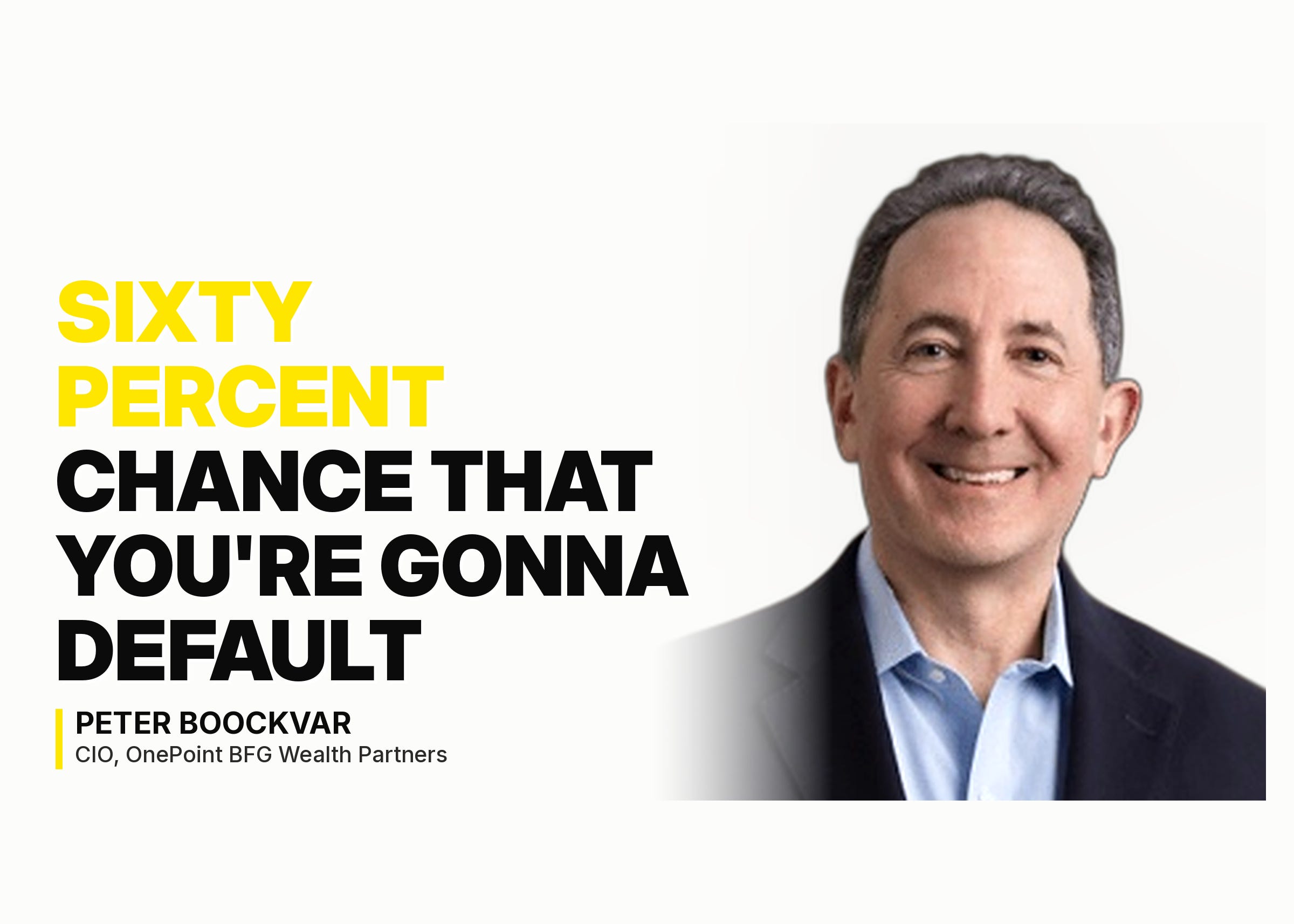
Peter Boockvar, chief investment officer of OnePoint BFG Wealth Partners, said the price of insuring CoreWeave's debt against default implies a 60% chance that the GPU-leasing company defaults.
That was one interview. Many of tonight's other appearances turned to Jensen Huang's exit as Nvidia's CEO. The rest included OTC Markets' CEO on a tax break that favors buyers of small public companies, and a microcap investor who sells every biotech before its late-stage trial results.
"The Bank of Nvidia ran through Jensen, and it's not clear what happens now. Is the bank closed indefinitely? Is it closed for some period of time and it restarts?" — Chamath Palihapitiya, Founder and CEO at Social Capital, on All-In (Read summary)
We scanned 819 shows and 14 hours of audio, wrote 18 summaries, and pulled 38 quotes into this 12-minute read.
Here is what mattered.
Financials
OTC Markets prices like Costco because it lacks an exchange's monopoly
"We like having a Costco model, which is subscriptions with some transactional prices on top, where we can deliver everyday value. We look at our margin as a competitive advantage because we don't have the monopoly of an exchange." — Cromwell Coulson, President and CEO at OTC Markets Group, on Monetary Matters (Read summary)
Acquirers get about a 15% price premium from tax write-offs, OTC Markets' CEO says
"When a private equity firm or a public company buys another company, they get about a 15% premium to the price just in tax benefits of having intangibles that they can write off over time." — Cromwell Coulson, President and CEO at OTC Markets Group, on Monetary Matters (Read summary)
A $10T AI build-out would probably need $3T a year in revenue to pay off, Dudley says
"The total build-out people are talking about, if everything is done, is about $10 trillion through 2032. You're probably going to need to generate $3 trillion a year of revenue to get an adequate return on that investment." — Bill Dudley, former President of the Federal Reserve Bank of New York, on Wall Street Week (Read summary)
Dudley would have Congress examine where the AI build-out's debt sits and on what terms
"I think really the issues that I'd be focusing on, if I was Elizabeth Warren, is really the non-bank financial sector and the rapid accumulation of debt to finance the AI build-out, where that debt sits, what terms and conditions are the debt, what's the counterparty risk." — Bill Dudley, former President of the Federal Reserve Bank of New York, on Wall Street Week (Read summary)
Crypto and Digital Assets
Bitcoin has traded with gold since March because liquidity is tight, Visser says
"Gold is at the lows, and Bitcoin and gold have been moving together since March. The reason they've moved together is because of the liquidity headwinds that have been there." — Jordi Visser, Founder and Chief Strategist at Visser Labs, on The Pomp Podcast (Read summary)
Visser expects tokenization to move fiat-system wealth into crypto
"There's $900 trillion over here in this fiat system. The crypto world is worth three to four trillion. How are we going to get that 900 trillion to move into the three to four trillion? I believe tokenization is going to be that reason." — Jordi Visser, Founder and Chief Strategist at Visser Labs, on The Pomp Podcast (Read summary)
Leland names his multisig custodian so thieves know his Bitcoin cannot be taken quickly
"I use Unchained for the most part right now. If you use someone that's multisig, I think that's a smart thing to let people know. Then they won't be breaking into your house trying to cut your fingers off to get your Bitcoin, because they'll realize you can't get it that quick." — Gary Leland, Founder at the BitBlockBoom Bitcoin conference, on Onramp Bitcoin Media (Read summary)
Alternatives and PE
Adding commodity trend-following lifts a trend portfolio's Sharpe ratio from 0.6 to 0.8, Git says
"If you add it, that will bump up your performance — you're going from a Sharpe of 0.6 to a Sharpe of 0.8. And that makes it a lot easier for you to live with." — Yoav Git, Co-Head and Head of Research at Gresham Investment Management, on Top Traders Unplugged (Read summary)
Above about 4% to 5% inflation, bonds fall with stocks instead of hedging them, Git says
"Above about four or five percent inflation, you definitely start getting a very positive correlation between bonds and equity — when equity goes down, bonds go down as well." — Yoav Git, Co-Head and Head of Research at Gresham Investment Management, on Top Traders Unplugged (Read summary)
Consumer
Poppi's founders launch Jettie with 100mg of sodium, as a drink and a powder at once
"We only have 100 milligrams of sodium compared to others... we're the first hydration brand to launch powders and drink at the same time." — Allison Ellsworth, Co-Founder at Poppi, on Bloomberg Television (Read summary)
One TikTok video Allison Ellsworth posted drew 250M views and changed Poppi's course
"I have that original video that I posted that broke the Internet and changed the whole trajectory of the business — it has 250 million views." — Allison Ellsworth, Co-Founder at Poppi, on Bloomberg Television (Read summary)
Technology & AI
Chip computing power grew about 1M-fold in 25 years, memory bandwidth about 40-fold
"We've been extraordinarily good with Moore's law at scaling flop count. We've scaled it about a million-fold in the last 25 years on these chips. Bandwidth, by contrast, is much more intrinsically physics limited. We've scaled it about 40-fold in the same time." — Walter Goodwin, Founder and CEO at Fractile, on 20VC (Read summary)
Fractile will never sell its own AI models, so it never competes with its customers
"We never intend to compete with our customers. We will never monetize internal models — that's how we've chosen to build this company. We've chosen to compete in the chip layer." — Walter Goodwin, Founder and CEO at Fractile, on 20VC (Read summary)
Nvidia trades at 10 times forward earnings, which Roberts calls cheap
"It trades at a 0.12 PEG ratio and a 10 forward PE. I mean, if I can buy Nvidia at a 10 forward PE, it's pretty cheap." — Lance Roberts, Chief Investment Strategist at RIA Advisors, on Thoughtful Money (Read summary)
Boockvar buys cyclical chip stocks at high P/Es and sells them at low ones
"You want to buy the stock when it has a high PE, because that usually implies depressed earnings, and you want to sell the stock when there's a low PE, because that's usually peak earnings." — Peter Boockvar, CIO at OnePoint BFG Wealth Partners, on Excess Returns Clips (Read summary)
CoreWeave's credit default swaps imply a 60% chance of default, Boockvar says
"That implies the market is pricing in a sixty percent chance that you're gonna default." — Peter Boockvar, CIO at OnePoint BFG Wealth Partners, on Excess Returns Clips (Read summary)
Stocks fell about 11% on average in the year after a CEO was ousted for conduct, Roberts says
"The statistics are pretty clear: with the exception of Kohl's, when Buchanan got ousted in 2025, Kohl's actually did really well, but for most other companies the average rate of return over the next year is about 11% loss." — Lance Roberts, Chief Investment Strategist at RIA Advisors, on Thoughtful Money (Read summary)
Executives must disclose any conflict with a customer or partner, Friedberg says
"Companies have what's called a code of conduct. You have to report relationships... You cannot have a personal conflict of interest with a customer or a partner without reporting it." — David Friedberg, Founder and CEO at The Production Board, on All-In (Read summary)
Breaching disclosure covenants puts directors' liability insurance at risk, Palihapitiya says
"You need that for things like D&O insurance, which is what gives a wrapper of liability for board members. When you start to breach covenants, those are the actual dominoes that tip." — Chamath Palihapitiya, Founder and CEO at Social Capital, on All-In (Read summary)
Palihapitiya puts 80% of Anthropic's value on the wider AI economy, and so on Nvidia
"20% of the value of Anthropic will be because of Anthropic... 80% has to do with the broad-based economy, and that has 100% to do with Nvidia." — Chamath Palihapitiya, Founder and CEO at Social Capital, on All-In (Read summary)
Ahluwalia says the head of Nvidia's data-center business, not its CFO, should have become CEO
"The logical person would be Ian, the guy who runs the data center business — the largest P&L, the fastest growing business. He knows the customers, he knows the product." — Ram Ahluwalia, CEO at Lumida Wealth, on Lumida Wealth (Read summary)
Open-weight models now handle about 25% of the tokens AI users consume, Ahluwalia says
"These open-weight models are now about 25% of token share consumption, which is up quite a lot from single digits like two years ago." — Ram Ahluwalia, CEO at Lumida Wealth, on Lumida Wealth (Read summary)
SanDisk is deeply discounted but volatile enough that position size matters, Dividend Talks says
"I'd never call SanDisk a low-risk S tier stock. I would call it a deeply discounted high volatility opportunity where position sizing matters just as much as stock selection." — Dividend Talks, the channel's anonymous chartered-accountant host, on Dividend Talks (Read summary)
Google still crawls Reddit but sends fewer readers there, O'Malley says
"Google is still crawling Reddit as hard as ever. It just isn't sending people back. So Google still needs Reddit's content. It just doesn't need you to visit Reddit to read it." — Shawn O'Malley, Analyst at The Investor's Podcast Network, on The Investor's Podcast (Read summary)
Unpaid users and moderators give Reddit gross margins around 91%, O'Malley says
"Reddit doesn't own data centers — it rents the compute power. It doesn't pay for content because its users create it for them for free, and it doesn't have to pay people to manage the content because they have volunteer moderators. You get gross margins around 91%, and Reddit brings in over a million dollars of revenue per employee." — Shawn O'Malley, Analyst at The Investor's Podcast Network, on The Investor's Podcast (Read summary)
Grieve reads a dropped company metric as a warning, as Reddit phases one out
"I think usually it's probably a red flag, or maybe at least a yellow flag. When I look at businesses, I like to review the KPIs they've used historically and see if they're still using them today. If they had a really good KPI five years ago and now it's missing, I have to ask why." — Kyle Grieve, Co-Host of The Intrinsic Value Podcast at The Investor's Podcast Network, on The Investor's Podcast (Read summary)
Losing pricing power or seats to AI would cost Adobe its premium valuation, Carlisle says
"Those online businesses tend to be quite good businesses. They've got high margins and high returns on invested capital, so they command a premium valuation — and if that premium goes away, or they lose seats because people don't need that capability anymore, that's going to hurt them." — Tobias Carlisle, Principal at Acquirers Funds, on The Acquirers Podcast (Read summary)
Carlisle would probably own Adobe, since AI fears have discounted the stock
"To be clear, I'm not bearish on Adobe at all. The financials still look very impressive. There are AI fears that are creating a discount in the stock, and I would probably be inclined to own them long." — Tobias Carlisle, Principal at Acquirers Funds, on The Acquirers Podcast (Read summary)
Materials & Energy
Little permitted US LNG export capacity is left to sell, LNG Allies' CEO says
"What people may not appreciate very much is how little is left to sell... we do not have a whole lot of that permitted project gas that's left for sale." — Fred Hutchison, President and CEO at LNG Allies, on SmarterMarkets (Read summary)
Free-on-board contracts let US LNG buyers send cargoes anywhere
"The contracts that were signed were free on board contracts. So once the purchaser got the LNG on board their ships... they could go to any point in the world, and that's been a tremendous advantage for the US compared to other customers." — Fred Hutchison, President and CEO at LNG Allies, on SmarterMarkets (Read summary)
New copper mines take 20 years to reach production, mostly because of permitting, Giustra says
"What we can't tolerate any longer is these 20-year time frames to put a copper mine in production. It's just ridiculous. It shouldn't take that long. And most of it has to do with permitting." — Frank Giustra, CEO at Fiore Group, on The David Lin Report (Read summary)
Giustra expects serious copper supply deficits within 4 to 5 years
"You're going to see elevated commodity prices for quite a long time, and in things such as copper you're going to see supply deficits hitting us within the next four to five years — real serious supply deficits." — Frank Giustra, CEO at Fiore Group, on The David Lin Report (Read summary)
Policy
About 60% of Canada's exports to the US are inputs for US factories, Freeland says
"About 60% of Canada's exports to the United States are intermediate goods. So tariffs on Canada are quite literally a tax on U.S. manufacturers." — Chrystia Freeland, former Deputy Prime Minister and Finance Minister of Canada, on Wall Street Week (Read summary)
Nuggets of Wisdom
Pabrai looks at a company's debt first, because leverage is the top reason businesses fail
"The single biggest reason businesses fail is leverage. So the first thing I look at when I look at a company is what is the debt situation?" — Mohnish Pabrai, Founder at Pabrai Investment Funds, on The Financial Economics (Read summary)
IKEA's founder refused all debt so the company could last 500 years
"He felt that if IKEA took debt, there could be a downturn in the future and the company may not survive, so he said if we have to survive 500 years, we cannot have any debt." — Mohnish Pabrai, Founder at Pabrai Investment Funds, on The Financial Economics (Read summary)
Tuttle buys a biotech on its promise and sells before the Phase 2 or Phase 3 results
"You buy the company for the promise before the promise is appreciated by the investment community, and you sell it immediately after that. You do not wait for phase two or phase three." — Kris Tuttle, Founder at IPO Candy and CIO at Blue Caterpillar, on Planet MicroCap (Read summary)
Tuttle replays a CEO's recent earnings-call Q&A before agreeing to meet
"We definitely look at the backgrounds of the management teams. I'll queue up their last couple conference calls and just jump to the Q&A to hear them talk, because if I can tell they're lying in the conference call from the last quarter, it's probably not worth my time to meet them." — Kris Tuttle, Founder at IPO Candy and CIO at Blue Caterpillar, on Planet MicroCap (Read summary)
If this was worth your time, send it to someone who has to follow all of this too.
What did you think of today’s edition? Hit ‘reply’ to this email, send us a message, leave a comment, or join the chat!
Get the latest market chatter as it happens: